
Chronic Arterial Insufficiency
Chronic arterial insufficiency is a progressive narrowing or occlusion of the arterial lumen, most commonly due to atherosclerosis, resulting in inadequate blood flow to the distal tissues and manifesting as intermittent claudication, rest pain, and eventual tissue loss.
| Exam domain | One-glance essentials |
|---|---|
| Definition / diagnosis |
|
| Epidemiology / risks |
|
| Core mechanism |
|
| Clinical picture |
|
| Investigations |
|
| Management |
|
| Complications |
|
| Prevention / follow-up |
|
| Exam traps |
|
References
[1] Lecture slides: WCS 002 - Toe gangrene and leg ulcer - by Prof SWK Cheng.pdf (p1, p2, p8, p14, p22, p23)
Chronic Arterial Insufficiency
Chronic arterial insufficiency (also called chronic limb ischaemia or peripheral arterial disease, PAD) is defined as a gradual reduction in limb perfusion — developing over more than 2 weeks — that threatens limb viability or impairs function [1][2][3].
The key conceptual distinction from acute limb ischaemia is time: the chronicity allows the body to mount a compensatory response (collateral vessel formation), which is why patients may walk a surprising distance before symptoms appear. However, once the disease progresses beyond the compensatory capacity of collaterals, the limb enters a state of critical limb ischaemia (CLI) — a clinical emergency where the tissue is at imminent risk of death.
Think of it this way: arteries are pipes. Chronic arterial insufficiency is a slowly rusting pipe that gradually narrows. The body tries to build detour pipes (collaterals), but eventually the demand outstrips supply.
Acute & chronic occlusion are distinct entities [1].
The condition is broadly subdivided into:
- Non-critical limb ischaemia: manifests as intermittent claudication (IC) — the limb is not immediately threatened
- Critical limb ischaemia (CLI): manifests as rest pain, tissue loss (ischemic ulcers), or gangrene — the limb is at risk [1][2][3]
What does 'claudication' mean?
"Claudicatio" is Latin for "to limp." Emperor Claudius himself was named for his limp. Intermittent claudication = intermittent limping due to muscle pain on walking, relieved by rest.
2. Epidemiology
- PAD affects approximately 200 million people worldwide.
- Prevalence increases sharply with age: ~3–10% in the general population, rising to 15–20% in those aged > 70.
- In Hong Kong, the ageing population and high prevalence of diabetes mellitus (affecting ~10% of adults), hypertension, and historically high rates of male smoking make PAD a significant and growing clinical burden.
- PAD patients have 2–3× increased cardiovascular mortality — most die of MI or stroke, not limb loss. Atherosclerosis is a systemic disease [1].
- Only ~5–10% of patients with intermittent claudication progress to CLI over 5 years, but those who do face a 1-year major amputation rate of ~25% and 1-year mortality of ~25%.
- Male:Female ratio ≈ 2:1, though narrows after menopause.
- The superficial femoral artery (SFA) is the single most commonly affected segment (~70% of symptomatic PAD) [2][3].
- Aorto-iliac disease accounts for ~30% [1][3].
- Diabetics develop more distal (infrapopliteal) disease, making reconstruction harder.
Atherosclerotic Occlusive Disease: Risk Factors — Smoking, Diabetes mellitus, Hypertension, Hyperlipidemia, Family history [1].
| Risk Factor | Mechanism / Notes |
|---|---|
| Smoking | Single most important modifiable risk factor. Nicotine causes endothelial damage, promotes thrombosis (↑ fibrinogen, ↑ platelet aggregation), ↑ LDL oxidation, vasoconstriction. Risk of PAD is 3–4× higher in smokers. Dose-dependent. |
| Diabetes mellitus | Accelerates atherosclerosis via advanced glycation end-products (AGEs) damaging endothelium, promotes small-vessel disease (microangiopathy), neuropathy masks pain → late presentation. DM doubles the risk of PAD and is particularly associated with distal (below-knee) disease. |
| Hypertension | Chronically elevated shear stress damages endothelium → facilitates lipid infiltration and plaque formation. |
| Hyperlipidaemia | ↑ LDL cholesterol is directly atherogenic (oxidised LDL → foam cells → fatty streak → plaque). |
| Family history | Genetic predisposition to lipid disorders, endothelial dysfunction, pro-thrombotic states. |
| Age > 65 | Cumulative exposure to risk factors; natural arterial stiffening and endothelial senescence. |
| Other | Chronic kidney disease (accelerated calcific atherosclerosis), obesity, sedentary lifestyle, male sex |
High Yield
Atherosclerosis is a systemic disease [1]. A patient presenting with PAD very likely also has coronary artery disease (CAD) and/or cerebrovascular disease. Always assess for IHD and carotid disease. Think of PAD as a "window" into the patient's overall vascular health.
4. Anatomy & Function of the Lower Limb Arterial System
Understanding the anatomy is essential because:
- The site of occlusion determines the pattern of symptoms.
- The availability of collaterals determines whether the disease is survivable for the limb.
- The anatomy dictates surgical approach (where to bypass from and to).
Arterial System of the Lower Limbs [1]:
Key anatomical points:
- External iliac artery passes through the inguinal ligament and becomes the femoral artery [3].
- The common femoral artery bifurcates into:
- Profunda femoris (deep femoral): the "lifeline" collateral vessel. Gives off perforating branches that anastomose around the thigh. When the SFA is occluded (very common), the profunda keeps the distal limb alive via collaterals — this is why profundaplasty can be life-saving.
- Superficial femoral artery (SFA): the most commonly diseased segment. Enters Hunter's canal (adductor canal) to become the popliteal artery.
- Popliteal artery gives off LAMP — mnemonic for its branches [3]:
- Lateral (superior & inferior genicular)
- Anterior tibial
- Peroneal (fibular)
- Posterior tibial
- Medial (superior & inferior genicular)
Why is the SFA so commonly affected? It runs through the adductor canal, where it is subject to repetitive mechanical stress (compression and flexion with every step). This chronic mechanical trauma to the arterial wall predisposes to intimal injury and atherosclerosis.
Layers of vessel wall [3]:
- Tunica intima: innermost layer — endothelium + subendothelial connective tissue. This is where atherosclerosis begins (endothelial dysfunction → lipid infiltration).
- Tunica media: smooth muscle + elastic fibres. Responsible for vasoconstriction/dilation. Calcification here (Mönckeberg's) makes vessels rigid and falsely elevates ABPI.
- Tunica adventitia: outermost connective tissue layer. Contains vasa vasorum (vessels that supply the vessel wall itself) and nerves.
This is the key reason chronic ischaemia behaves differently from acute ischaemia:
| Collateral Pathway | Bypasses Occlusion At |
|---|---|
| Internal iliac → gluteal aa. → profunda femoris | Aorto-iliac |
| Profunda femoris perforating branches → genicular aa. | Superficial femoral artery |
| Genicular network around knee | Popliteal artery |
| Peroneal artery collaterals | Tibial arteries |
The profunda femoris is the most important collateral channel in lower limb PAD. Protecting and opening this vessel is a surgical priority.
5. Etiology & Pathophysiology
5.1 Causes of Chronic Arterial Occlusion
Chronic occlusion: Atherosclerosis, Vasculitis, Entrapment [1].
Pathophysiology — from first principles:
- Endothelial injury: Smoking, hypertension, hyperglycaemia, dyslipidaemia, and turbulent flow at arterial bifurcations cause chronic damage to the endothelial lining.
- Lipid infiltration: Damaged endothelium becomes permeable to LDL cholesterol, which accumulates in the subendothelial space (tunica intima).
- Oxidation & inflammation: LDL is oxidised → triggers recruitment of monocytes → monocytes become macrophages → engulf oxidised LDL → become foam cells → form fatty streak (earliest lesion).
- Smooth muscle migration: Cytokines cause smooth muscle cells from the media to migrate into the intima and proliferate, producing collagen → forms a fibrous cap over the lipid core.
- Advanced plaque: The mature atherosclerotic plaque has a necrotic lipid core (cholesterol crystals, dead foam cells), a fibrous cap, and may calcify.
- Progressive stenosis: The plaque gradually narrows the lumen → reduced distal perfusion → symptoms appear when blood supply cannot meet metabolic demand (first during exercise → eventually at rest).
- Compensatory collateral formation: Over weeks to months, ischaemia stimulates angiogenesis via VEGF/HIF-1α → collateral vessels develop to bypass the stenosis. This is why chronic occlusion is more tolerable than acute — the body has time to build detours [2][3].
- Multi-level disease: In advanced cases, atherosclerosis affects multiple arterial segments simultaneously → collaterals become insufficient → critical limb ischaemia [2].
Young (30–40s), Male, Smokers. Pan-arteriitis. Medium & small sized arteries & veins. Lower limb > upper limbs. Rest pain, digital ulcer, gangrene. Clinical diagnosis. Arteriogram: "tree trunk." Reconstruction seldom possible. Stop smoking is effective. [1]
- "Thrombo" = clot, "angiitis" = vessel inflammation, "obliterans" = obliterating/blocking
- Non-atherosclerotic, segmental, inflammatory disease
- Almost exclusively in young male heavy smokers (age 20–45)
- Pathology: pan-arteritis (inflammation of all 3 vessel wall layers) with highly cellular thrombus and preservation of internal elastic lamina (distinguishing it from other vasculitides)
- Affects small and medium arteries AND veins of distal extremities (hands and feet)
- Lower limb > upper limb involvement [1]
- Clinical features: digit ischaemia, ischaemic ulcers, rest pain, Raynaud's phenomenon, superficial thrombophlebitis
- Angiography shows characteristic "tree trunk" pattern — abrupt segmental occlusions with collaterals resembling tree roots [1]
- Treatment: Absolute smoking cessation is the only effective treatment. Reconstruction is seldom possible because the disease affects small distal vessels where bypass is technically infeasible [1].
Buerger's vs Atherosclerosis
Key differentiators: Buerger's = young, heavy smoker, distal small vessels, involves veins too, no typical CV risk factors. Atherosclerosis = older, large and medium vessels, classic CV risk factors. If a 35-year-old smoker presents with toe gangrene and no DM/HT/HL — think Buerger's.
- "Behçet" = named after Turkish dermatologist Hulusi Behçet
- Rare systemic vasculitis characterised by recurrent oral aphthous ulcers + at least one of: genital ulcers, ocular inflammation (uveitis), skin lesions (erythema nodosum, pathergy)
- Remarkable for ability to involve blood vessels of any size and both arteries and veins [2]
- Can cause arterial aneurysms, thrombosis, and chronic ischaemia
- More common along the ancient Silk Road (Turkey, Middle East, East Asia including China/HK)
- Pathology: neutrophilic vasculitis
- Typically affects young, athletic patients (often muscular males in 20s–30s)
- Caused by anomalous musculoskeletal attachments (usually abnormal medial head of gastrocnemius) or an abnormal course of the popliteal artery → compression of the popliteal artery during activity (e.g., plantarflexion)
- Key clue: presents with intermittent claudication but lacks atherosclerotic risk factors [2][3]
- Diagnosis: provocation testing (plantarflexion), duplex ultrasound, MRA
- Treatment: surgical release of compressing structure ± arterial reconstruction if damaged
Major Levels of Arterial Occlusion [1]:
| Level | Vessels | Clinical Features |
|---|---|---|
| Aorto-iliac | Large vessels | Claudication (thigh AND calf), Impotence |
| Femoro-popliteal | Medium vessels | Claudication (calf), Tissue loss |
| Distal (infrapopliteal) | Small vessels | Tissue loss |
Why does occlusion level matter?
- The more proximal the occlusion, the larger the muscle groups deprived → bilateral thigh + buttock claudication (aorto-iliac).
- The more distal the occlusion, the more likely it is to present with tissue loss (ulcers, gangrene) rather than claudication, because distal vessels have fewer collateral options.
- Diabetic patients typically have distal disease → present late with tissue loss.
Leriche syndrome: gradual occlusion of terminal aorta [3], causing the classic triad:
- Absent femoral pulses bilaterally
- Intermittent claudication (bilateral buttock, thigh, calf)
- Erectile dysfunction (impotence) — because the internal iliac arteries (which supply the internal pudendal artery → penile blood supply) are occluded
"Leriche" = named after French surgeon René Leriche. The syndrome is the archetypal aorto-iliac occlusive disease. Always ask about impotence in male PAD patients — it may be the presenting complaint!
6. Classification Systems
| Stage | Description | Clinical Features |
|---|---|---|
| I | Asymptomatic | Subclinical disease, no symptoms |
| IIa | Mild claudication | Claudication distance > 200m |
| IIb | Moderate-severe claudication | Claudication distance < 200m |
| III | Ischaemic rest pain | Rest pain, especially nocturnal |
| IV | Tissue loss | Ulceration, necrosis, or gangrene |
| Grade | Category | Description |
|---|---|---|
| 0 | 0 | Asymptomatic |
| I | 1 | Mild claudication |
| I | 2 | Moderate claudication |
| I | 3 | Severe claudication |
| II | 4 | Ischaemic rest pain |
| III | 5 | Minor tissue loss (non-healing ulcer, focal gangrene with diffuse pedal ischaemia) |
| III | 6 | Major tissue loss (extending above transmetatarsal level, functional foot no longer salvageable) |
Fontaine III + IV / Rutherford 4–6 = Critical Limb Ischaemia (CLI)
Critical Limb Ischaemia — Definition
CLI is defined as the presence of chronic ischaemic rest pain, ulcers, or gangrene attributable to objectively proven arterial occlusive disease [1][2][3]. It represents an absolute indication for intervention — without revascularisation, major amputation is highly likely within 6–12 months. Never confuse it with simple intermittent claudication, which is a relative indication.
The TransAtlantic Inter-Society Consensus (TASC II) classifies aorto-iliac and femoropopliteal lesions into Types A–D based on anatomical complexity:
- Type A: Short, focal stenoses → best treated with endovascular approaches
- Type B: Multiple stenoses or short occlusions → endovascular preferred
- Type C: Long stenoses, multiple occlusions → surgery preferred
- Type D: Complete occlusions of long segments → best treated with surgery [3]
7. Clinical Features
The Problems: A patient with LEG PAIN. A patient with ULCER or GANGRENE in the foot. [1]
7.1 Symptoms
Definition: Reproducible, cramping muscular pain in a defined muscle group, brought on by walking a consistent distance, and completely relieved by rest within a few minutes (typically ~5 min) [2][3].
Pathophysiology: During exercise, working muscles demand increased blood flow. In a stenosed artery, the flow cannot increase to meet demand → anaerobic metabolism in the muscle → lactic acid accumulates → pain. At rest, the demand drops back to baseline and the limited blood flow is sufficient again → pain resolves.
Localisation tells you the level of disease [1][3]:
| Symptom Location | Level of Occlusion |
|---|---|
| Bilateral thigh + buttock claudication | Aorto-iliac (30%) |
| Unilateral buttock | Iliac artery |
| Calf claudication (most common) | Superficial femoral / femoropopliteal (70%) |
| Foot | Tibial / peroneal arteries |
Why is calf claudication the most common? Because the SFA is the most commonly diseased artery. The SFA supplies the popliteal artery, which in turn supplies the calf muscles (gastrocnemius, soleus) via the tibial arteries.
Key claudication characteristics [3]:
- Claudication distance (always ask on flat ground vs. slope — uphill is worse because muscles work harder)
- How long they need to rest (usually ~5 minutes)
- Whether they can then walk the same distance again (reproducibility is a hallmark)
- Nature of pain: must be muscular pain (cramping, aching — NOT sharp, shooting, or burning) [3]
Definition: Persistent, severe pain in the forefoot and toes at rest, typically worst at night.
Pathophysiology: The arterial disease is now so severe that even the basal metabolic demands of resting tissue cannot be met. The pain is worst at night/when recumbent because:
- Loss of gravity-assisted perfusion: When lying flat, the hydrostatic pressure column that assists blood flow to the feet (when standing/sitting) is lost → foot perfusion pressure drops further below the critical threshold.
- Reduced cardiac output during sleep: HR and BP are lower at night → further reduction in already compromised perfusion.
Classical description [3]:
- Patient wakes up due to pain
- Swings legs out of bed to hang feet over the side → this restores the hydrostatic pressure column → perfusion improves → pain eases
- May sleep in a chair with legs dependent
Why does hanging legs down help? Gravity adds ~60 cmH₂O of hydrostatic pressure to the foot arteries when the leg is dependent. In a critically ischaemic limb, this extra pressure may be just enough to push blood through to the tissue.
Consequences of chronic dependency:
- Dependent rubor: chronic venous congestion and maximal arteriolar dilation give the foot a dusky red/purple colour when dependent
- Peripheral oedema: chronic dependency → venous pooling → oedema → further compromises tissue perfusion (Starling forces)
Any tissue loss: ulcer, gangrene +/- infection [3]
Ischaemic ulcers:
- Occur at pressure points (tips of toes, heel, malleoli, metatarsal heads)
- Painful (unless concurrent neuropathy, as in diabetics)
- Punched-out appearance, pale/grey base (poor blood supply = no granulation tissue)
- Surrounded by pale/atrophic skin
Gangrene ("ganggraina" = Greek for "gnawing sore"):
| Feature | Dry Gangrene | Wet Gangrene |
|---|---|---|
| Pathophysiology | Pure ischaemia → coagulative necrosis → tissue mummifies | Ischaemia + secondary bacterial infection → liquefactive necrosis |
| Appearance | Black, shrivelled, dry, well-demarcated | Swollen, discoloured, oedematous, blistered, pus, foul-smelling |
| Pain | Variable (may be painless once tissue is dead) | Very painful, systemically unwell |
| Management | May auto-amputate; revascularise first | Urgent — risk of sepsis, requires debridement/amputation + antibiotics |
| Systemic features | Minimal | Fever, tachycardia, sepsis |
Never amputate digits before revascularization
Never amputate digits before revascularization [1]. If you amputate an ischaemic toe without restoring blood supply, the wound will not heal, and you'll need to amputate more proximally. Always restore inflow first, then let demarcation occur, then amputate the minimum necessary.
- Specific to aorto-iliac disease (Leriche syndrome)
- The internal iliac artery → internal pudendal artery → supplies the corpus cavernosum
- Bilateral internal iliac artery occlusion → insufficient penile blood flow → inability to achieve/maintain erection [1][3]
- Always ask about this in males — it may be the presenting complaint or a key clue to the level of disease
Because atherosclerosis is a systemic disease [1], always ask about:
- Angina / chest pain / dyspnoea on exertion → coronary artery disease
- TIA symptoms (amaurosis fugax, transient hemiparesis, dysarthria) → carotid/cerebrovascular disease
- Abdominal angina (postprandial pain) → mesenteric ischaemia
7.2 Signs
| Sign | Pathophysiology |
|---|---|
| Pallor (especially on elevation) | Reduced arterial inflow → insufficient blood to colour the skin |
| Dependent rubor | Chronic maximal arteriolar dilation (due to ischaemia) → when dependent, blood pools in dilated vessels → dusky red/purple colour |
| Trophic changes: hair loss, shiny atrophic skin, thickened nails | Chronic ischaemia → inadequate nutrition to skin appendages → atrophy |
| Muscle wasting (especially calf) | Chronic disuse (limited walking) + ischaemic myopathy |
| Ulceration / gangrene | As described above — tissue necrosis from inadequate perfusion |
| Amputation stumps (previous surgery) | Indication of severity/progression |
Pulse assessment — systematically palpate from proximal to distal and compare both sides:
- Common femoral (mid-inguinal point)
- Popliteal (deep in popliteal fossa, flex knee slightly)
- Posterior tibial (behind medial malleolus)
- Dorsalis pedis (lateral to extensor hallucis longus tendon)
| Finding | Interpretation |
|---|---|
| Absent femoral pulses bilaterally | Aorto-iliac disease (Leriche syndrome) |
| Present femoral, absent popliteal | SFA occlusion |
| Present popliteal, absent pedal pulses | Tibial artery disease |
| All pulses present but reduced | Proximal stenosis (not complete occlusion) or multilevel disease |
Temperature: Compare both limbs. The ischaemic limb is cooler distally. The level at which temperature changes gives a rough indication of the occlusion level.
Capillary refill time: > 2 seconds is abnormal → suggests inadequate arterial perfusion.
Buerger's test: lift both legs slowly for pallor (Buerger's angle) → swing legs down for reactive hyperemia [3]
Technique:
- Patient supine. Raise both legs to ~90° (or until pallor develops).
- Buerger's angle = the angle at which the foot becomes pale.
- Normal: no pallor even at 90°
- Severe ischaemia: pallor at < 20°
- The lower the angle, the worse the ischaemia
- Then sit the patient up and swing legs over the edge of the bed.
- Reactive hyperaemia: In ischaemic limbs, the foot turns dusky red/purple (dependent rubor) due to maximally dilated arterioles filling slowly with deoxygenated blood. Normal limbs regain pink colour within seconds.
Why does this work? Raising the leg removes the hydrostatic pressure component. In normal circulation, arterial pressure is more than sufficient to perfuse the foot even when elevated. In PAD, the already-low perfusion pressure cannot overcome gravity → foot becomes pale at a threshold angle.
- Listen for bruits over the femoral artery (groin), iliac arteries (lower abdomen), and aorta (epigastric).
- A bruit indicates turbulent flow across a stenosis. Absence does not rule out disease (complete occlusion produces no flow, hence no bruit).
To complete: bedside Doppler for pulses, measure ABI on both sides, examine abdomen for AAA / RAS, cardiovascular examination for other CV risk factors (e.g., BP/P, AF), urine multistix for glucose [3]
- Bedside handheld Doppler: to detect pedal pulses that may be impalpable manually
- ABPI measurement: see diagnostic section (next session)
- Abdominal examination: palpate for AAA (pulsatile expansile mass), listen for renal artery stenosis (RAS) bruits
- Cardiovascular examination: BP, pulse rate and rhythm (AF → embolic risk), heart murmurs, carotid bruits
- Urine dipstick for glucose: screen for diabetes
- Neurological examination of lower limbs: differentiate from neurogenic claudication
This is a classic exam question and a critical clinical distinction [3]:
| Feature | Vascular Claudication | Neurogenic Claudication (Spinal Stenosis) |
|---|---|---|
| Cause | Chronic limb ischaemia | Spinal stenosis |
| Nature of pain | Muscular cramping | Heaviness, weakness, tingling, burning |
| Radiation of pain | From distal to proximal | From proximal to distal (radiates down from back/buttock) |
| Claudication distance | Fixed, reproducible | Variable — may walk further some days than others |
| Exacerbating factor | Walking uphill (muscles work harder → more O₂ demand) | Walking downhill (spine extends → narrows spinal canal further) |
| Relieving factor | Rest — "Shop window to shop window" | Bending over, sitting — "Park bench to park bench" (flexion opens spinal canal) |
| Pulse | Absent | Present |
| Associations | Atherosclerotic risk factors, Atrophic changes | Only 10% SLR +ve, Back pain |
Also differentiate from:
- Sciatica [2][3]: Back pain with radiation, not relieved by resting — nerve root compression (usually L4-S1), dermatomal distribution, positive straight leg raise, not exercise-dependent.
Shop window vs Park bench
Vascular claudication: patient stops to rest (as if looking in a shop window), pain resolves, walks same distance again → "shop window to shop window". Neurogenic claudication: patient sits on a park bench (flexes spine), pain resolves → "park bench to park bench".
| Feature | Arterial Ulcer | Venous Ulcer |
|---|---|---|
| Location | Pressure points: toes, heel, metatarsal heads, between toes | Gaiter area (medial malleolus, medial lower leg) |
| Appearance | Punched-out, pale/grey base, poor granulation | Shallow, irregular, sloughy base, may have granulation |
| Pain | Typically very painful | Usually less painful (may ache) |
| Surrounding skin | Pale, shiny, atrophic, hairless | Lipodermatosclerosis, haemosiderin staining (brown), varicose eczema |
| Pulses | Absent or reduced | Present |
| ABPI | Low (< 0.9) | Normal or high (unless mixed disease) |
Assessment of Lower Limb Ischaemia [1]:
Two parallel assessments must happen simultaneously:
1. Assess the Patient (Systemic)
- Risk factors: Elderly, Cardiac / pulmonary disease, Smoker [1]
- Fitness for intervention (general anaesthetic risk, cardiac function, renal function)
- Systemic atherosclerotic burden (IHD, cerebrovascular disease)
2. Assess the Limb
- Limb at Risk: Rest Pain, Tissue Loss → Absolute indication for intervention [1]
- Limb not threatened: Claudication → Relative indication for intervention [1]
High Yield Summary
- Chronic arterial insufficiency = gradual (> 2 weeks) reduction in limb perfusion; most commonly due to atherosclerosis.
- Acute and chronic occlusion are distinct entities — chronic allows collateral formation.
- Risk factors: Smoking, DM, HT, HL, Family history — atherosclerosis is a systemic disease.
- SFA is the most commonly affected vessel (~70%); aorto-iliac ~30%.
- Fontaine: I (asymptomatic) → IIa (> 200m) → IIb (< 200m) → III (rest pain) → IV (tissue loss).
- CLI (Fontaine III–IV) = absolute indication for intervention; claudication = relative.
- Intermittent claudication: exercise-induced muscular pain, fixed distance, relieved by rest. Calf = SFA; thigh + buttock = aorto-iliac.
- Rest pain: worst at night, relieved by dependency (hanging legs down restores hydrostatic pressure).
- Leriche syndrome: aortic bifurcation occlusion → absent femoral pulses + bilateral claudication + impotence.
- Buerger's disease: young male smokers, small distal vessels, "tree trunk" angiogram, stop smoking is the only effective treatment.
- Never amputate digits before revascularization.
- Buerger's test: elevation pallor (Buerger's angle) + dependent rubor (reactive hyperaemia).
- Vascular vs neurogenic claudication: fixed distance vs variable; rest relieves vs bending forward; absent pulses vs present.
Active Recall - Chronic Arterial Insufficiency (Part 1)
Differential Diagnosis of Chronic Arterial Insufficiency
The differential diagnosis (DDx) of chronic arterial insufficiency is really about answering two questions in sequence:
- Is this truly vascular leg pain, or is something else mimicking it? (DDx of the symptom — especially intermittent claudication and rest pain)
- If it is vascular, is it chronic or acute? (DDx within vascular pathology)
A very common exam pitfall highlighted on the lecture slides: Mis-diagnosis of claudication and Beware of "leg pain" [1]. Not all leg pain on walking is claudication. You must systematically consider and exclude the mimics.
The best way to organise the DDx is by the presenting complaint, because that is how you encounter patients in practice:
2. Differential Diagnosis of Intermittent Claudication
This is the most commonly tested DDx. The key principle: true vascular claudication is muscular pain with a fixed, reproducible claudication distance, relieved completely by rest within minutes, with absent pulses on examination. Any deviation from this pattern should make you think of alternatives [1][2][3].
Why does it mimic claudication? Lumbar spinal stenosis narrows the spinal canal → the cauda equina nerve roots become compressed, especially during walking when the spine is extended. This produces leg pain on walking that can look remarkably similar to vascular claudication.
How to tell them apart — this is a classic table from both lecture slides and senior notes [3]:
| Feature | Vascular Claudication | Neurogenic Claudication |
|---|---|---|
| Cause | Chronic limb ischaemia | Spinal stenosis |
| Nature of pain | Cramping, muscular | Heaviness, weakness, tingling, burning, "jelly legs" |
| Radiation of pain | Distal → proximal (starts in calf, may extend to thigh) | Proximal → distal (starts in back/buttock, radiates down leg) |
| Claudication distance | Fixed, reproducible | Variable — better some days, worse others |
| Exacerbating factor | Walking uphill (muscles work harder, more O₂ demand) | Walking downhill (spine extends → canal narrows) |
| Relieving factor | Rest — "Shop window to shop window" (standing still is enough) | Bending over, sitting — "Park bench to park bench" (flexion widens spinal canal) |
| Pulse | Absent | Present |
| Skin changes | Atrophic changes (hairless, shiny, cool) | Normal skin |
| Associations | Atherosclerotic risk factors | Only 10% SLR +ve, Back pain |
Why the different exacerbating factors?
- Walking uphill in vascular disease: the calf muscles must generate more force against gravity → higher metabolic demand → ischaemic threshold reached sooner.
- Walking downhill in spinal stenosis: going downhill forces the spine into extension → the ligamentum flavum buckles inward, the spinal canal narrows → nerve compression worsens. Conversely, going uphill tends to flex the spine slightly, which is why neurogenic claudication may paradoxically be better uphill.
Why "shop window" vs "park bench"?
- Vascular: the patient only needs to stop moving (reducing muscle O₂ demand) → pain resolves in ~5 min → they can walk the same distance again before it recurs. They stop every 200m as if window-shopping.
- Neurogenic: simply standing still doesn't help because the spine is still extended. The patient must sit down (flexes spine, opens canal) → finds a park bench. Alternatively they lean on a shopping trolley (the "shopping cart sign" — lumbar flexion while walking delays symptoms).
Sciatica: back pain with radiation, not relieved by resting [2][3]
- "Sciatica" = "ischiadica" (Greek/Latin) = pain along the sciatic nerve (L4–S1 roots)
- Caused by nerve root compression, most commonly from a herniated (prolapsed) intervertebral disc at L4/5 or L5/S1 [2]
- Pain is sharp, burning, or shooting and radiates down the posterior or lateral aspect of the leg in a dermatomal distribution, often to the foot/ankle
- Key distinguishing feature: pain is NOT exercise-dependent in the same reproducible way as claudication. It may be present at rest, worsened by coughing/sneezing/straining (Valsalva — increases intrathecal pressure), and is not relieved by simply stopping walking [2][3]
- Positive straight leg raise (SLR) test (Lasègue sign)
- Peripheral pulses are present
The crucial point: in sciatica, the pain pattern does not follow the exercise → rest → exercise cycle of true claudication. The patient may have pain while sitting, lying, or even at night — and standing still doesn't help.
- Hip osteoarthritis: pain localised to the groin/hip, worsened by weight-bearing and movement (not specifically walking a fixed distance), stiffness after rest, reduced range of motion (especially internal rotation)
- Knee osteoarthritis: pain over the joint, mechanical locking/giving way, stiffness
- Foot arthritis (e.g., hallux rigidus, midfoot OA): localised joint pain on walking
- Key difference: joint pain is localised to the joint, not a diffuse muscular cramping. Pain may be present even at first step (not after a fixed distance). Pulses are present.
Chronic compartment syndrome [2]:
- Typically affects young heavy-muscled athletes — runners, footballers, military recruits
- A reversible form of compartment syndrome: during exercise, muscle swelling within a tight fascial compartment raises intra-compartmental pressure → compromises local tissue perfusion → produces pain, tightness, and sometimes paraesthesia
- Pathophysiology from first principles: Exercising muscle swells (increased blood flow + oedema). Normally the fascial compartment is compliant enough to accommodate this. In susceptible individuals, the fascia is abnormally tight or the muscle bulk is excessive → pressure rises above capillary perfusion pressure → ischaemic pain
- Pain resolves within minutes of stopping exercise (similar to vascular claudication — this can be tricky!)
- Key differences from vascular claudication: young, no CV risk factors, pulses present, pain is a tight/bursting sensation (not cramping), often bilateral, may have paraesthesia. Definitive diagnosis by intra-compartmental pressure measurement during and after exercise.
Baker's cyst [2]:
- A popliteal synovial cyst arising from the gastrocnemius-semimembranosus bursa
- Usually associated with underlying joint disease (OA, RA, meniscal tears) — synovial fluid from the knee joint tracks posteriorly into the bursa
- Presents with posterior knee pain, stiffness, and a palpable swelling behind the knee
- Can mimic claudication if it compresses the popliteal artery or causes posterior knee discomfort on walking
- If the cyst ruptures, it can mimic DVT (acute calf pain, swelling — "pseudo-DVT")
- Key difference: palpable posterior knee mass, pulses present, associated joint disease, USG confirms cyst
This is the second critical DDx axis — once you've confirmed the problem is vascular, you must determine the acuity [1][3]:
Acute & chronic occlusion are distinct entities [1].
| Feature | Acute Limb Ischaemia | Chronic Arterial Insufficiency |
|---|---|---|
| Onset | Sudden (< 2 weeks) [4] | Gradual (> 2 weeks) [3] |
| Mechanism | Embolism, acute thrombosis, trauma [1] | Atherosclerosis, vasculitis, entrapment [1] |
| Collaterals | Absent → complete ischaemia | Present (had time to develop) → incomplete ischaemia |
| Clinical features | 6 P's: Pain, Pallor, Pulseless, Perishingly cold, Paraesthesia, Paralysis [4] | Intermittent claudication → rest pain → tissue loss (gradual progression) |
| Contralateral limb | Often normal (if embolic) | Often also affected (systemic atherosclerosis) |
| Skin changes | Marble white → mottling (blanchable then fixed) [4] | Chronic trophic changes (hairless, shiny, thickened nails) |
| Urgency | Surgical emergency — irreversible damage in 4–6 hours without collaterals [4] | Elective workup in non-critical; urgent in CLI |
Why is this distinction so critical? Because the management is completely different. Acute ischaemia = emergency embolectomy or thrombolysis. Chronic ischaemia = risk factor modification ± elective revascularisation. Missing acute ischaemia (Delay recognition of acute ischaemia [1]) leads to limb loss.
A specific scenario to watch for: Acute-on-chronic ischaemia — a patient with pre-existing PAD (chronic) who develops sudden worsening (acute thrombosis on top of a plaque). They may have some collaterals, so the presentation is not as catastrophic as a pure embolus, but they still need urgent assessment.
When a patient presents with a leg ulcer or tissue loss, the DDx extends beyond pure arterial disease:
| Type | Arterial Ulcer | Venous Ulcer | Neuropathic Ulcer (Diabetic) | Mixed |
|---|---|---|---|---|
| Location | Pressure points: toes, heel, metatarsal heads | Gaiter area (medial malleolus) | Plantar surface, pressure points | Variable |
| Pain | Very painful | Mild aching | Painless (neuropathy) | Variable |
| Appearance | Punched-out, pale base | Shallow, irregular, sloughy | Deep, may probe to bone | Combination |
| Surrounding skin | Pale, atrophic, hairless | Haemosiderin staining, lipodermatosclerosis, eczema | Callus, warm foot, loss of sensation | Mixed features |
| Pulses | Absent/reduced | Present | May be present or absent | Reduced |
| ABPI | Low (< 0.9) | Normal (0.9–1.3) | May be falsely elevated (> 1.3 due to calcification) [5] | Low |
Diabetic Foot Ulcers — ABPI Pitfall
In diabetic patients, ABPI may be falsely elevated (> 1.3) because medial arterial calcification (Mönckeberg's sclerosis) makes the vessels incompressible. The cuff cannot occlude the calcified vessel, so the measured ankle pressure is artefactually high. In such cases, use toe-brachial index (TBI) or transcutaneous oxygen pressure (TcPO₂) instead — digital arteries are usually spared from calcification [5].
Other causes of leg ulcers to consider:
- Traumatic ulcers: history of injury, any location
- Malignant ulcers: Marjolin's ulcer (SCC arising in a chronic wound/scar), BCC, melanoma — raised/rolled edges, bleeds easily, biopsy any non-healing ulcer
- Infective ulcers: tropical ulcers, TB (Bazin's erythema induratum)
- Vasculitic ulcers: e.g., rheumatoid vasculitis, pyoderma gangrenosum (IBD-associated)
- Haematological: sickle cell disease (common cause of leg ulcers in young Afro-Caribbean patients)
Once you've confirmed chronic arterial ischaemia, you should consider the specific aetiology, because management differs:
| Aetiology | Age/Demographics | Vessel Size | Key Features | Pulses | Angiographic Appearance |
|---|---|---|---|---|---|
| Atherosclerosis | Elderly, CV risk factors | Large/medium | Most common (> 95%), systemic | Absent at level of disease | Irregular stenoses, calcification |
| Buerger's disease | Young (30–40s), Male, Smokers [1] | Medium & small | Pan-arteriitis, lower limb > upper limb, digital ulcers, involves veins too | Absent distally | "Tree trunk" appearance [1] |
| Behçet's disease | Young adult, Silk Road populations | Any size | Oral/genital ulcers, uveitis, pathergy, involves arteries AND veins | Variable | Aneurysms, occlusions |
| Popliteal entrapment | Young, athletic, muscular | Popliteal artery | No CV risk factors, symptoms provoked by plantarflexion | Absent on provocation | Compression/occlusion of popliteal with provocative manoeuvres |
| Fibromuscular dysplasia | Young women | Medium (renal, carotid) | Non-atherosclerotic, "string of beads" on angiography | Variable | Alternating stenoses and dilations |
| Radiation arteritis | Any age with radiation hx | Field of radiation | History of radiotherapy, can present years later | Absent in field | Focal stenosis in radiation field |
Arterial Diseases: Common Pitfalls [1]:
- Mis-diagnosis of claudication — calling neurogenic or arthritic pain "claudication"
- Toe amputation before revascularization — treating the end-organ (gangrene) without fixing the cause (arterial inflow)
- Delay recognition of acute ischaemia — calling acute ischaemia "chronic" and not treating urgently
- Beware of "leg pain" — not all leg pain is vascular; think systematically
- "Treating the angiogram" — intervention for asymptomatic disease — finding a stenosis on imaging does not mean it needs fixing if the patient is asymptomatic (Fontaine I)
'Treating the Angiogram'
This is a critical concept: just because you see a narrowed artery on imaging does not mean you should intervene. Many patients have significant anatomical stenoses but adequate collateral circulation and no symptoms. Intervention carries risk (dissection, embolisation, restenosis). Only intervene for symptomatic disease — disabling claudication that fails conservative management, or critical limb ischaemia. Never treat the angiogram — treat the patient. [1]
When faced with a patient with leg pain or tissue loss, work through this checklist:
| Step | Question | How to Answer |
|---|---|---|
| 1 | Is this vascular? | Pulses, ABPI, trophic changes, Buerger's test |
| 2 | Is it acute or chronic? | Onset < or > 2 weeks, presence of collaterals, chronicity of skin changes |
| 3 | If chronic vascular, what level? | Symptom location (buttock/thigh = aortoiliac; calf = femoropopliteal; foot = distal) |
| 4 | If chronic vascular, what aetiology? | Age, risk factors (atherosclerosis vs Buerger's vs entrapment) |
| 5 | If not clearly vascular, what mimic? | Neurogenic claudication, sciatica, arthritis, compartment syndrome, Baker's cyst |
| 6 | If tissue loss, what type of ulcer? | Location, pain, surrounding skin, pulses, ABPI |
High Yield Summary
- Most important DDx of intermittent claudication: neurogenic claudication (spinal stenosis), sciatica, hip/knee arthritis, chronic compartment syndrome, Baker's cyst.
- Vascular vs neurogenic claudication: Fixed distance vs variable; rest relieves vs flexion relieves; absent pulses vs present; "shop window" vs "park bench"; uphill worse vs downhill worse.
- Sciatica: back pain radiating down leg, dermatomal, NOT relieved by rest, positive SLR, pulses present.
- Acute vs chronic: < 2 weeks = acute (emergency), > 2 weeks = chronic; acute lacks collaterals and presents with 6 P's.
- Lecture slides pitfalls: mis-diagnosis of claudication, toe amputation before revascularisation, delay recognition of acute ischaemia, "treating the angiogram."
- Leg ulcer DDx: arterial (painful, pressure points, absent pulses) vs venous (gaiter area, haemosiderin) vs neuropathic/diabetic (painless, plantar, may have falsely elevated ABPI).
- Within chronic arterial causes: atherosclerosis (elderly, CV risk factors) vs Buerger's (young male smoker, small vessels, "tree trunk") vs popliteal entrapment (young athlete, no risk factors).
Active Recall - DDx of Chronic Arterial Insufficiency
References
[1] Lecture slides: WCS 002 - Toe gangrene and leg ulcer - by Prof SWK Cheng.pdf (p2, p3, p7, p8, p22, p28) [2] Senior notes: felixlai.md (Chronic arterial insufficiency — Etiology, DDx of intermittent claudication) [3] Senior notes: maxim.md (Chronic limb ischaemia — DDx, History taking, Vascular vs neurogenic claudication table) [4] Senior notes: felixlai.md (Acute arterial insufficiency — 6 P's, clinical manifestation); maxim.md (Acute limb ischaemia) [5] Senior notes: maxim.md (Diabetic foot ulcers — ABPI pitfall, TcPO₂)
Diagnostic Criteria, Algorithm & Investigations for Chronic Arterial Insufficiency
Unlike conditions such as rheumatic fever or SLE, there is no formal point-based diagnostic criterion set for chronic arterial insufficiency. Instead, the diagnosis is made by combining three pillars:
- Clinical history and examination — the foundation
- Haemodynamic confirmation — primarily the Ankle-Brachial Index (ABI)
- Anatomical localisation — imaging to define the level, length, and severity of disease for treatment planning
The lecture slides frame this beautifully as a systematic Clinical Evaluation checklist [1]:
Does the patient have arterial disease? Acute or chronic? How severe? Where is the obstruction? Why? [1]
Let's unpack each:
| Question | How to Answer |
|---|---|
| Does the patient have arterial disease? | History (claudication, rest pain, tissue loss), examination (absent pulses, trophic changes, Buerger's test), confirmed by ABI |
| Acute or chronic? | Onset < 2 weeks = acute; > 2 weeks = chronic. Chronic has trophic changes and collaterals. |
| How severe? | Fontaine/Rutherford staging + ABI value + presence of tissue loss |
| Where is the obstruction? | Symptom localisation + pulse assessment + duplex USG + angiography |
| Why? | Risk factor profile (atherosclerosis vs Buerger's vs entrapment) |
The ABI is the cornerstone objective test that both confirms the diagnosis and quantifies severity [1][2][3].
| ABI Value | Interpretation | Pathophysiological Basis |
|---|---|---|
| > 1.3 | Calcified (non-compressible) artery — falsely elevated [2][3] | Mönckeberg's medial calcification (especially in DM) makes the vessel rigid → cuff cannot compress it → artefactually high reading |
| > 0.9 – ≤ 1.3 | Normal [2][3] | Ankle systolic pressure is normally equal to or slightly higher than brachial (pulse wave amplification in peripheral arteries) |
| 0.4 – ≤ 0.9 | Claudication — arterial obstruction associated with intermittent claudication [2][3] | Stenosis reduces distal perfusion pressure, but still sufficient at rest for tissue viability |
| < 0.4 | Critical limb ischaemia — associated with rest pain, non-healing ulceration, gangrene [2][3] | Severe multi-level disease; perfusion pressure at rest is below the threshold needed to maintain tissue viability |
ABI Does Not Rule Out Disease When Normal
Normal ABI values may present with intermittent claudication [3]. How? In early/mild disease, collaterals maintain resting perfusion pressure at near-normal levels. The stenosis only becomes haemodynamically significant during exercise when flow demand increases. This is why an exercise treadmill test is needed when the clinical suspicion is high but resting ABI is normal [2].
Criteria for a positive exercise ABI test [2]:
- Patient walks on treadmill until symptoms reproduced
- ABI is measured before and immediately after exercise
- A decrease in ABI of ≥ 0.2 (or an absolute post-exercise ABI < 0.9) confirms exercise-induced ischaemia
Key logic points in this algorithm:
- ABI first — it is cheap, bedside, non-invasive, and answers "does this patient have PAD?" for > 95% of cases.
- Exercise ABI — for the borderline/normal resting ABI with convincing clinical history. Think of it as a "stress test for the legs."
- Duplex USG — the first-line imaging investigation to localise the disease anatomically.
- Arteriography is indicated ONLY when surgery is planned — NOT used for diagnosis [1]. This is a critical lecture slide point.
- TBI/TcPO₂ — for diabetics with falsely elevated ABI.
4. Investigation Modalities — Detailed Breakdown
4.1 Non-Invasive Vascular Laboratory
The Non-invasive VASCULAR LABORATORY [1]:
- Ultrasound based
- Segmental pressure
- Waveform analysis
- Ankle-brachial index (ABI)
- Exercise test [1]
What it is: The ratio of the highest ankle systolic pressure to the highest brachial systolic pressure.
ABI = Ankle systolic pressure ÷ Arm systolic pressure [1]
- Patient supine, rested for 10 minutes (eliminates exercise effect)
- Brachial pressure: BP cuff on arm, handheld Doppler probe over brachial artery. Inflate cuff until signal is obliterated → slowly deflate → record pressure at which signal returns (systolic). Measure both arms — use the higher value as denominator (to account for possible subclavian stenosis)
- Ankle pressure: BP cuff around the lower calf (NOT the ankle itself — common mistake). Doppler probe over the posterior tibial artery and then the dorsalis pedis artery. Measure both → use the higher value as numerator for that side
- Calculate separately for left and right legs
Why does this work from first principles?
- In a normal person, as blood travels from the aorta to the periphery, the systolic pressure actually increases slightly (pulse wave amplification due to progressive narrowing and wave reflection). So the ankle pressure should be ≥ brachial pressure → ABI ≥ 1.0.
- A stenosis acts as a resistance → pressure drops across it (Poiseuille's law: ΔP ∝ resistance). The more severe the stenosis, the lower the downstream pressure → lower ABI.
Interpretation (as per table above):
ABI < 0.9 = diagnostic of PAD (sensitivity ~95%, specificity ~99% for angiographically confirmed > 50% stenosis) [6]
What: BP cuffs placed at multiple levels (upper thigh, above knee, below knee, ankle) to identify the level of occlusion.
- A pressure drop of > 20 mmHg between adjacent segments indicates a significant stenosis in the intervening arterial segment.
Major Levels of Arterial Occlusion — Segmental pressures [1]:
| Level | Aortoiliac | Femoropopliteal | Distal |
|---|---|---|---|
| Segmental pressures (example from slides) | 140, 140 | 120, 60 | 50, 50 |
These numbers from the lecture slide [1] illustrate:
- Aortoiliac: both thigh pressures ~140 (normal). No drop at this level.
- Femoropopliteal: pressure drops from 120 (above knee) to 60 (below knee) — a huge > 20 mmHg drop → stenosis in the SFA/popliteal segment.
- Distal: stays at ~50 at the ankle — no additional major drop below the knee, but the absolute pressure is critically low.
Doppler Velocity Waveforms [1]
Normal arterial flow is triphasic [2][3]:
- Phase 1 (systolic forward flow): a tall, sharp peak — blood is pushed forward by ventricular systole
- Phase 2 (early diastolic reversal): a brief period of retrograde flow — elastic recoil of the arterial wall plus high peripheral vascular resistance causes a transient reversal
- Phase 3 (late diastolic forward flow): a small forward flow component — as the aortic valve closes and elastic recoil settles, there's a tiny antegrade blip before the next systole
Abnormal waveforms in PAD:
- Biphasic: loss of phase 3 (early disease or moderate stenosis). The diastolic reversal is blunted.
- Monophasic: loss of both phase 2 and 3 (severe stenosis/occlusion). Continuous forward flow — because the peripheral resistance downstream is so low (maximally dilated arterioles trying to compensate) that there is never any reversal.
Normal arterial flow waveform should be triphasic and either monophasic or biphasic waveforms are abnormal [2]
Why Does Severe Stenosis Produce Monophasic Flow?
Downstream of a critical stenosis, the arterioles are maximally vasodilated (autoregulatory compensation to maintain tissue perfusion). This dramatically reduces peripheral vascular resistance. With low resistance, there is continuous forward flow even in diastole — hence the monophasic "low resistance" pattern. The loss of the reversal phase tells you the vascular bed is "open" and begging for blood.
Used when ABI is unreliable (> 1.3 = calcified vessels, especially in DM) [3][5]:
| Investigation | Method | Normal | Abnormal | Why It Works |
|---|---|---|---|---|
| TBI | Small cuff on great toe + photoplethysmography | > 0.7 | < 0.7 = PAD; < 0.3 = CLI | Digital arteries are spared from medial calcification → compressible → accurate pressure measurement |
| TcPO₂ | Electrode on dorsum of foot measures transcutaneous O₂ | > 60 mmHg | > 30 mmHg = good wound healing potential; < 30 mmHg = poor healing [5] | Directly measures O₂ delivery to the skin, bypassing the problem of incompressible arteries altogether |
Indication [2]:
- Classical history of intermittent claudication or atypical extremity pain BUT normal ABI at rest
Protocol:
- Patient walks on a treadmill at a standardised speed (usually 3.2 km/h) at 10–12% incline
- ABI measured before and immediately after exercise
- Positive = ABI drop ≥ 0.2 from baseline [2]
Why does exercise unmask disease?
- At rest, collaterals are sufficient → normal ABI. During exercise, working muscles demand massively increased blood flow. The stenosed artery cannot increase flow to meet demand → pressure drops distal to the stenosis → ABI falls. It's the same principle as a cardiac exercise stress test for coronary artery disease.
4.2 Imaging Investigations
Duplex Ultrasound [1]
Duplex USG = B-mode USG + Doppler [2][3]:
- B-mode (brightness mode): provides a real-time 2D anatomical image of the vessel — you can see plaque, thrombus, vessel diameter
- Doppler: measures blood flow velocity. At a stenosis, velocity increases (Bernoulli principle — flow through a narrowing accelerates, like water through a garden hose nozzle). A peak systolic velocity ratio > 2 across a lesion indicates > 50% stenosis; > 4 indicates > 75% stenosis.
Advantages [3]:
- Non-invasive, no radiation, no contrast, bedside, repeatable
- Locates the level of obstruction and quantifies severity
- Can assess both inflow (aortoiliac) and outflow (femoropopliteal, tibial) vessels
Limitations [3]:
- Operator-dependent — quality varies with sonographer experience
- Poor image for aortoiliac segment [3] — overlying bowel gas obscures deep abdominal vessels
- Cannot easily image heavily calcified vessels
- Limited for planning complex surgical procedures (insufficient anatomical road-mapping)
- What: IV contrast injection with thin-cut helical CT → 3D reconstruction of the arterial tree
- Less invasive alternative to DSA [3]
- Advantages: rapid, widely available, excellent spatial resolution, shows vessel wall (calcification, plaque morphology), simultaneous assessment of surrounding anatomy
- Limitations:
- Contrast allergy / nephropathy [3] — must check renal function (eGFR) and allergy history before contrast administration. Pre-hydration with IV saline ± N-acetylcysteine for renal protection if eGFR borderline.
- Radiation dose
- Heavy calcification can obscure lumen assessment (blooming artefact)
- No significant difference in accuracy between CTA and MRA [2]
- What: uses gadolinium contrast (or time-of-flight techniques without contrast) to image vessels
- Avoids exposure to ionizing radiation and minimal risk of contrast nephropathy [2] — however, gadolinium is contraindicated in severe renal impairment (eGFR < 30) due to risk of nephrogenic systemic fibrosis (NSF)
- Rarely done in routine PAD workup [3] — reserved for patients with iodinated contrast allergy, borderline renal function, or when CTA is equivocal
- Limitations: overestimates degree of stenosis, cannot image calcification well, slow, expensive, contraindicated with certain metallic implants
Arteriography: Indicated ONLY when surgery is planned — NOT used for diagnosis [1]
Digital subtraction angiography (DSA): gold standard [2][3]
What it is: A catheter (usually inserted via the common femoral artery under local anaesthesia) is advanced to the target arterial segment. Radio-opaque contrast is injected while serial X-ray images are taken. The computer digitally "subtracts" the pre-contrast image (bone, soft tissue) from the post-contrast image, leaving only the contrast-filled arterial lumen visible [2].
Why is it the gold standard?
- Highest spatial resolution of any imaging modality
- Real-time assessment: you can see flow dynamics
- Can be done intra-op: guides endovascular intervention [3] — this is the key advantage. The diagnostic study and the therapeutic intervention (angioplasty, stenting) can be done in the same session
- Provides the definitive "road map" for surgical planning
- Indicated ONLY in patients with planned intervention such as angioplasty and stenting [1][2]
- Never performed "just to see" or to confirm a diagnosis — the ABI + duplex are sufficient for that
- This is exactly the pitfall: "Treating the angiogram" — intervention for asymptomatic disease [1] — don't do a DSA unless you're ready to act on it
- Contrast/drug allergy
- Contrast nephropathy (iodinated contrast → direct tubular toxicity + renal vasoconstriction)
- Arterial injury: dissection, pseudoaneurysm formation, haematoma at puncture site
- Distal embolisation (dislodge plaque/thrombus during catheter manipulation)
- Local infection at puncture site
Arteriography: Aortoiliac disease [1] — the slides show an angiogram demonstrating aortoiliac stenosis, illustrating the "road map" concept for surgical planning.
These are not specific to diagnosing PAD, but are essential in the workup because atherosclerosis is a systemic disease [1]:
| Investigation | Rationale |
|---|---|
| CBC with differentials | Polycythaemia (↑ viscosity → worsens ischaemia), anaemia (reduces O₂ delivery), thrombocytosis |
| Clotting profile | Baseline before any anticoagulation or intervention |
| Renal function tests (RFT) | Baseline creatinine/eGFR before contrast administration (contrast nephropathy risk) [2] |
| Fasting glucose / HbA1c | Screen/monitor diabetes — major risk factor and affects prognosis |
| Fasting lipid profile | Assess dyslipidaemia — guides statin therapy |
| Arterial blood gas (ABG) | Look for lactic acidosis (in acute/severe ischaemia suggesting tissue hypoxia) [2] |
| Serum CK | Rhabdomyolysis screening (more relevant in acute ischaemia, but check if severe chronic disease with tissue necrosis) [2] |
| Cardiac enzymes (Troponin) | If suspecting concurrent AMI — remember systemic atherosclerosis [2] |
| ECG | Screen for AF (embolic source), LVH (hypertension), ischaemic changes [2] |
| Echocardiogram | If embolic source suspected (mural thrombus, valvular heart disease) [2] |
| CXR | Cardiac silhouette, mediastinal width (aortic dissection), pulmonary disease |
| Urine multistix | Screen for glycosuria (DM) and proteinuria (renal disease) [3] |
| XR foot & ankle | If tissue loss — assess for osteomyelitis (especially in diabetic foot) [5] |
| Tier | Investigation | Purpose | When |
|---|---|---|---|
| 1st line | ABI (± exercise ABI) | Confirm diagnosis + severity | Every patient with suspected PAD |
| 1st line | Segmental pressures + Doppler waveforms | Localise level + characterise flow | Part of vascular lab workup |
| 2nd line | Duplex USG | Anatomical localisation, quantify stenosis | All confirmed PAD, initial imaging |
| 2nd line | TBI / TcPO₂ | When ABI unreliable (DM, calcified) | Diabetic patients, ABPI > 1.3 |
| 3rd line | CTA | Detailed anatomical road map | When intervention is being considered |
| 3rd line (rarely) | MRA | Same as CTA, but avoid iodinated contrast | Contrast allergy, borderline renal function |
| Gold standard | DSA | Definitive road map + therapeutic in same session | ONLY when intervention is planned |
Key Exam Points on Investigations
- ABI < 0.9 confirms PAD. ABI < 0.4 = critical limb ischaemia.
- ABI > 1.3 = calcified vessels → use TBI or TcPO₂ instead (especially in DM).
- Normal resting ABI does NOT exclude PAD — use exercise treadmill test if clinical suspicion is high.
- Duplex USG is the first-line imaging modality — non-invasive, locates obstruction, quantifies severity.
- Arteriography (DSA) is indicated ONLY when surgery/intervention is planned — NOT for diagnosis [1].
- Normal arterial Doppler flow is triphasic; monophasic = severe disease.
High Yield Summary
- Diagnosis is clinical + haemodynamic (ABI) + anatomical (imaging).
- Clinical Evaluation framework: Does the patient have arterial disease? Acute or chronic? How severe? Where? Why? [1]
- ABI interpretation: > 1.3 = calcified; 0.9–1.3 = normal; 0.4–0.9 = claudication; < 0.4 = CLI.
- Exercise ABI: drop ≥ 0.2 confirms exercise-induced ischaemia when resting ABI is normal.
- Segmental pressures: > 20 mmHg drop between segments = significant stenosis at that level.
- Doppler waveforms: triphasic = normal; biphasic = moderate disease; monophasic = severe.
- Duplex USG: first-line imaging, non-invasive, operator-dependent, poor for aortoiliac.
- CTA: for pre-intervention planning; watch for contrast nephropathy and allergy.
- DSA: gold standard, ONLY for planned intervention, can be therapeutic (intra-op).
- TBI/TcPO₂: essential in diabetics with falsely elevated ABI from vessel calcification.
- Adjuncts: ECG (AF, ischaemia), bloods (renal function before contrast, glucose, lipids, CBC), CXR.
Active Recall - Diagnosis & Investigations of Chronic Arterial Insufficiency
References
[1] Lecture slides: WCS 002 - Toe gangrene and leg ulcer - by Prof SWK Cheng.pdf (p7, p8, p9, p10, p12, p14) [2] Senior notes: felixlai.md (Chronic arterial insufficiency — Diagnosis: ABI, exercise treadmill, biochemical tests, radiological tests) [3] Senior notes: maxim.md (Chronic limb ischaemia — Investigations: ABPI, Duplex USG, CTA, MRA, DSA) [5] Senior notes: maxim.md (Diabetic foot ulcers — TcPO₂, ABPI pitfall in DM) [6] Lecture slides: GC 234. Common Foot and Ankle Conditions.pdf (p108 — ABI calculation and interpretation)
Management of Chronic Arterial Insufficiency
The management of chronic arterial insufficiency follows a logical, stepwise approach determined by two parallel assessments [1]:
- How severe is the limb disease? (Fontaine/Rutherford stage → determines urgency)
- How fit is the patient? (Systemic atherosclerotic burden, comorbidities → determines what intervention is safe)
Treatment of Lower Limb Ischemia [1]:
| Presentation | Action |
|---|---|
| Asymptomatic | Do not treat (risk factor modification only) |
| Leg Pain (Claudication) | Conservative first → intervention if failed/disabling |
| Tissue Loss | Do not amputate (revascularise first) → then amputate minimum necessary |
The lecture slide treatment framework for claudication specifically divides goals into two streams [1]:
| Goal | Improve Survival | Improve Symptoms |
|---|---|---|
| Modality | Risk factor modification + Drugs | Exercise + Drugs + Endovascular + Surgery |
| Specifics | Smoking cessation, Diabetes control, Lipid lowering therapy, Hypertension control, Anti-platelet agents | Trental (Pentoxyphylline), Praxilene (Naftidrofuryl), Pletaal (Cilostazol) |
This dual-stream concept is critical: you are treating the patient's survival (cardiovascular mortality is the biggest killer, not the leg itself) AND the limb symptoms simultaneously. Never lose sight of the systemic disease.
3. Conservative Management (The Foundation for ALL Patients)
Every patient with PAD — regardless of stage — receives conservative management. Even if they go on to have surgery, these measures are lifelong.
Improve Survival: Smoking cessation, Diabetes control, Lipid lowering therapy, Hypertension control [1]
| Intervention | Mechanism & Rationale | Target |
|---|---|---|
| Smoking cessation | Single most important intervention. Smoking cessation slows disease progression, improves claudication distance, reduces cardiovascular mortality, and is essential for graft patency post-surgery. Continued smoking doubles graft failure rate. | Complete cessation — offer pharmacotherapy (NRT, varenicline, bupropion) + behavioural support |
| Diabetes control | Hyperglycaemia accelerates endothelial damage (AGEs), promotes microvascular disease, impairs wound healing. Tight control reduces microvascular complications. | HbA1c < 7% (individualised) |
| Lipid lowering therapy — Statin | Regardless of lipid level for overall CVS protection [3]. Statins reduce LDL, stabilise plaques (anti-inflammatory effect on endothelium), improve endothelial function, and reduce cardiovascular events by ~25%. | LDL < 1.8 mmol/L (or ≥ 50% reduction). High-intensity statin (atorvastatin 40–80 mg or rosuvastatin 20–40 mg) |
| Hypertension control | Reduces shear stress on arterial wall, slows plaque progression. Target BP < 130/80 in most PAD patients. ACE inhibitors have additional vascular protective effects (ramipril shown in HOPE trial to reduce CV events in PAD). | BP < 130/80 mmHg |
| Weight reduction | Reduces metabolic demand on lower limbs, improves insulin sensitivity, reduces BP. | BMI < 25 |
Anti-platelet agents [1]
- Low dose aspirin (72–325 mg) [3]: secondary prevention of coronary heart disease and stroke — NOT primarily for improving claudication symptoms [2]
- Aspirin inhibits cyclooxygenase-1 (COX-1) → reduces thromboxane A₂ production → decreases platelet aggregation → reduces thrombotic events
- Clopidogrel 75 mg is an alternative if aspirin-intolerant (ADP receptor P2Y12 antagonist)
- Note: antiplatelet therapy provides only modest or no improvement in claudication symptoms themselves — its main role is cardiovascular event prevention [2]
Exercise — listed under "Improve Symptoms" on the lecture slides [1]
Supervised exercise programme [3] — this is one of the most effective non-surgical interventions:
How it works (from first principles):
- Increased collateral vessel formation: Repeated exercise → intermittent ischaemia → local release of VEGF and other angiogenic factors → stimulates new collateral vessels to bypass stenoses
- Improved O₂ extraction: Training improves mitochondrial density and oxidative enzyme capacity in skeletal muscle → more efficient use of limited blood supply
- Improved muscle metabolism: Aerobic conditioning shifts muscle from anaerobic to more efficient aerobic metabolism → delays lactic acid accumulation
- Improved endothelial function: Exercise promotes nitric oxide (NO) release → vasodilation
- Improved rheology: Reduced blood viscosity, improved RBC deformability
Protocol: typically 30–45 minutes of supervised walking, 3× per week, for ≥ 12 weeks. Walk until near-maximal claudication pain → rest → walk again. This "train through the pain" approach is key.
Evidence: increases claudication distance by 50–200% — comparable to or better than angioplasty for claudication alone.
Drugs to Improve Symptoms: Trental (Pentoxyphylline), Praxilene (Naftidrofuryl), Pletaal (Cilostazol) [1]
| Drug | Mechanism | Efficacy | Key Side Effects / Contraindications |
|---|---|---|---|
| Cilostazol (Pletaal) | Phosphodiesterase III (PDE3) inhibitor → inhibits platelet aggregation + direct arterial vasodilation → ↑ blood flow to ischaemic muscle [2][3] | Only FDA-approved drug for claudication [2]. Increases walking distance by ~50%. | Contraindicated in heart failure of any severity [2][3] (PDE3 inhibitors ↑ mortality in HF — milrinone class effect). GI upset, headache, diarrhoea. |
| Naftidrofuryl (Praxilene) | 5-HT₂ receptor antagonist → reduces platelet aggregation + improves aerobic muscle metabolism [2][3] | Fewer side effects than cilostazol. Moderate improvement in walking distance. | Well-tolerated; GI side effects |
| Pentoxifylline (Trental) | Rheologic modifier / PDE inhibitor → decreases blood viscosity, improves RBC deformability, reduces fibrinogen [2][3] | Benefits not firmly established [2]. Marginal benefit. | Nausea, dizziness. Largely superseded by cilostazol. |
| Prostaglandins (e.g., iloprost) | PGI₂ analogue → potent vasodilation + antiplatelet effects | Reserved for CLI when revascularisation not possible. IV infusion. | Hypotension, flushing, headache |
Cilostazol — The Only FDA-Approved Drug
Cilostazol is the only drug specifically approved for improving claudication distance. However, its absolute contraindication in heart failure is a classic exam trap. Why? PDE3 inhibitors prevent the breakdown of cAMP in cardiac myocytes → increased contractility initially, BUT long-term ↑ cAMP in the heart → arrhythmias and increased mortality in HF patients. Remember the milrinone trials.
Surgery for Chronic Arterial Obstruction — INDICATIONS [1]:
- Disabling claudication (failed 6 months of conservative management)
- Limb salvage (critical ischaemia) — rest pain, tissue loss
Put another way from the assessment framework [1]:
- Limb at Risk: Rest Pain, Tissue Loss → Absolute indication for intervention
- Limb not threatened: Claudication → Relative indication for intervention
When to intervene for claudication [2][3]:
- Failed conservative management (typically 6 months of supervised exercise + risk factor modification)
- Claudication is "disabling" — significantly impacts quality of life, occupation, or independence
- The decision is shared with the patient — unlike CLI, claudication intervention is not urgent
When to intervene for CLI:
- Urgent — all patients with CLI (Fontaine III–IV) should be assessed for revascularisation
- Without intervention, 1-year major amputation rate ~25%, 1-year mortality ~25%
The TransAtlantic Inter-Society Consensus II (TASC II) classification determines whether endovascular or open surgical revascularisation is preferred, based on the anatomical pattern of disease [2]:
| TASC Type | Lesion Pattern | Preferred Treatment |
|---|---|---|
| TASC A | Short, focal stenoses (e.g., single stenosis ≤ 10 cm in SFA) | Endovascular — excellent result [2] |
| TASC B | Multiple stenoses or short occlusions (e.g., single occlusion ≤ 15 cm in SFA) | Endovascular — good result, preferred unless open surgery needed for another lesion [2] |
| TASC C | Long stenoses, multiple occlusions (e.g., total occlusion > 15 cm) | Open revascularisation preferred — better long-term results [2] |
| TASC D | Complete long-segment occlusions (e.g., CFA/SFA occlusion > 20 cm involving popliteal) | Open revascularisation primary treatment — endovascular associated with poor results [2] |
Additional decision factors [2]:
- For patients with estimated life expectancy ≤ 2 years or who do NOT have autogenous vein available as conduit → Balloon angioplasty (better short-term outcome, lower procedural risk)
- For patients with estimated life expectancy > 2 years or who have autogenous vein available as conduit → Bypass surgery (better long-term durability)
7.1 Percutaneous Transluminal Angioplasty (PTA) ± Stenting
Percutaneous transluminal balloon angioplasty (PTA) +/- stenting [3]
Procedure from first principles:
- Access via common femoral artery (Seldinger technique) under local anaesthesia + fluoroscopic guidance
- Guidewire crossed through the stenosis/occlusion
- Balloon catheter advanced over the wire to the lesion
- Balloon inflated for ~30 seconds → mechanically compresses the plaque against the arterial wall, widening the lumen [3]
- Dilation confirmed by angiogram [3]
- If result suboptimal (residual stenosis ≥ 30%, flow-limiting dissection, elastic recoil): stent deployment [2]
Stenting [3]:
- Stenting (+/- drug-elution): improve patency and reduce distal embolism
- NOT used below knee [3] — below-knee stents have poor patency due to high mechanical stress (flexion at ankle), small vessel calibre, and worse run-off
- Drug-eluting stents/balloons release antiproliferative agents (e.g., paclitaxel) to reduce neointimal hyperplasia and restenosis
Post-operative care [3]:
- Post-op: antiplatelet + anticoagulation to prevent stent thrombosis
- Typically: dual antiplatelet therapy (aspirin + clopidogrel) for a period, then lifelong single antiplatelet
Advantages [2]:
- Lower procedural risk than open surgery
- Repeatable (if restenosis occurs, can re-do PTA)
- Shorter recovery time
- Can be performed under local anaesthesia
Preferred for [3]:
- TASC Types A and B
- Aortoiliac diseases (iliac PTA has excellent results — primary patency > 90% at 5 years)
- Short segment occlusion < 10 cm long
- Life expectancy < 2 years
- Arterial dissection
- Arterial rupture
- Distal embolisation
- Restenosis of vessels (the most common late complication — neointimal hyperplasia)
- Access site complications: haematoma, pseudoaneurysm, AV fistula
8. Surgical Revascularisation
LOCAL PROCEDURES: Endarterectomy [1]
Endarterectomy: Open the artery → evacuate the atheromatous plaque from the intima → close the artery [3]
Indications [1]:
- Larger vessels
- Short segments
- Stenosis (not long occlusions)
- e.g., Iliac, Carotid [1]
- Also at femoral bifurcation — profundaplasty (endarterectomy of the profunda femoris origin) [3]
Why only for short segments? Removing plaque from a long segment is technically difficult, causes excessive vessel wall trauma, and has poor patency compared to bypass. For short focal lesions (e.g., common femoral bifurcation), direct removal is simple and effective.
Profundaplasty deserves special mention: opening up the origin of the profunda femoris can dramatically improve limb perfusion because the profunda is the key collateral channel when the SFA is occluded. Even without bypassing the SFA, restoring profunda inflow can upgrade a leg from CLI to stable claudication.
Arterial Bypass [1]: The principle is simple — take blood from a healthy artery proximal to the obstruction (inflow) and deliver it to a healthy artery distal to the obstruction (outflow/run-off) via a conduit.
Inflow -------- OBSTRUCTION -------- Outflow (runoff) [1]
Types of bypass [1]:
| Type | Route | Indication |
|---|---|---|
| ANATOMICAL | Follows the native arterial pathway | Standard approach when patient can tolerate major surgery |
| Aorto-iliac | Aortic graft to iliac artery | Aorto-iliac occlusive disease |
| Aorto-bifemoral bypass | Aortic graft bifurcating to both femoral arteries [1] | Preferred method for symptomatic aortoiliac occlusion [2] |
| Femoro-popliteal bypass | Femoral artery to popliteal artery | SFA or proximal popliteal artery occlusion where the popliteal artery has luminal continuity with at least one tibial branch [2] |
| EXTRA-ANATOMICAL | Does NOT follow the native pathway | When standard approach is too risky or anatomy is hostile |
| Femoro-femoral bypass [1] | Graft from one femoral artery to the contralateral femoral artery | Unilateral iliac occlusion where aorta and contralateral iliac artery are disease-free [2]. Can be done under local anaesthesia. |
| Axillo-bifemoral bypass [1] | Axillary artery → subcutaneous tunnel → both femoral arteries | High-risk patients unfit for major aortic surgery; neither thoracic nor abdominal cavity is violated [2]. Poorer long-term patency than aorto-femoral bypass — reserved for limb-threatening ischaemia in high-risk patients [2]. |
| Axillo-popliteal bypass | Axillary artery to popliteal artery | Last attempt to prevent amputation — when groin is hostile (infection, scarring) and iliac/femoral systems are involved [2] |
| Conduit | Details | Patency |
|---|---|---|
| Autologous vein (Best choice) | Great saphenous vein remains the conduit of choice [2]; alternatives: lesser saphenous vein, arm veins | Best long-term patency, especially for below-knee bypasses. Living endothelium = less thrombogenic. |
| Prosthetic graft (PTFE) | Polytetrafluoroethylene — synthetic | Patency comparable to vein grafts for above-knee bypasses; significantly lower patency for more distal (below-knee) procedures [2]. Higher infection risk. |
Why is autologous vein superior below the knee? Below-knee arteries are smaller calibre, lower flow, and higher resistance. A venous conduit has a living endothelium that produces NO and prostacyclin (antithrombotic), making it more resistant to thrombosis in these challenging conditions. Prosthetic grafts lack this endothelial advantage and thrombose more readily in low-flow environments.
History-Taking for Surgery Planning
Always ask about: Contrast allergy (for DSA/CTA), Saphenous vein condition [3] — has the patient had vein stripping? Varicose vein surgery? Previous CABG harvesting the GSV? If the great saphenous vein is unavailable, you'll need an alternative conduit (lesser saphenous, arm vein) or prosthetic graft, which alters the surgical plan.
Bypass surgery is preferred for [2][3]:
- TASC Types C and D
- Failed angioplasty
- Long-segment occlusion
- Complete occlusion — no lumen for angioplasty guidewire to pass through [3]
Never amputate digits before revascularization [1]
Amputation after revascularization [1] — the slides make this sequence crystal clear: always try to restore blood flow first. Only then, once the limb has the best possible perfusion, amputate the minimum amount of non-viable tissue.
Indications (mnemonic: 3 D's) [3]:
- Dead limb: Irreversible gangrene — delay in amputation results in infection, rhabdomyolysis, sepsis
- Dangerous limb: Life-threatening infection (wet gangrene, necrotising fasciitis), malignancy
- Damn nuisance: Un-reconstructable CLI, non-functional limb (contractures, paralysis), major trauma
Principles of amputation [3]:
- Remove all infected/necrotic tissue
- Preserve as much length as safely possible — functional outcome depends on preserving joints
- Ensure adequate blood supply to heal the stump — revascularisation may be required before amputation
Levels of amputation [3]:
| Level | When | Key Point |
|---|---|---|
| Toe / Ray amputation | Isolated toe gangrene with good proximal perfusion | Minimal functional loss |
| Transmetatarsal amputation | Forefoot gangrene | Preserves ankle function |
| Syme's amputation | Ankle joint level | End-bearing stump |
| Below-knee amputation (BKA) | Most common level. Aim to preserve the knee joint — much easier to walk on BKA prosthesis than AKA [3] | Contraindicated if fixed flexion deformity of knee [3] |
| Above-knee amputation (AKA) [1] | If femoral pulse is absent [3] — indicates insufficient blood supply to heal a BKA stump | Loss of knee joint → harder rehabilitation |
Complications of amputation [3]:
| Timing | Complication | Mechanism / Notes |
|---|---|---|
| Early | Wound haematoma, infection, dehiscence | Poor blood supply → delayed healing |
| Early | Stump gangrene | Inadequate perfusion to stump → higher amputation needed |
| Early | Phantom limb pain | Central sensitisation — the brain continues to "map" the amputated limb. Mx: reassurance, amitriptyline, gabapentin [3] |
| Early | DVT/PE | Immobility post-op. Mx: prophylactic heparin [3] |
| Late | Fixed flexion deformity of joint above | Muscle imbalance, inadequate rehabilitation |
| Late | Osteomyelitis, osteophyte formation | Exposed/infected bone |
| Late | Stump ulceration | Pressure from prosthesis |
| Late | Stump neuroma | Nerve regrowth into scar tissue → painful nodule |
Rehabilitation [3]: Usually can bear weight on contralateral limb by 1 week, fit temporary prosthesis by 3 weeks.
10. Management of Specific Aetiologies
Reconstruction seldom possible. Stop smoking is effective. [1]
- Small distal vessels → not amenable to bypass or angioplasty
- Only effective treatment: absolute smoking cessation
- Supportive: wound care, prostanoids (iloprost) for severe ischaemia, sympathectomy (limited evidence)
- If smoking continues → progressive disease → eventual amputation
- Dual pathology: neuropathy (insensate foot → unnoticed trauma → ulcers) + ischaemia (distal vessel disease)
- Vascular component: angioplasty [5] (tibial/peroneal angioplasty — even though infrapopliteal, angioplasty is preferred over bypass in diabetic distal disease due to vessel size)
- Neuropathic component: customised insole [5] — offloading to redistribute pressure
- Surgical: debridement, below knee amputation [5] if unreconstructable
| Clinical Scenario | Primary Management |
|---|---|
| Fontaine I (Asymptomatic) | Risk factor modification. Do not treat the artery [1]. |
| Fontaine IIa (Mild claudication, > 200m) | Conservative: exercise + risk factor modification + antiplatelet + statin ± cilostazol |
| Fontaine IIb (Moderate claudication, < 200m) | Same conservative approach for 6 months → intervention if disabling |
| Fontaine III (Rest pain) | Urgent revascularisation (endovascular or surgical based on TASC) |
| Fontaine IV (Tissue loss) | Urgent revascularisation → amputation AFTER revascularisation [1] |
| Failed revascularisation / unreconstructable | Amputation (preserve maximum length) |
| Buerger's disease | Stop smoking → only effective treatment [1] |
High Yield Summary
- All patients get CV risk factor modification + antiplatelet + statin — this is for survival, not just the leg.
- Improve Survival: Smoking cessation, DM control, lipid lowering (statin regardless of lipid level), HT control, antiplatelet agents.
- Improve Symptoms: Supervised exercise programme + drugs (cilostazol, naftidrofuryl, pentoxifylline) + endovascular/surgery.
- Cilostazol (PDE3 inhibitor) = only FDA-approved drug for claudication. Contraindicated in heart failure.
- Aspirin = secondary CV prevention, NOT primarily for claudication improvement.
- Supervised exercise increases claudication distance by 50–200% — comparable to angioplasty.
- Indications for intervention: disabling claudication (failed 6 months conservative) + limb salvage (critical ischaemia).
- TASC A-B → endovascular (PTA ± stent). TASC C-D → surgical bypass.
- Endarterectomy: short segments, larger vessels (iliac, carotid, femoral bifurcation/profundaplasty).
- Bypass: anatomical (aorto-bifemoral, fem-pop) vs extra-anatomical (fem-fem, axillo-bifemoral). Autologous vein = best conduit, especially below knee.
- Never amputate digits before revascularisation.
- Amputation indications (3 D's): Dead, Dangerous, Damn nuisance. BKA preferred to preserve knee joint.
- "Treating the angiogram" = intervening on an asymptomatic stenosis — DON'T DO IT [1].
Active Recall - Management of Chronic Arterial Insufficiency
References
[1] Lecture slides: WCS 002 - Toe gangrene and leg ulcer - by Prof SWK Cheng.pdf (p8, p14, p15, p16, p18, p22, p28, p29) [2] Senior notes: felixlai.md (Chronic arterial insufficiency — Treatment: TASC classification, medical treatment, endovascular, surgical revascularisation, amputation) [3] Senior notes: maxim.md (Chronic limb ischaemia — Management: conservative, endovascular, surgical, amputation; History taking — contrast allergy, saphenous vein condition) [5] Senior notes: maxim.md (Diabetic foot ulcers — Management)
Complications of Chronic Arterial Insufficiency
Complications of chronic arterial insufficiency can be broadly divided into three categories:
- Complications of the disease itself (progressive ischaemia)
- Complications of revascularisation (endovascular or surgical)
- Complications of amputation
Understanding the pathophysiology behind each complication is what separates exam success from rote memorisation. Let's work through every complication from first principles.
1. Complications of the Disease Itself
Tissue Loss: Ulcers (painful), Gangrene (dry / wet), Pressure areas [1]
This is not really a "complication" in the traditional sense — it IS the natural history of untreated chronic arterial insufficiency. However, it is the complication of inadequately managed claudication.
Pathophysiology: Fontaine I → II → III → IV is a continuum. As atherosclerosis progresses and collaterals become insufficient, the limb transitions from compensated ischaemia (claudication) to decompensated ischaemia (rest pain) to tissue death (ulceration/gangrene). The transition can be accelerated by:
- Acute thrombosis on a chronic plaque ("acute-on-chronic")
- Progression of multi-level disease
- Intercurrent illness reducing cardiac output (e.g., MI, sepsis, dehydration)
- Minor trauma to the ischaemic foot (the tissue has no reserve to heal)
Gangrene progression:
- Dry gangrene → coagulative necrosis, mummification. Relatively stable — can auto-amputate if left.
- Dry → Wet gangrene → secondary bacterial infection of necrotic tissue → liquefactive necrosis → surgical emergency (risk of overwhelming sepsis, gas gangrene from Clostridium)
Delays in amputation of a non-viable extremity can result in infection, myoglobinuria, acute renal failure and hyperkalemia [2]. This is because dead muscle releases intracellular contents (K⁺, myoglobin, CK, H⁺) into the systemic circulation — effectively the same mechanism as crush syndrome/rhabdomyolysis.
A patient with stable chronic PAD may suddenly deteriorate if:
- An atherosclerotic plaque ruptures → acute thrombosis
- Dehydration or low cardiac output causes stasis → thrombosis on an existing stenosis
- An embolic event (e.g., new-onset AF → embolus lodges at a bifurcation)
This converts a chronic picture (collateralised, tolerable) into an acute limb-threatening emergency. The presence of pre-existing collaterals may partially protect the limb, but the clinical deterioration can be dramatic.
Atherosclerosis is a systemic disease [1]
This is the single most important "complication" to understand: patients with PAD die from their hearts and brains, not their legs.
| Event | Mechanism | Statistics |
|---|---|---|
| Myocardial infarction | Shared atherosclerotic disease in coronary arteries. PAD patients have 2–4× higher MI risk. | Leading cause of death in PAD patients |
| Stroke | Carotid/cerebrovascular atherosclerosis. | 2nd leading cause of death |
| Cardiovascular death | Combined coronary + cerebrovascular + aortic events | 5-year mortality ~30% in symptomatic PAD; up to 50% in CLI |
This is exactly why the lecture slides emphasise Improve Survival: Smoking cessation, Diabetes control, Lipid lowering therapy, Hypertension control, Anti-platelet agents [1]. You are treating the patient's cardiovascular mortality risk just as much as (if not more than) their leg.
- Specific complication of aorto-iliac disease
- Bilateral internal iliac artery stenosis/occlusion → reduced blood supply to the corpus cavernosum via the internal pudendal arteries
- Part of the Leriche syndrome triad: absent femoral pulses + bilateral claudication + impotence [3]
Chronic ischaemic ulcers and gangrenous tissue are highly susceptible to infection because:
- Reduced blood flow → inadequate delivery of immune cells, antibodies, and antibiotics to the wound
- Impaired wound healing → chronic open wounds serve as portals of entry
- In diabetics: additional immune dysfunction (neutrophil chemotaxis and phagocytosis impaired by hyperglycaemia)
Infections can range from:
- Cellulitis (superficial soft tissue)
- Osteomyelitis (especially in diabetic foot — probe-to-bone test positive)
- Necrotising fasciitis (surgical emergency — rapid tissue destruction along fascial planes)
- Sepsis (systemic inflammatory response to uncontrolled local infection)
2. Complications of Revascularisation
These are divided by modality: endovascular and surgical.
| Complication | Pathophysiology | Management |
|---|---|---|
| Arterial dissection | Balloon inflation tears the intima → blood enters the vessel wall → creates a false lumen → can obstruct true lumen | Stenting to tack down the intimal flap; rarely requires open surgical repair |
| Arterial rupture | Balloon over-inflation or vessel wall calcification → perforation | Covered stent-graft deployment; if massive → emergency open repair |
| Distal embolisation | Plaque/thrombus fragments dislodged during wire/balloon manipulation → travel distally → occlude small vessels | Aspiration thrombectomy, catheter-directed thrombolysis, or surgical embolectomy. Prevention: distal embolic protection devices |
| Restenosis | Most common late complication. Neointimal hyperplasia (smooth muscle proliferation in response to intimal injury) → progressive re-narrowing over weeks to months. More common in SFA than iliac stents. | Drug-eluting stents/balloons (paclitaxel) reduce restenosis; repeat PTA; surgical bypass if recurrent |
| Access site complications | Femoral artery puncture → haematoma, pseudoaneurysm, AV fistula, retroperitoneal haemorrhage | Manual compression, ultrasound-guided thrombin injection (for pseudoaneurysm), surgical repair if large |
| Contrast nephropathy | Iodinated contrast causes direct tubular toxicity + renal vasoconstriction → acute kidney injury (typically peaks at 48–72h post-procedure) | Prevention: pre-hydration with IV saline, minimise contrast volume, avoid nephrotoxic drugs. Treatment: supportive, dialysis if severe. |
| Contrast allergy | Type I hypersensitivity to iodinated contrast | Pre-medication with steroids + antihistamines if known allergy; use CO₂ angiography as alternative |
| Complication | Pathophysiology | Notes |
|---|---|---|
| Graft failure (early) | Technical error, graft kink, graft thrombosis (inadequate run-off, hypercoagulability) [3] | Occurs within 30 days. Requires urgent re-exploration. |
| Graft failure (intermediate) | Neointimal hyperplasia — smooth muscle proliferation at the anastomotic sites [3] | Occurs 1 month – 2 years. Detected by surveillance duplex. Treated with patch angioplasty or interposition graft. |
| Graft failure (late) | Atherosclerosis — progression of native disease in inflow/outflow vessels or within vein graft itself [3] | Occurs > 2 years. Managed with redo-bypass or endovascular intervention. |
| Graft infection | Especially with prosthetic grafts [3]. Bacteria colonise the graft → biofilm formation → chronic infection that is extremely difficult to eradicate | Devastating complication. May require graft explantation + extra-anatomical bypass through clean tissue planes + prolonged IV antibiotics. |
| Aortoenteric fistula | Erosion of an aortic graft (especially aorto-bifemoral) into the overlying duodenum [3] | Presents with "herald bleed" (small GI bleed) → then massive haematemesis. Surgical emergency. |
| Autonomic nerve damage | Dissection around the aortic bifurcation can damage the superior hypogastric plexus → retrograde ejaculation or erectile dysfunction [3] | Relevant in aorto-bifemoral bypass in males |
| Embolic complications | Manipulation of atheromatous aorta → cholesterol crystal embolisation → renal impairment, ischaemic bowel, spinal cord ischaemia (Adamkiewicz artery), blue toe syndrome [3] | "Trash foot" — microemboli cause patchy toe ischaemia despite palpable pulses |
| Ureter injury | Ureteral injury during retroperitoneal dissection for aortic procedures [3] | Prevent by careful identification; treat by repair over stent |
Graft surveillance [3]:
- Palpate for patency, auscultate for bruits, serial USG surveillance — typically duplex at 1 month, 3 months, 6 months, then annually
- Peak systolic velocity ratio > 3 or absolute velocity > 300 cm/s at a focal point → suggests > 70% stenosis → needs re-intervention before graft thromboses
2.3 Reperfusion Injury
When blood flow is suddenly restored to ischaemic tissue (whether by endovascular or surgical means), a paradoxical cascade of injury occurs. This is one of the most important complications to understand from first principles.
Pathophysiology of reperfusion injury [2]:
- During ischaemia: Cells switch to anaerobic metabolism → ATP depletion → failure of Na⁺/K⁺ ATPase pump → cellular swelling → membrane instability → accumulation of hypoxanthine (purine degradation product)
- Upon reperfusion: Oxygen floods back in → xanthine oxidase converts accumulated hypoxanthine to xanthine and then uric acid, generating massive amounts of reactive oxygen species (ROS / oxygen free radicals)
- ROS cause:
- Direct cell membrane damage (lipid peroxidation)
- Increased capillary permeability → fluid leaks into interstitium → oedema
- Neutrophil activation and sequestration in microcirculation → further inflammation and microvascular occlusion
- Result: Reperfusion injury prolongs the ischaemic interval since it impairs adequate nutrient flow to the tissue despite restoration of axial blood flow [2]
This reperfusion injury can manifest as two major complications:
Compartment syndrome [1][2][3]:
Why does it happen after revascularisation?
- Ischaemic muscle swells after reperfusion (capillary leak from ROS damage)
- Muscle is enclosed within a non-distensible fascial envelope [2]
- Swelling raises intra-compartmental pressure → when it exceeds capillary perfusion pressure (~30 mmHg) → microvascular blood flow is occluded → further ischaemia → more swelling → vicious cycle
- Intracompartmental pressure > 30 mmHg is diagnostic [3]
- Anterior compartment is most commonly affected whereas involvement of the posterior compartment is the most functionally devastating [2]
- Pain out of proportion with clinical signs, worsening with time despite analgesia — this is the earliest and most sensitive sign
- Numbness in the distribution of nerves running within the compartment — e.g., numbness in the web space between the 1st and 2nd toes suggests compression of the deep peroneal nerve in the anterior compartment [2]
- Tense compartment on passive toe dorsiflexion and plantarflexion [3]
- Pulses can be present — because systolic arterial pressure (SBP) >> intra-compartmental pressure; compartment syndrome is a microvascular problem, not a macrovascular one [3]
Pulses Present Does NOT Rule Out Compartment Syndrome
A common trap: students and junior doctors assume that palpable pedal pulses exclude compartment syndrome. They don't. SBP is typically 120 mmHg; compartment syndrome occurs at pressures as low as 30 mmHg. The large arteries easily transmit pulsatile flow through the compartment, but the capillaries within the compartment are compressed and cannot perfuse the muscle. Loss of pulse is a very late (and ominous) sign.
Management: Urgent fasciotomy (medial + lateral incisions) [3]
- All compartments of the affected leg must be decompressed (the leg has 4 compartments: anterior, lateral, superficial posterior, deep posterior)
- Skin incisions are left open for re-inspection at 48h
- Delayed primary closure or skin grafting when swelling resolves
- Prophylactic fasciotomy should be considered if ischaemia has lasted > 6 hours before revascularisation [2]
Rhabdomyolysis: Release of K⁺, H⁺ and myoglobin from damaged muscle cells [3]
Why does it happen?
- Ischaemic and reperfusion-injured muscle undergoes necrosis → cell membranes rupture → intracellular contents flood into the systemic circulation
What is released?
| Substance | Consequence |
|---|---|
| K⁺ (Potassium) | Hyperkalemia → cardiac arrhythmia [2] (peaked T waves, widened QRS, VF, cardiac arrest) |
| Myoglobin | Myoglobinuria → acute kidney injury (AKI) by acute tubular necrosis (ATN) [2]. Myoglobin precipitates in the renal tubules (especially in acidic urine), causing mechanical obstruction + direct tubular toxicity. |
| H⁺ (Hydrogen ions) | Metabolic acidosis — from lactic acid and cellular breakdown products |
| CK (Creatine kinase) | Marker of muscle injury — diagnostic, not directly harmful |
| Phosphate | Hyperphosphataemia → can bind calcium → hypocalcaemia → arrhythmias, tetany |
- Post-op: monitor BP/P, UO, APTT, RFT, cardiac monitor [3]
- Aggressive hydration (IV normal saline — aim UO > 200 mL/h initially) — to dilute myoglobin and maintain renal perfusion
- Diuresis with mannitol — osmotic diuretic to flush myoglobin through tubules and reduce compartment pressure
- IV bicarbonate to alkalinize the urine [2] — myoglobin is less nephrotoxic in alkaline urine (pH > 6.5) because it doesn't precipitate as readily
- Treat hyperkalaemia urgently: calcium gluconate (cardioprotection), insulin-dextrose, salbutamol nebuliser, kayexalate, dialysis if refractory
- ECG monitoring for arrhythmias
Complications: Compartment syndrome, Electrolytes / renal failure [1]
3. Complications of Amputation
When revascularisation fails or the limb is not salvageable, amputation becomes necessary. It carries its own set of complications [3]:
| Complication | Pathophysiology | Management |
|---|---|---|
| Wound haematoma | Bleeding from cut surfaces, inadequate haemostasis | Evacuation if expanding; re-exploration if compromising flap |
| Wound infection / abscess | Contaminated field (especially if wet gangrene), poor tissue perfusion | Antibiotics, drainage, debridement |
| Wound dehiscence | Poor healing (ischaemic tissue), tension on sutures, infection | Revision — may need higher-level amputation |
| Stump gangrene | Inadequate perfusion to the stump (amputated too distally for the blood supply available) | Mx: higher amputation [3] — this is exactly why amputation after revascularization [1] is the correct sequence |
| Phantom limb pain | Central sensitisation — the brain's somatosensory cortex retains a "map" of the amputated limb. Peripheral nerve endings at the stump send aberrant signals that the brain interprets as pain from the missing limb. | Mx: reassurance, amitriptyline, gabapentin [3]. Mirror therapy, TENS. |
| DVT / PE | Post-operative immobility + hypercoagulable state (surgical stress response) + loss of calf muscle pump | Mx: prophylactic heparin [3], early mobilisation, compression stockings on remaining limb |
| Complication | Pathophysiology | Management |
|---|---|---|
| Fixed flexion deformity | Unopposed flexor tone (loss of distal extensors); patient tends to keep stump flexed for comfort → contracture develops | Prevention: physiotherapy, positioning. Treatment: difficult once established. |
| Osteomyelitis / Osteophyte formation | Residual infection in bone; bony overgrowth at stump end | Antibiotics (prolonged), debridement; revision amputation if refractory |
| Stump ulceration | Pressure from ill-fitting prosthesis, poor tissue quality, ongoing ischaemia | Prosthesis adjustment, wound care, assess for further revascularisation |
| Stump neuroma | Cut nerve endings attempt to regenerate → tangled mass of axons (neuroma) at the stump → painful on palpation or pressure | Desensitisation, nerve block, surgical excision with burial of nerve end into muscle/bone |
Rehabilitation timeline [3]: Bear weight on contralateral limb by 1 week, temporary prosthesis by 3 weeks.
High Yield Summary
Disease complications:
- Tissue loss (ulcers → gangrene → sepsis) is the natural history of untreated CLI.
- Cardiovascular events (MI, stroke) are the leading cause of death — not the leg. Always manage systemic atherosclerosis.
- Delay in amputating a non-viable limb → infection, myoglobinuria, AKI, hyperkalaemia.
Revascularisation complications: 4. Endovascular: dissection, rupture, distal embolisation, restenosis (most common late complication), contrast nephropathy. 5. Bypass surgery: graft failure (kink → neointimal hyperplasia → atherosclerosis), graft infection (prosthetic > autologous), aortoenteric fistula, autonomic nerve damage. 6. Reperfusion injury → compartment syndrome (pain out of proportion, tense compartment, pulses can be present, Mx: urgent fasciotomy) and rhabdomyolysis (K⁺/myoglobin release → arrhythmia/AKI, Mx: aggressive hydration, mannitol, IV bicarbonate).
Amputation complications: 7. Early: stump gangrene (→ higher amputation), phantom limb pain (Mx: amitriptyline/gabapentin), DVT/PE. 8. Late: fixed flexion deformity, stump neuroma, stump ulceration.
Active Recall - Complications of Chronic Arterial Insufficiency
References
[1] Lecture slides: WCS 002 - Toe gangrene and leg ulcer - by Prof SWK Cheng.pdf (p2, p4, p14, p18, p27) [2] Senior notes: felixlai.md (Chronic/Acute arterial insufficiency — Complications: compartment syndrome, rhabdomyolysis, reperfusion injury, delayed amputation) [3] Senior notes: maxim.md (Chronic limb ischaemia — Complications of bypass surgery, reperfusion injury, compartment syndrome, rhabdomyolysis, amputation complications)
High Yield Summary
- Chronic arterial insufficiency = gradual (> 2 weeks) reduction in limb perfusion; most commonly due to atherosclerosis.
- Acute and chronic occlusion are distinct entities — chronic allows collateral formation.
- Risk factors: Smoking, DM, HT, HL, Family history — atherosclerosis is a systemic disease.
- SFA is the most commonly affected vessel (~70%); aorto-iliac ~30%.
- Fontaine: I (asymptomatic) → IIa (> 200m) → IIb (< 200m) → III (rest pain) → IV (tissue loss).
- CLI (Fontaine III–IV) = absolute indication for intervention; claudication = relative.
- Intermittent claudication: exercise-induced muscular pain, fixed distance, relieved by rest. Calf = SFA; thigh + buttock = aorto-iliac.
- Rest pain: worst at night, relieved by dependency (hanging legs down restores hydrostatic pressure).
- Leriche syndrome: aortic bifurcation occlusion → absent femoral pulses + bilateral claudication + impotence.
- Buerger's disease: young male smokers, small distal vessels, "tree trunk" angiogram, stop smoking is the only effective treatment.
- Never amputate digits before revascularization.
- Buerger's test: elevation pallor (Buerger's angle) + dependent rubor (reactive hyperaemia).
- Vascular vs neurogenic claudication: fixed distance vs variable; rest relieves vs bending forward; absent pulses vs present.
High Yield Summary
- Most important DDx of intermittent claudication: neurogenic claudication (spinal stenosis), sciatica, hip/knee arthritis, chronic compartment syndrome, Baker's cyst.
- Vascular vs neurogenic claudication: Fixed distance vs variable; rest relieves vs flexion relieves; absent pulses vs present; "shop window" vs "park bench"; uphill worse vs downhill worse.
- Sciatica: back pain radiating down leg, dermatomal, NOT relieved by rest, positive SLR, pulses present.
- Acute vs chronic: < 2 weeks = acute (emergency), > 2 weeks = chronic; acute lacks collaterals and presents with 6 P's.
- Lecture slides pitfalls: mis-diagnosis of claudication, toe amputation before revascularisation, delay recognition of acute ischaemia, "treating the angiogram."
- Leg ulcer DDx: arterial (painful, pressure points, absent pulses) vs venous (gaiter area, haemosiderin) vs neuropathic/diabetic (painless, plantar, may have falsely elevated ABPI).
- Within chronic arterial causes: atherosclerosis (elderly, CV risk factors) vs Buerger's (young male smoker, small vessels, "tree trunk") vs popliteal entrapment (young athlete, no risk factors).
High Yield Summary
- Diagnosis is clinical + haemodynamic (ABI) + anatomical (imaging).
- Clinical Evaluation framework: Does the patient have arterial disease? Acute or chronic? How severe? Where? Why? [1]
- ABI interpretation: > 1.3 = calcified; 0.9–1.3 = normal; 0.4–0.9 = claudication; < 0.4 = CLI.
- Exercise ABI: drop ≥ 0.2 confirms exercise-induced ischaemia when resting ABI is normal.
- Segmental pressures: > 20 mmHg drop between segments = significant stenosis at that level.
- Doppler waveforms: triphasic = normal; biphasic = moderate disease; monophasic = severe.
- Duplex USG: first-line imaging, non-invasive, operator-dependent, poor for aortoiliac.
- CTA: for pre-intervention planning; watch for contrast nephropathy and allergy.
- DSA: gold standard, ONLY for planned intervention, can be therapeutic (intra-op).
- TBI/TcPO₂: essential in diabetics with falsely elevated ABI from vessel calcification.
- Adjuncts: ECG (AF, ischaemia), bloods (renal function before contrast, glucose, lipids, CBC), CXR.
High Yield Summary
- All patients get CV risk factor modification + antiplatelet + statin — this is for survival, not just the leg.
- Improve Survival: Smoking cessation, DM control, lipid lowering (statin regardless of lipid level), HT control, antiplatelet agents.
- Improve Symptoms: Supervised exercise programme + drugs (cilostazol, naftidrofuryl, pentoxifylline) + endovascular/surgery.
- Cilostazol (PDE3 inhibitor) = only FDA-approved drug for claudication. Contraindicated in heart failure.
- Aspirin = secondary CV prevention, NOT primarily for claudication improvement.
- Supervised exercise increases claudication distance by 50–200% — comparable to angioplasty.
- Indications for intervention: disabling claudication (failed 6 months conservative) + limb salvage (critical ischaemia).
- TASC A-B → endovascular (PTA ± stent). TASC C-D → surgical bypass.
- Endarterectomy: short segments, larger vessels (iliac, carotid, femoral bifurcation/profundaplasty).
- Bypass: anatomical (aorto-bifemoral, fem-pop) vs extra-anatomical (fem-fem, axillo-bifemoral). Autologous vein = best conduit, especially below knee.
- Never amputate digits before revascularisation.
- Amputation indications (3 D's): Dead, Dangerous, Damn nuisance. BKA preferred to preserve knee joint.
- "Treating the angiogram" = intervening on an asymptomatic stenosis — DON'T DO IT [1].
High Yield Summary
Disease complications:
- Tissue loss (ulcers → gangrene → sepsis) is the natural history of untreated CLI.
- Cardiovascular events (MI, stroke) are the leading cause of death — not the leg. Always manage systemic atherosclerosis.
- Delay in amputating a non-viable limb → infection, myoglobinuria, AKI, hyperkalaemia.
Revascularisation complications: 4. Endovascular: dissection, rupture, distal embolisation, restenosis (most common late complication), contrast nephropathy. 5. Bypass surgery: graft failure (kink → neointimal hyperplasia → atherosclerosis), graft infection (prosthetic > autologous), aortoenteric fistula, autonomic nerve damage. 6. Reperfusion injury → compartment syndrome (pain out of proportion, tense compartment, pulses can be present, Mx: urgent fasciotomy) and rhabdomyolysis (K⁺/myoglobin release → arrhythmia/AKI, Mx: aggressive hydration, mannitol, IV bicarbonate).
Amputation complications: 7. Early: stump gangrene (→ higher amputation), phantom limb pain (Mx: amitriptyline/gabapentin), DVT/PE. 8. Late: fixed flexion deformity, stump neuroma, stump ulceration.
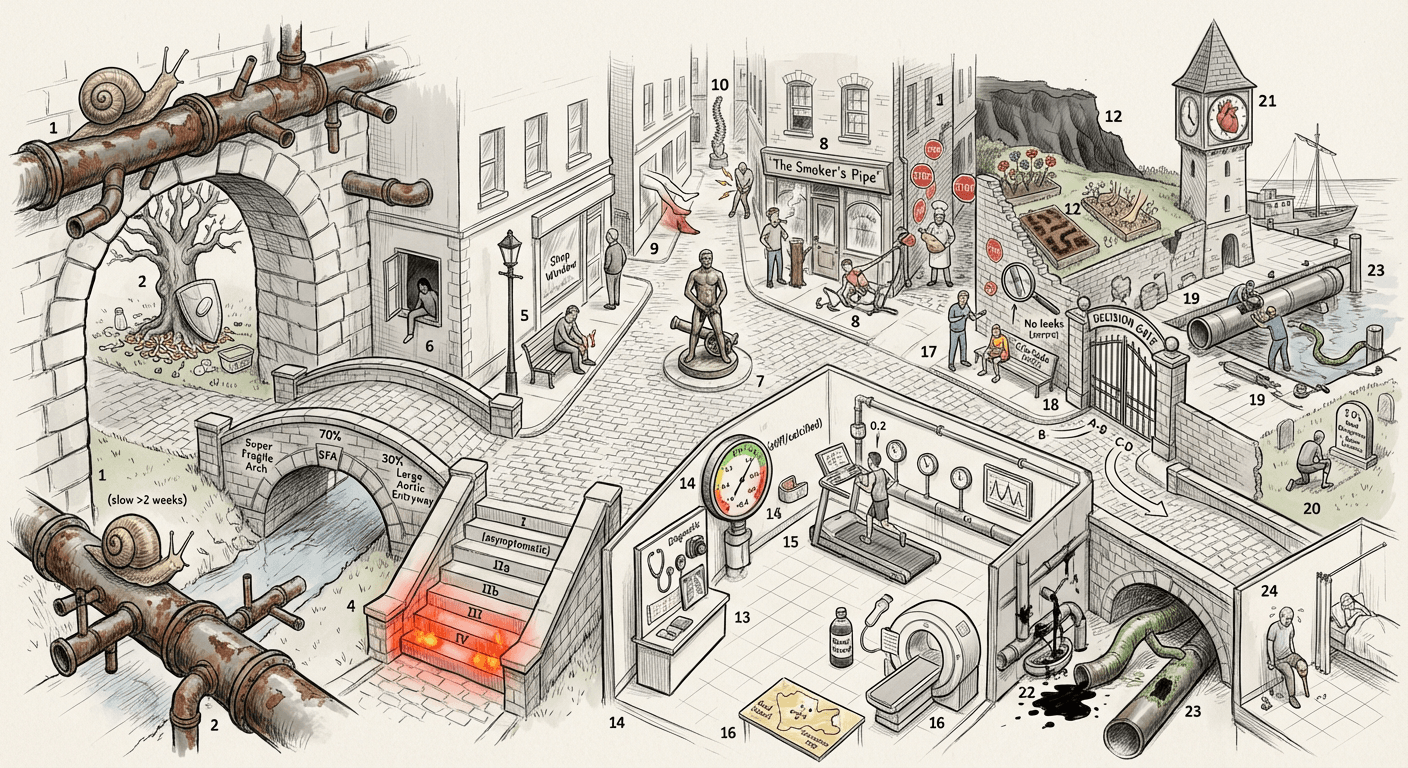
Sketchy memory palace for Chronic Arterial Insufficiency
| No. | Visual Cue | Meaning |
|---|---|---|
| 1 | A snail (slow >2 weeks) on a pipe (vessel) with many tiny branching tubes (collaterals). | - Chronic arterial insufficiency = gradual (> 2 weeks) reduction in limb perfusion; most commonly due to atherosclerosis. - Acute and chronic occlusion are distinct entities — chronic allows collateral formation. - Acute vs chronic: 2 weeks = chronic; acute lacks collaterals and presents with 6 P's. |
| 2 | A family tree surrounded by risk factors (smoking, DM, HT, HL) and a survival shield representing medical management (antiplatelets, statins, and risk modification). | - Risk factors: Smoking, DM, HT, HL, Family history — atherosclerosis is a systemic disease. - All patients get CV risk factor modification + antiplatelet + statin — this is for survival, not just the leg. - Improve Survival: Smoking cessation, DM control, lipid lowering (statin regardless of lipid level), HT control, antiplatelet agents. - Aspirin = secondary CV prevention, NOT primarily for claudication improvement. |
| 3 | A bridge labeled 70% SFA and 30% Aorto-Iliac. | - SFA is the most commonly affected vessel (~70%); aorto-iliac ~30%. |
| 4 | Fontaine steps: I (asymptomatic), IIa (>200m), IIb (<200m), III (rest pain), IV (tissue loss). Red glowing steps indicate absolute surgical need. | - Fontaine: I (asymptomatic) → IIa (> 200m) → IIb (< 200m) → III (rest pain) → IV (tissue loss). - CLI (Fontaine III–IV) = absolute indication for intervention; claudication = relative. |
| 5 | Fixed distance walk followed by rest on a bench; 'Shop window' stance contrasting with a 'Park bench' sitter flexing forward. | - Intermittent claudication: exercise-induced muscular pain, fixed distance, relieved by rest. Calf = SFA; thigh + buttock = aorto-iliac. - Vascular vs neurogenic claudication: fixed distance vs variable; rest relieves vs bending forward; absent pulses vs present. - Vascular vs neurogenic claudication: Fixed distance vs variable; rest relieves vs flexion relieves; absent pulses vs present; "shop window" vs "park bench"; uphill worse vs downhill worse. |
| 6 | Leg hanging down from a bed at night. | - Rest pain: worst at night, relieved by dependency (hanging legs down restores hydrostatic pressure). |
| 7 | Statue with absent femoral pulses and impotence. | - Leriche syndrome: aortic bifurcation occlusion → absent femoral pulses + bilateral claudication + impotence. |
| 8 | Young smoker with a 'tree trunk' (angiogram sign) vs. a young athlete (popliteal entrapment). | - Buerger's disease: young male smokers, small distal vessels, "tree trunk" angiogram, stop smoking is the only effective treatment. - Within chronic arterial causes: atherosclerosis (elderly, CV risk factors) vs Buerger's (young male smoker, small vessels, "tree trunk") vs popliteal entrapment (young athlete, no risk factors). |
| 9 | Elevation pallor followed by dependent rubor. | - Buerger's test: elevation pallor (Buerger's angle) + dependent rubor (reactive hyperaemia). |
| 10 | Spinal column (stenosis), lightning bolt (sciatica), and a Baker's sack (cyst). | - Most important DDx of intermittent claudication: neurogenic claudication (spinal stenosis), sciatica, hip/knee arthritis, chronic compartment syndrome, Baker's cyst. - Sciatica: back pain radiating down leg, dermatomal, NOT relieved by rest, positive SLR, pulses present. |
| 11 | Stopped toe amputation and 'treating the angiogram' (intervening on a non-symptom pipe). | - Never amputate digits before revascularization. - Lecture slides pitfalls: mis-diagnosis of claudication, toe amputation before revascularisation, delay recognition of acute ischaemia, "treating the angiogram." - Never amputate digits before revascularisation. - "Treating the angiogram" = intervening on an asymptomatic stenosis — DON'T DO IT . |
| 12 | Arterial ulcer (painful/pressure), Venous (hemosiderin/gaiter), and Neuropathic (painless/plantar). Untreated, these lead to a dark gangrene cliff. | - Leg ulcer DDx: arterial (painful, pressure points, absent pulses) vs venous (gaiter area, haemosiderin) vs neuropathic/diabetic (painless, plantar, may have falsely elevated ABPI). - Tissue loss (ulcers → gangrene → sepsis) is the natural history of untreated CLI. |
| 13 | The 'Evaluation Framework' containing clinical exam, hemodynamic (ABI), and anatomical (imaging) tools. | - Diagnosis is clinical + haemodynamic (ABI) + anatomical (imaging). - Clinical Evaluation framework: Does the patient have arterial disease? Acute or chronic? How severe? Where? Why? - Adjuncts: ECG (AF, ischaemia), bloods (renal function before contrast, glucose, lipids, CBC), CXR. |
| 14 | Pressure dial and a toe-specific cuff (TBI). | - ABI interpretation: > 1.3 = calcified; 0.9–1.3 = normal; 0.4–0.9 = claudication; < 0.4 = CLI. - TBI/TcPO₂: essential in diabetics with falsely elevated ABI from vessel calcification. |
| 15 | Treadmill ABI drop (0.2), segmental pressure drops (>20mmHg), and triphasic Doppler waves. | - Exercise ABI: drop ≥ 0.2 confirms exercise-induced ischaemia when resting ABI is normal. - Segmental pressures: > 20 mmHg drop between segments = significant stenosis at that level. - Doppler waveforms: triphasic = normal; biphasic = moderate disease; monophasic = severe. |
| 16 | Ultrasound (1st line), CTA (pre-op planning with contrast), and Gold-standard DSA (intervention only). | - Duplex USG: first-line imaging, non-invasive, operator-dependent, poor for aortoiliac. - CTA: for pre-intervention planning; watch for contrast nephropathy and allergy. - DSA: gold standard, ONLY for planned intervention, can be therapeutic (intra-op). |
| 17 | Supervised exercise and a Cilostazol pill bottle. | - Improve Symptoms: Supervised exercise programme + drugs (cilostazol, naftidrofuryl, pentoxifylline) + endovascular/surgery. - Cilostazol (PDE3 inhibitor) = only FDA-approved drug for claudication. Contraindicated in heart failure. - Supervised exercise increases claudication distance by 50–200% — comparable to angioplasty. |
| 18 | TASC A-B (endovascular) vs. TASC C-D (surgical bypass). | - Indications for intervention: disabling claudication (failed 6 months conservative) + limb salvage (critical ischaemia). - TASC A-B → endovascular (PTA ± stent). TASC C-D → surgical bypass. |
| 19 | Pipe scraper (endarterectomy) and a natural vine bypass hose (autologous vein). | - Endarterectomy: short segments, larger vessels (iliac, carotid, femoral bifurcation/profundaplasty). - Bypass: anatomical (aorto-bifemoral, fem-pop) vs extra-anatomical (fem-fem, axillo-bifemoral). Autologous vein = best conduit, especially below knee. |
| 20 | 3 D's tombstone and a prosthetic leg showing a preserved knee joint (BKA). | - Amputation indications (3 D's): Dead, Dangerous, Damn nuisance. BKA preferred to preserve knee joint. |
| 21 | A heart clock representing the leading cause of death. | - Cardiovascular events (MI, stroke) are the leading cause of death — not the leg. Always manage systemic atherosclerosis. |
| 22 | Leaking ink (myoglobinuria), kidney damage (AKI), and a sliced muscle-box (fasciotomy for compartment syndrome). | - Delay in amputating a non-viable limb → infection, myoglobinuria, AKI, hyperkalaemia. - Endovascular: dissection, rupture, distal embolisation, restenosis (most common late complication), contrast nephropathy. - Reperfusion injury → compartment syndrome (pain out of proportion, tense compartment, pulses can be present, Mx: urgent fasciotomy) and rhabdomyolysis (K⁺/myoglobin release → arrhythmia/AKI, Mx: aggressive hydration, mannitol, IV bicarbonate). |
| 23 | Kinked, infected bypass hose leaking into a stomach-shaped sewer (aortoenteric fistula). | - Bypass surgery: graft failure (kink → neointimal hyperplasia → atherosclerosis), graft infection (prosthetic > autologous), aortoenteric fistula, autonomic nerve damage. |
| 24 | A phantom ghost limb, a fixed-flexed stump, and a nerve lump (neuroma). | - Early: stump gangrene (→ higher amputation), phantom limb pain (Mx: amitriptyline/gabapentin), DVT/PE. - Late: fixed flexion deformity, stump neuroma, stump ulceration. |
Carotid Artery Stenosis
Narrowing of the carotid artery lumen, usually due to atherosclerotic plaque, that reduces cerebral blood flow and increases the risk of ischemic stroke.
Chronic Venous Insuffiency
Chronic venous insufficiency is the impaired return of venous blood from the lower extremities due to valvular incompetence or venous obstruction, often manifesting as varicose veins, edema, skin changes, and ulceration.