
Acute Limb Ischemia
Acute limb ischemia is a sudden decrease in limb perfusion, typically due to thrombosis or embolism, threatening tissue viability if not revascularized within hours.
| Exam domain | One-glance essentials |
|---|---|
| Definition / diagnosis |
|
| Epidemiology / risks |
|
| Core mechanism |
|
| Clinical picture |
|
| Investigations |
|
| Management |
|
| Complications |
|
| Prevention / follow-up |
|
| Exam traps |
|
References
[1] Rutherford RB, et al. Recommended standards for reports dealing with lower extremity ischemia. J Vasc Surg. 1997;26(3):517-538. [2] Senior notes: felixlai.md (Acute arterial insufficiency — Differential diagnosis, Clinical manifestation sections)
Acute Limb Ischemia
Acute limb ischemia (ALI) is defined as a sudden decrease in limb perfusion that causes a potential threat to limb viability in a patient who presents within 2 weeks of the acute event [1][2][3].
Let's break this down:
- "Acute" = sudden onset (< 2 weeks), as opposed to chronic limb ischemia (> 2 weeks) where collateral vessels have had time to develop.
- "Limb ischemia" = "isch-" (to hold back) + "haemia" (blood) — literally, blood is being held back from the limb.
- The 2-week cutoff matters clinically because it determines whether collateral circulation has had time to develop. In truly acute presentations, there are no collaterals, so the tissue is completely dependent on the now-occluded vessel.
Acute & chronic occlusion are distinct entities [4]. This is a critical concept — they have different etiologies, different urgency, and different management strategies.
Critical Time Window
Irreversible damage occurs 4–6 hours after onset if adequate collateral circulation is absent [2]. Skeletal muscle can only withstand approximately 6 hours of ischemia before irreversible necrosis begins. Peripheral nerves are even more sensitive — they are the first structures to fail (hence paraesthesia appears before paralysis). This is why ALI is a surgical emergency (6 hours) [5].
Key nuance: Patients with pre-existing peripheral vascular disease (PVD) can often tolerate longer periods of ischemia because they have already developed collateral vessels around chronically stenotic segments [2]. This is why a patient with acute-on-chronic thrombosis may present less dramatically than someone with a fresh embolus to a previously normal artery.
2. Epidemiology
- ALI affects approximately 1.5 per 10,000 persons per year in Western populations.
- In Hong Kong, the aging population, high prevalence of diabetes mellitus, and increasing rates of atrial fibrillation make ALI a significant clinical entity seen in emergency departments and vascular surgery units.
- Age: Most common in the elderly (> 60 years), reflecting the high prevalence of atrial fibrillation and atherosclerosis in this group.
- Sex: Males are more commonly affected due to higher rates of atherosclerosis and smoking.
- Acute thrombotic occlusion of a pre-existing stenotic arterial segment (acute-on-chronic PVD) accounts for approximately 60% of cases (the most common cause) [3].
- Embolism accounts for approximately 30% of cases [3].
- Arterial trauma accounts for the remaining ~10%.
- 30-day mortality is approximately 15–20%, reflecting the fact that many ALI patients have significant underlying cardiovascular comorbidity (the same atrial fibrillation or myocardial infarction that caused the embolism also puts them at risk of death).
- Amputation rates remain significant at 10–30% despite modern revascularization techniques.
3. Risk Factors
Understanding risk factors requires mapping them to the three major etiological categories (embolism, thrombosis, trauma):
- Atrial fibrillation (AF) — by far the most common embolic source (cardiac origin accounts for ~80% of emboli) [3]
- Recent myocardial infarction (MI) — left ventricular mural thrombus forms over akinetic/dyskinetic wall segments
- Valvular heart disease / prosthetic heart valves — turbulent flow across abnormal valves promotes thrombus formation
- Left ventricular aneurysm — stasis within the aneurysm promotes thrombus
- Infective endocarditis — vegetations can embolize
- Abdominal aortic aneurysm (AAA) — thrombus lining the aneurysm wall can embolize distally, causing blue toe syndrome / trash foot [3]
These are the classic atherosclerotic occlusive disease risk factors [4]:
- Smoking — the single most modifiable risk factor; accelerates endothelial damage and promotes hypercoagulability
- Diabetes mellitus — promotes accelerated atherosclerosis, particularly of distal (tibial) vessels
- Hypertension — shear stress damages endothelium
- Hyperlipidemia — drives plaque formation
- Family history — genetic predisposition to atherosclerosis
- Hypercoagulable states: malignancy (especially adenocarcinoma secreting mucin), antiphospholipid syndrome (APLS), heparin-induced thrombocytopenia (HIT), sepsis [3]
- Buerger's disease (thromboangiitis obliterans) — young (30–40s), male, smokers [6]
- Aortic dissection — the dissection flap can occlude branch vessels
- Prior vascular intervention — bypass graft thrombosis, in-stent thrombosis
- Penetrating trauma (stab wounds, gunshot wounds)
- Blunt trauma (fractures, dislocations — especially supracondylar humeral fracture → brachial artery, posterior knee dislocation → popliteal artery)
- Iatrogenic — endovascular diagnostic or interventional procedures (catheterization, angioplasty)
Hong Kong Context
In Hong Kong, the aging population with high rates of AF, diabetes, and hypertension makes thrombotic and embolic ALI common. Buerger's disease, while less common than in other parts of Asia, should still be considered in young male smokers presenting with digital ischemia. The high volume of percutaneous coronary interventions and endovascular procedures also contributes to iatrogenic cases.
Lower Limb Arterial System
Understanding the anatomy is essential because the level of occlusion determines the clinical presentation and the surgical approach.
Arterial Tree (Proximal → Distal)
Abdominal Aorta
├── Common Iliac Artery
│   ├── Internal Iliac (Hypogastric) → pelvis, gluteal region
│   └── External Iliac → crosses under inguinal ligament
│       └── Common Femoral Artery (CFA)
│           ├── Profunda Femoris (Deep Femoral) → important collateral
│           └── Superficial Femoral Artery (SFA)
│               └── Popliteal Artery (behind the knee)
│                   ├── Anterior Tibial Artery → Dorsalis Pedis
│                   ├── Posterior Tibial Artery → behind medial malleolus
│                   └── Peroneal (Fibular) Artery
Major Levels of Arterial Occlusion [4]
| Level | Vessels | Clinical Presentation |
|---|---|---|
| Aorto-iliac | Large vessels | Claudication (thigh and calf), impotence (Leriche syndrome if bilateral) |
| Femoro-popliteal | Medium vessels | Claudication (calf), tissue loss |
| Distal | Small vessels | Tissue loss (ulcers, gangrene) |
Why does aorto-iliac disease cause impotence? Because the internal iliac (hypogastric) arteries supply the pelvic organs including the erectile tissue. Bilateral aorto-iliac disease (Leriche syndrome) = buttock claudication + impotence + absent femoral pulses.
Why does distal disease cause tissue loss rather than claudication? Because the small distal vessels supply end-organ tissue (toes, skin), and when these occlude, there are very few collaterals at the most distal level. The metabolic demand of skin/subcutaneous tissue at rest is enough that occlusion causes ischemia even without exercise.
Key Anatomical Points for Embolism
Emboli usually lodge at branching points because the vessel suddenly narrows [3]:
- Femoral bifurcation (CFA → SFA + profunda) — most common site
- Popliteal trifurcation (→ anterior tibial, posterior tibial, peroneal) — 2nd most common
- Aortic bifurcation ("saddle embolus") — causes bilateral limb ischemia
- Iliac bifurcation
Collateral Pathways
The profunda femoris (deep femoral artery) is the single most important collateral vessel in the lower limb. Even with complete SFA occlusion, the profunda can reconstitute the popliteal artery via genicular anastomoses. This is why patients with chronic SFA disease often have surprisingly good perfusion to the foot.
5. Etiology
Acute arterial occlusion is caused by three main mechanisms [4][5]:
- Acute embolism
- Acute thrombosis
- Trauma
5.1 Arterial Embolism (~30%)
Definition: A blood clot (or other material) formed proximally travels through the arterial system and lodges at a point where the vessel narrows (typically bifurcations).
| Source | Mechanism | Details |
|---|---|---|
| Cardiac (80%) | Thrombus forms in cardiac chambers/valves | AF (most common single cause), MI with mural thrombus, valvular heart disease, prosthetic valves, endocarditis, atrial myxoma |
| Aortic | Thrombus/debris from aortic pathology | AAA (thrombus lines aneurysm wall → fragments embolize), atherosclerotic debris ("trash foot" / blue toe syndrome) [3] |
| Paradoxical | Venous thrombus crosses to arterial side | Via patent foramen ovale (PFO) or atrial septal defect (ASD) |
| Unknown | No identifiable source found | ~5–10% of cases |
- Thrombus forms at the source (e.g., left atrial appendage in AF due to stasis)
- Thrombus dislodges and travels distally through the arterial tree
- Thrombus lodges at a bifurcation point where the vessel caliber suddenly decreases
- Complete occlusion occurs → no antegrade flow
- Because the native artery was previously healthy (no pre-existing stenosis), no collateral circulation has developed
- This is why embolism causes complete ischemia (no collaterals) — severity is typically worse than thrombosis [3]
Acute limb + chest pain
Acute limb ischemia with concurrent chest pain should immediately raise two diagnoses [3]:
- MI → new-onset AF or mural thrombus → embolism to limb
- Aortic dissection → dissection flap occluding limb vessels
Both are life-threatening and require different management. Always get an ECG and CXR to rule these out [7].
5.2 Arterial Thrombosis (~60%)
Definition: Thrombus forms in-situ on a diseased artery, usually at the site of a pre-existing atherosclerotic plaque.
This is the most common cause of ALI [3] — "acute-on-chronic" PVD.
| Mechanism | Explanation |
|---|---|
| Acute plaque rupture in PVD | The fibrous cap of an atherosclerotic plaque ruptures → exposes thrombogenic subendothelial collagen and lipid core → platelet adhesion and aggregation → thrombus formation → vessel occlusion |
| Progressive stenosis with low flow | Severe narrowing → stasis → eventual thrombosis (Virchow's triad: stasis, endothelial injury, hypercoagulability) |
| Intraplaque hemorrhage | Bleeding within the plaque causes sudden expansion → luminal narrowing → thrombosis |
| Aortic dissection | Intimal flap creates false lumen → true lumen collapses → branch vessel occlusion [3] |
| Hypercoagulability | Malignancy, APLS, sepsis [3] — Virchow's hypercoagulable component |
| Buerger's disease | Non-atherosclerotic inflammatory vasculitis of small-medium arteries [3][6] |
| Graft/stent thrombosis | Previous vascular bypass graft or angioplasty/stent → thrombosis at the intervention site |
- Chronic atherosclerosis → progressive stenosis over months to years
- During this time, collateral vessels develop as a compensatory mechanism
- When the artery finally occludes completely (acute event), the collaterals partially maintain perfusion
- This is why ischemia from thrombosis is usually less severe than from emboli — the collaterals "buffer" the impact [2]
- However, the thrombosis can propagate proximally and distally from the occlusion site, potentially blocking collateral inflow/outflow points, worsening ischemia
Types of Vascular Trauma
Vascular trauma [5]:
- Penetrating vs blunt
- High index of suspicion
- Recognize signs of acute ischemia
- Arteriography if in doubt
| Type | Mechanism | Example |
|---|---|---|
| Iatrogenic | Endovascular diagnostic or interventional procedures | Cardiac catheterization, angioplasty, intra-aortic balloon pump |
| Penetrating | Direct vessel injury → may lead to AV fistula that shunts blood away from the limb [2] | Stab wound, gunshot wound |
| Blunt | Fracture or dislocation → intimal tear with media and adventitia intact → thrombus forms at exposed collagen site [2] | Supracondylar fracture (brachial artery), knee dislocation (popliteal artery), high-energy trauma |
High-Energy Trauma and Vascular Injury
In high-energy trauma, always assess distal pulses and perform serial neurovascular checks. Certain fracture patterns carry high risk of vascular injury — posterior knee dislocation has up to 40% incidence of popliteal artery injury [8]. Delayed recognition is disastrous.
- Popliteal artery entrapment syndrome — anomalous musculoskeletal anatomy compresses the popliteal artery, usually in young athletes without atherosclerotic risk factors
- Thoracic outlet syndrome (arterial type, aTOS) — compression of subclavian artery → distal embolization → claudication, acute limb ischemia → management: embolectomy, surgical decompression [9]
- Phlegmasia cerulea dolens — massive iliofemoral DVT causing venous outflow obstruction so severe that arterial inflow is compromised (a differential, not a true arterial cause)
6. Relevant Classification
This distinction is critically important because different investigation and management [3]:
| Feature | Embolism | Thrombosis-in-situ |
|---|---|---|
| Common causes | Cardiac origin (80%) — AF, MI (LV mural thrombus), valvular disease/prosthesis; AAA (blue toe syndrome/trash foot) | Atherosclerosis: acute plaque rupture in PVD; Aortic dissection; Hypercoagulability: malignancy, APLS, sepsis; Buerger's disease |
| Severity | Complete ischemia (no collaterals) | Incomplete ischemia (collaterals) |
| Onset | Hyperacute (seconds to minutes) | Acute (hours or days) |
| History and PE | Embolic source identifiable (e.g., AF); Contralateral limb pulses present; Absent bruits | Previous claudication; PVD in contralateral limb (e.g., absent pulse); Present bruits |
| Angiographic findings | Minimal atherosclerosis, regular sharp cut-off, few collaterals [2] | Diffuse atherosclerosis, irregular cut-off, well-developed collaterals [2] |
| Management | Embolectomy, anticoagulation | Medical, bypass, thrombolysis |
Key Clinical Pearl
The quickest bedside way to differentiate: Check the contralateral limb. If the other leg has normal pulses → likely embolism (the underlying arteries are healthy). If the other leg also has absent/reduced pulses → likely thrombosis (bilateral atherosclerotic disease).
This is the standard classification system that guides management decisions:
| Category | Prognosis | Sensory Loss | Motor Deficit | Arterial Doppler | Venous Doppler | Investigation | Management |
|---|---|---|---|---|---|---|---|
| I (Viable) | No immediate threat | None | None | Audible | Audible | CTA | Revascularisation |
| IIA (Marginally threatened) | Salvageable if promptly treated | Minimal (toes) or none | None | Inaudible | Audible | CTA | Revascularisation |
| IIB (Immediately threatened) | Salvageable only if immediately revascularised | More than toes, rest pain | Mild/moderate | Inaudible | Audible | CTA | Revascularisation (emergency) |
| III (Irreversible) | Inevitable limb loss | Profound | Paralysis | Inaudible | Inaudible | Not required | Amputation |
How to interpret this table:
- Doppler signals are the most objective clinical tool. An audible arterial Doppler signal means there is still some flow through or around the occlusion → the limb is viable. Inaudible arterial but audible venous means there is still venous return but no arterial inflow → the limb is threatened. When both are inaudible → the limb is dead.
- Sensory loss before motor loss: This reflects the differential sensitivity of tissues to ischemia. Nerve fibers (especially myelinated sensory fibers) are the most sensitive to ischemia, followed by skeletal muscle, then skin and bone. That's why paraesthesia (sensory) is an early sign and paralysis (motor) is a late, ominous sign.
- Category III (Irreversible) → The muscles are already infarcted. Attempting revascularization at this point is not only futile but dangerous — reperfusing necrotic muscle will release potassium, myoglobin, and acid into the systemic circulation → hyperkalemia, rhabdomyolysis, renal failure, cardiac arrest. Amputation is the appropriate treatment.
Exam Trap
A common exam mistake is to think "we should always try to save the limb." In Rutherford III, revascularization is contraindicated — it will kill the patient via reperfusion syndrome. The correct answer is primary amputation.
Limb colour progresses [3]:
- 0–6 hours: "Marble white" pallor — arterial inflow is absent, the limb blanches
- 6–12 hours: Blanchable mottling — deoxygenated blood pools in the capillary bed; pressing on the skin temporarily displaces this blood (blanching), then it refills
- > 12 hours: Fixed mottling (irreversible) — the capillary endothelium has died, blood has extravasated into the interstitium, and pressing no longer causes blanching → revascularization at this point might cause significant reperfusion injury [3]
Why does this progression occur?
- Initially, absent arterial inflow → venous blood drains out → limb is pale/white
- As capillary endothelium becomes ischemic, it becomes "leaky" → deoxygenated blood pools in the subdermal plexus → mottled appearance
- If ischemia continues, capillary endothelium undergoes irreversible damage → blood extravasates and becomes fixed in the tissue → cannot be blanched away
7. Clinical Features
7.1 Symptoms
- Nerves are the most sensitive to ischemia [3] — this is why pain is usually the earliest symptom
- Character: Severe, sudden onset, constant, and unrelenting
- Location: Depends on the level of occlusion — e.g., calf pain with femoro-popliteal occlusion, forefoot pain with distal occlusion
- Pathophysiology: Ischemic nerve fibers fire pain signals; as ischemia progresses, metabolic waste products (lactate, H⁺, adenosine, bradykinin) accumulate in the tissue and directly stimulate nociceptors
- In embolic ALI: pain onset is hyperacute (seconds to minutes) because a previously well-perfused limb suddenly loses all blood flow
- In thrombotic ALI: pain onset is acute (hours or days) and may be superimposed on a background of chronic claudication pain
- "Para-" (abnormal) + "aesthesia" (sensation) = abnormal sensation
- Presents as tingling, numbness, or "pins and needles"
- Pathophysiology: Large myelinated sensory nerve fibers (Aβ fibers carrying light touch and proprioception) are extremely sensitive to ischemia and fail early. Unmyelinated C fibers (pain) are slightly more resistant, which is why the patient may paradoxically lose touch sensation before losing pain sensation.
- Clinical significance: Presence of sensory loss in the toes distinguishes Rutherford IIA from I; sensory loss extending beyond the toes suggests IIB.
- The affected limb feels cold to the patient
- Pathophysiology: Without arterial inflow, the limb cannot maintain its temperature. Heat dissipates through the skin surface, and the limb equilibrates toward room temperature. Normally, the arterial blood at ~37°C continuously warms the limb.
- Continuous burning pain in the forefoot/toes, often worse at night and when the limb is elevated
- Why worse when elevated? Gravity assists venous drainage but reduces the already-compromised arterial perfusion pressure. When the leg hangs dependent, gravity adds to the arterial pressure head, slightly improving perfusion.
- Why worse at night? Cardiac output falls during sleep, and the leg is typically elevated in bed → both reduce perfusion.
7.2 Signs
- The limb appears white/pale or waxy
- Pathophysiology: Absent arterial inflow → the cutaneous capillary bed empties of blood → skin loses its normal pink color
- Progresses to mottling (see color progression above) as ischemia worsens
- Absent or diminished pulse distal to the occlusion
- Can assess with handheld Doppler [3] — this is more sensitive than palpation
- Pathophysiology: The embolus/thrombus physically blocks the vessel lumen → no pressure wave is transmitted distally
- Bilateral pulselessness suggests aortic saddle embolus or bilateral iliac disease
- Compare with the contralateral limb — if the other side has normal pulses, this supports an embolic cause
- Late sign indicating muscle infarction [3]
- Pathophysiology: Skeletal muscle undergoes irreversible ischemic necrosis → the muscle can no longer contract → motor function is lost
- Clinically: inability to dorsiflex/plantarflex the foot, inability to wiggle toes
- This is an ominous sign — it suggests the limb may be moving toward Rutherford Class III (irreversible)
- Palpate both limbs simultaneously — there will be a clear temperature demarcation at the level of occlusion
- The level of coolness often correlates with the level of arterial occlusion (e.g., cool from the mid-thigh down suggests SFA occlusion; cool from below the knee suggests popliteal occlusion)
- Prolonged capillary refill time ( > 2 seconds) in the affected limb
- Pathophysiology: With absent arterial inflow, the capillary bed cannot refill after blanching
- Absent bruits in embolic disease (the underlying artery was healthy)
- Present bruits in thrombotic disease (turbulent flow through chronically stenosed vessels)
- Irregularly irregular pulse (AF) — suggests cardiac embolic source
- Cardiac murmurs — valvular disease as embolic source
- Abdominal aortic aneurysm — palpable pulsatile abdominal mass → source of distal embolization
- Contralateral limb examination: normal pulses (embolism) vs. absent pulses (thrombosis/bilateral PVD)
7.3 Systematic History Taking [2]
- Site: Buttock/Thigh/Calf/Foot/Toes
- Onset: Sudden (seconds/minutes suggests embolism) vs. gradual (hours/days suggests thrombosis); < 2 weeks or > 2 weeks
- Character: Severity of pain, constant vs. intermittent; presence of pre-existing claudication
- Radiation: To other parts of body
- Associated symptoms: Sensory disturbances (tingling/numbness), motor disturbances (weakness/inability to move), color change, temperature change
- Time course: Progressive worsening
- Exacerbating factors: Worsened when raising the limb (gravity reduces arterial head pressure), worsened at night (reduced cardiac output during sleep)
- Relieving factors: Hanging leg over the side of the bed (gravity assists arterial inflow), analgesics
- Severity: Pain score 1–10, wakes patient from sleep
- Functional outcomes: Ability to walk, ADLs, wheelchair-bound
- Atrial fibrillation — embolic source
- Recent MI — mural thrombus
- Previous stroke/TIA — shared atherosclerotic risk, may also indicate paradoxical embolism
- Known PVD/claudication — suggests thrombotic etiology
- Diabetes mellitus, Hypertension, Hyperlipidemia — atherosclerotic risk factors
- Thrombophilic states — malignancy, APLS, protein C/S deficiency, Factor V Leiden
- Connective tissue disorders — Marfan, Ehlers-Danlos (aortic dissection risk)
- Previous vascular revascularization (bypass, angioplasty, stenting) → graft/stent thrombosis
- Recent cardiac catheterization → iatrogenic vascular injury
- Anticoagulants (warfarin, NOACs, heparin) — therapeutic compliance?
- Antiplatelet agents (aspirin, clopidogrel)
- Vasopressors/inotropes (in ICU patients) → can precipitate non-occlusive ischemia
- Smoking — the most important modifiable risk factor for atherosclerosis; also the key causative factor in Buerger's disease
- Occupation — prolonged immobility
- Recent trauma — blunt or penetrating injury to the limb
Understanding the cascade from vessel occlusion to irreversible damage:
Why are nerves affected first? Peripheral nerves have high metabolic demands and poor ischemic tolerance. Large myelinated fibers fail first (loss of touch, proprioception) → then unmyelinated fibers (loss of pain, temperature) → then motor neurons fail (paralysis). This explains the clinical progression: paraesthesia → anesthesia → paralysis.
Why is muscle damage so dangerous? Skeletal muscle contains large quantities of myoglobin, potassium, and phosphate. When muscle cells necrose, these are released into the circulation. Myoglobin is freely filtered by the kidney but precipitates in acidic urine → tubular obstruction → acute kidney injury (AKI). Potassium release → hyperkalemia → cardiac arrhythmias → cardiac arrest.
9. Special Etiological Entities
Buerger's Disease (Thromboangiitis Obliterans) [6]:
- Young (30–40s), Male, Smokers
- Pan-arteriitis
- Medium & small sized arteries & veins
- Lower limb > upper limbs
- Rest pain, digital ulcer, gangrene
- Clinical diagnosis
- Arteriogram: "tree trunk" appearance (smooth tapering of vessels with corkscrew collaterals)
- Reconstruction seldom possible (because the disease affects small distal vessels not amenable to bypass)
- Stop smoking is effective — the single most important treatment; disease progression halts with smoking cessation
Pathophysiology: Unlike atherosclerosis (which is a lipid-driven process), Buerger's disease is an inflammatory vasculitis. There is segmental thrombotic occlusion of small and medium arteries and veins with intense inflammatory infiltrate involving all three vessel wall layers (hence "pan-arteriitis"). The exact mechanism is unclear but is strongly linked to tobacco exposure — possibly an autoimmune response triggered by tobacco antigens.
Aortic dissection can present with ALI when the dissection flap extends to occlude the iliac or femoral arteries. Key features:
- Chest/back pain (tearing, radiating) + acute limb ischemia
- Pulse deficit — weak or absent femoral pulse on the affected side
- BP discrepancy between arms
- Must rule out aortic dissection before giving heparin [7] — because anticoagulation in the setting of aortic dissection can be catastrophic (worsening hemorrhage into false lumen)
- Microemboli of cholesterol crystals and atherosclerotic debris from a proximal source (aorta, iliac arteries, AAA) shower distally
- Presents as painful, cyanotic (blue) toes with palpable pedal pulses (the main arteries are patent; it's the small digital arteries that are occluded)
- Often triggered by vascular procedures, anticoagulation (destabilizes thrombus overlying plaques), or spontaneously
- Blue toe syndrome: manage medically e.g., statins [7]
High Yield Exam Points:
- ALI = sudden decrease in perfusion threatening limb viability, presenting within 2 weeks
- 6 P's: Pain, Paraesthesia, Pallor, Pulselessness, Paralysis, Perishing cold
- Most common cause: acute-on-chronic thrombosis (60%); embolism (30%); trauma (10%)
- Embolism → hyperacute, complete ischemia, no collaterals; Thrombosis → acute, incomplete ischemia, collaterals present
- Emboli lodge at bifurcation points — femoral bifurcation (MC), popliteal trifurcation (2nd MC)
- Cardiac source accounts for 80% of emboli; AF is the single most common cause
- Irreversible damage at 6 hours — this is a surgical emergency
- Rutherford III = amputation, NOT revascularization
- Paralysis is a late, ominous sign indicating muscle infarction
- Fixed mottling ( > 12h) = irreversible — revascularization risks lethal reperfusion injury
- Always check the contralateral limb and get an ECG (looking for AF/MI)
High Yield Summary
Definition: Sudden decrease in limb perfusion threatening viability, presenting within 2 weeks.
6 P's: Pain → Paraesthesia → Pallor → Pulselessness → Paralysis → Perishing cold (in order of sensitivity to ischemia: nerves first, then muscle).
Etiology: Thrombosis (60%, acute-on-chronic PVD) > Embolism (30%, cardiac 80%) > Trauma (10%).
Emboli lodge at bifurcations: Femoral bifurcation (MC), popliteal trifurcation (2nd MC).
Embolism vs Thrombosis: Check contralateral pulses (present = embolism; absent = bilateral PVD/thrombosis), history of claudication (absent = embolism), onset (hyperacute = embolism).
Rutherford Classification: I (viable) → IIA (marginally threatened) → IIB (immediately threatened) → III (irreversible). Key differentiators: sensory loss, motor deficit, Doppler signals. Category III = primary amputation.
Time is muscle: Irreversible damage at 6 hours. Paralysis and fixed mottling are late/irreversible signs.
Always rule out aortic dissection before anticoagulation (ECG + CXR).
Buerger's disease: Young male smokers, small/medium vessels, "tree trunk" arteriogram, stop smoking is curative.
Active Recall - Acute Limb Ischemia (Definition, Etiology, Clinical Features)
[1] Rutherford RB, et al. Recommended standards for reports dealing with lower extremity ischemia. J Vasc Surg. 1997;26(3):517-538. [2] Senior notes: felixlai.md (Acute arterial insufficiency section) [3] Senior notes: maxim.md (Acute limb ischaemia section) [4] Lecture slides: WCS 002 - Toe gangrene and leg ulcer - by Prof SWK Cheng.pdf (p2 — Arterial Occlusive Diseases) [5] Lecture slides: WCS 002 - Toe gangrene and leg ulcer - by Prof SWK Cheng.pdf (p24, p26, p27 — Symptoms, Treatment, Complications) [6] Lecture slides: WCS 002 - Toe gangrene and leg ulcer - by Prof SWK Cheng.pdf (p22 — Buerger's Disease) [7] Senior notes: maxim.md (Management section — Initial management, rule out dissection) [8] Lecture slides: GC 231. High Energy Trauma Open Fracture_Part 3.pdf [9] Senior notes: maxim.md (Thoracic outlet syndrome section)
Differential Diagnosis of Acute Limb Ischemia
When a patient presents with a sudden, painful, cold, pale limb, the instinctive diagnosis is acute limb ischemia (ALI). But several other conditions can mimic ALI by producing some combination of pain, pallor, pulselessness, or swelling in a limb. The key to working through the differential is to ask: Is this truly an acute arterial occlusion, or is something else reducing perfusion or mimicking ischemia?
Let's work through this systematically — first by understanding the two named differentials from the senior notes and lecture slides, then broadening out to the complete list.
The differential for an acutely painful, compromised limb can be organized by mechanism:
Acute extremity compartment syndrome is a named differential of ALI [2][3].
Why does it mimic ALI? Compartment syndrome causes extrinsic compression of arteries leading to ischemic symptoms [2]. The swollen, tense compartment physically squeezes both the vessels and nerves running within it, producing pain, pallor, paraesthesia, and even pulselessness — overlapping heavily with the 6 P's.
How to differentiate from ALI:
| Feature | Acute Limb Ischemia | Compartment Syndrome |
|---|---|---|
| Cause | Intrinsic arterial occlusion (embolus/thrombus) | Raised intracompartmental pressure compressing contents |
| Pain | Severe, distal, constant | Severe pain disproportional to clinical picture, unrelieved by analgesia [10] |
| Passive stretch | Not a specific feature | Pain on passive stretching of digits [10] — this is the most sensitive clinical sign |
| Swelling | Usually absent (unless reperfusion has occurred) | Severe swelling, tense and shiny skin [10] |
| Pulses | Absent distal to the occlusion | Pulses always palpable [10] — because the occlusion is at the microvascular/compartmental level, not the main artery |
| Onset | Sudden (embolism) or over hours (thrombosis) | Commonly post-traumatic [10], or post-reperfusion |
| Neurological deficit | Sensory loss → then motor loss (due to nerve ischemia from absent arterial flow) | Sensory deficit, later paralysis [10] (due to direct nerve compression and ischemia within the compartment) |
Critical Distinction
The single most important distinguishing feature: pulses. In compartment syndrome, pulses are always palpable [10] because the systolic blood pressure far exceeds the intracompartmental pressure. By the time pulses are lost in compartment syndrome, the limb is almost certainly non-viable. In ALI, pulselessness is an early and defining feature.
Why does compartment syndrome occur? The lower leg has four fascial compartments (anterior, lateral/peroneal, superficial posterior, deep posterior), each enclosed by unyielding fascia. When there is swelling within a compartment (post-fracture bleeding, post-ischemia reperfusion edema), the pressure rises because the fascia cannot expand. When intracompartmental pressure exceeds capillary perfusion pressure (~30 mmHg), local microvascular flow ceases → muscle and nerve ischemia within that compartment → necrosis if untreated.
Management: Mainly a clinical diagnosis [10]. Confirmed by measuring intracompartmental pressure ( > 30 mmHg, or within 30 mmHg of diastolic pressure). Treatment is urgent fasciotomy (medial + lateral incisions in the leg to decompress all four compartments).
DVT with superficial vein thrombosis — known as phlegmasia cerulea dolens (literally "painful blue edema") [2][3].
Why does it mimic ALI? In this condition, venous pressure is increased to an extent that extremity perfusion is impaired [2]. Normally, arterial-to-capillary flow depends on a pressure gradient: arterial pressure > capillary pressure > venous pressure. If venous outflow is completely blocked (massive iliofemoral DVT), venous pressure rises enormously → capillary pressure rises → eventually, the venous back-pressure exceeds the arterial driving pressure → arterial inflow ceases → the limb becomes ischemic despite no primary arterial pathology.
Clinical features:
- Massively swollen limb (distinguishing feature — ALI limbs are NOT swollen; they are typically normal or slightly shrunken)
- Cyanotic (blue) rather than pale — because the limb is engorged with deoxygenated venous blood, not empty of blood
- Severe pain
- May progress to venous gangrene if untreated
- Pulses may be absent due to secondary arterial compromise from back-pressure
How to differentiate from ALI:
| Feature | Acute Limb Ischemia | Phlegmasia Cerulea Dolens |
|---|---|---|
| Limb appearance | Pale/white → mottled | Blue/cyanotic, massively swollen |
| Swelling | Absent or minimal | Massive edema (the limb is engorged) |
| Mechanism | Primary arterial occlusion | Primary venous occlusion → secondary arterial compromise |
| Risk factors | AF, atherosclerosis, trauma | DVT risk factors: malignancy, immobility, hypercoagulability, surgery |
| Venous Doppler | Audible (until Rutherford III) | Absent (the veins are thrombosed) |
| Response to elevation | Worsens ischemia (reduces arterial head) | May improve venous congestion |
Related entity — Phlegmasia Alba Dolens ("painful white leg"):
- An earlier stage of massive DVT where the limb is swollen and pale (white) rather than blue
- "Alba" = white; the pallor is caused by arterial spasm triggered by the massive venous occlusion
- Can progress to phlegmasia cerulea dolens if venous thrombosis extends
Aortic dissection can present primarily as ALI when the dissection flap extends to occlude iliac or femoral arteries [3]. This is not a "mimic" per se — it actually IS a cause of limb ischemia — but it must be considered in the differential because management is radically different.
How to recognize:
- Concurrent chest, back, or abdominal pain (tearing, radiating)
- Pulse deficit: asymmetric pulses (e.g., absent left femoral with present right femoral)
- Blood pressure discrepancy between arms
- Risk factors: hypertension, connective tissue disorders (Marfan, Ehlers-Danlos), bicuspid aortic valve
Why it matters for ALI differential: Must rule out aortic dissection before giving heparin [3] — anticoagulation in dissection worsens hemorrhage into the false lumen. Always get an ECG and CXR as initial screening. CT angiography is definitive.
This is less of a "differential" and more of a spectrum. A patient with pre-existing chronic limb ischemia (Fontaine Stage II–III) may present with worsening symptoms that can be confused with true acute ALI:
- Key differentiators: gradual progression over > 2 weeks, pre-existing claudication history, trophic changes (hair loss, nail thickening, skin atrophy), well-developed collaterals on imaging
- However, if an atherosclerotic plaque acutely ruptures and thromboses, this becomes a genuine ALI event — "acute-on-chronic"
This is a differential for the claudication component of chronic limb ischemia, but may also confuse an acute presentation if the patient has acute worsening of spinal stenosis symptoms [3][11]:
| Feature | Vascular Claudication | Neurogenic Claudication |
|---|---|---|
| Cause | Chronic limb ischaemia | Spinal stenosis |
| Radiation of pain | From distal to proximal | From proximal to distal |
| Exacerbating factor | Walking uphill (increased muscle O₂ demand) | Walking downhill (lumbar extension narrows spinal canal) |
| Relieving factor | Rest "Shop window to shop window" | Bending over, sitting "Park bench to park bench" (flexion widens spinal canal) |
| Pulse | Absent | Present |
| Associations | Atherosclerotic risk factors, atrophic changes | Only 10% SLR +ve, back pain |
Why the different pattern? In neurogenic claudication, the problem is nerve root compression in the lumbar spinal canal. Lumbar extension (standing upright, walking downhill) narrows the spinal canal further, compressing nerve roots. Flexion (bending forward, sitting) opens the canal. That's why these patients lean on a shopping cart at the supermarket — it flexes the spine and relieves symptoms.
In vascular claudication, the problem is inadequate blood supply to exercising muscle. Walking uphill demands more muscle work → more O₂ demand → but stenosed arteries can't deliver → ischemic pain. Rest reduces O₂ demand → pain resolves within minutes.
| Condition | Why It Mimics ALI | How to Differentiate |
|---|---|---|
| Sciatica / Lumbar radiculopathy [11] | Leg pain, numbness, weakness (can mimic paraesthesia and paralysis) | Pain radiates from back, follows dermatomal distribution (L5–S1), positive straight leg raise, pulses present |
| Acute peripheral neuropathy (e.g., diabetic mononeuropathy) | Sudden numbness, weakness in a limb | Neurological distribution, pulses present, no pallor/coolness |
| Musculoskeletal injury (fracture, muscle tear) | Acute limb pain, swelling, inability to move | History of trauma, point tenderness, abnormal X-ray, pulses present |
| Baker's cyst (ruptured) [11] | Acute calf pain and swelling mimicking DVT or ALI | Posterior knee mass, MRI confirms cyst, pulses present |
| Chronic compartment syndrome [11] | Exertional leg pain in athletes | Young, heavy-muscled, pain resolves with rest (unlike rest pain of ALI), pulses present, no atherosclerotic risk factors |
| Arthritis of hip or foot [11] | Limb pain with walking | Joint pain rather than muscle group pain, pulses present, X-ray shows joint changes |
| Raynaud's phenomenon | Digital pallor, cyanosis, pain | Episodic, triggered by cold/stress, symmetrical, affects fingers > toes, normal pulses between episodes |
The lecture slides specifically highlight arterial diseases: common pitfalls [12]:
- Mis-diagnosis of claudication — confusing neurogenic claudication with vascular claudication
- Toe amputation before revascularization — performing local tissue surgery without addressing the underlying arterial insufficiency first
- Delay recognition of acute ischemia — every hour of delay reduces the chance of limb salvage; the 6-hour window is critical
- Beware of "leg pain" — not all leg pain is vascular; systematic assessment is needed
- "Treating the angiogram" – intervention for asymptomatic disease — finding an arterial stenosis on imaging does not mean it needs treatment unless it is causing symptoms
Exam Pitfall
Delay recognition of acute ischemia [12] is the most dangerous clinical pitfall. A patient with a cold, painful, pulseless limb needs emergency assessment NOW — not a routine outpatient referral. The 6-hour window to irreversible damage means this is as time-critical as an acute STEMI ("time is muscle" applies to both the heart and the limb).
| Differential | Key Distinguishing Feature(s) from ALI |
|---|---|
| Compartment syndrome | Pulses present; tense swelling; pain on passive stretch; post-trauma/post-reperfusion |
| Phlegmasia cerulea dolens | Massive swelling + cyanosis (blue, not pale); venous > arterial |
| Aortic dissection | Chest/back pain; BP discrepancy; pulse deficit; widened mediastinum on CXR |
| Neurogenic claudication | Pulses present; pain proximal→distal; relieved by flexion; back pain |
| Sciatica | Dermatomal distribution; SLR positive; pulses present |
| Acute neuropathy | Neurological distribution; no color/temperature change; pulses present |
| Ruptured Baker's cyst | Posterior knee mass; calf swelling; pulses present |
| Raynaud's | Episodic; cold-triggered; symmetrical digital involvement; self-resolving |
The unifying theme: In ALI, pulses are absent and the limb is pale/white. In almost every mimic, pulses are present (the arterial supply is intact) and the mechanism is something else entirely — nerve compression, venous congestion, or compartmental pressure. Always check the pulses and use a handheld Doppler.
High Yield Summary
Named differentials of ALI (from senior notes and slides):
- Acute extremity compartment syndrome — extrinsic arterial compression; pulses present; tense swelling; pain on passive stretch; mainly clinical diagnosis
- Phlegmasia cerulea dolens — massive DVT causing secondary arterial compromise; blue swollen limb (not pale); venous Doppler absent
- Aortic dissection — must rule out before anticoagulation; chest/back pain; pulse deficit
Other differentials: Neurogenic claudication (spinal stenosis), sciatica, Baker's cyst, musculoskeletal injury, Raynaud's phenomenon.
Key bedside differentiator: Are the pulses present? → If yes, it's likely NOT primary ALI.
Common pitfalls (from lecture slides): Mis-diagnosis of claudication, delay recognition of acute ischemia, toe amputation before revascularization, beware of "leg pain", treating the angiogram.
Active Recall - Differential Diagnosis of Acute Limb Ischemia
References
[2] Senior notes: felixlai.md (Acute arterial insufficiency — Differential diagnosis, Clinical manifestation sections) [3] Senior notes: maxim.md (Acute limb ischaemia — DDx, Etiology, Management sections) [10] Lecture slides: GC 231. High Energy Trauma Open Fracture_Part 3.pdf (p4 — Compartment syndrome) [11] Senior notes: felixlai.md (Chronic arterial insufficiency — Differential diagnosis of intermittent claudication) [12] Lecture slides: WCS 002 - Toe gangrene and leg ulcer - by Prof SWK Cheng.pdf (p28 — Common Pitfalls)
Diagnostic Criteria, Algorithm & Investigation Modalities
This is a crucial point to understand from first principles: Diagnosis is clinical [5]. Unlike many conditions where you need a blood test or imaging study to confirm the diagnosis, ALI is diagnosed at the bedside by recognizing the 6 P's and assessing the Doppler signals. You don't wait for a CT scan before starting treatment — the 6-hour window to irreversible damage means every minute counts.
That said, you need a systematic framework to:
- Confirm the diagnosis (Is this really arterial ischemia?)
- Classify severity (Rutherford — determines management)
- Determine the etiology (Embolism vs thrombosis — determines surgical approach)
- Localize the occlusion (Where exactly? — determines operative plan)
- Assess the patient (Fitness for surgery, comorbidities, embolic source)
The lecture slides frame the clinical evaluation as five sequential questions [13]:
Clinical Evaluation [13]:
- Does the patient have arterial disease?
- Acute or chronic?
- How severe?
- Where is the obstruction?
- Why?
Let's now build the diagnostic algorithm around these five questions.
Key Principle
The algorithm is driven by clinical severity first, imaging second. You classify Rutherford at the bedside using the 6 P's and handheld Doppler — this determines the urgency. Imaging (CTA) is obtained only when the limb is viable enough to afford the time.
3. Step-by-Step Diagnostic Approach
History + Physical Examination — as detailed in the clinical features section. The key bedside maneuvers:
-
Palpation of peripheral pulses [2]:
- Upper extremities: Carotid / Subclavian / Axillary / Brachial / Radial / Ulnar
- Lower extremities: Femoral / Popliteal / Posterior tibial / Dorsalis pedis
- Compare both sides — asymmetry is the most important finding
- The level where pulses disappear tells you where the occlusion is (the occlusion is one joint above the line of demarcation between normal and ischemic tissue [2])
-
Temperature, color, capillary refill [2]:
- Cool / Pale / Delayed capillary refill
- Look for mottling and determine whether it is blanchable (potentially reversible) or fixed (irreversible)
-
Handheld Doppler assessment [3]:
- This is the single most important bedside tool
- Check for arterial and venous Doppler signals at the ankle (posterior tibial and dorsalis pedis)
- The combination of arterial and venous Doppler signals maps directly onto the Rutherford classification
-
Neurological examination [2]:
- Signs of early nerve dysfunction: numbness or paraesthesia
- Signs of advanced nerve dysfunction: motor loss (paralysis)
-
Buerger test [2]:
- Elevate the foot with patient lying supine until veins drain completely, then place foot in dependent position
- Normal: Remains pink on elevation
- Ischemia: Pallor on elevation → Dusky flush (rubor) spreading proximally from toes when dependent (reactive hyperemia — the ischemic capillary bed vasodilates maximally and floods with blood when gravity assists inflow)
This is done clinically + with handheld Doppler, not with imaging. Refer to the Rutherford table from the previous section [2][3]:
| Category | Sensory Loss | Motor Deficit | Arterial Doppler | Venous Doppler | Action |
|---|---|---|---|---|---|
| I (Viable) | None | None | Audible | Audible | CTA → plan revascularization |
| IIA (Marginally threatened) | Minimal (toes) | None | Inaudible | Audible | CTA → revascularization |
| IIB (Immediately threatened) | Beyond toes | Mild/moderate | Inaudible | Audible | CTA if time permits → emergency revascularization |
| III (Irreversible) | Profound | Paralysis | Inaudible | Inaudible | Not required → primary amputation |
Why is Doppler so useful here? The handheld continuous-wave Doppler detects blood flow velocity by the frequency shift of ultrasound waves reflected off moving red blood cells (the Doppler effect — named after Christian Doppler). Even when a pulse is not palpable by hand, the Doppler can detect low-velocity flow. If the arterial signal is audible, there is still some flow reaching the limb (viable). If inaudible, the limb is at risk. If even the venous signal is inaudible, there is no flow whatsoever — the limb is dead.
Muscle Viability Assessment — Intra-operative
When there is doubt about viability (borderline Rutherford IIB/III), the surgeon can directly assess muscle viability at the time of surgery [2]: Viable muscle appears shiny and twitches in response to flicking. Non-viable muscle appears dull and does not respond to flicking. This is a critical intra-operative decision point.
This is determined by history, physical examination, and imaging [2]:
| Feature | Embolic | Thrombotic |
|---|---|---|
| Identifiable source | AF / AMI | Less common |
| History | Absence of claudication | Presence of claudication |
| Physical examination | Presence of contralateral pulse | Absence of contralateral pulse |
| Imaging (Angiography) | Minimal atherosclerosis, regular sharp cut-off, few collaterals | Diffuse atherosclerosis, irregular cut-off, well-developed collaterals |
Why does the angiographic appearance differ?
- Embolic cut-off is "regular" and "sharp" because the embolus lodges in a previously normal artery — the vessel wall is smooth upstream, and there is an abrupt meniscus where the embolus sits. Few collaterals are seen because the artery was never stenosed before, so the body never had stimulus to develop them.
- Thrombotic cut-off is "irregular" because the underlying artery is diseased with diffuse atherosclerotic plaque, creating an irregular luminal surface. Collaterals are well-developed because the chronic stenosis progressively stimulated angiogenesis over months to years.
4. Investigation Modalities
Investigations are divided into urgent bedside/laboratory tests and imaging studies.
4A. Urgent Bedside Investigations
The Non-invasive Vascular Laboratory [13]:
- Ultrasound based
- Segmental pressure
- Waveform analysis
- Ankle-brachial index (ABI)
- Exercise test
How to measure [2]:
- ABI = Resting systolic ankle BP (higher of posterior tibial or dorsalis pedis) ÷ Systolic brachial BP (higher of left or right arm)
- Ankle pressure: BP cuff around the calf, Doppler probe at dorsalis pedis or posterior tibial artery. Inflate cuff until signal obliterated, slowly deflate until signal returns — that is the systolic ankle pressure.
- Brachial pressure: BP cuff around the arm, Doppler probe at brachial artery, same inflation-deflation technique.
| ABI | Interpretation | Pathophysiology |
|---|---|---|
| > 1.3 | Calcified (non-compressible) artery | Mönckeberg medial calcification (common in DM patients) → the artery cannot be compressed by the cuff, giving a falsely elevated reading. Use toe-brachial pressure index (TBPI) instead (digital arteries are spared from calcification) |
| 0.9–1.3 | Normal | Ankle pressure should be approximately equal to or slightly higher than brachial (due to pulse wave amplification distally) |
| 0.4–0.9 | Claudication | Arterial obstruction reduces distal pressure; sufficient for rest but insufficient during exercise |
| < 0.4 | Critical limb ischemia | Severe obstruction → rest pain, non-healing ulceration, gangrene |
Why is ABI useful in ALI? It provides an objective, quantitative measure of severity. A critically low ABI ( < 0.4) or unmeasurable ABI (no Doppler signal) confirms severe ischemia. However, in the acute setting with a clearly ischemic limb, don't waste precious time calculating a formal ABI — the Doppler assessment alone (audible vs inaudible) is sufficient for Rutherford classification.
Exam Pitfall — ABI > 1.3
An ABI > 1.3 does NOT mean the patient has super-normal blood flow. It means the artery is calcified and incompressible — commonly in diabetic patients. The ABI is falsely elevated and unreliable. You must use alternative methods: toe-brachial pressure index (TBPI), transcutaneous oxygen measurement (TcO₂), or arterial Doppler USG [14].
- Indicated when a patient has a classical history of intermittent claudication but normal ABI at rest [2]
- Measure ABI before and after exercise on a treadmill
- A decrease of ≥ 0.2 in ABI post-exercise indicates hemodynamically significant claudication [2]
- Why? At rest, collateral flow may be sufficient to maintain near-normal ankle pressure. Exercise increases muscle oxygen demand → vasodilation in the muscle bed → "steals" blood through the collaterals → pressure drops distal to the stenosis.
- Not typically used in the acute setting (patients can't walk on a treadmill with ALI), but important to know for context.
Urgent investigations [3]: CBC D/C, clotting, LRFT, T&S, CK (muscle injury)
| Test | Rationale | Key Findings |
|---|---|---|
| CBC with differentials [2] | Baseline; assess for polycythemia (increases viscosity → thrombosis), thrombocytopenia (HIT), leukocytosis (infection/gangrene) | Elevated WCC may suggest infected gangrene or sepsis |
| Clotting profile (PT/APTT) [2] | Baseline before anticoagulation; assess for coagulopathy | Prolonged APTT may suggest lupus anticoagulant; needed for heparin monitoring (target APTT 60–80s) |
| Renal function tests (RFT) [2] | Baseline renal function; anticipate contrast nephropathy from CTA; anticipate myoglobin-induced AKI | Elevated creatinine/urea may indicate pre-existing CKD or early rhabdomyolysis-induced AKI |
| Liver function tests (LFT) | General assessment; hepatic synthetic function affects coagulation | — |
| Group & Save / Type & Screen (T&S) [3] | Anticipate need for blood products if surgical intervention required | — |
| Serum CK level [2][3] | Evaluation of rhabdomyolysis — CK is released from necrotic skeletal muscle (CK-MM isoform) | Markedly elevated CK ( > 5× normal) indicates significant muscle necrosis. Serial monitoring post-revascularization is essential |
| Arterial blood gas (ABG) [2] | Look for lactic acidosis — lactate rises as ischemic muscle switches to anaerobic metabolism | Metabolic acidosis (low pH, low HCO₃⁻, high lactate). Severe lactate elevation ( > 4 mmol/L) suggests extensive muscle ischemia and predicts higher complication rates |
| Cardiac enzymes (Troponin) [2] | Indicated if suspecting an AMI with left ventricular mural thrombus — AMI is both a cause of embolism and a comorbidity that affects surgical risk | Elevated troponin may indicate concurrent MI or demand ischemia |
| Electrolytes (K⁺, Ca²⁺, PO₄³⁻) | Hyperkalemia from muscle necrosis can cause fatal arrhythmias; needed before and after revascularization | K⁺ > 5.5 mmol/L is dangerous; > 6.5 mmol/L is life-threatening. May rise dramatically post-reperfusion |
ECG and CXR: rule out aortic dissection (especially if chest pain) [3]
| Investigation | What You're Looking For | Why |
|---|---|---|
| ECG [2][3] | AF (irregularly irregular rhythm, absent P waves); acute MI (ST changes); LVH | AF is the most common embolic source. New MI → mural thrombus. Must rule out aortic dissection before giving heparin [3] |
| CXR [2][3] | Widened mediastinum (aortic dissection); cardiomegaly (heart failure → mural thrombus); pulmonary edema | Widened mediastinum is the classic CXR sign of aortic dissection — though sensitivity is only ~60%, it is a rapid screening tool |
| Transthoracic echocardiogram (TTE) [2] | LV mural thrombus, valvular vegetations, atrial myxoma, LV wall motion abnormalities, patent foramen ovale | Non-invasive assessment of cardiac embolic sources. Should be performed once the limb emergency is addressed |
| Transoesophageal echocardiogram (TOE) [2] | Left atrial appendage thrombus (not well seen on TTE), aortic atheroma, prosthetic valve thrombus | More sensitive than TTE for left atrial thrombus and aortic arch atheroma. Semi-invasive (requires sedation) |
Locate source of emboli [5] — this is an essential part of the post-revascularization workup. Finding and treating the embolic source prevents recurrence.
4D. Imaging Studies — Localizing the Occlusion
The imaging modalities proceed from non-invasive to invasive:
- Duplex USG = 2D (B-mode) USG + Doppler technique [14]
- What it does: Locates the level of obstruction and classifies severity based on Doppler waveform analysis
- Normal arterial flow waveform: Should be triphasic [2][14]:
- First forward-flow peak (systolic) — high velocity forward flow
- Brief reverse-flow component (early diastole) — elastic recoil of arterial wall
- Second forward-flow peak (late diastole) — small forward flow from vessel compliance
- Abnormal waveforms: Monophasic or biphasic waveforms are abnormal [2] — loss of the reverse-flow component indicates increased downstream resistance or proximal stenosis → continuous forward flow
- Advantages: Non-invasive, no radiation, no contrast, portable, can be done at bedside
- Limitations: Operator-dependent, poor image quality for aorto-iliac segment (deep, bowel gas interference), cannot map entire arterial tree as comprehensively as CTA
Urgent CT angiogram to confirm level of occlusion and determine any run-off [3]:
- 2–3 patent lower leg arteries to the foot / 1 patent artery with intact anterior or posterior foot arch [3]
This is the workhorse imaging modality for ALI:
- What it does: Diagnoses the location and severity of arterial stenosis or occlusion with excellent anatomical detail
- Technique: IV contrast injection with rapid helical CT acquisition timed to the arterial phase → 3D reconstruction of entire arterial tree from aorta to foot
- Key findings to look for:
- Site of occlusion: Exact level (aorto-iliac, femoro-popliteal, tibial)
- Cut-off morphology: Sharp "meniscus" (embolism) vs irregular taper (thrombosis)
- Collateral vessels: Sparse (embolism) vs well-developed (thrombosis)
- Run-off vessels: How many tibial vessels are patent below the occlusion? This determines whether bypass/endovascular intervention is feasible
- Bilateral disease: Extent of atherosclerosis in the contralateral limb
- Aortic pathology: AAA, dissection, saddle embolus
- Advantages: Fast (< 5 minutes scan time), widely available, excellent spatial resolution, non-invasive
- Disadvantages: Radiation exposure, IV contrast (risk of contrast nephropathy — always check RFT beforehand; risk of contrast allergy)
- No significant difference in accuracy between CTA and MRA [2]
CTA: The Key Imaging in ALI
CTA is indicated for Rutherford I, IIA, and IIB (if time allows). It maps the occlusion, assesses run-off, and helps plan the revascularization strategy. For Rutherford III, imaging is not required [3] — the limb is dead and the patient proceeds to amputation. Arteriography is NOT necessary for amputation since the level of amputation is determined by clinical findings and tissue viability at surgery [2].
- Advantages: Avoids ionizing radiation; minimal risk of contrast nephropathy (gadolinium-based contrast, though caution in severe CKD — risk of nephrogenic systemic fibrosis)
- Disadvantages: Longer acquisition time (not ideal in emergencies), less widely available, contraindicated with certain metallic implants/pacemakers
- Role in ALI: Rarely used acutely — CTA is faster and more practical. MRA is more useful for elective planning in chronic disease.
Arteriography [13]: Indicated ONLY when surgery is planned. NOT used for diagnosis [13].
- What it does: A catheter is inserted into the arterial tree (usually via femoral or brachial artery puncture), radio-opaque contrast is injected, and fluoroscopic images are acquired. Digital subtraction removes overlying bone to better visualize the arteries.
- Gold standard for evaluation of arterial tree before planning revascularization [2][14]
- Key advantages:
- Highest spatial resolution of all imaging modalities
- Can be done intra-operatively to guide endovascular intervention [14]
- Allows simultaneous therapeutic intervention — angioplasty, stenting, or catheter-directed thrombolysis can be performed in the same session
- Disadvantages: Invasive technique associated with [2]:
- Risk of contrast or drug allergy
- Risk of bleeding from arterial puncture
- Worsening of ischemia due to arterial dissection or damage
- Hematoma formation
- Local infection
- Contrast nephropathy
- When used in ALI: When the CTA suggests a thrombotic cause amenable to endovascular therapy, DSA is performed as the first step of the therapeutic procedure (diagnostic + therapeutic in one sitting). Also used intra-operatively after embolectomy to confirm completeness of clot removal.
| Modality | Invasive? | Radiation | Contrast | Best Use in ALI | Key Findings |
|---|---|---|---|---|---|
| Handheld Doppler | No | No | No | Immediate bedside Rutherford classification | Audible vs inaudible arterial/venous signals |
| Duplex USG | No | No | No | Locate occlusion level; waveform analysis (triphasic = normal) | Monophasic/biphasic = abnormal; absent flow at occlusion |
| ABI | No | No | No | Quantify severity | > 0.9 normal; 0.4–0.9 claudication; < 0.4 critical |
| CTA | Minimal | Yes | IV iodinated | Primary imaging — map occlusion, run-off, plan revascularization | Sharp cut-off (embolus) vs irregular taper (thrombosis); collateral pattern |
| MRA | No | No | IV gadolinium | Alternative when CTA contraindicated | Similar to CTA but longer acquisition |
| DSA | Yes | Yes | IA iodinated | Only when intervention is planned [13]; gold standard for surgical planning; intra-operative use | Highest resolution; allows simultaneous therapy |
Once the limb emergency has been addressed, these investigations help identify the underlying cause and prevent recurrence:
| Investigation | Purpose |
|---|---|
| Echocardiogram (TTE/TOE) [2] | Identify cardiac embolic source (mural thrombus, valvular disease, myxoma, PFO) |
| 24-hour Holter monitor | Detect paroxysmal AF not captured on resting ECG |
| Thrombophilia screen | Protein C, Protein S, Antithrombin III, Factor V Leiden, antiphospholipid antibodies — especially in young patients without obvious cause |
| Malignancy workup | CT thorax/abdomen/pelvis, tumour markers — hypercoagulable state from occult malignancy (especially adenocarcinoma) |
| HbA1c, fasting lipids | Assess and optimize atherosclerotic risk factors |
Mapping the investigations back to the clinical evaluation framework from the lecture [13]:
| Question | How Answered | Investigation |
|---|---|---|
| Does the patient have arterial disease? | 6 P's, absent pulses, Doppler signals | Bedside clinical exam, handheld Doppler, ABI |
| Acute or chronic? | Onset < 2 weeks; absence vs presence of trophic changes, collaterals | History, physical exam (trophic changes), CTA |
| How severe? | Rutherford classification (I / IIA / IIB / III) | Clinical exam + Doppler; ABI; CK, lactate |
| Where is the obstruction? | Level of pulse loss, temperature demarcation | Duplex USG, CTA, DSA |
| Why? | Embolism vs thrombosis; cardiac source; risk factors | ECG, Echo, history, CTA morphology, bloods |
High Yield Summary
ALI is a clinical diagnosis — confirmed by 6 P's + handheld Doppler. Do not wait for imaging before starting anticoagulation.
Rutherford classification is done at the bedside using clinical findings + Doppler. It drives the management decision (conservative vs emergency revascularization vs amputation).
Urgent bloods: CBC D/C, clotting, LRFT, T&S, CK (rhabdomyolysis), ABG (lactic acidosis), troponin (AMI as embolic source), electrolytes (hyperkalemia).
ECG + CXR: Rule out AF, MI, and aortic dissection. Must rule out dissection before giving heparin.
ABI: Normal 0.9–1.3; Claudication 0.4–0.9; Critical < 0.4; > 1.3 = calcified (unreliable, use TBPI).
CTA: Primary imaging — localize occlusion, assess run-off, differentiate embolism (sharp cut-off, no collaterals) from thrombosis (irregular, collaterals). Not needed in Rutherford III.
DSA: Gold standard but invasive — indicated ONLY when intervention is planned, NOT for diagnosis. Can be done intra-operatively.
Duplex USG: Normal waveform = triphasic. Abnormal = monophasic/biphasic. Locates obstruction level.
Arteriography NOT needed for amputation — level determined by clinical findings and tissue viability.
Active Recall - Diagnosis & Investigations of ALI
References
[2] Senior notes: felixlai.md (Acute arterial insufficiency — Diagnosis, Physical examination, Biochemical tests, Radiological tests sections) [3] Senior notes: maxim.md (Acute limb ischaemia — Urgent investigations, Rutherford classification, Management sections) [5] Lecture slides: WCS 002 - Toe gangrene and leg ulcer - by Prof SWK Cheng.pdf (p24, p26 — Symptoms, Treatment of Acute Embolism) [13] Lecture slides: WCS 002 - Toe gangrene and leg ulcer - by Prof SWK Cheng.pdf (p7, p10 — Clinical Evaluation, Non-invasive Vascular Laboratory, Arteriography) [14] Senior notes: maxim.md (Investigations for PVD — ABPI, Duplex USG, DSA sections)
Management of Acute Limb Ischemia
The management of ALI is driven by a single overarching principle: surgical emergency (6 hours) [5]. The lecture slides distil the treatment into a clear hierarchy [15]:
Treatment of Lower Limb Ischemia [15]:
- Asymptomatic → Do not treat
- Leg Pain → Acute Ischemia / Chronic Ischemia → Indications → Revascularization
- Tissue loss → Do not amputate (without first attempting revascularization)
This hierarchy embeds a critical pitfall: Toe amputation before revascularization is a common mistake [12]. Always revascularize first (restore inflow), THEN deal with the tissue loss. Amputating a toe without fixing the blood supply means the stump won't heal — you'll end up doing progressively higher amputations.
The management algorithm is dictated by Rutherford classification (determines urgency) and etiology (embolism vs thrombosis → determines surgical approach).
Step 1: Initial Management (ALL Patients)
These measures begin immediately upon clinical diagnosis, regardless of Rutherford category [3]:
| Measure | Rationale |
|---|---|
| NPO [3] | Patient may need emergency surgery; fasting prevents aspiration during anaesthesia |
| IV fluids [3] | Maintain circulating volume; dehydration → low flow → thrombus propagation; also prepare for contrast-induced diuresis |
| Monitor BP/P, SpO₂ [3] | Hemodynamic instability may indicate concurrent MI, aortic dissection, or sepsis from gangrene |
| Foley catheter for I/O [3] | Strict monitoring of urine output; anticipate myoglobin-induced AKI post-revascularization; target UO > 0.5 mL/kg/hr |
| High-flow O₂ [2][3] | Maximize tissue oxygenation — even if PaO₂ is normal, increasing dissolved O₂ in plasma provides marginal benefit to ischemic tissue at the periphery |
| Keep foot dependent [2][3] | Gravity assists arterial inflow to the ischemic limb. Never elevate an acutely ischemic limb — this reduces arterial perfusion pressure (unlike venous disease where elevation helps) |
| Correction of hypotension [2] | Hypotension → reduced arterial driving pressure → worsens ischemia AND promotes stasis → further thrombosis. Fluid resuscitation ± vasopressors as needed |
| Analgesia [2] | Parenteral opioids (e.g., IV morphine) — the pain of ALI is severe. Adequate analgesia also reduces sympathetic vasoconstriction |
Never Elevate an Ischemic Limb
A very common nursing error: elevating the legs "for circulation." In venous disease, elevation helps by reducing venous congestion. In arterial disease, elevation reduces the arterial perfusion pressure gradient and worsens ischemia. Keep foot dependent [3].
Anticoagulate [5] — this is one of the first things you do.
- ALL patients should be anticoagulated once the diagnosis of acute arterial ischemia due to emboli or thrombi is made, in the absence of contraindications [2]
- Heparin: IV bolus 3000–5000 IU + continuous infusion [3]
- Monitor APTT (60–80 seconds) [3], aiming for APTT 2–2.5× normal [2]
Why heparin first?
- Prevents further propagation of thrombus — the initial embolus/thrombus acts as a nidus; stasis distal to the occlusion promotes secondary thrombus formation that can extend into collateral inflow/outflow points, worsening ischemia
- Protects collateral vessels [3] — by preventing thrombosis of the small collateral channels that are providing whatever residual flow exists
- Prevents venous thrombosis in the ischemic, immobilized limb
Mechanism of heparin: Unfractionated heparin (UFH) binds antithrombin III (AT-III) and potentiates its activity ~1000-fold. The heparin–AT-III complex inactivates thrombin (Factor IIa) and Factor Xa, blocking the coagulation cascade. UFH is preferred over LMWH in the acute setting because:
- It has a short half-life (~60–90 min) — can be reversed rapidly with protamine sulfate if the patient goes to the OR
- Its effect is titratable and monitored by APTT
Must Rule Out Aortic Dissection Before Giving Heparin
Must rule out aortic dissection before giving heparin [3]. Aortic dissection with branch vessel occlusion can mimic ALI perfectly. Giving heparin to a patient with aortic dissection worsens hemorrhage into the false lumen. Always get an ECG + CXR first. If high clinical suspicion (chest/back pain, BP discrepancy, pulse deficit), proceed to CTA before anticoagulation.
While resuscitating and anticoagulating, send off [3]:
- CBC D/C, clotting, LRFT, T&S, CK (muscle injury)
- ECG and CXR: rule out aortic dissection, identify AF/MI as embolic source
- Urgent CT angiogram: confirm level of occlusion, assess run-off
Step 2: Management by Rutherford Category
Indications: Rutherford I and IIA [3]
These patients have viable or marginally threatened limbs — there is still some perfusion (either through collaterals or incomplete occlusion). You have time to image and plan.
Management:
- Continue heparin infusion [3]
- Obtain CTA to map the occlusion and plan revascularization strategy
- If the limb improves on heparin (pain resolves, sensation returns, Doppler signals improve) → semi-elective revascularization can be planned
- If the limb does not improve or worsens on heparin → escalate to surgical management (treat as IIB) [3]
The limb is irreversible — muscles are infarcted, there is profound sensory and motor loss, and both arterial and venous Doppler signals are absent.
Arteriography is NOT necessary since the level of amputation is determined by clinical findings and tissue viability at surgery [2].
Delays in amputation of non-viable extremities can result in infection, myoglobinuria, acute renal failure and hyperkalemia [2]. The dead muscle is a ticking time bomb of toxic metabolites — the longer you wait, the more systemic poison leaks out.
Step 3: Surgical Management — By Etiology and Anatomy
| Surgical Revascularization | Endovascular Revascularization | |
|---|---|---|
| Modalities | Embolectomy (OR), Bypass grafting, ± Prophylactic fasciotomy | IA Thrombolysis, Angioplasty and stenting |
| Indications | Immediately threatened extremities; Recent occlusion < 2 weeks | Viable or marginally threatened extremities; Prolonged occlusion > 2 weeks (preferred in diseased vessels since it can be difficult to trawl out a clot in a stenosed vessel) |
| Embolic Cause | Thrombotic Cause | |
|---|---|---|
| Above knee | Open embolectomy with Fogarty catheter +/- prophylactic fasciotomy (if ischemia > 6h) | IA thrombolysis or bypass grafting |
| Below knee | Consider extent of ischemia → Complete: LA open embolectomy; Incomplete: pre-op imaging → endovascular; Non-viable: amputation | Local thrombolysis or bypass |
3A. Open Embolectomy with Fogarty Catheter
This is the classic emergency operation for embolic ALI, and one of the most important procedures to know.
Treatment of Acute Embolism [5]:
- Surgical emergency (6 hours)
- Diagnosis is clinical
- Anticoagulate
- Surgery — embolectomy
- Fogarty catheter
- Thrombolysis in selected cases
The Fogarty Catheter — named after Dr. Thomas Fogarty who invented it in 1963. It's an ingenious device:
Fogarty Embolectomy Catheter [5]: A thin catheter with an inflatable balloon at the tip.
Procedure [2]:
- Arterotomy: The involved artery is clamped and a small incision (arterotomy) is made — usually at the common femoral artery in the groin (easiest access point, and both proximal and distal clots can be retrieved from here)
- Catheter insertion: The Fogarty balloon catheter is inserted past the clot (distal to the occlusion) while the balloon is deflated
- Balloon inflation: The balloon is inflated with saline
- Clot retrieval: The catheter is slowly withdrawn, and the inflated balloon "trawls" the clot out of the artery
- Flushing: The artery is flushed with heparinized normal saline to clear residual debris
- Closure: Arterotomy is closed with meticulous hemostasis
- Intraoperative angiography is advisable to ascertain adequacy of clot removal and document distal patency [2]
Why is embolectomy preferred for embolic ALI? Because the underlying artery is healthy (the embolus came from elsewhere). The Fogarty balloon can easily pass through a normal-caliber vessel and cleanly extract the clot. In contrast, in thrombotic ALI, the artery is diseased and stenotic — trying to pass a balloon through a narrowed, irregular, plaque-laden vessel risks dissection, perforation, and incomplete clot removal [2].
Fasciotomy should be routinely considered in any patient with > 6 hours of acute limb ischemia or in the presence of combined arterial and venous injuries [2].
Compartment Syndrome and Fasciotomy [5]: The leg has distinct fascial compartments:
- Anterior compartment
- Peroneal compartment
- Posterior compartments (superficial and deep)
Technique: Two longitudinal incisions — medial and lateral — to decompress all four compartments of the lower leg. The wounds are left open and closed secondarily (delayed primary closure or skin grafting) once the swelling subsides.
Why prophylactic? After prolonged ischemia ( > 6 hours), reperfusion causes massive capillary leak into the interstitium (ischemia–reperfusion injury). The resulting swelling within the non-expansible fascial compartments can produce compartment syndrome — which would destroy the limb you just saved. Performing fasciotomy at the time of revascularization prevents this cascade.
- Locate source of emboli [5] — echocardiogram, Holter monitor, assess for AF, AAA
- Conversion to warfarin anticoagulation: Up-titrate warfarin until INR 2.0–2.5 before heparin is stopped [2]. The overlap period is needed because warfarin initially is pro-thrombotic (it depletes protein C before factors II, IX, X).
- Monitor for reperfusion complications (see Complications section)
This is the primary modality for thrombotic ALI, and an alternative to surgery in selected embolic cases.
Potential to reduce morbidity and mortality while achieving limb salvage makes thrombolysis preferable to open surgery as 1st line treatment in patients with ALI [2] — particularly for thrombotic causes where the underlying vessel is diseased.
Procedure [2]:
- Pre-thrombolysis angiography — DSA is performed to locate the exact site and extent of occlusion
- Catheter placement — A thrombolysis catheter is inserted directly into the clot via percutaneous arterial access
- Thrombolytic infusion — Recombinant tissue plasminogen activator (tPA) is infused (e.g., alteplase or reteplase)
- tPA mechanism: "t" = tissue, "PA" = plasminogen activator. tPA converts plasminogen → plasmin, which directly digests fibrin clot. Catheter-directed delivery concentrates the drug at the clot, minimizing systemic bleeding risk compared to IV thrombolysis
- Post-thrombolysis angiography — Check for residual clot and identify underlying lesions
- Balloon angioplasty ± stenting — Can be performed in the same session after complete lysis to treat the underlying atherosclerotic stenosis that caused the thrombosis [2]
Advantages [2]:
- More gradual and complete clot lysis in branch vessels too small to access by embolectomy balloons — the drug diffuses into tiny collateral vessels that a balloon cannot reach
- More gradual clot dissolution decreases incidence of reperfusion syndrome compared to open surgery where rapid return of blood flow may precipitate compartment syndrome — the gradual restoration of flow allows the body to buffer the toxic metabolite washout
Disadvantages [2]:
- Higher risk of hemorrhagic stroke and major hemorrhage — tPA activates plasmin systemically despite catheter-directed delivery
- Takes longer than surgical embolectomy (hours of infusion vs immediate mechanical removal)
- Not suitable for immediately threatened (IIB) limbs where every minute counts
Contraindications to Thrombolysis [2][3]:
| Contraindication | Rationale |
|---|---|
| Cerebrovascular accident within past 2 months | Risk of hemorrhagic transformation of recent stroke |
| Intracranial hemorrhage within past 3 months | Risk of rebleeding |
| Intracranial malignancy or brain metastasis | Highly vascular tumors prone to hemorrhage |
| Active bleeding within past 10 days | Cannot lyse clot systemically in a patient who is actively bleeding |
| Major surgery or trauma within past 10 days | Disrupted surgical sites/wounds will bleed |
| Uncontrolled hypertension | Increased risk of intracranial hemorrhage |
| Previous stroke/TIA, recent GI bleed, bleeding tendency, pregnancy [3] | Additional contraindications |
Embolectomy vs Thrombolysis — When to Choose Which
Embolectomy is best for: embolic cause, above-knee location, immediately threatened limb (IIB), recent occlusion ( < 2 weeks), normal underlying artery.
Thrombolysis is best for: thrombotic cause (acute-on-chronic PVD), below-knee or diffuse disease, viable/marginally threatened limb (I/IIA), prolonged occlusion ( > 2 weeks), diseased vessels where Fogarty balloon would struggle [2].
Think of it this way: embolectomy is a plumber pulling a blockage out of a clean pipe. Thrombolysis is dissolving a blockage in a corroded, narrowed pipe where a plumbing tool would cause damage.
3C. Bypass Grafting
Bypass grafting is used when the occlusion is extensive or the artery is too diseased for simple clot removal/thrombolysis.
Principle: Create an alternative route for blood to bypass the occluded segment — like building a detour road around a blocked highway.
| Graft Type | Material | Best For | Key Features |
|---|---|---|---|
| Autogenous vein graft | Great saphenous vein (GSV), lesser saphenous vein (SSV), arm veins | Smaller arteries (femoro-popliteal, tibial) | Lined by endothelium → natural antithrombotic; more resistant to infection; valvulotome used to disrupt venous valves (so blood flows in the correct direction); best long-term patency below the knee [14] |
| Prosthetic graft | PTFE (polytetrafluoroethylene), Dacron | Larger arteries (aorto-iliac, aorto-femoral) | Comparable patency to vein grafts above the knee, but significantly lower patency distally [2]; +/- Miller cuff (vein cuff at distal anastomosis) to improve patency [14] |
| Bypass | Indication | Notes |
|---|---|---|
| Aorto-bifemoral bypass | Symptomatic aorto-iliac occlusion | Preferred method; excellent patency; requires abdominal surgery |
| Femoro-popliteal bypass | SFA or proximal popliteal occlusion with patent popliteal artery having continuity with ≥ 1 tibial branch | Most common bypass in ALI/CLI |
| Femoro-femoral bypass [15] | Unilateral iliac occlusion with disease-free contralateral iliac/aorta | Can be performed under local anaesthesia [2]; extra-anatomical (no abdominal surgery needed) |
| Axillo-bifemoral bypass [15] | Bilateral aorto-iliac disease in patients unfit for major abdominal surgery | Neither thoracic nor abdominal cavity is violated; can be performed under LA [2]; poorer patency than aorto-femoral bypass; reserved for high-risk patients |
| Axillo-popliteal bypass | Last resort before amputation | Used when groin is unavailable (infection, scarring, graft infection) [2] |
- Graft failure: Graft kink (early), neointimal hyperplasia (intermediate), atherosclerosis (late)
- Graft infection (especially prosthetic grafts)
- Ureter injury (during aorto-iliac bypass)
- Autonomic nerve damage → sexual dysfunction
- Aortoenteric fistula — erosion of graft into duodenum → GI bleed (rare but catastrophic)
- Embolic complications: renal impairment, ischemic bowel, spinal cord ischemia
- Surveillance: Serial Doppler USG; palpate for patency, auscultate for bruits
Below-knee occlusions are trickier because the vessels are small and diseased:
- Complete ischemia: Proceed to LA open embolectomy [3]
- Incomplete ischemia: Obtain pre-op imaging if possible → endovascular treatments [3]
- Non-viable limb: Amputation [3]
- Blue toe syndrome (microembolism from proximal source): Manage medically e.g., statins [3] — statins stabilize the proximal atherosclerotic plaque that is showering emboli; antiplatelet agents; address the source (AAA repair if indicated)
Step 4: Amputation
When revascularization is not possible or the limb is non-viable, amputation is the definitive treatment.
| Indication | Explanation |
|---|---|
| Dead | Ischemia and unsalvageable limb (Rutherford III); PVD causing gangrene |
| Dangerous | Infection (wet gangrene, necrotising fasciitis), ascending sepsis, malignancy |
| Damn nuisance | Un-reconstructable critical limb ischemia, paralysis, contracture, major trauma |
- Remove all infected tissue
- Preserve as much length as safely possible — more length = better rehabilitation outcomes
- Adequate blood supply to heal the amputation — revascularization may be needed BEFORE amputation to ensure stump healing [3]
Toe amputation before revascularization is a common pitfall [12]. Always restore inflow first.
| Level | Indication | Rehabilitation |
|---|---|---|
| Toe / Ray amputation | Isolated digital gangrene, recalcitrant osteomyelitis | Minimal functional impact |
| Transmetatarsal | Multiple toes involved, failed digital amputations | Preserves foot, custom shoe needed |
| Syme's amputation | Ankle joint | End-bearing stump, good for prosthetics |
| Below-knee amputation (BKA) | Most common type [2]; preserves knee joint | 90% will walk again [2]; energy ↑ 40% (unilateral), 60–70% (bilateral) |
| Above-knee amputation (AKA) | Femoral pulse absent; heals more easily than BKA | 50% will walk again [2]; energy ↑ 100% (unilateral) |
Why preserve the knee? The knee joint is critical for prosthetic ambulation. A BKA patient uses a prosthesis with a hinge at the anatomical knee, which is far more energy-efficient and natural than an AKA prosthesis where the entire knee mechanism must be artificial. That's why BKA is the most common amputation performed — surgeons fight to preserve the knee.
Why does AKA heal more easily? The thigh has much better blood supply (profunda femoris provides abundant collateral flow) compared to the calf (which depends on diseased tibial vessels). So the stump of an AKA is more likely to heal primarily.
| Timing | Complication |
|---|---|
| Early | Bleeding/hematoma, wound infection/dehiscence, skin necrosis (poor perfusion to stump), phantom limb pain (Mx: reassurance, amitriptyline, gabapentin [3]), DVT/PE |
| Late | Stump ulceration (pressure from prosthesis), stump neuroma, osteomyelitis, osteophyte formation, fixed flexion deformity |
Phantom limb pain — "phantom" = ghost. The brain's somatosensory cortex still has a representation of the amputated limb. Neural reorganization and ectopic firing of severed nerve endings produce the perception of pain in a limb that no longer exists. Treatment includes tricyclic antidepressants (amitriptyline — blocks norepinephrine and serotonin reuptake, modulating descending pain inhibition), gabapentin (blocks α2δ subunit of voltage-gated calcium channels, reducing neuronal excitability), and mirror therapy.
After revascularization, the work isn't over. The post-operative period is critical [3]:
| Aspect | Action | Rationale |
|---|---|---|
| Monitoring | BP/P, UO, APTT, RFT, cardiac monitor [3] | Detect reperfusion complications early |
| Anticoagulation | Continue heparin → bridge to warfarin (INR 2.0–2.5) [2], or NOAC in AF patients | Prevent re-thrombosis; long-term anticoagulation if embolic source (AF) |
| Electrolytes | Serial K⁺, pH monitoring | Hyperkalemia from reperfusion can cause fatal arrhythmias |
| Renal function | Serial creatinine, urine myoglobin | Rhabdomyolysis → myoglobinuria → AKI |
| CK monitoring | Serial CK levels | Track degree of muscle injury; rising CK indicates ongoing damage |
| Locate source of emboli [5] | Echocardiogram, Holter monitor, assess for AF, AAA | Prevent recurrence — this is essential |
| CV risk factor modification | Statins, antihypertensives, diabetes control, smoking cessation | Address underlying atherosclerosis for long-term outcome |
| Antiplatelet therapy | Aspirin ± clopidogrel | Secondary prevention of cardiovascular events |
| Rutherford | Etiology | Above Knee | Below Knee |
|---|---|---|---|
| I / IIA | Embolism | Heparin + CTA → embolectomy | Heparin + CTA → embolectomy or endovascular |
| I / IIA | Thrombosis | Heparin + CTA → thrombolysis or bypass | Heparin + CTA → local thrombolysis or bypass |
| IIB | Embolism | Emergency open embolectomy + Fogarty catheter +/- fasciotomy | LA embolectomy (if complete ischemia) |
| IIB | Thrombosis | Emergency bypass or thrombolysis | Local thrombolysis or bypass |
| III | Any | Primary amputation | Primary amputation |
High Yield Summary
Initial management (ALL patients): NPO, IV fluids, monitor vitals + UO, heparin IV bolus + infusion (prevent thrombus propagation, protect collaterals), high-flow O₂, keep foot dependent. Rule out aortic dissection before heparin.
Rutherford I/IIA: Conservative (heparin) + CTA → planned revascularization. Escalate to surgery if failing.
Rutherford IIB: Emergency revascularization. Embolic → Fogarty embolectomy +/- fasciotomy. Thrombotic → IA thrombolysis or bypass.
Rutherford III: Primary amputation. No imaging needed. Delay = infection + rhabdomyolysis + death.
Embolectomy: For emboli, above knee, normal vessel. Fogarty balloon catheter trawls clot out. Intra-op angiography to confirm clearance.
Thrombolysis: For thrombosis, diseased vessel, below knee, I/IIA. tPA via catheter into clot. More gradual reperfusion = less compartment syndrome. C/I: recent CVA, ICH, active bleeding, major surgery.
Fasciotomy: Prophylactic if > 6h ischemia. Two incisions (medial + lateral) to decompress all four compartments.
Amputation: 3D's (Dead, Dangerous, Damn nuisance). BKA most common (90% walk again). AKA if femoral pulse absent (50% walk again). Always revascularize before amputating tissue loss.
Post-op: Locate embolic source (echo, Holter), bridge to warfarin/NOAC, monitor for reperfusion injury (K⁺, CK, RFT, UO).
Active Recall - Management of Acute Limb Ischemia
References
[2] Senior notes: felixlai.md (Acute arterial insufficiency — Management, Surgical treatment, Embolectomy, Thrombolysis, Amputation sections) [3] Senior notes: maxim.md (Acute limb ischaemia — Initial management, Conservative management, Surgical management, Amputation sections) [5] Lecture slides: WCS 002 - Toe gangrene and leg ulcer - by Prof SWK Cheng.pdf (p24, p26, p27 — Symptoms, Treatment of Acute Embolism, Complications) [12] Lecture slides: WCS 002 - Toe gangrene and leg ulcer - by Prof SWK Cheng.pdf (p28 — Arterial Diseases: Common Pitfalls) [14] Senior notes: maxim.md (Bypass surgery — Type of graft, Complications sections) [15] Lecture slides: WCS 002 - Toe gangrene and leg ulcer - by Prof SWK Cheng.pdf (p29, p18 — Treatment of Lower Limb Ischemia, Surgery for Chronic Arterial Obstruction)
Complications of Acute Limb Ischemia
Complications of ALI fall into two broad categories that logically follow the disease timeline: complications from the ischemia itself (before treatment), and complications from the revascularization (after treatment). This distinction is critical because, paradoxically, restoring blood flow can sometimes be more dangerous than the ischemia was. Additionally, complications of any surgical procedures (embolectomy, bypass, thrombolysis, amputation) must be considered.
Complications of acute embolism [5]:
- Compartment syndrome
- Electrolytes / renal failure
Let's work through each systematically from first principles.
1. Complications Due to Ischemia (Pre-Revascularization)
These complications occur when the limb has been ischemic for a prolonged period, whether or not revascularization is attempted.
- If ischemia persists beyond the 6-hour window without collateral compensation, skeletal muscle undergoes coagulative necrosis
- Nerves die first (sensory → motor), then muscle, then skin, then bone (tissue sensitivity: nerves > muscle > skin > bone [2])
- Untreated, this progresses to gangrene — dry gangrene if the tissue mummifies without infection; wet gangrene if secondary bacterial infection supervenes
- Wet gangrene is a surgical emergency requiring debridement or amputation because ascending infection → sepsis → multiorgan failure → death
Even before revascularization, necrotic muscle leaks its intracellular contents into the local interstitial fluid, which slowly seeps into the systemic circulation:
- Potassium (K⁺): Intracellular K⁺ concentration is ~150 mmol/L vs. extracellular ~4 mmol/L. Massive cell death releases enormous K⁺ loads → hyperkalemia → cardiac arrhythmias (peaked T waves → widened QRS → sine wave → VF/asystole)
- Myoglobin: Released from necrotic myocytes → filtered by glomerulus → precipitates in acidic tubular fluid → tubular obstruction → acute kidney injury (AKI) by acute tubular necrosis (ATN) [2]
- Hydrogen ions (H⁺): Lactic acid from anaerobic metabolism + cell lysis → metabolic acidosis
- Phosphate (PO₄³⁻): Released from broken-down ATP → hyperphosphatemia → binds calcium → hypocalcemia
- Creatine kinase (CK): Marker of muscle injury; CK-MM isoform is skeletal-muscle specific
Why Delay in Amputation of Rutherford III is Lethal
Delays in amputation of non-viable extremities can result in infection, myoglobinuria, acute renal failure and hyperkalemia [2]. The dead limb acts as a reservoir of toxic metabolites — every hour it remains attached, more K⁺, myoglobin, and acid leak into the systemic circulation. Primary amputation removes the source.
2. Complications Due to Revascularization (Post-Treatment)
This is the ischemia–reperfusion injury paradigm — a concept that appears across many organ systems (cardiac STEMI, stroke, organ transplantation, ALI). The principle is always the same: restoring blood flow to ischemic tissue triggers a cascade of secondary injury that can be as harmful as the ischemia itself.
Why does restoring blood flow cause damage?
During ischemia, cells switch to anaerobic metabolism, ATP is depleted, and a compound called hypoxanthine accumulates (a breakdown product of ATP degradation). Simultaneously, the enzyme xanthine dehydrogenase is converted to xanthine oxidase by calcium-activated proteases.
When oxygen-rich blood returns (reperfusion):
- Xanthine oxidase uses the returning O₂ to convert hypoxanthine → xanthine → uric acid, generating reactive oxygen species (ROS) — superoxide (O₂⁻), hydrogen peroxide (H₂O₂), hydroxyl radical (OH•)
- These ROS directly damage cell membranes, proteins, and DNA [2]
- ROS also activate endothelial cells → expression of adhesion molecules (P-selectin, ICAM-1) → white blood cell (WBC) accumulation and sequestration in the microcirculation [2]
- Activated WBCs release further ROS and proteases → additional tissue damage
- Increased vascular permeability → fluid leaks from capillaries into the interstitium → massive edema
This results from formation of oxygen-free radicals that directly damage the tissue and cause WBC accumulation and sequestration in microcirculation [2]. It prolongs the ischemic interval since it impairs adequate nutrient flow to the tissue despite restoration of axial blood flow [2].
Think of it this way: ischemia primes a bomb (hypoxanthine + xanthine oxidase), and reperfusion lights the fuse (oxygen returns).
This is the single most important complication to understand and recognize.
Compartment syndrome [5] — listed as a key complication in the lecture slides.
- Post-ischemic compartment syndrome occurs after revascularization procedures [2]
- Prolonged ischemia → cell lysis → fluid leak into interstitium [3]
- Muscle deprived of arterial blood flow becomes ischemic → formation of oxygen free radicals upon reperfusion → damage to capillary walls → increased vascular permeability → localized swelling and edema → increases the compartment pressure [2]
- The lower leg has four compartments enclosed by non-distensible fascia. Once swelling exceeds the capacity of the fascial envelope, pressure rises
- When intracompartmental pressure > 30 mmHg [3] (or within 30 mmHg of diastolic BP), capillary perfusion ceases → muscle and nerve ischemia within the compartment — a vicious cycle
Compartment syndrome: mainly a clinical diagnosis [10]:
- Severe pain disproportional to clinical picture, unrelieved by analgesia [10] — this is the earliest and most sensitive sign. The pain is out of proportion with what you'd expect from the underlying injury/surgery
- Pain on passive stretching of digits [10] — passively dorsiflexing or plantarflexing the toes stretches the muscles within the swollen compartment, eliciting severe pain. This is the most sensitive clinical test.
- Severe swelling, tense and shiny skin [10] — the compartment is visibly and palpably tense
- Sensory deficit, later paralysis [10] — nerves coursing through the compartment are compressed
- Pulses always palpable [10] — systolic arterial pressure far exceeds intracompartmental pressure, so main-vessel pulses are preserved. Loss of pulses is an extremely late and unreliable sign — by that point, the limb is lost
- Numbness in the web space between first and second toes is suggestive of compression of the deep peroneal nerve coursing through the anterior compartment [2]
Which compartment is most commonly affected? Anterior compartment is most commonly affected. However, involvement of the posterior compartment is the most functionally devastating [2] — the deep posterior compartment contains the tibial nerve and the flexor muscles essential for ambulation.
Compartment Syndrome and Fasciotomy [5]: The four compartments:
- Anterior compartment (tibialis anterior, extensor digitorum longus, deep peroneal nerve)
- Peroneal (lateral) compartment (peroneus longus and brevis, superficial peroneal nerve)
- Posterior compartments — superficial (gastrocnemius, soleus) and deep (tibialis posterior, flexor hallucis longus, tibial nerve, posterior tibial artery)
- Remove constrictive dressings (casts, bandages) [16]
- Urgent fasciotomy (medial + lateral incisions) [3] — two-incision technique decompresses all four compartments
- Leave skin incisions open for re-inspection after 48 hours ± removal of necrotic tissue [16]
- Delayed primary closure or skin grafting once swelling resolves
Prevention: Fasciotomy should be routinely considered in any patient with > 6 hours of acute limb ischemia or combined arterial and venous injuries [2]. This is prophylactic fasciotomy — done at the time of revascularization to pre-empt the reperfusion edema.
Exam Pearl — Pulses in Compartment Syndrome
Students commonly think that absent pulses = compartment syndrome. This is wrong. Pulses are always palpable [10] in compartment syndrome. The key sign is pain out of proportion, especially pain on passive stretch. If you wait for pulses to disappear, the limb is already lost.
Rhabdomyolysis [2][3]: Release of K⁺, H⁺ and myoglobin from damaged muscle cells [3]
"Rhabdo-" (skeletal muscle) + "myo-" (muscle) + "lysis" (breakdown) — literally, the breakdown/dissolution of skeletal muscle.
Pathophysiology: Reperfusion washes out all the intracellular contents from necrotic muscle cells into the systemic circulation simultaneously:
| Substance Released | Consequence | Mechanism |
|---|---|---|
| Myoglobin | AKI [2][3] | Myoglobin is freely filtered by the glomerulus → precipitates in the acidic environment of the renal tubules → forms myoglobin casts → tubular obstruction → acute tubular necrosis (ATN). Free iron from myoglobin also generates ROS → direct tubular epithelial damage |
| Potassium (K⁺) | Cardiac arrhythmia [2][3] | Massive K⁺ release → hyperkalemia → alters cardiac myocyte resting membrane potential → peaked T waves, widened QRS, sine wave pattern → VF → cardiac arrest |
| Hydrogen ions (H⁺) | Metabolic acidosis | Lactic acid + intracellular acid release → worsens myoglobin precipitation (acidic pH promotes cast formation) |
| Phosphate | Hyperphosphatemia → hypocalcemia | Chelates calcium |
| CK | Biomarker (not directly toxic) | CK > 5× upper limit of normal confirms rhabdomyolysis |
Clinical Features [3]:
- Arrhythmia — from hyperkalemia
- AKI — dark "tea-colored" or "cola-colored" urine (myoglobinuria); oliguria/anuria
- Muscle pain, weakness, swelling (though these may be masked by the ALI presentation)
- Aggressive hydration — high-volume IV normal saline (target UO > 200–300 mL/hr) to dilute myoglobin in the tubules and maintain renal perfusion
- Diuresis with mannitol — osmotic diuretic that increases tubular flow rate, reducing myoglobin concentration and precipitation
- IV bicarbonate — alkalinizes the urine (target urine pH > 6.5), reducing myoglobin precipitation and cast formation in the tubules (myoglobin is less nephrotoxic in alkaline conditions)
- Cardiac monitoring — continuous ECG for arrhythmia detection
- Treat hyperkalemia urgently if present: IV calcium gluconate (membrane stabilizer), insulin + glucose (drives K⁺ intracellularly), nebulized salbutamol, sodium bicarbonate, kayexalate, dialysis if refractory
Post-operative monitoring [3]: Monitor BP/P, UO, APTT, RFT, cardiac monitor
Stroke and hemorrhage: Patients treated with endovascular procedures (thrombolysis) have a higher risk of stroke and major hemorrhage including GI bleeding and hematoma at vascular puncture site [2].
Why? Thrombolytic agents (tPA) activate plasmin systemically, not just locally at the catheter tip. Plasmin breaks down fibrin clot everywhere in the body — including hemostatic plugs at recent wound sites, in cerebral vessels, or in the GI tract. This is why thrombolysis has strict contraindications (recent surgery, CVA, active bleeding).
- Reperfusion washes accumulated lactic acid and other organic acids from the ischemic limb into the systemic circulation
- Can cause profound systemic acidosis → myocardial depression, vasodilatation, hemodynamic collapse
- Monitor with serial ABG; treat with IV bicarbonate and supportive care
3. Complications of Surgical Procedures
| Complication | Mechanism | Notes |
|---|---|---|
| Graft failure | Early: graft kink; Intermediate: neointimal hyperplasia; Late: atherosclerosis [14] | Surveillance with serial Doppler USG; palpate for patency, auscultate for bruits |
| Graft infection | Especially prosthetic grafts (PTFE, Dacron) — synthetic material is a nidus for bacterial colonization | Autogenous vein grafts are more resistant to infection [14] |
| Re-thrombosis / embolization | Incomplete clot removal; residual stenosis; new embolism from cardiac source | Intra-operative angiography reduces this risk; long-term anticoagulation |
| Arterial dissection | Fogarty balloon or catheter damages intima | More likely in diseased vessels |
| Aortoenteric fistula | Erosion of prosthetic aortic graft into duodenum (usually D3/D4) | Rare but catastrophic; presents with GI bleeding months to years post-op [14] |
| Ureter injury | During aorto-iliac bypass dissection | Proximity of ureter to iliac vessels |
| Autonomic nerve damage | Injury to hypogastric plexus during aortic surgery | Sexual dysfunction [14] |
| Embolic complications | Distal showering of debris during surgery | Renal impairment, ischemic bowel, spinal cord ischemia [14] |
| Complication | Incidence | Notes |
|---|---|---|
| Hemorrhagic stroke | ~1–2% | Most feared complication; reason for strict contraindications |
| Major hemorrhage | ~5–10% | GI bleeding, retroperitoneal hemorrhage, puncture site bleeding |
| Distal embolization | Variable | Clot fragments break off during lysis and occlude smaller distal vessels |
| Reperfusion injury | Expected | Though more gradual than surgical embolectomy, still occurs |
| Timing | Complication | Mechanism / Management |
|---|---|---|
| Early | Bleeding / hematoma | Inadequate intra-operative hemostasis |
| Wound infection / dehiscence | Compromised blood supply to stump; contamination from wet gangrene | |
| Skin necrosis | Poor perfusion of stump — may require revision to a higher level [3] | |
| Phantom limb pain | Brain somatosensory cortex retains representation of amputated limb; ectopic firing of severed nerve endings. Mx: reassurance, amitriptyline, gabapentin [3] | |
| DVT / PE | Immobility; hypercoagulable post-surgical state. Mx: prophylactic heparin [3] | |
| Late | Stump ulceration | Pressure from prosthesis on inadequately vascularized stump |
| Stump neuroma | Disordered regrowth of severed nerve endings forms a painful nodule | |
| Osteomyelitis | Infection extends to bone, especially if wound healing was compromised | |
| Osteophyte formation | Abnormal bone growth at the cut end of the stump | |
| Fixed flexion deformity | Muscle imbalance and contracture after unopposed flexor pull. For BKA: knee flexion contracture (contraindicates BKA if pre-existing) |
Remember: ALI patients are usually elderly with significant cardiovascular comorbidity. The physiological stress of ischemia, surgery, and reperfusion can trigger systemic events:
| Complication | Why It Happens |
|---|---|
| Myocardial infarction | Stress response (catecholamine surge), hypotension, metabolic acidosis, hyperkalemia — all stress the heart; many of these patients already have coronary artery disease |
| Acute kidney injury | Myoglobin nephrotoxicity + contrast nephropathy from CTA/DSA + hypotension + pre-existing CKD (diabetic patients) |
| Sepsis / SIRS | Necrotic tissue is an ideal culture medium for bacteria; reperfusion washout of endotoxins and cytokines triggers systemic inflammatory response |
| Multi-organ failure | Final common pathway when reperfusion injury, sepsis, and metabolic derangements overwhelm compensatory mechanisms |
| Death | 30-day mortality ~15–20%; mainly from cardiac events, sepsis, and reperfusion-related multi-organ failure |
While classically associated with supracondylar fractures in children, Volkmann's contracture can follow any missed compartment syndrome. If compartment syndrome is not treated with fasciotomy in time, muscle undergoes ischemic necrosis → replaced by fibrous tissue → contracture of the affected muscles → fixed deformity. In the forearm: classic "claw hand" with flexed wrist and fingers. In the leg: fixed equinus (plantarflexed) foot with clawed toes.
This is the end-stage result of untreated compartment syndrome — entirely preventable with timely fasciotomy.
| Phase | Complication | Key Features | Management |
|---|---|---|---|
| During ischemia | Tissue necrosis, gangrene | Progressive: pallor → mottling → fixed mottling → gangrene | Revascularization (if viable) or amputation (if non-viable) |
| Metabolic derangements | Hyperkalemia, acidosis, myoglobinuria (even before reperfusion) | Monitor bloods; amputate if Rutherford III | |
| After reperfusion | Compartment syndrome | Pain out of proportion, pain on passive stretch, tense swelling, pulses present | Urgent fasciotomy |
| Rhabdomyolysis | Hyperkalemia → arrhythmia; myoglobinuria → AKI | Aggressive hydration, mannitol, IV bicarbonate, cardiac monitoring | |
| Reperfusion injury | ROS-mediated tissue damage, WBC sequestration | Supportive; prophylactic fasciotomy prevents worst sequelae | |
| Electrolyte / renal failure | Hyperkalemia, metabolic acidosis, AKI | Serial K⁺, RFT, UO monitoring; treat hyperkalemia urgently | |
| After thrombolysis | Stroke, major hemorrhage | Systemic plasmin activation | ICU monitoring; transfusion; neurosurgical consult if stroke |
| After surgery | Graft failure / infection | Kink (early), neointimal hyperplasia (intermediate), atherosclerosis (late) | Surveillance Doppler USG; graft revision |
| After amputation | Phantom limb pain | Brain retains representation of absent limb | Amitriptyline, gabapentin, mirror therapy |
| Stump complications | Ulceration, neuroma, osteomyelitis, flexion deformity | Prosthetic fitting, revision surgery | |
| Systemic | MI, AKI, sepsis, MOF, death | Elderly patients with CVS comorbidity under physiological stress | ICU care, multidisciplinary support |
High Yield Summary
Complications are classified as ischemia-related vs revascularization-related (reperfusion).
The two key complications from the lecture slides: Compartment syndrome and Electrolytes / renal failure [5].
Compartment syndrome (post-revascularization): Ischemia–reperfusion → ROS → capillary leak → interstitial edema → raised intracompartmental pressure > 30 mmHg. Signs: pain out of proportion and on passive stretch, tense swelling, sensory deficit, pulses present. Anterior compartment most commonly affected; posterior compartment most functionally devastating. Management: urgent fasciotomy (medial + lateral). Prophylactic fasciotomy if ischemia > 6 hours.
Rhabdomyolysis: Muscle necrosis releases K⁺ (arrhythmia), myoglobin (AKI by ATN), H⁺ (acidosis). Management: aggressive IV hydration, mannitol diuresis, IV bicarbonate to alkalinize urine, cardiac monitoring, treat hyperkalemia.
Delays in amputating non-viable limbs → infection, myoglobinuria, AKI, hyperkalemia → death. Rutherford III = amputate promptly.
Post-thrombolysis: Hemorrhagic stroke, major GI/puncture-site hemorrhage.
Post-amputation: Phantom limb pain (Mx: amitriptyline, gabapentin), stump necrosis, infection, neuroma, fixed flexion deformity.
Active Recall - Complications of Acute Limb Ischemia
References
[2] Senior notes: felixlai.md (Acute arterial insufficiency — Complications due to ischemia, Complications due to revascularization sections) [3] Senior notes: maxim.md (Acute limb ischaemia — Complications: compartment syndrome, rhabdomyolysis; Amputation complications) [5] Lecture slides: WCS 002 - Toe gangrene and leg ulcer - by Prof SWK Cheng.pdf (p26, p27 — Treatment of Acute Embolism, Complications) [10] Lecture slides: GC 231. High Energy Trauma Open Fracture_Part 3.pdf (p1, p4 — Compartment syndrome: clinical diagnosis, features) [14] Senior notes: maxim.md (Bypass surgery — Complications of bypass surgery) [16] Senior notes: maxim.md (Complications of trauma — Compartment syndrome management)
High Yield Summary
Definition: Sudden decrease in limb perfusion threatening viability, presenting within 2 weeks.
6 P's: Pain → Paraesthesia → Pallor → Pulselessness → Paralysis → Perishing cold (in order of sensitivity to ischemia: nerves first, then muscle).
Etiology: Thrombosis (60%, acute-on-chronic PVD) > Embolism (30%, cardiac 80%) > Trauma (10%).
Emboli lodge at bifurcations: Femoral bifurcation (MC), popliteal trifurcation (2nd MC).
Embolism vs Thrombosis: Check contralateral pulses (present = embolism; absent = bilateral PVD/thrombosis), history of claudication (absent = embolism), onset (hyperacute = embolism).
Rutherford Classification: I (viable) → IIA (marginally threatened) → IIB (immediately threatened) → III (irreversible). Key differentiators: sensory loss, motor deficit, Doppler signals. Category III = primary amputation.
Time is muscle: Irreversible damage at 6 hours. Paralysis and fixed mottling are late/irreversible signs.
Always rule out aortic dissection before anticoagulation (ECG + CXR).
Buerger's disease: Young male smokers, small/medium vessels, "tree trunk" arteriogram, stop smoking is curative.
High Yield Summary
Named differentials of ALI (from senior notes and slides):
- Acute extremity compartment syndrome — extrinsic arterial compression; pulses present; tense swelling; pain on passive stretch; mainly clinical diagnosis
- Phlegmasia cerulea dolens — massive DVT causing secondary arterial compromise; blue swollen limb (not pale); venous Doppler absent
- Aortic dissection — must rule out before anticoagulation; chest/back pain; pulse deficit
Other differentials: Neurogenic claudication (spinal stenosis), sciatica, Baker's cyst, musculoskeletal injury, Raynaud's phenomenon.
Key bedside differentiator: Are the pulses present? → If yes, it's likely NOT primary ALI.
Common pitfalls (from lecture slides): Mis-diagnosis of claudication, delay recognition of acute ischemia, toe amputation before revascularization, beware of "leg pain", treating the angiogram.
High Yield Summary
ALI is a clinical diagnosis — confirmed by 6 P's + handheld Doppler. Do not wait for imaging before starting anticoagulation.
Rutherford classification is done at the bedside using clinical findings + Doppler. It drives the management decision (conservative vs emergency revascularization vs amputation).
Urgent bloods: CBC D/C, clotting, LRFT, T&S, CK (rhabdomyolysis), ABG (lactic acidosis), troponin (AMI as embolic source), electrolytes (hyperkalemia).
ECG + CXR: Rule out AF, MI, and aortic dissection. Must rule out dissection before giving heparin.
ABI: Normal 0.9–1.3; Claudication 0.4–0.9; Critical < 0.4; > 1.3 = calcified (unreliable, use TBPI).
CTA: Primary imaging — localize occlusion, assess run-off, differentiate embolism (sharp cut-off, no collaterals) from thrombosis (irregular, collaterals). Not needed in Rutherford III.
DSA: Gold standard but invasive — indicated ONLY when intervention is planned, NOT for diagnosis. Can be done intra-operatively.
Duplex USG: Normal waveform = triphasic. Abnormal = monophasic/biphasic. Locates obstruction level.
Arteriography NOT needed for amputation — level determined by clinical findings and tissue viability.
High Yield Summary
Initial management (ALL patients): NPO, IV fluids, monitor vitals + UO, heparin IV bolus + infusion (prevent thrombus propagation, protect collaterals), high-flow O₂, keep foot dependent. Rule out aortic dissection before heparin.
Rutherford I/IIA: Conservative (heparin) + CTA → planned revascularization. Escalate to surgery if failing.
Rutherford IIB: Emergency revascularization. Embolic → Fogarty embolectomy +/- fasciotomy. Thrombotic → IA thrombolysis or bypass.
Rutherford III: Primary amputation. No imaging needed. Delay = infection + rhabdomyolysis + death.
Embolectomy: For emboli, above knee, normal vessel. Fogarty balloon catheter trawls clot out. Intra-op angiography to confirm clearance.
Thrombolysis: For thrombosis, diseased vessel, below knee, I/IIA. tPA via catheter into clot. More gradual reperfusion = less compartment syndrome. C/I: recent CVA, ICH, active bleeding, major surgery.
Fasciotomy: Prophylactic if > 6h ischemia. Two incisions (medial + lateral) to decompress all four compartments.
Amputation: 3D's (Dead, Dangerous, Damn nuisance). BKA most common (90% walk again). AKA if femoral pulse absent (50% walk again). Always revascularize before amputating tissue loss.
Post-op: Locate embolic source (echo, Holter), bridge to warfarin/NOAC, monitor for reperfusion injury (K⁺, CK, RFT, UO).
High Yield Summary
Complications are classified as ischemia-related vs revascularization-related (reperfusion).
The two key complications from the lecture slides: Compartment syndrome and Electrolytes / renal failure [5].
Compartment syndrome (post-revascularization): Ischemia–reperfusion → ROS → capillary leak → interstitial edema → raised intracompartmental pressure > 30 mmHg. Signs: pain out of proportion and on passive stretch, tense swelling, sensory deficit, pulses present. Anterior compartment most commonly affected; posterior compartment most functionally devastating. Management: urgent fasciotomy (medial + lateral). Prophylactic fasciotomy if ischemia > 6 hours.
Rhabdomyolysis: Muscle necrosis releases K⁺ (arrhythmia), myoglobin (AKI by ATN), H⁺ (acidosis). Management: aggressive IV hydration, mannitol diuresis, IV bicarbonate to alkalinize urine, cardiac monitoring, treat hyperkalemia.
Delays in amputating non-viable limbs → infection, myoglobinuria, AKI, hyperkalemia → death. Rutherford III = amputate promptly.
Post-thrombolysis: Hemorrhagic stroke, major GI/puncture-site hemorrhage.
Post-amputation: Phantom limb pain (Mx: amitriptyline, gabapentin), stump necrosis, infection, neuroma, fixed flexion deformity.
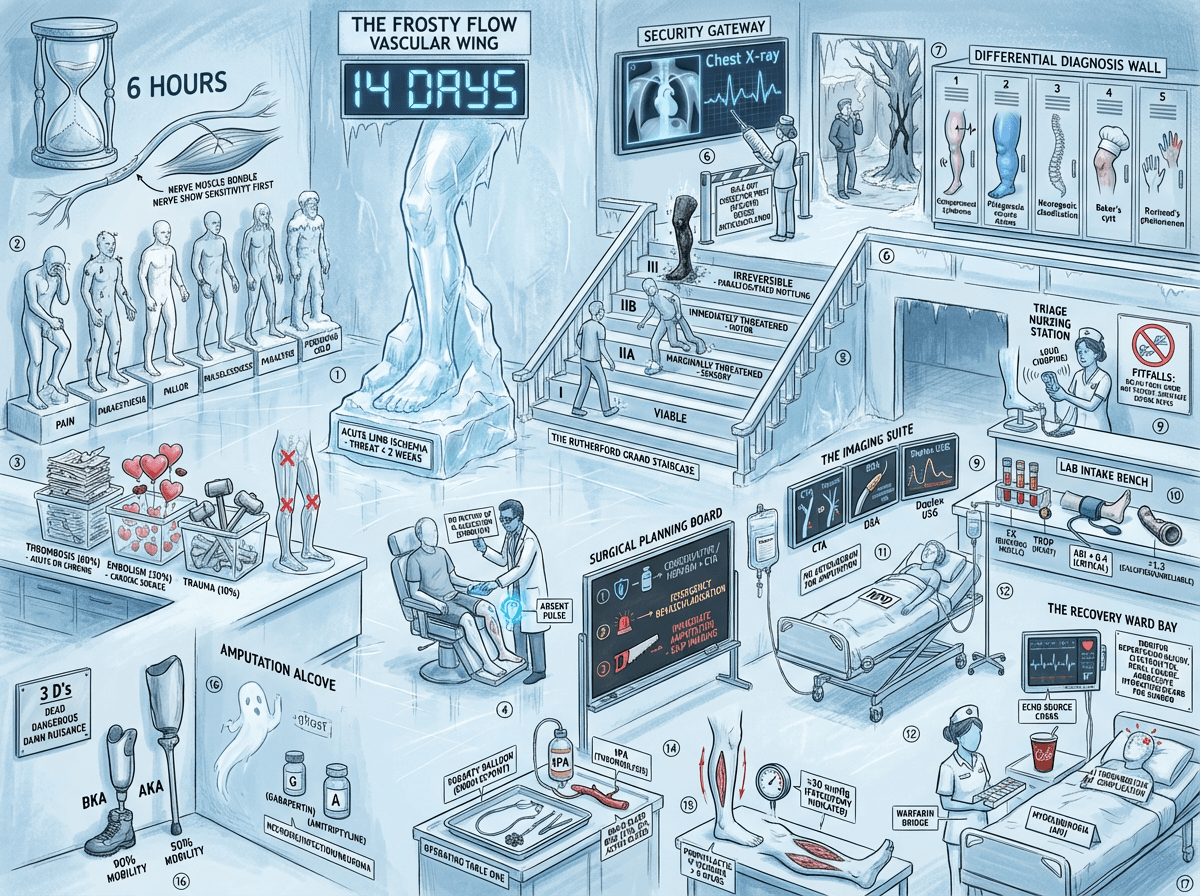
Sketchy memory palace for Acute Limb Ischemia
| No. | Visual Cue | Meaning |
|---|---|---|
| 1 | A translucent ice leg with a digital clock overhead showing '14 Days' counting down; the ice is rapidly advancing. | - Definition: Sudden decrease in limb perfusion threatening viability, presenting within 2 weeks. |
| 2 | Statues showing: 1. Crying (Pain), 2. Ants crawling on skin (Paraesthesia), 3. White marble (Pallor), 4. Broken wrist watch (Pulselessness), 5. Limp strings (Paralysis), 6. Snow coating (Perishing cold). A golden hourglass labeled '6 Hours' shows muscle sand running out. | - 6 P's: Pain → Paraesthesia → Pallor → Pulselessness → Paralysis → Perishing cold (in order of sensitivity to ischemia: nerves first, then muscle). - Time is muscle: Irreversible damage at 6 hours. Paralysis and fixed mottling are late/irreversible signs. |
| 3 | A 60% stack of calcified old papers (Thrombosis/PVD), a 30% heart-shaped floating balloon (Embolism), and a 10% heavy mallet (Trauma). A leg model has red 'X' marks at the thigh split (Femoral bifurcation) and the knee's three-way split (Popliteal trifurcation). | - Etiology: Thrombosis (60%, acute-on-chronic PVD) > Embolism (30%, cardiac 80%) > Trauma (10%). - Emboli lodge at bifurcations: Femoral bifurcation (MC), popliteal trifurcation (2nd MC). |
| 4 | The examiner feels the right pulse (present = embolism) but finds the left pulse missing (absent = thrombosis/PVD). One leg has a 'No history of claudication' sticker. | - Embolism vs Thrombosis: Check contralateral pulses (present = embolism; absent = bilateral PVD/thrombosis), history of claudication (absent = embolism), onset (hyperacute = embolism). - Key bedside differentiator: Are the pulses present? → If yes, it's likely NOT primary ALI. |
| 5 | Step I: Walking man (Viable); Step IIA: Man rubbing numb toes (Marginally threatened); Step IIB: Man dragging a limp leg (Immediately threatened); Step III: A black, crumbling stone leg (Irreversible). | - Rutherford Classification: I (viable) → IIA (marginally threatened) → IIB (immediately threatened) → III (irreversible). Key differentiators: sensory loss, motor deficit, Doppler signals. Category III = primary amputation. - Rutherford classification is done at the bedside using clinical findings + Doppler. It drives the management decision (conservative vs emergency revascularization vs amputation). |
| 6 | A large Chest X-ray and a jagged ECG strip blocking a nurse holding a Heparin syringe. The X-ray shows a 'ripped' aorta silhouette. | - Always rule out aortic dissection before anticoagulation (ECG + CXR). - Aortic dissection — must rule out before anticoagulation; chest/back pain; pulse deficit - ECG + CXR: Rule out AF, MI, and aortic dissection. Must rule out dissection before giving heparin. |
| 7 | A young man smoking; his legs are gnarled like rough 'tree trunk' bark on an angiogram-style silhouette. | - Buerger's disease: Young male smokers, small/medium vessels, "tree trunk" arteriogram, stop smoking is curative. |
| 8 | Locker 1: A tight, swollen balloon with a pulse (Compartment Syndrome); Locker 2: A massive blue swollen leg (Phlegmasia cerulea dolens); Locker 3: A spine model (Neurogenic claudication); Locker 4: A baker's hat on a knee (Baker's cyst); Locker 5: Color-changing fingers (Raynaud's). | - Named differentials of ALI (from senior notes and slides) - Acute extremity compartment syndrome — extrinsic arterial compression; pulses present; tense swelling; pain on passive stretch; mainly clinical diagnosis - Phlegmasia cerulea dolens — massive DVT causing secondary arterial compromise; blue swollen limb (not pale); venous Doppler absent - Other differentials: Neurogenic claudication (spinal stenosis), sciatica, Baker's cyst, musculoskeletal injury, Raynaud's phenomenon. |
| 9 | A nurse holding a handheld Doppler chirping loudly. A poster nearby shows a 'No' sign over a toe being snipped while the thigh is still frozen. | - Common pitfalls (from lecture slides): Mis-diagnosis of claudication, delay recognition of acute ischemia, toe amputation before revascularization, beware of "leg pain", treating the angiogram. - ALI is a clinical diagnosis — confirmed by 6 P's + handheld Doppler. Do not wait for imaging before starting anticoagulation. |
| 10 | Vials labeled: CK (bursting muscle), K+ (banana peel), Trop (heart), and ABG (lemon for acid). An ankle blood pressure cuff reads '0.4' next to a rock-hard calcified pipe reading '>1.3'. | - Urgent bloods: CBC D/C, clotting, LRFT, T&S, CK (rhabdomyolysis), ABG (lactic acidosis), troponin (AMI as embolic source), electrolytes (hyperkalemia). - ABI: Normal 0.9–1.3; Claudication 0.4–0.9; Critical 1.3 = calcified (unreliable, use TBPI). |
| 11 | Monitor 1: CTA showing a 'sharp cut' (embolism) vs 'irregular' with side branches (thrombosis). Monitor 2: Gold-plated DSA catheter (invasive, only for intervention). Monitor 3: Waveform with 3 peaks (triphasic) turning into 1 peak (monophasic). A sign says 'No Arteriogram for Amp'. | - CTA: Primary imaging — localize occlusion, assess run-off, differentiate embolism (sharp cut-off, no collaterals) from thrombosis (irregular, collaterals). Not needed in Rutherford III. - DSA: Gold standard but invasive — indicated ONLY when intervention is planned, NOT for diagnosis. Can be done intra-operatively. - Duplex USG: Normal waveform = triphasic. Abnormal = monophasic/biphasic. Locates obstruction level. - Arteriography NOT needed for amputation — level determined by clinical findings and tissue viability. |
| 12 | An 'NPO' sign, IV fluids, an O2 mask, a Heparin infusion bag, and the foot of the bed tilted downward (dependent). | - Initial management (ALL patients): NPO, IV fluids, monitor vitals + UO, heparin IV bolus + infusion (prevent thrombus propagation, protect collaterals), high-flow O₂, keep foot dependent. Rule out aortic dissection before heparin. |
| 13 | Path 1 (I/IIA): Conservative/Heparin icon. Path 2 (IIB): Emergency siren icon. Path 3 (III): A saw icon with 'Immediate Amputation - Skip Imaging' written in large letters. | - Rutherford I/IIA: Conservative (heparin) + CTA → planned revascularization. Escalate to surgery if failing. - Rutherford IIB: Emergency revascularization. Embolic → Fogarty embolectomy +/- fasciotomy. Thrombotic → IA thrombolysis or bypass. - Rutherford III: Primary amputation. No imaging needed. Delay = infection + rhabdomyolysis + death. - Delays in amputating non-viable limbs → infection, myoglobinuria, AKI, hyperkalemia → death. Rutherford III = amputate promptly. |
| 14 | A Fogarty balloon catheter pulling out a 'clot grape' (Embolectomy). A slow-dripping 'tPA' bottle into a diseased-looking pipe (Thrombolysis) with a 'Brain Bleed' warning label. | - Embolectomy: For emboli, above knee, normal vessel. Fogarty balloon catheter trawls clot out. Intra-op angiography to confirm clearance. - Thrombolysis: For thrombosis, diseased vessel, below knee, I/IIA. tPA via catheter into clot. More gradual reperfusion = less compartment syndrome. C/I: recent CVA, ICH, active bleeding, major surgery. |
| 15 | Two long vertical slices (medial and lateral) on the calf. Inside, a pressure gauge reads '30 mmHg'. A sign says '>6 Hours = Cut'. | - Fasciotomy: Prophylactic if > 6h ischemia. Two incisions (medial + lateral) to decompress all four compartments. - Compartment syndrome (post-revascularization): Ischemia–reperfusion → ROS → capillary leak → interstitial edema → raised intracompartmental pressure > 30 mmHg. Signs: pain out of proportion and on passive stretch, tense swelling, sensory deficit, pulses present. Anterior compartment most commonly affected; posterior compartment most functionally devastating. Management: urgent fasciotomy (medial + lateral). Prophylactic fasciotomy if ischemia > 6 hours. |
| 16 | Three 'D' blocks: Dead, Dangerous, Damn nuisance. A BKA prosthesis with a hiker's boot (90% walk) and an AKA prosthesis with a cane (50% walk). A ghost-shaped limb (Phantom pain) next to pills labeled 'G' and 'A'. | - Amputation: 3D's (Dead, Dangerous, Damn nuisance). BKA most common (90% walk again). AKA if femoral pulse absent (50% walk again). Always revascularize before amputating tissue loss. - Post-amputation: Phantom limb pain (Mx: amitriptyline, gabapentin), stump necrosis, infection, neuroma, fixed flexion deformity. |
| 17 | Monitor showing a heart rhythm (Echo/source check) and high K+. A cup of brown 'Cola' liquid (myoglobinuria). A nurse holds a 'Warfarin Bridge'. A 'Bleeding Brain' icon (thrombolysis complication). | - Post-op: Locate embolic source (echo, Holter), bridge to warfarin/NOAC, monitor for reperfusion injury (K⁺, CK, RFT, UO). - Complications are classified as ischemia-related vs revascularization-related (reperfusion). - The two key complications from the lecture slides: Compartment syndrome and Electrolytes / renal failure . - Rhabdomyolysis: Muscle necrosis releases K⁺ (arrhythmia), myoglobin (AKI by ATN), H⁺ (acidosis). Management: aggressive IV hydration, mannitol diuresis, IV bicarbonate to alkalinize urine, cardiac monitoring, treat hyperkalemia. - Post-thrombolysis: Hemorrhagic stroke, major GI/puncture-site hemorrhage. |
Abdominal Aortic Aneurysm
Abnormal focal dilation of the abdominal aorta exceeding 3 cm in diameter, most commonly infrarenal, resulting from degenerative weakening of the vessel wall and carrying a risk of rupture.
Aortic Dissection
Aortic dissection is a life-threatening condition in which a tear in the aortic intima allows blood to enter and separate the layers of the aortic wall, creating a false lumen.