
Abdominal Aortic Aneurysm
Abnormal focal dilation of the abdominal aorta exceeding 3 cm in diameter, most commonly infrarenal, resulting from degenerative weakening of the vessel wall and carrying a risk of rupture.
| Exam domain | One-glance essentials |
|---|---|
| Definition / diagnosis |
|
| Epidemiology / risks |
|
| Core mechanism |
|
| Clinical picture |
|
| Investigations |
|
| Management |
|
| Complications |
|
| Prevention / follow-up |
|
| Exam traps |
|
References
[1] Lecture slides: GC 199. Pulsating abdominal mass aortic aneurysm.pdf (p1–p4)
Abdominal Aortic Aneurysm (AAA)
1. Definition
Aneurysm — from Greek aneurysma ("a widening") — is defined as a permanent, localised dilatation of an artery that exceeds 50% increase in diameter compared to the expected normal diameter of that vessel [1].
For the abdominal aorta specifically:
- The normal infrarenal aortic diameter is approximately 2.0 cm (range 1.4–2.3 cm depending on sex, body surface area, and age) [2][3].
- Therefore, an abdominal aorta ≥ 3.0 cm is considered aneurysmal (since 3.0 cm is ≥ 50% of the normal ~2.0 cm diameter) [2][3].
- AAA is the most common true arterial aneurysm [2].
| Term | Definition | Why It Matters |
|---|---|---|
| True aneurysm | Wall formed by all 3 layers — tunica intima, media, and adventitia | The wall is structurally intact but weakened and dilated; AAA is a true aneurysm [1][3] |
| Pseudo-aneurysm (false aneurysm) | Wall formed by extravascular connective tissue only (blood contained by adventitia or surrounding tissue, not by all 3 vessel layers) | Results from vessel wall disruption (e.g., trauma, anastomotic leak); technically not a "true" aneurysm [1][3] |
| Anastomotic aneurysm | Pseudo-aneurysm at a surgical suture line (e.g., after graft insertion) | A specific surgical complication [1] |
| Rapidly expanding AAA | Growth > 1.0 cm/year | Indicates high rupture risk → surgical intervention warranted regardless of absolute size [2] |
| Category | Diameter |
|---|---|
| Normal aorta | ~2.0 cm |
| Aneurysmal | ≥ 3.0 cm |
| Small | < 4.0 cm |
| Medium | 4.0 – 5.5 cm |
| Large | > 5.5 cm |
| Very large | ≥ 6.0 cm |
Why 5.5 cm?
The threshold for elective surgical repair is typically 5.5 cm in men (5.0 cm in women) because the annual rupture risk begins to exceed the operative mortality risk at this size. Below this threshold, the natural history risk of rupture is lower than the ~3–5% perioperative mortality of open repair, so surveillance is preferred.
2. Epidemiology
- Prevalence: Population screening studies (men aged 65–74) report prevalence of 4–7% in Western populations. In Hong Kong / Asian populations, prevalence is lower (~1–2%) but is increasing due to ageing, urbanisation, and rising atherosclerotic risk factors [2][3].
- M > F — Male-to-female ratio approximately 9:1 for clinically significant AAA [1][3]. Women develop AAA about a decade later than men on average but have a higher rupture risk at any given diameter.
- Age: Incidence rises sharply after age 60; peak incidence in the 7th–8th decades.
- Ethnic variation: More common in Caucasians than Asians or African Americans; however, when present in non-Caucasian populations, presentation may be later and outcomes worse [2].
- One-time ultrasound screening recommended for:
- Men aged 65–75 who have ever smoked
- Men or women with a first-degree relative with AAA
- Not routinely recommended in women who have never smoked (unless additional risk factors present)
Association with Peripheral Aneurysms
This is a commonly tested association:
- 14% of patients with AAA have a concomitant femoral or popliteal aneurysm [2]
- 62% of patients with a popliteal aneurysm have an associated AAA → screen with abdominal ultrasound [2]
- 82% of patients with a femoral aneurysm have an associated AAA → screen [2]
- Conversely, finding an AAA should prompt examination of the femoral and popliteal arteries.
3. Risk Factors
| Risk Factor | Mechanism |
|---|---|
| Age (elderly) | Cumulative degeneration of elastin and collagen; progressive loss of smooth muscle cells in tunica media |
| Male sex | Hormonal protective effect of oestrogen in premenopausal women (oestrogen inhibits MMP activity); higher smoking rates historically in men |
| Smoking | Strongest modifiable risk factor (OR ~5). Directly promotes MMP-9/MMP-2 activity → elastin degradation; induces oxidative stress and chronic inflammation in the vessel wall; also impairs α1-antitrypsin (a protease inhibitor) |
| Atherosclerosis | 95% associated atherosclerosis [1]. Atherosclerosis weakens media via chronic inflammation, macrophage infiltration, and MMP release; also obliterates vasa vasorum → medial ischaemia |
| Hypertension | Increases wall stress (Law of Laplace: Wall tension = Pressure × Radius / Wall thickness). Higher pressure on an already weakened wall accelerates dilation |
| Family history of AAA | First-degree relative with AAA confers ~2× risk; suggests genetic susceptibility (e.g., polymorphisms in MMP genes, fibrillin, TGF-β pathway) |
| Presence of other large artery aneurysms | Iliac, femoral, popliteal aneurysms → systemic arteriopathy; shared degenerative process |
| Risk Factor | Notes |
|---|---|
| Non-Caucasian females | Lower overall prevalence but still at risk |
| Hyperlipidaemia | Accelerates atherosclerosis |
| Connective tissue disease (Marfan syndrome, Ehlers-Danlos syndrome type IV) | Intrinsic defects in fibrillin-1 (Marfan) or type III collagen (EDS IV) → structurally weak vessel wall from birth [1][3] |
| Mycotic (infective) aneurysm | e.g., non-typhoid Salmonella, Staphylococcus, Syphilis [3]. Infection destroys vessel wall → weakening and dilation. In Hong Kong, Salmonella is a particularly important cause in immunosuppressed patients. |
Diabetes & AAA – A Counter-Intuitive Relationship
Unlike most cardiovascular conditions, diabetes is NOT a risk factor for AAA — in fact, it appears to be inversely associated (protective). The mechanism is incompletely understood but hypotheses include:
- Glycation cross-linking of collagen in the aortic wall → makes the wall stiffer and more resistant to dilation
- Altered MMP expression in diabetic vasculopathy
- Metformin may have anti-inflammatory effects on vessel wall
This is a favourite exam curveball — do not list DM as a risk factor for AAA. [3]
4. Anatomy and Function of the Abdominal Aorta
Understanding the anatomy is critical for classifying aneurysm location, predicting complications, and planning repair.
Gross Anatomy
The abdominal aorta begins as it passes through the aortic hiatus of the diaphragm at the level of T12 and descends retroperitoneally along the left side of the vertebral column until it bifurcates into the common iliac arteries at L4 (roughly at the level of the umbilicus).
| Branch | Level | Structure Supplied |
|---|---|---|
| Inferior phrenic arteries | T12 | Diaphragm |
| Coeliac trunk | T12/L1 | Foregut (stomach, liver, spleen, proximal duodenum) |
| Superior mesenteric artery (SMA) | L1 | Midgut (distal duodenum to splenic flexure) |
| Renal arteries | L1–L2 | Kidneys (most important landmark for AAA classification) |
| Gonadal arteries | L2 | Testes/ovaries |
| Inferior mesenteric artery (IMA) | L3 | Hindgut (splenic flexure to upper rectum) |
| Lumbar arteries | L1–L4 | Posterior abdominal wall, spinal cord (segmental supply) |
| Median sacral artery | L4 | Sacrum, coccyx |
| Common iliac arteries (bifurcation) | L4 | Lower limbs and pelvis |
The aorta is an elastic artery with a thick tunica media containing:
- Concentric elastic lamellae (40–70 layers) interspersed with smooth muscle cells
- Collagen (mainly types I and III) — provides tensile strength
- Elastin — provides recoil and compliance
- Vasa vasorum — small blood vessels supplying the outer media and adventitia (the inner layers are nourished by luminal diffusion)
The infrarenal aorta is particularly vulnerable to aneurysmal degeneration because:
- It has fewer elastic lamellae than the thoracic aorta (28 vs. 60)
- It has fewer vasa vasorum → more susceptible to medial ischaemia
- It experiences reflected pressure waves from the iliac bifurcation that increase wall stress
- It is exposed to high atherosclerotic burden (predilection for atheroma at bifurcations and branch points)
This is why 97% of AAA are infrarenal [1].
| Type | Description |
|---|---|
| Infrarenal AAA | Aneurysm originates below the renal arteries — most common (85–97%) |
| Juxtarenal AAA | Aneurysm originates at the level of the renal arteries, but the aorta at the renal artery ostia is still normal calibre (i.e., there is a "neck" but it's very short or absent) |
| Pararenal AAA | The aneurysm involves the aorta at the level of the renal arteries (the renal arteries arise from the aneurysmal segment) |
| Suprarenal AAA | Aneurysm originates above the renal arteries (may also involve visceral arteries — coeliac trunk, SMA) |
Why Does Location Matter So Much?
- Infrarenal AAA can be repaired with standard infrarenal cross-clamp or endovascular stent-graft (EVAR) because the proximal "neck" of normal aorta below the renal arteries provides a landing zone.
- Juxtarenal / pararenal / suprarenal AAA require suprarenal or supracoeliac cross-clamping during open repair (higher risk of renal ischaemia, visceral ischaemia) or fenestrated / branched endografts — significantly more complex and higher morbidity.
5. Etiology and Pathophysiology
AAA is multi-factorial in aetiology:
| Category | Examples | Notes |
|---|---|---|
| Mechanical | Degeneration, blood pressure (BP) | Haemodynamic stress on a degenerating wall |
| Proteolytic | Enhancement of proteolytic activity — elevated Matrix Metalloproteinases (MMP) | MMP-2 and MMP-9 degrade elastin and collagen in the media |
| Genetic | Marfan syndrome, Ehlers-Danlos type IV | Intrinsic connective tissue defects |
| Autoimmune / inflammatory | Inflammatory AAA (~5% of all AAA) | Dense periaortic fibrosis, elevated ESR/CRP |
| Infective (mycotic) | Non-typhoid Salmonella, Staphylococcus aureus, Treponema pallidum (syphilis) | Bacterial destruction of vessel wall; in Hong Kong, Salmonella and TB are important considerations |
Pathophysiology of Aneurysmal Degeneration [1][2]
The majority (~90%) of AAA are degenerative in origin. The remaining cases are inflammatory (~5%) or idiopathic. The fundamental process is:
Alterations in vascular wall biology → progressive thinning and weakening of aortic wall → enlargement of aortic diameter
- Loss of elastin and smooth muscle cells — the media becomes thin and depleted of its structural elements
- Disruption of extracellular matrix — MMP-mediated degradation of the organised lamellar structure
- Deposition of adventitial collagen and thickening — a compensatory but ultimately insufficient response to wall weakening
- Inflammatory infiltrate — transmural inflammatory changes with macrophages, lymphocytes, and plasma cells (especially prominent in inflammatory AAA)
- Abnormal collagen remodelling and cross-linking [2]
\text\{Wall Tension\} (T) = \frac\{\text\{Pressure\} (P) \times \text\{Radius\} (r)\}\{\text\{Wall Thickness\} (w)\}
- As the aorta dilates (↑ radius) and the wall thins (↓ wall thickness), wall tension increases dramatically
- This increased tension causes further dilation → further increase in tension → positive feedback loop
- This explains why larger aneurysms grow faster and rupture more readily — the relationship between size and rupture risk is exponential, not linear
| AAA Diameter | Annual Rupture Risk |
|---|---|
| < 4.0 cm | 0% |
| 4.0–4.9 cm | 0.5–5% |
| 5.0–5.9 cm | 3–15% |
| 6.0–6.9 cm | 10–20% |
| 7.0–7.9 cm | 20–40% |
| ≥ 8.0 cm | 30–50% |
High Yield: Laplace's Law in AAA
Laplace's Law is the single most important concept for understanding why aneurysms rupture. It explains:
- Why larger aneurysms are more likely to rupture (higher wall tension)
- Why hypertension accelerates rupture (higher transmural pressure)
- Why BP control is critical in surveillance and perioperative management
- Why the growth rate matters — rapid expansion indicates the compensatory mechanisms are failing
- Characterised by a thick, white, glistening periaortic fibrotic rind that adheres to surrounding structures (duodenum, ureters, IVC)
- Patients present with pain, elevated ESR/CRP, and weight loss (mimics malignancy or retroperitoneal fibrosis)
- CT shows a characteristic thickened aortic wall with periaortic soft tissue cuffing that enhances with contrast
- Treatment: open repair or EVAR; the inflammation often resolves after repair. Steroids may be used adjunctively.
- Not due to fungi despite the name — "mycotic" was coined by Osler because the infected aneurysm resembled a fungal growth
- Organisms: Non-typhoid Salmonella (most common in Asia / Hong Kong), Staphylococcus aureus, Treponema pallidum (syphilis — historically important, now rare)
- Mechanism: haematogenous seeding of an atherosclerotic plaque or pre-existing aneurysm → infection destroys media → rapid expansion and high rupture risk
- In Hong Kong context: Salmonella mycotic aneurysm is a well-recognised entity, particularly in elderly or immunocompromised patients. Blood cultures and CT findings (saccular morphology, periaortic gas, irregular wall) are key to diagnosis.
- Treatment: urgent surgery + prolonged IV antibiotics (often lifelong suppression)
6. Classification
| Type | Description | Clinical Significance |
|---|---|---|
| Fusiform | Diffuse, symmetrical dilation involving the entire circumference of the vessel | Most common morphology for degenerative AAA |
| Saccular | Localised outpouching involving only part of the circumference | More commonly associated with mycotic aneurysm, penetrating aortic ulcer, or trauma; higher rupture risk per diameter |
| Type | Wall Composition |
|---|---|
| True aneurysm | All 3 layers (intima, media, adventitia) — as in degenerative AAA |
| Pseudo-aneurysm | Contained rupture — wall formed by fibrous tissue / adventitia only |
| Anastomotic aneurysm | Pseudo-aneurysm at a surgical suture line |
(As detailed in Section 4 above: infrarenal, juxtarenal, pararenal, suprarenal)
| Category | Examples |
|---|---|
| Degenerative (~90%) | Atherosclerotic, age-related |
| Inflammatory (~5%) | Periaortic fibrosis, elevated inflammatory markers |
| Genetic | Marfan syndrome, Ehlers-Danlos type IV, Loeys-Dietz syndrome |
| Infective (mycotic) | Salmonella, Staphylococcus, Syphilis |
| Post-dissection | Chronic false lumen dilation |
| Traumatic | Pseudo-aneurysm after blunt/penetrating injury |
This is explicitly listed on the lecture slides:
- Rupture
- Thrombosis
- Embolism
- Infection
- Pressure effects
7. Clinical Features
Clinical Presentation Overview
The key teaching point: most AAA are asymptomatic (60%) and discovered incidentally on imaging performed for other reasons. Symptomatic AAA (10%) must be considered potentially ruptured until proven otherwise. Ruptured AAA (30%) is a surgical emergency with ~80% mortality if untreated. [3]
7.1 Symptoms
- The aneurysm grows silently over years
- Often discovered incidentally during:
- Abdominal ultrasound or CT for other indications
- Physical examination (palpable pulsatile mass)
- Screening programmes
- May have concomitant peripheral aneurysms — femoral aneurysm (80% have associated AAA) or popliteal aneurysm (50% have associated AAA) [3]
Symptoms arise from the mechanical effects of the expanding aneurysm or its contents:
| Symptom | Pathophysiological Basis |
|---|---|
| Abdominal pain (dull, constant, often in the epigastrium or periumbilical region) | Rapid expansion stretches the aortic wall → stimulates nociceptors in the adventitia and surrounding retroperitoneal structures |
| Back pain (mid-lumbar) | Aneurysm expands posteriorly → compresses or erodes into the vertebral bodies and lumbar spine → somatic pain |
| Flank pain | Lateral expansion of aneurysm compresses retroperitoneal structures (kidney, ureter) or retroperitoneal nerves |
| Pelvic / groin pain | Distal aneurysm near iliac bifurcation irritates lumbar plexus or iliac branches |
| Limb ischaemia | Due to distal embolisation of mural thrombus that accumulates along the aneurysm wall as blood flow becomes turbulent; presents as: |
| — Blue toe syndrome ("trash foot") | Cholesterol crystal or thrombus microemboli occlude small digital arteries → painful, cyanotic toes with palpable pedal pulses (because the large vessels are patent) |
| — Acute limb ischaemia | Large thrombus embolises → occludes major distal artery (femoral, popliteal) → acutely painful, pulseless, cool extremity |
| — Claudication | Chronic low-grade embolisation or thrombus partially occluding iliac arteries → exercise-induced muscle ischaemia |
| Constitutional symptoms | Occur with infected (mycotic) or inflammatory AAA, or rarely with DIC: fever, malaise, weight loss, nausea [2] |
Exam Pearl: Symptomatic AAA = Rule Out Rupture
Any patient with a known or newly discovered AAA presenting with abdominal, back, or flank pain must be assumed to have a ruptured or rapidly expanding AAA until proven otherwise. This is a time-critical surgical emergency — do NOT delay with unnecessary investigations. [3]
The classic triad of ruptured AAA (present in only ~50% of cases):
- Sudden-onset severe abdominal or back pain
- Hypotension / haemodynamic shock
- Pulsatile abdominal mass
The symptom pattern depends on the direction of rupture:
| Direction of Rupture | Symptoms | Explanation |
|---|---|---|
| Posterior wall (most common — retroperitoneal rupture) | Severe focal back / flank pain → may temporarily stabilise as retroperitoneal haematoma becomes contained (tamponade effect) → then pain may subside briefly before catastrophic free rupture [2] | Blood tracks into the retroperitoneum, which is a confined space → allows temporary haemostasis |
| Anterior wall (intraperitoneal rupture) | Abdominal pain that rapidly progresses → free intraperitoneal haemorrhage → haemodynamic instability (faster and more severe than retroperitoneal) [2] | The peritoneal cavity is a large, non-confined space → no tamponade → rapid exsanguination |
| Proximal (near renal arteries) | Back or flank pain [2] | Haemorrhage into the perirenal / pararenal spaces |
| Distal (near iliac bifurcation) | Abdominal or pelvic pain, radiating to groin or thigh [2] | Irritation of lumbar nerve roots (L2–L4) by haematoma |
Other presentations of rupture / fistulae:
| Presentation | Mechanism |
|---|---|
| Aortoenteric fistula | Aneurysm erodes into the duodenum (usually the 3rd / 4th part) → massive GI bleeding (haematemesis, melaena). A "herald bleed" (small initial GI bleed) may precede catastrophic haemorrhage |
| Aortocaval fistula | Aneurysm ruptures into the IVC → massive left-to-right shunt → high-output heart failure, lower limb oedema, continuous abdominal bruit, renal impairment |
| Aorto-ureteric fistula | Erosion into the ureter → haematuria |
Physical Examination Findings [3]
Inspection:
- Patient may appear comfortable (asymptomatic) or in extremis (ruptured)
- Abdominal distension (if large aneurysm or intraperitoneal rupture)
- Look for signs of peripheral embolisation: blue/gangrenous toes, livedo reticularis on feet
Palpation — The Pulsatile, Expansile Mass:
- Pulsatile and expansile mass — usually in the epigastrium [3]
- This is the cardinal sign of AAA on physical examination
Pulsatile vs. Expansile — Know the Difference
- A pulsatile mass simply transmits the pulse of an adjacent artery (e.g., a lymph node overlying the aorta will be pulsatile but not expansile)
- An expansile mass expands outward in all directions with each systole — place both hands on either side of the mass and feel them being pushed apart with each heartbeat
- AAA is both pulsatile AND expansile — this distinguishes it from a transmitted pulsation
Characteristics of the mass [3]:
- Non-tender (if asymptomatic); tender (if expanding or ruptured — tenderness implies imminent or actual rupture)
- Immobile (retroperitoneal, fixed)
- Firm in consistency
- Smooth surface
- Fusiform or saccular shape
- Borders:
- Can get above the upper edge = likely infrarenal (i.e., there's a space between the costal margin and the top of the mass)
- Can get below the lower edge = likely no iliac artery involvement (aneurysm does not extend to the bifurcation)
- If you cannot get below = iliac aneurysm extension should be suspected
- Measure transverse diameter by palpation (place both hands on either side)
Clinical tip: Abdominal palpation has a sensitivity of ~70–80% for AAA > 5 cm but is much less sensitive for smaller aneurysms or in obese patients. A normal examination does NOT exclude AAA.
Additional examination [3]:
- Palpate for other aneurysms: femoral arteries (groin), popliteal arteries (popliteal fossa) — remember the strong associations
- Palpate femoral pulses — may be diminished if thrombus extends to iliac vessels or if aortoiliac disease coexists
- Assess for features of limb ischaemia: skin colour, temperature, capillary refill, presence of ulceration, sensation, motor function (the "6 Ps" — Pain, Pallor, Pulselessness, Paraesthesia, Paralysis, Poikilothermia — more relevant in acute ischaemia)
Auscultation:
- A bruit may be heard over the aneurysm (turbulent flow) — not specific
- In aortocaval fistula: a continuous machinery-like bruit
Signs in Ruptured AAA:
- Haemodynamic instability: tachycardia, hypotension, altered consciousness
- Abdominal distension and tenderness (guarding, rigidity if intraperitoneal)
- Grey Turner's sign (flank bruising) or Cullen's sign (periumbilical bruising) — late signs of retroperitoneal haemorrhage (blood tracking along fascial planes; takes hours to develop, so often absent on initial presentation)
- Cold, mottled lower extremities (hypovolaemic shock → peripheral vasoconstriction)
When you encounter a pulsatile abdominal mass, your structured approach should be:
- Confirm it is truly expansile (both hands pushed apart with systole)
- Determine borders: Can you get above? Can you get below?
- Assess tenderness: Tender = symptomatic = suspect expansion/rupture
- Measure transverse diameter by palpation
- Check all peripheral pulses: radial, femoral, popliteal, dorsalis pedis, posterior tibial
- Look for other aneurysms: femoral and popliteal
- Look for signs of distal embolisation: blue toes, livedo
- Check haemodynamic status: HR, BP (in both arms if aortic dissection is a differential)
- Listen: bruits over aorta, iliac vessels, renal arteries, femoral arteries
8. Important Associations & Red Flags
Think of AAA when you encounter:
- An elderly male smoker with a pulsatile abdominal mass
- Unexplained back pain in an elderly patient with cardiovascular risk factors
- Blue toe syndrome with palpable pedal pulses (think: proximal embolic source)
- New GI bleeding in a patient with a previous aortic graft (aortoenteric fistula until proven otherwise)
- Unexplained hypotension in an elderly patient
Common Misdiagnoses of Ruptured AAA
Ruptured AAA is frequently misdiagnosed as:
- Renal colic (flank pain, haematuria from ureteric compression)
- Musculoskeletal back pain (lumbar pain)
- Acute pancreatitis (epigastric pain radiating to back)
- Perforated peptic ulcer (sudden abdominal pain)
- Acute MI (if vasovagal response causes ECG changes)
- GI bleed (if aortoenteric fistula)
Always check for a pulsatile expansile mass and haemodynamic status in any elderly patient with acute abdominal, back, or flank pain. A missed ruptured AAA is one of the leading causes of medicolegal claims in emergency medicine.
| Feature | Asymptomatic | Symptomatic (Non-Ruptured) | Ruptured |
|---|---|---|---|
| Pain | None | Dull abdominal / back / flank | Sudden, severe, often radiating |
| Haemodynamic status | Stable | Stable (but must exclude rupture!) | Unstable (hypotension, tachycardia) |
| Mass | May be found incidentally | Pulsatile, expansile, may be tender | Pulsatile, expansile, TENDER |
| Limb ischaemia | Possible (emboli) | More likely (emboli / thrombosis) | May be present (shock → poor perfusion) |
| Constitutional Sx | No (unless inflammatory) | Possible (if infected / inflammatory) | Possible |
| Management urgency | Elective | Urgent | Emergency |
High Yield Summary
- AAA = permanent, localised dilation of abdominal aorta ≥ 3 cm (≥ 50% of normal ~2 cm diameter); the most common true arterial aneurysm.
- 97% are infrarenal due to fewer elastic lamellae, fewer vasa vasorum, and reflected pressure waves at the iliac bifurcation.
- 95% associated with atherosclerosis; M > F (9:1); risk increases with age, smoking (strongest modifiable RF), HT, FHx, and connective tissue diseases.
- Diabetes is NOT a risk factor (inversely associated — collagen cross-linking protects wall).
- Pathology: loss of elastin and smooth muscle cells, disruption of ECM, elevated MMPs, adventitial collagen deposition, inflammatory infiltrate.
- Laplace's Law explains the positive feedback loop: as radius increases and wall thins, tension rises → more dilation → more tension → rupture.
- Most are asymptomatic (60%); symptomatic AAA (10%) presents with abdominal/back/flank pain or limb ischaemia from embolisation; ruptured AAA (30%) presents with the classic triad of sudden pain + hypotension + pulsatile mass.
- The cardinal sign is a pulsatile, expansile mass in the epigastrium; always check for peripheral aneurysms (femoral 82% associated AAA, popliteal 62%).
- Complications of aneurysms: rupture, thrombosis, embolism, infection, pressure effects.
- Ruptured AAA has ~80% overall mortality; retroperitoneal rupture may be temporarily contained → diagnostic window; intraperitoneal rupture causes rapid exsanguination.
- Always suspect ruptured AAA in elderly patients with acute abdominal/back pain and haemodynamic instability — do not delay for investigations.
Active Recall - AAA Definition, Epidemiology, Risk Factors, Anatomy, Pathophysiology and Clinical Features
Differential Diagnosis of Abdominal Aortic Aneurysm (AAA)
The challenge with AAA is that its presentations — epigastric/periumbilical pain, back pain, flank pain, haemodynamic collapse — are non-specific and overlap with many other abdominal and retroperitoneal emergencies. Getting the differential wrong can be fatal: a missed ruptured AAA has an overall mortality > 80% [1][3]. Conversely, taking a patient to emergency laparotomy for suspected ruptured AAA when they actually have acute pancreatitis carries its own morbidity. Your job is to systematically work through the differentials, anchored by the clinical context.
Let's think about this from first principles. AAA and its mimics share pain in similar territories because:
- The aorta is a midline retroperitoneal structure → pain from it is referred to the epigastrium, periumbilical region, back, and flanks via visceral afferents (T10–L2 dermatomes)
- Rupture produces haemorrhagic shock → the differential includes any cause of acute intra-abdominal haemorrhage
- Limb ischaemia from emboli can mimic primary peripheral arterial disease or cardiac embolism
I've organised the differentials by clinical presentation (the way you'd actually encounter them), since the differential changes depending on whether you're dealing with an incidental pulsatile mass, acute abdominal/back pain, or haemodynamic collapse.
A. Differentials for the Symptomatic (Non-Ruptured) AAA Presentation
These are conditions that mimic AAA pain — epigastric, periumbilical, back, or flank pain in an elderly patient with cardiovascular risk factors.
| Feature | AAA | Aortic Dissection |
|---|---|---|
| Pain character | Dull, constant, gradually worsening | Sharp, tearing, knife-like, maximal at onset |
| Pain location | Epigastric / back / flank | Anterior chest (Type A) or back/abdomen (Type B) |
| Pulse deficit | Rare (unless embolisation) | Common — weak or absent carotid, brachial, or femoral pulse |
| BP discrepancy | Usually not present | Inter-arm BP difference > 20 mmHg |
| Murmur | Not characteristic | Early diastolic decrescendo murmur (aortic regurgitation) in Type A |
| Imaging | Dilated aorta with mural thrombus | Intimal flap with true and false lumen on CTA |
Why the confusion? Both are aortic pathologies, both present with acute pain, and a pre-existing AAA is itself a risk factor for dissection. Type B dissection (descending aorta) presents with back/abdominal pain that closely mimics symptomatic AAA. The key differentiator is the character of pain (sudden-onset tearing vs. dull and constant) and pulse deficits [4].
Teaching point: Aortic dissection creates a false lumen by splitting the media; AAA dilates all three layers. They can coexist — chronic dissection can lead to aneurysmal dilation of the false lumen.
- An atherosclerotic ulcer that penetrates through the intima into the media
- Presents with acute aortic pain (back, chest) in an elderly patient with extensive atherosclerosis
- Can progress to intramural haematoma, dissection, or frank rupture
- On CTA: focal ulcer crater with adjacent subadventitial haematoma, usually in a heavily calcified and atheromatous aorta
- Why it's a differential: The pain quality and patient demographics are nearly identical to symptomatic AAA. Imaging is essential to differentiate.
| Feature | AAA | Acute Pancreatitis |
|---|---|---|
| Pain location | Epigastric / periumbilical / back | Epigastric, radiating to back |
| Relieving factor | None characteristic | Leaning forward |
| Biochemistry | Normal amylase/lipase | Amylase or lipase ≥ 3× upper limit of normal |
| Risk factors | Smoking, HT, male | Gallstones, alcohol, hypertriglyceridaemia |
| Ecchymosis | Grey-Turner / Cullen (if ruptured) | Grey-Turner / Cullen (in necrotising pancreatitis) |
Why the confusion? Both are retroperitoneal pathologies → both cause epigastric pain radiating to the back, and both can produce Grey-Turner and Cullen signs from retroperitoneal haemorrhage [2][6]. The distinguishing features are serum lipase/amylase (elevated in pancreatitis, normal in AAA) and imaging (CT shows dilated aorta in AAA vs. inflamed/necrotic pancreas in pancreatitis).
Ecchymosis — Not Pathognomonic for Any Single Condition
Grey-Turner sign (flank), Cullen sign (periumbilical), Fox sign (proximal thigh), and Bryant sign (scrotal discolouration) indicate retroperitoneal haemorrhage from any cause [2]:
- Ruptured AAA
- Necrotising pancreatitis
- Ruptured ectopic pregnancy
- Ruptured HCC
- Perinephric haematoma
Do not assume these signs automatically mean ruptured AAA.
- Inferior MI in particular can present with epigastric pain, nausea, and diaphoresis — closely mimicking abdominal pathology
- Conversely, ruptured AAA can cause a vasovagal response with ECG changes, leading to a misdiagnosis of MI
- Key differentiator: ECG changes (ST elevation/depression), troponin elevation; abdominal examination and imaging distinguish the two
- Why it's a critical differential: Both conditions can present with hypotension and shock; however, rushing to the cath lab for a suspected MI when the patient actually has a ruptured AAA is a fatal error
Ruptured AAA or aortic dissection should be considered in any patient presenting with tearing pain at epigastrium radiating to the back with shock [5].
- Colicky flank pain radiating to the groin — very similar to distal AAA expansion or retroperitoneal rupture irritating the lumbar plexus
- Key differentiators: microscopic haematuria on urinalysis; non-contrast CT KUB shows calculus but no aortic dilation
- Beware: AAA can compress the ureter → hydronephrosis and even frank haematuria (aorto-ureteric fistula), further muddying the picture
- Rule of thumb: Any elderly male with "first-episode renal colic" and cardiovascular risk factors should have an urgent abdominal USS or CT to exclude AAA before being discharged with analgesics
- Perforated peptic ulcer (PPU) or perforated diverticulum can cause sudden-onset severe abdominal pain with peritonism
- AAA rarely causes peritoneal signs unless there is anterior (intraperitoneal) rupture
- Differentiators: erect CXR shows pneumoperitoneum (free air under diaphragm) in perforation but NOT in AAA; CT confirms the diagnosis
- Acute mesenteric ischaemia presents with severe abdominal pain "out of proportion to examination findings" — similar to early ruptured AAA
- Both occur in elderly patients with atherosclerotic risk factors
- Differentiators: mesenteric ischaemia often has prominent GI symptoms (bloody diarrhoea, vomiting); CT angiography shows SMA/IMA occlusion vs. aneurysmal aorta
- Note: AAA itself can cause mesenteric ischaemia if thrombus embolises to mesenteric vessels
- Presents with colicky abdominal pain, distension, vomiting, and constipation
- Large AAA can rarely cause duodenal obstruction by extrinsic compression (aortoduodenal syndrome), creating genuine diagnostic overlap
- Differentiators: plain AXR shows dilated loops and air-fluid levels; CT confirms obstruction vs. aneurysm
- AAA is listed as a non-spinal cause of back pain in the lumbar spine differential [8]
- Degenerative disc disease, disc herniation, spondylolisthesis, and vertebral fractures are far more common causes of chronic back pain
- Key differentiators: AAA pain is typically deep, dull, pulsatile, not positional, and associated with cardiovascular risk factors; musculoskeletal pain is usually positional, reproducible with movement/palpation, and has no vascular signs
- Pearl: Always palpate the abdomen in an elderly patient presenting with "back pain" — if you feel an expansile pulsatile mass, the diagnosis changes entirely
When the patient presents with the triad: pain (abdomen/back), pulsatile mass (may be masked), shock (transient/profound) [1], the differential narrows to causes of acute intra-abdominal haemorrhage or catastrophic abdominal emergencies.
Life-threatening differentials of acute abdomen [6]:
| Differential | Key Distinguishing Features | Why It Mimics Ruptured AAA |
|---|---|---|
| Ruptured HCC | History of chronic liver disease / HBV / HCC; USS/CT shows liver mass with haemoperitoneum; AFP often elevated | Both cause acute intraperitoneal haemorrhage with shock in an elderly population; very important differential in Hong Kong (high HBV prevalence) [3] |
| Ruptured ectopic pregnancy | Reproductive-age female; positive β-hCG; transvaginal USS shows adnexal mass / free fluid | Both cause acute haemoperitoneum with shock; the demographics are completely different (young female vs. elderly male), making this a "cannot miss" but usually distinguishable [3] |
| Perforated peptic ulcer (PPU) | Sudden-onset epigastric pain; board-like rigidity (chemical peritonitis); erect CXR: pneumoperitoneum | Both cause sudden severe epigastric pain; PPU has peritonism earlier and pneumoperitoneum on CXR |
| Severe acute pancreatitis | Epigastric pain radiating to back; lipase/amylase markedly elevated; CT shows pancreatic necrosis | Both retroperitoneal, both cause back pain and Grey-Turner/Cullen signs [6] |
| Acute mesenteric ischaemia | Pain out of proportion to findings; metabolic acidosis, raised lactate; CT angiography shows mesenteric vessel occlusion | Both cause severe abdominal pain and haemodynamic instability in atherosclerotic patients [6] |
| Aortic dissection with rupture | Tearing pain, pulse deficit, inter-arm BP discrepancy; CTA shows intimal flap | Same vessel, similar demographics; often coexist |
C. Differentials for Specific AAA-Related Presentations
Must differentiate from other sources of peripheral embolism [9]:
| Source | Mechanism |
|---|---|
| AAA mural thrombus | Cholesterol/thrombus microemboli from aneurysm wall |
| Atrial fibrillation | Cardiac thrombus → arterial embolism (usually larger territory) |
| Acute MI with mural thrombus | LV thrombus post-MI → systemic embolism |
| Valvular heart disease / prosthesis | Thrombus on abnormal/prosthetic valve |
| Atherosclerotic plaque in aorta | Ulcerated plaque → cholesterol crystal emboli (also called "cholesterol embolisation syndrome") |
| Thoracic aortic aneurysm | Same mechanism as AAA but more proximal source |
Acute limb ischaemia + chest pain should raise suspicion for MI (mural thrombus / new-onset AF) or aortic dissection [9].
- Classic triad: upper GI bleeding, fever, abdominal pain in a patient with a previous aortic graft [3]
- The 3rd or 4th portion of the duodenum is the most common site [10]
- Must be differentiated from peptic ulcer bleeding, variceal bleeding, or other causes of UGIB
- A "herald bleed" (small, self-limiting GI bleed) often precedes the catastrophic haemorrhage by hours to days — this is your diagnostic window
The 'Do Not Forget' List for Acute Abdominal Pain
From the lecture slides [5], always consider these easily missed diagnoses in acute abdominal pain:
- Hernia (inguinal or femoral) — strangulated hernia can cause bowel ischaemia and shock
- Ruptured AAA or aortic dissection — tearing pain at epigastrium radiates to the back; shock
- Herpes zoster — dermatomal hyperaesthesia; vesicular eruption (pain precedes rash by days → can be mistaken for visceral pain)
- Pancreatitis
- Retention of urine
- Non-specific abdominal pain
These are the diagnoses that get missed because clinicians fixate on the "usual suspects" (appendicitis, cholecystitis, etc.).
Since ruptured AAA can present with periumbilical pain, it is specifically listed as a differential for central/periumbilical abdominal pain alongside [5]:
- Small bowel obstruction
- Gastroenteritis
- Early acute appendicitis
- Bowel ischaemia
- Irritable bowel syndrome
- Acute pancreatitis
And for diffuse/non-specific abdominal pain, ruptured AAA is listed among the life-threatening differentials [6]:
- Perforated viscus (e.g., PPU)
- Ruptured AAA
- Acute mesenteric ischaemia
- Acute intestinal obstruction
- Severe pancreatitis
- Ruptured HCC
- Medical conditions: DKA, acute MI, Addisonian crisis
- Obstetric: ruptured ectopic pregnancy, placental abruption
| Feature | Points Toward AAA | Points Away from AAA |
|---|---|---|
| Demographics | Elderly male, smoker, cardiovascular RF | Young, female, no RF |
| Pulsatile expansile mass | Pathognomonic | Absent (but may be masked by obesity or hypotension) |
| Pain character | Deep, dull, constant | Colicky (suggests obstruction/colic), sharp tearing (dissection), positional (musculoskeletal) |
| Lipase / amylase | Normal | Elevated ≥ 3× ULN → pancreatitis |
| Urinalysis | Usually normal (unless aorto-ureteric fistula) | Haematuria → renal stone / ureteric colic |
| ECG / Troponin | Usually normal | ST changes + troponin ↑ → MI |
| Erect CXR | No pneumoperitoneum | Free air → perforated viscus |
| CT abdomen | Dilated aorta ± retroperitoneal haematoma | Normal aorta |
| β-hCG | Not applicable | Positive → ectopic pregnancy |
| Liver history | Not relevant | HBV/cirrhosis/known HCC → ruptured HCC |
High Yield Summary — Differential Diagnosis of AAA
- Symptomatic AAA differentials: aortic dissection, ulcerated aortic plaque, acute pancreatitis, acute peritonitis, acute MI [2] — and also renal colic, mesenteric ischaemia, intestinal obstruction, musculoskeletal back pain.
- Ruptured AAA differentials: ruptured HCC, ruptured ectopic pregnancy [3] — plus perforated viscus, severe pancreatitis, acute mesenteric ischaemia, ruptured aortic dissection.
- Classic ruptured AAA triad = pain (abdomen/back) + pulsatile mass (may be masked) + shock (transient/profound) [1]. Present in only ~50% of cases.
- AAA is a listed differential for periumbilical pain and non-spinal back pain — always palpate the abdomen in elderly patients with back pain [5][8].
- Grey-Turner / Cullen signs are shared by ruptured AAA, pancreatitis, ruptured ectopic pregnancy, and ruptured HCC — they indicate retroperitoneal/intraperitoneal haemorrhage, not a specific diagnosis [2].
- In Hong Kong, ruptured HCC is a particularly important differential due to high HBV prevalence [3].
- Aortoenteric fistula presents with UGIB + fever + abdominal pain in patients with prior aortic graft — must be suspected until excluded [3][10].
Active Recall - Differential Diagnosis of AAA
References
[1] Lecture slides: GC 199. Pulsating abdominal mass aortic aneurysm.pdf (p5, p20) [2] Senior notes: felixlai.md ([felix:1334]) [3] Senior notes: maxim.md ([maxim:347], [maxim:348]) [4] Senior notes: felixlai.md ([felix:1323], [felix:1327], [felix:1328]) [5] Lecture slides: GC 195. Lower and diffuse abdominal pain RLQ problems; pelvic inflammatory disease; peritonitis and abdominal emergencies.pdf (p7, p44) [6] Senior notes: maxim.md ([maxim:85], [maxim:86]) [7] Senior notes: felixlai.md ([felix:1158]) [8] Lecture slides: GC 226. Lumbar Spine Pathology_Part E (2).pdf (p2) [9] Senior notes: maxim.md ([maxim:357]) [10] Senior notes: felixlai.md ([felix:500])
Diagnosis of Abdominal Aortic Aneurysm (AAA)
Before diving into individual tests, let's understand what we need from our investigations and why:
- Confirm the diagnosis: Is there truly an aneurysm (aorta ≥ 3 cm)?
- Determine the size: This dictates surveillance interval vs. surgical intervention (threshold ~5 cm [1][11])
- Define the anatomy: Where is the aneurysm (infrarenal vs. juxta/para/suprarenal)? What is the proximal "neck" length? Is there iliac involvement? — This determines suitability for open repair vs. EVAR [11][3]
- Assess for complications: Is there rupture? Mural thrombus? Distal embolisation? Inflammatory changes? Fistula formation?
- Evaluate fitness for surgery: Cardiac assessment is critical because major operative mortality = myocardial infarction [1]
- Screen for associated aneurysms: Femoral, popliteal
The investigation you choose depends entirely on the clinical scenario — an asymptomatic patient found incidentally needs a different workup than a haemodynamically unstable patient with suspected rupture.
AAA does not have formal diagnostic criteria in the way that, say, acute pancreatitis has the Revised Atlanta criteria. Rather, the diagnosis is defined by measurement:
AAA is diagnosed when the maximum transverse diameter of the abdominal aorta is ≥ 3.0 cm (i.e., ≥ 50% increase over the normal ~2.0 cm diameter) [1][2].
The clinical diagnosis is supported by:
- Physical examination: pulsatile, expansile mass above the umbilicus
- Confirmed by imaging: ultrasound (screening/surveillance) or CT angiography (preoperative/acute setting)
For ruptured AAA, the diagnosis is clinical:
- The TRIAD of Rupture: Pain (abdomen/back), Mass (pulsatile — may be masked), Shock (transient/profound) [1]
- In a haemodynamically unstable patient with this triad → immediate diagnosis → operation — no further imaging needed [1][3]
- In a haemodynamically stable patient with suspected rupture → CT abdomen with contrast to confirm and plan repair [3]
Key Principle: Do NOT Delay for Imaging in Unstable Patients
USG cannot diagnose ruptured AAA [3] — it can confirm the presence of an aneurysm but cannot reliably detect retroperitoneal haemorrhage. In a haemodynamically unstable patient with clinical triad of rupture, imaging wastes precious time. Proceed directly to the operating theatre. A FAST scan may be performed rapidly at the bedside to detect free intraperitoneal fluid (if anterior rupture), but a negative FAST does not exclude retroperitoneal rupture [2][3].
Investigation Modalities — Detailed Breakdown
This is your first-line "investigation" and often the one that triggers the entire diagnostic pathway.
AAA: Physical Examination [1]:
| Component | What to Assess | Key Findings |
|---|---|---|
| Confirm AAA | Mass above umbilicus with expansile pulsation | Pulsatile AND expansile = AAA; pulsatile only = transmitted pulsation from overlying structure |
| Extent of AAA | Size (transverse diameter by palpation), Upper border (can you get above it? → infrarenal), Lower border (can you get below it? → no iliac involvement) | Defines approximate anatomy before imaging |
| Cardiovascular | Pulses (radial, femoral, popliteal, pedal), Heart (rhythm, murmurs), BP | Detects associated atherosclerotic disease, AF (embolic risk), aortic valve disease |
| Peripheral aneurysms | Palpate femoral and popliteal arteries | 20% of AAA have associated aneurysms [1] |
| Distal embolisation | Blue toes, livedo reticularis, cool extremities | Suggests mural thrombus with embolisation |
Sensitivity caveat: Abdominal palpation has ~70–80% sensitivity for AAA > 5 cm but is much less reliable in obese patients or for smaller aneurysms. A normal examination does NOT exclude AAA → always confirm with imaging if clinical suspicion exists.
Laboratory tests do not diagnose AAA but are essential for assessing the patient's baseline status, detecting complications, and preparing for surgery.
| Test | Key Findings in AAA | Pathophysiological Basis |
|---|---|---|
| CBC with differentials | Anaemia (hypochromic microcytic) | Acute blood loss from rupture → decreased Hb; initially may be normal due to haemodilution lag |
| Leukocytosis | Infected or inflamed aneurysm; stress response in rupture | |
| Clotting profile (PT, APTT, TT, fibrinogen, D-dimer) | Prolonged PT, APTT, TT; ↓ platelet count; ↓ fibrinogen; ↑ D-dimers | DIC — large aneurysms have a turbulent, slow-flow environment that activates the coagulation cascade within the sac → consumption of clotting factors and platelets → consumptive coagulopathy. D-dimers ↑ because of ongoing clot formation and fibrinolysis [2] |
| Inflammatory markers (ESR, CRP) | ↑ ESR and CRP | Elevated in infected or inflammatory AAA; normal in uncomplicated degenerative AAA [2] |
| Renal function tests (Cr, urea, eGFR) | May be elevated | Baseline for contrast administration; suprarenal/pararenal AAA may compromise renal arteries; post-rupture AKI from hypoperfusion |
| Liver function tests | Baseline | Pre-operative assessment; also to detect coagulopathy of liver disease |
| Arterial blood gas (ABG) | Metabolic acidosis | Acute blood loss leading to shock → tissue hypoperfusion → anaerobic metabolism → lactic acidosis [2] |
| Group and cross-match | — | Essential pre-operatively; in rupture, request massive transfusion protocol (packed cells : platelets : FFP = 1:1:1) [3] |
| ECG | Baseline; rule out concurrent MI | Major operative mortality = myocardial infarction [1] — must identify pre-existing ischaemic heart disease |
| Cardiac enzymes (Troponin) | Rule out acute MI as differential | Elderly patients with shock may have demand ischaemia |
DIC in AAA — Why?
You might wonder: why would an aneurysm cause DIC? The answer lies in the haemodynamics. Inside a large aneurysm, blood flow becomes turbulent and slow (the dilated segment acts like a stagnant pool). This activates the intrinsic coagulation pathway on the thrombus-lined wall → consumption of clotting factors and platelets → chronic low-grade DIC. This is why you see ↑ D-dimers and prolonged clotting times in patients with large AAA even before rupture. Frank DIC becomes clinically significant primarily with very large aneurysms or post-rupture.
C. Radiological Investigations
- Role: Not a primary diagnostic tool but may be the first clue when AAA is discovered incidentally
- Key finding: Calcification of the aortic wall — seen as curvilinear calcification outlining the aortic wall on AP or lateral views [1][3]
- "Plain X-ray calcifications" [1]
- Limitations:
- Only ~50–75% of AAA have enough wall calcification to be visible on XR
- Cannot measure true aortic diameter (calcification is in the wall, not the lumen)
- Cannot detect rupture
- Cannot assess intramural thrombus
- When you see it: An elderly patient gets an AXR for non-specific abdominal complaints → you notice curvilinear calcification in the mid-abdomen → suspect AAA → confirm with USS
This is the workhorse investigation for AAA — think of it as the stethoscope of AAA diagnosis.
| Feature | Details |
|---|---|
| Role | Initial diagnostic modality in asymptomatic patients suspected of AAA; screening tool; surveillance of known small/medium AAA [2][3] |
| Advantages | Non-invasive, inexpensive, no radiation, no contrast, high sensitivity (95%) and specificity (99%) for detecting AAA and measuring diameter, portable (bedside) |
| What it shows | Transverse and AP diameter of the aorta; presence of mural thrombus; proximal/distal extent; associated iliac aneurysms |
| Preparation | Fasting required to reduce overlying bowel gas that obscures the aorta [2] |
| Limitations | USG cannot diagnose ruptured AAA [3] — it cannot reliably detect retroperitoneal haemorrhage; operator-dependent; limited by obesity and bowel gas; does not show relationship to renal/visceral arteries well enough for surgical planning |
Surveillance intervals [3]:
| AAA Size | Surveillance Frequency |
|---|---|
| 3.0–3.9 cm | Yearly USG |
| 4.0–5.4 cm | USG every 6 months |
| ≥ 5.5 cm or rapidly expanding | Proceed to CTA for surgical planning |
FAST scan (Focused Assessment with Sonography in Trauma):
- Indicated in haemodynamically unstable patients [2][3]
- Can rapidly detect free intraperitoneal fluid (suggesting anterior rupture) at the bedside
- A FAST showing a large aorta + free fluid + hypotension = go to OT immediately
- But: most AAA rupture posteriorly (retroperitoneal) → FAST may be negative even with rupture → clinical decision must override negative FAST
AAA: Ultrasound is explicitly highlighted on the lecture slides as a key diagnostic test [1].
The gold standard for defining AAA anatomy and planning intervention. Think of CTA as the "architectural blueprint" that the surgeon needs.
| Feature | Details |
|---|---|
| Role | Indicated in symptomatic patients with suspected AAA [2]; preoperative assessment of anatomy for suitability for EVAR vs. open repair [3]; diagnosis and characterisation of ruptured AAA in stable patients |
| What it shows | Precise diameter measurement; relationship to renal arteries (crucial for classifying infrarenal vs. juxtarenal/pararenal/suprarenal); proximal neck length and angulation; iliac artery involvement; mural thrombus; retroperitoneal haematoma (if ruptured); inflammatory changes; fistulae; variant anatomy |
| Protocol | Non-contrast phase (for calcification) + arterial phase (for lumen and branch vessels) + delayed phase (for endoleak assessment post-EVAR) |
| Advantages | High spatial resolution; rapid acquisition (seconds); widely available; excellent for surgical planning |
| Limitations | Radiation exposure; IV contrast (risk of contrast-induced nephropathy — especially important given the elderly population with potential baseline renal impairment); skip if haemodynamically unstable [3] |
Key CT findings in different scenarios:
| Scenario | CT Findings |
|---|---|
| Intact AAA | Dilated aorta with mural thrombus; patent lumen may appear much smaller than outer diameter (why CTA/MRA/DSA are not for size measurement due to intramural thrombus [3] — they show the lumen, not the full extent); calcified wall |
| Ruptured AAA | Dilated aorta + retroperitoneal haematoma (high-attenuation stranding/collection adjacent to aorta); ± active contrast extravasation ("blush"); ± haemoperitoneum (if anterior rupture) |
| Inflammatory AAA | Thickened aortic wall with periaortic soft tissue cuffing that enhances with contrast; may encase ureters/duodenum |
| Mycotic AAA | Saccular morphology; periaortic gas (suggestive of infection); irregular wall; periaortic fluid |
| Aortoenteric fistula | Loss of fat plane between aorta/graft and duodenum; periaortic gas; contrast extravasation into bowel lumen |
CT Scan — the lecture slides show multiple examples of CT images demonstrating AAA, including suprarenal aneurysm, iliac aneurysms, and mural thrombus [1].
Why Not Use CTA/DSA for Size Surveillance?
This is a common point of confusion. CTA, MRA, and DSA show the patent lumen of the aorta — the channel through which contrast flows. But AAA almost always contains mural thrombus lining the inner wall. This means the patent lumen can appear much smaller than the true outer-to-outer diameter of the aneurysm. USS measures the true outer wall diameter and is therefore the correct modality for surveillance. CTA is used preoperatively because it provides anatomical detail (not just size) — the relationship to branch vessels, neck morphology, access vessel calibre, etc. [3]
| Feature | Details |
|---|---|
| Role | Comparable to CT for anatomical assessment [2]; alternative when CTA is contraindicated |
| Advantages | No ionising radiation; no iodinated contrast (uses gadolinium instead — but beware nephrogenic systemic fibrosis in severe renal impairment); excellent soft tissue contrast |
| Limitations | Longer acquisition time (not suitable for emergencies); claustrophobia; contraindicated with certain metallic implants (pacemakers, etc.); less available; more expensive; overestimates stenosis |
| When to use | Patients with IV contrast contraindications (e.g., severe iodinated contrast allergy, severe renal impairment where iodinated contrast must be avoided) [2]; young patients requiring serial imaging (to reduce cumulative radiation) |
- Historically the gold standard; now largely replaced by CTA
- Shows the lumen only (not the wall or thrombus) → not suitable for measuring AAA size [3]
- Still occasionally used intraoperatively or for simultaneous endovascular intervention
- Useful for delineating branch vessel anatomy when CTA is equivocal
- Calcification of aortic wall may be seen incidentally [1][3]
- An "egg-shell" pattern of curvilinear calcification in the mid-abdomen on an AP film suggests AAA
- On a lateral AXR, you can sometimes estimate the AP diameter from the calcification
- Not a diagnostic investigation per se, but an important incidental finding that should trigger USS
The lecture slides explicitly list the AAA: Pre-Operative Preparation requirements [1]:
| Category | Components | Rationale |
|---|---|---|
| General | Blood tests, ECG, CXR | Baseline assessment; detect anaemia, coagulopathy, renal impairment; CXR for cardiopulmonary status |
| Cardiac | Cardiac assessment / intervention | Major operative mortality = myocardial infarction [1]; patients with significant coronary artery disease may need coronary revascularisation (PCI/CABG) before elective AAA repair |
| Preparations | Monitors, blood (cross-matched and available) | Major surgery with potential for massive haemorrhage; ICU bed must be arranged |
Detailed cardiac workup may include:
- Resting ECG: baseline rhythm, ischaemic changes
- Transthoracic echocardiogram: LV function (EF), valvular disease, regional wall motion abnormalities
- Cardiopulmonary exercise testing (CPET): objective assessment of functional capacity — helps risk-stratify (anaerobic threshold < 11 mL/kg/min = high risk)
- Dobutamine stress echocardiography or myocardial perfusion scan: if unable to exercise, to detect inducible ischaemia
- Coronary angiography ± PCI/CABG: if significant inducible ischaemia detected
Why so much cardiac workup? Elective open AAA repair involves aortic cross-clamping, which causes:
- Sudden ↑ afterload (blood can no longer flow into the distal aorta) → ↑ LV wall stress → risk of myocardial ischaemia
- Sudden ↓ afterload on unclamping → peripheral vasodilation + reperfusion → risk of hypotension and arrhythmia
- These haemodynamic swings are lethal in a patient with unrecognised severe coronary disease
AAA Screening in Men over 65 is specifically covered in the lecture slides [1]:
- The Multicenter Aneurysm Study (MASS), Lancet 2002 demonstrated that AAA screening reduces mortality in men — specifically, a one-time USS screening in men aged 65–74 reduced AAA-related mortality by ~42% over 4 years [1]
- Screening is cost-effective because it identifies asymptomatic AAA → enables elective repair (mortality 3–5%) rather than emergency repair for rupture (mortality > 50%) [1]
- Lindholdt 2008 further confirmed the mortality benefit of screening [1]
Current screening recommendations:
| Population | Recommendation |
|---|---|
| Men aged 65–75 who have ever smoked | One-time USS screening |
| Men or women with first-degree relative with AAA | One-time USS screening |
| Women who have never smoked, no FHx | Not routinely recommended |
| Scenario | Primary Investigation | Rationale |
|---|---|---|
| Screening / Incidental | Abdominal USS | Non-invasive, accurate for diameter, cheap, no radiation |
| Surveillance of known AAA | Serial USS (yearly or 6-monthly depending on size) | Track growth rate; no radiation burden for repeated scans |
| Symptomatic AAA (stable) | CTA | Defines anatomy, detects impending rupture, guides surgical planning |
| Suspected ruptured AAA (stable) | CTA | Confirms rupture, localises haematoma, assesses EVAR suitability |
| Suspected ruptured AAA (unstable) | Bedside FAST ± clinical diagnosis → straight to OT | Skip CT if haemodynamically unstable [3]; delay = death |
| Pre-operative planning for elective repair | CTA (or MRA if contrast contraindicated) | Detailed anatomy for open vs. EVAR decision |
| Post-EVAR surveillance | CTA (or contrast-enhanced USS) | Detect endoleaks, graft migration, continued sac expansion |
High Yield Summary — Diagnosis of AAA
- AAA is defined by aortic diameter ≥ 3 cm; diagnosed definitively by imaging (USS for screening/surveillance, CTA for surgical planning).
- USS is the initial diagnostic modality — non-invasive, cheap, high sensitivity/specificity. Used for screening (men > 65, MASS trial) and surveillance. Cannot diagnose rupture [3].
- CTA is the gold standard for anatomical planning — shows proximal neck, renal artery relationship, iliac extent, mural thrombus, and detects rupture. Skip if haemodynamically unstable [3].
- CTA/MRA/DSA are NOT for size measurement because intramural thrombus makes the lumen appear smaller than the true aneurysm diameter [3].
- Plain X-ray may show calcification of the aortic wall incidentally [1] — trigger USS for confirmation.
- Ruptured AAA in unstable patients = clinical diagnosis → immediate surgery: resuscitate, permissive hypotension (SBP 80–100), FAST scan at bedside, straight to OT [1][3].
- Lab tests: CBC (anaemia from haemorrhage), clotting (DIC), inflammatory markers (infected/inflammatory AAA), ABG (metabolic acidosis in shock), G+XM (prepare blood) [2].
- Pre-operative preparation: blood tests, ECG, CXR + cardiac assessment + blood preparation — because major operative mortality = myocardial infarction [1].
- Surveillance: 3.0–3.9 cm → yearly USS; 4.0–5.4 cm → 6-monthly USS; ≥ 5.5 cm → CTA + surgical referral [3].
- MASS trial (Lancet 2002): USS screening in men > 65 reduces AAA-related mortality [1].
Active Recall - Diagnosis and Investigation of AAA
References
[1] Lecture slides: GC 199. Pulsating abdominal mass aortic aneurysm.pdf (p1, p5, p6, p7, p8, p9, p10, p17, p18, p20) [2] Senior notes: felixlai.md ([felix:1334], [felix:1335]) [3] Senior notes: maxim.md ([maxim:342], [maxim:347], [maxim:348]) [5] Lecture slides: GC 195. Lower and diffuse abdominal pain RLQ problems; pelvic inflammatory disease; peritonitis and abdominal emergencies.pdf (p7, p44) [11] Senior notes: felixlai.md ([felix:1332], [felix:1335])
Management of Abdominal Aortic Aneurysm (AAA)
The entire management strategy for AAA is built on one key decision: does the risk of rupture exceed the risk of intervention? This is a risk-benefit calculation that changes depending on three variables:
- Aneurysm size (and growth rate) — determines rupture risk
- Symptoms — any symptoms suggest impending rupture → urgent intervention
- Patient fitness — determines operative risk
The logic is straightforward:
- Intact aneurysm operative mortality: 3–5% [1]
- Ruptured aneurysm operative mortality: > 50% [1]
- Unoperated rupture mortality: 100% [1]
Therefore: if the annual rupture risk exceeds the operative mortality, you operate. If it doesn't, you watch and wait.
A. Conservative Management (Surveillance)
- AAA < 5.5 cm with no symptoms and no rapid expansion [3]
- The UK Small Aneurysm Trial (N=1,090, 4.0–5.5 cm, NEJM 2002) demonstrated no survival benefit from early surgery for small AAA (4.0–5.5 cm) compared to surveillance [1][3]
- Local HKU/HK consensus: some centres use a lower threshold of 5 cm for Asian populations (thinner aortic walls, smaller body habitus) [3]
| Intervention | Rationale | Evidence |
|---|---|---|
| Smoking cessation | Strongest modifiable risk factor — smoking promotes MMP activity → elastin degradation → wall weakening; cessation slows aneurysm growth by ~20% | Observational data consistently shows smoking cessation is the single most effective lifestyle measure |
| BP control | Reduces wall tension (Laplace's Law: T = P × r / w); target < 130/80 mmHg; beta-blockers often first-line (also reduce dP/dt, the rate of rise of aortic pressure, thereby reducing shear stress) | Beta-blockers have theoretical benefit though RCT evidence is mixed; ACEi/ARBs may have additional anti-MMP properties |
| Statin therapy | Anti-inflammatory, plaque-stabilising; some evidence they may slow AAA growth via anti-MMP effect | Retrospective studies suggest statin use associated with slower expansion |
| Aspirin | Cardiovascular risk reduction (these patients have high burden of atherosclerosis → concurrent CAD, cerebrovascular disease) | Standard secondary prevention in atherosclerotic vascular disease |
| Exercise and weight loss | Improves cardiovascular fitness (important for future surgery if needed); reduces metabolic syndrome | General CVD risk reduction |
| Treatment of COPD | COPD is independently associated with AAA rupture (chronic cough → repeated surges in intra-abdominal pressure → ↑ wall stress); optimising COPD reduces this risk and improves operative fitness | Also important for perioperative respiratory management |
| AAA Size | Surveillance | Rationale |
|---|---|---|
| 3.0–3.9 cm | USG yearly | Average growth ~1–2 mm/year; low rupture risk < 1%/year |
| 4.0–5.4 cm | USG every 6 months | Faster growth expected; approaching surgical threshold |
| ≥ 5.5 cm or rapidly expanding | Proceed to CTA → surgical referral | Rupture risk exceeds operative risk |
Why Not Operate on All AAA?
Small AAA (< 5.5 cm) have an annual rupture risk of < 1%. Elective open repair carries 3–5% mortality. Operating on a small AAA exposes the patient to a higher risk of death from the surgery than from the aneurysm itself. This is why the UK Small Aneurysm Trial showed no survival benefit from early surgery in 4.0–5.5 cm AAA [1][3]. You wait until the scales tip — when rupture risk overtakes operative risk.
B. Surgical Management — Indications
The lecture slides frame the decision around five factors:
| Factor | Detail |
|---|---|
| Symptoms | Any symptoms = urgent [1] — symptomatic AAA of any size requires urgent repair because pain suggests impending rupture |
| Size | 5 cm (approx) [1] — the threshold varies: 5.5 cm in Caucasians (UK Small Aneurysm Trial), 5 cm in Asian/HK local consensus [3][11] |
| Medical risk | Associated diseases — cardiac, respiratory, renal comorbidities determine operative risk; if operative mortality exceeds rupture risk → conservative management [1] |
| Life expectancy | If life expectancy is very limited (e.g., metastatic cancer), the benefit of repair may not be realised |
| Age | Not a contraindication [1] — advanced age alone is not a reason to deny surgery; physiological fitness matters more than chronological age |
| Indication | Notes |
|---|---|
| AAA ≥ 5.5 cm (Caucasian) / 5 cm (HK local consensus) | UK Small Aneurysm Trial established the 5.5 cm threshold [1][3] |
| Rapidly expanding AAA (> 1 cm/year or > 0.5 cm/6 months) | Indicates compensatory mechanisms are failing; high rupture risk regardless of absolute size [3][11] |
| Symptomatic AAA (pain, distal embolisation) of any size | Pain = impending rupture until proven otherwise [1][3] |
| Saccular aneurysm | Higher rupture risk per diameter than fusiform (more focal wall stress); lower threshold for repair [11] |
| Ruptured AAA | Absolute emergency surgical indication [1] |
| Factor | Rationale |
|---|---|
| Medically unfit — operative mortality > risk of rupture | e.g., severe cardiac failure, end-stage COPD, recent MI, severe dementia; patient would not survive the operation [1] |
| Limited life expectancy (< 2 years from other cause) | Patient unlikely to benefit from prophylactic repair |
| Patient refusal | After appropriate counselling |
C. Surgical Treatment Modalities
There are two principal approaches: Open Repair (Aneurysmectomy + Inlay Graft) and Endovascular Repair (EVAR — Aortic Stent Graft) [1].
Concept: The aneurysmal segment is replaced with a synthetic prosthetic graft (Dacron or PTFE) sutured directly inside the opened aneurysm sac (inlay technique).
Procedure:
- Replacement of diseased aortic segment with a tube or bifurcated prosthetic graft [11]
- Tube graft: if aneurysm is confined to the aorta without iliac involvement
- Aorto-iliac bifurcated graft: if iliac arteries are also aneurysmal or diseased [1]
- Transabdominal or retroperitoneal approach [11]:
| Approach | Incision | Advantages | When to Use |
|---|---|---|---|
| Transabdominal | Midline abdominal incision | Direct access to aorta and iliac bifurcation; allows inspection of all abdominal organs | Standard approach for most infrarenal AAA |
| Retroperitoneal | Left retroperitoneal incision (left flank) | Advantageous in patients with previous intra-abdominal surgery, obese patients, COPD patients [11]; proximal suprarenal or supraceliac control of aorta is more easily achieved [11] | Hostile abdomen, obesity, need for proximal clamp above renals |
Steps of open repair (simplified):
- Midline laparotomy → expose aorta
- Heparinisation (systemic heparin)
- Proximal and distal aortic cross-clamping
- Aneurysm sac opened longitudinally
- Mural thrombus removed
- Prosthetic graft sutured proximally and distally (inlay technique)
- Aneurysm sac wrapped around the graft (to separate graft from duodenum → prevents aortoenteric fistula)
- Close abdomen
For Suprarenal / Thoracoabdominal Aneurysms [1]: The challenges are significantly greater:
- High aortic clamp → proximal hypertension above the clamp
- Critical ischaemic time for organs below the clamp
- Visceral / renal arteries and vital branches must be managed
- Risk of spinal ischaemia (artery of Adamkiewicz — the major radiculomedullary artery supplying the anterior spinal cord, typically arising T9–T12)
- Management: Bypass or reimplant visceral arteries [1]
Concept: A modular stent-graft is deployed through the femoral/iliac arteries (percutaneous or via small groin incisions) and positioned within the aorta to line the diseased segment and exclude the aneurysm sac from the circulation — blood flows through the graft, not through the aneurysm.
EVAR: Critical Issues — the lecture slides specifically highlight the anatomical requirements [1]:
| Anatomical Parameter | Requirement | Why |
|---|---|---|
| Neck length | > 1.5 cm | Must have sufficient healthy aorta below the renal arteries to provide a proximal landing zone for the graft to seal against [1][12]; too short → no seal → Type Ia endoleak |
| Neck diameter | < 32 mm | Commercially available devices have a maximum endograft diameter of ~36 mm (need 15–20% oversizing) → maximum neck diameter treatable is ~32 mm [12] |
| Neck angle | < 45 degrees | Severe angulation prevents proper apposition of graft to aortic wall → seal failure [1][12] |
| Common iliac artery (CIA) length and diameter | Adequate length and diameter for distal landing zone | Short, wide CIA may mandate internal iliac artery (IIA) embolisation [1] to create a distal landing zone |
| Access vessels | Iliac/femoral artery diameter > 7 mm; acceptable tortuosity | Must be able to deliver the bulky stent-graft delivery system through the iliac arteries [1]; extreme tortuosity or small, calcified access vessels = EVAR not feasible |
| Calcifications | Minimal circumferential calcification at landing zones | Heavy circumferential calcification prevents graft expansion and seal |
| Preserve internal iliac artery | Aim to preserve at least one IIA | IIA supplies pelvic organs; bilateral IIA occlusion → buttock claudication, ischaemic colitis, erectile dysfunction |
MOST important selection criteria for EVAR is an appropriate aortoiliac anatomy [12]
Sizing pitfalls [12]:
- Undersizing → inadequate seal → failure to exclude aneurysm → endoleak
- Oversizing → incomplete expansion → infolding of graft → nidus for thrombus → endoleak or graft thrombosis
Post-EVAR Surveillance [12]:
- Lifelong surveillance is required to ensure graft integrity
- CT scan every 6 months for the first year, then yearly [12]
- Monitor for: endoleaks, graft migration, continued aneurysm sac expansion, limb occlusion
Why Lifelong Surveillance After EVAR?
Unlike open repair (where the diseased segment is physically replaced), EVAR leaves the aneurysm sac in situ — it simply excludes it from blood flow. If the graft develops a leak (endoleak), blood re-enters the sac and the aneurysm can continue to expand and even rupture. This is why EVAR requires lifelong monitoring — a major trade-off compared to open repair.
The landmark trials comparing the two approaches are EVAR-1, DREAM, and OVER [3]:
| Outcome | Open Repair | EVAR |
|---|---|---|
| 30-day mortality | 4.7% | 1.7% [1] |
| 4-year aneurysm-related mortality | 7% | 4% [1] |
| Hospital stay | Longer (7–14 days) | Shorter (2–5 days) [3] |
| Return to QoL | Slower (weeks–months) | Rapid [3] |
| Long-term rupture risk | Lower (graft directly replaces segment) | Higher (risk of endoleak → sac re-pressurisation) [3] |
| Re-intervention rate | Lower | Higher (endoleak management, graft migration) [3] |
| Overall long-term mortality | No significant difference | No significant difference [3] |
| Lifelong surveillance | Not required | Required |
Summary: EVAR: less 30-day morbidity and mortality, shorter duration of hospitalisation, rapid return of QoL. Open: lower risk of rupture / re-intervention in the long run. No significant difference in long-term morbidity and mortality [3].
Which to Choose?
In practice:
- EVAR is offered as first-line when anatomy is suitable, especially in elderly or comorbid patients who may not tolerate the physiological stress of open surgery [3]
- Open repair is preferred when: anatomy is unsuitable for EVAR (short neck, severe angulation, inadequate access vessels), patient does not want lifelong surveillance, or patient is at high risk for AAA rupture (where a definitive solution is preferred over one with long-term endoleak risk) [3]
- For young, fit patients, open repair may be preferred because the long-term durability is superior and avoids decades of surveillance CTs and potential re-interventions
| Indication | Open Repair Preferred | EVAR Preferred |
|---|---|---|
| Anatomy unsuitable for EVAR | ✓ | — |
| No desire for lifelong surveillance | ✓ | — |
| High risk of AAA rupture | ✓ | — |
| Previous abdominal surgery / obese / COPD | Consider retroperitoneal approach [11] | ✓ (avoids laparotomy entirely) |
| Poor cardiorespiratory reserve | — | ✓ (first-line) [3] |
| Elective repair in suitable anatomy | Either | ✓ (lower early morbidity) |
| Ruptured AAA | Unstable → immediate open repair [3] | Stable → EVAR preferred if anatomy suitable [11] |
E. Management of Ruptured AAA
This is the most time-critical management in all of vascular surgery.
Ruptured AAA: Management [1]:
- Treat haemorrhagic shock
- Large bore IV
- Cross-match blood / FFP
- Immediate operation
- Do not waste time in investigations [1]
| Step | Action | Rationale |
|---|---|---|
| 1 | High-flow O2, 2× large-bore IV access | Maximise oxygen delivery; establish routes for rapid fluid/blood administration |
| 2 | Urgent bloods: CBC, LRFT, clotting, group and cross-match | Baseline + prepare for massive transfusion |
| 3 | Permissive hypotension: target SBP 80–100 mmHg [3][11] | AVOID over-resuscitation — aggressive fluid boluses → dilute clotting factors, destabilise the retroperitoneal haematoma tamponade, and worsen haemorrhage [11]; aim for "just enough" perfusion to maintain consciousness and urine output |
| 4 | Massive transfusion protocol: pRBC : PLT : FFP = 1:1:1 (e.g., 8 units each) [3] | Replace blood loss with balanced products to prevent dilutional coagulopathy and maintain clotting function |
| 5 | Pain control (IV opioids — carefully, avoid excessive hypotension) | Humanitarian; also reduces sympathetic drive |
| 6 | Haemodynamically unstable: Immediate open repair [3] | No time for CT — clinical diagnosis → OT. Cross-clamp aorta, control haemorrhage, graft insertion |
| 7 | Haemodynamically stable after resuscitation: CT angiogram → decide suitability of open repair vs. EVAR [3] | EVAR approach is preferred over open surgery for ruptured AAA if anatomy is suitable [11]; associated with lower perioperative mortality in selected patients |
Permissive Hypotension — Why?
This is counter-intuitive: why would you allow a patient to remain hypotensive? The answer: in ruptured AAA, the only thing preventing exsanguination is the retroperitoneal tamponade — the haematoma compressed against surrounding tissues creates enough pressure to slow bleeding from the aortic tear. If you aggressively raise the BP with crystalloids:
- You destabilise the tamponade (higher pressure disrupts the clot)
- You dilute clotting factors (crystalloid has no coagulation factors)
- You worsen hypothermia (cold fluids)
- → More bleeding → lethal triad of trauma (hypothermia, acidosis, coagulopathy)
Target SBP 80–100 mmHg is enough to maintain cerebral and coronary perfusion while keeping the tamponade intact.
The grim "rule of 50s" [3]:
- Only 1 in 3 reaches hospital alive [1] (many die at home or in transit)
- 50% reach hospital alive → 50% can undergo OT → 50% survive OT [3]
- Operative mortality > 50% for ruptured AAA [1]
- Overall mortality > 80% [1]
- Unoperated rupture: 100% mortality [1]
This is precisely why screening and elective repair are so important — the mortality difference between elective (3–5%) and emergency repair ( > 50%) is enormous.
Endoleak = persistent blood flow into the aneurysm sac after EVAR, outside the stent-graft but within the aneurysm. This means the sac is not fully excluded → continued pressurisation → risk of expansion and rupture.
Types I and III have continuous direct flow into AAA → require re-operation! [3]
| Type | Description | Mechanism | Management |
|---|---|---|---|
| I | Seal failure at proximal or distal end — usually stent migration | Blood leaks around the graft at the landing zones. Subtypes: Ia (proximal end), Ib (distal end), Ic (iliac occluder plug) | Repeat EVAR (extension cuff, ballooning) or conversion to open [3] |
| II | Backflow from side branches (lumbar arteries / IMA) — most common type ("retroleak") | Patent branch vessels that were covered by the graft allow retrograde flow back into the sac. Subtypes: IIa (1 vessel), IIb (≥ 2 vessels) | Close observation for AAA expansion → if sac growing: laparoscopic / open clipping or IR embolisation [3] |
| III | Stent break (fabric tear) or modular dehiscence | Component disconnection or holes in the graft fabric allow direct flow into sac. Subtypes: IIIa (segment disconnection), IIIb (fabric holes) | Repair defect / bridge across defect [3] |
| IV | Porosity — blood seeps through small pores of the graft material | Self-limiting in most cases; occurs early post-implantation | Observe [3] |
| V | Endotension — sac expansion without identifiable endoleak on imaging | Mechanism unclear; may be caused by ultrafiltration through graft material or undetectable endoleak | Observe [3] |
High Yield: Which Endoleaks Require Intervention?
Strategies to overcome difficult EVAR anatomy [3]:
- Extend into proximal landing zone: fenestrated/branched devices, chimneys, snorkels [1][3]
- Proximal sealing with EndoAnchor
- Preservation of internal iliac artery with iliac bifurcation devices
Fenestrated Aortic Stent Graft — shown on lecture slides [1]: custom-made grafts with fenestrations (windows) or branches that allow blood flow into renal and visceral arteries while still excluding the aneurysm. Used for juxtarenal / pararenal / suprarenal AAA where a standard infrarenal graft cannot achieve adequate seal.
G. Management of Specific Scenarios
- Occurs after aortic graft surgery (open or EVAR)
- Classic triad: UGIB, fever, abdominal pain [3]
- Investigations: OGD (up to D4), contrast-enhanced CT abdomen [3]
- Management: Graft excision with extra-anatomical bypass [3] (e.g., axillo-bifemoral bypass — reroutes blood supply around the infected field)
- Urgent surgery + prolonged IV antibiotics (6 weeks minimum, often lifelong suppressive oral antibiotics)
- If possible, in-situ reconstruction with autologous vein (femoral vein) or cryopreserved homograft rather than synthetic graft (risk of re-infection)
- Blood cultures guide antibiotic choice
H. Post-Operative Complications Summary
General [1]:
| Complication | Mechanism |
|---|---|
| Cardiac (clamp/declamp) | Cross-clamping → sudden ↑ afterload → myocardial ischaemia/MI/arrhythmia. Unclamping → sudden ↓ afterload → hypotension, reperfusion injury. Major operative mortality = myocardial infarction [1] |
| Respiratory | Post-operative atelectasis, pneumonia, ARDS (especially with massive transfusion); COPD patients at particular risk |
| Complication | Mechanism |
|---|---|
| Haemorrhage | Intraoperative from aorta/iliac vessels; anastomotic bleeding |
| Bowel ischaemia | Ligation of IMA without adequate collateral (marginal artery of Drummond, arc of Riolan) → ischaemic colitis [11]; presents with postoperative fever, leukocytosis, bloody diarrhoea, peritonitis |
| Impotence | Damage to sympathetic plexus during dissection near the proximal left common iliac artery → retrograde ejaculation, erectile dysfunction [11] |
| Renal failure | Contrast nephropathy, hypotension, renal ischaemia from suprarenal clamping, embolisation to renal arteries [11] |
| Distal embolism (trash foot) | Atherosclerotic debris dislodged during manipulation of aneurysm → microembolisation to digital arteries [1][11]; prevented by minimising manipulation prior to clamping + Fogarty balloon catheters for distal emboli [11] |
| Paraplegia | Spinal cord ischaemia — artery of Adamkiewicz interrupted (especially in suprarenal/thoracoabdominal repairs) [1][11] |
| Complication | Mechanism |
|---|---|
| Graft infection | Seeding of synthetic graft by bacteria (Staph aureus, Staph epidermidis, enteric organisms); presents with fever, sepsis, false aneurysm at anastomosis; requires graft explantation + extra-anatomical bypass |
| Anastomotic aneurysm | Pseudo-aneurysm at suture line from suture line disruption or graft degeneration |
| Graft-duodenal fistula | Graft erodes into duodenum (usually 3rd/4th part) → UGIB; same entity as aortoenteric fistula |
| Complication | Cause |
|---|---|
| Cardiac | Shock → demand ischaemia, MI, arrhythmia |
| Respiratory | Shock, massive transfusion → ARDS, pulmonary oedema |
| Renal failure | Shock → acute tubular necrosis; prolonged suprarenal clamping |
| Bleeding tendency | Massive transfusion → dilutional coagulopathy + DIC |
| Paralytic ileus | Retroperitoneal haematoma irritates retroperitoneal structures → sympathetic activation → gut hypomotility |
| Jaundice | Bleeding + transfusion → haemolysis of transfused blood + hepatic hypoperfusion from shock → conjugated + unconjugated hyperbilirubinaemia |
High Yield Summary — Management of AAA
- Decision framework: Risk of rupture vs. risk of operation. Intact AAA operative mortality: 3–5%; Ruptured: > 50%; Unoperated rupture: 100% [1].
- Conservative management: AAA < 5.5 cm (no survival benefit from early repair per UK Small Aneurysm Trial); CV risk factor modification (smoking cessation, BP control, statin, aspirin); USG surveillance yearly (3.0–3.9 cm) or 6-monthly (4.0–5.4 cm) [3].
- Surgical indications: ≥ 5.5 cm (5 cm HK consensus); rapidly expanding > 1 cm/yr or > 0.5 cm/6mo; symptomatic of any size; saccular aneurysm [1][3][11].
- Operative considerations: Any symptoms = urgent; Size ~5 cm; Medical risk from associated diseases; Life expectancy; Age is NOT a contraindication [1].
- Open Repair: Aneurysmectomy + inlay graft (tube or bifurcated); transabdominal or retroperitoneal approach [1][11].
- EVAR: Aortic stent graft — requires suitable anatomy: neck length > 1.5 cm, diameter < 32 mm, angle < 45°; adequate iliac access > 7 mm [1]; lifelong CTA surveillance required [12].
- EVAR vs. Open: EVAR has lower 30-day mortality (1.7% vs. 4.7%), shorter stay, faster recovery; Open has lower re-intervention and rupture rate long-term; no difference in overall long-term mortality [1][3].
- Ruptured AAA management: Treat shock → large-bore IV → cross-match blood/FFP → permissive hypotension (SBP 80–100) → immediate operation; do not waste time in investigations [1]. Massive transfusion pRBC:PLT:FFP = 1:1:1 [3]. EVAR preferred if stable + suitable anatomy [11].
- Endoleaks: Types I and III → re-operate (direct flow into sac); Type II (most common) → observe unless sac expanding; Types IV and V → observe [3].
- Early complications: Cardiac (clamp/declamp), respiratory, haemorrhage, bowel ischaemia, impotence, renal failure, distal embolism, paraplegia [1]. Late: graft infection, anastomotic aneurysm, graft-duodenal fistula [1].
Active Recall - Management of AAA
References
[1] Lecture slides: GC 199. Pulsating abdominal mass aortic aneurysm.pdf (p5, p9, p10, p13, p14, p15, p17, p18, p20, p21, p22, p24, p25, p26, p27) [3] Senior notes: maxim.md ([maxim:342], [maxim:345], [maxim:347], [maxim:348]) [11] Senior notes: felixlai.md ([felix:1335], [felix:1336]) [12] Senior notes: felixlai.md ([felix:1337])
Complications of Abdominal Aortic Aneurysm (AAA)
Complications of AAA can be divided into two broad categories:
- Complications of the aneurysm itself (natural history) — what happens if you leave the aneurysm alone
- Complications of treatment (operative/post-operative) — what happens as a consequence of repair
Both categories are heavily tested and explicitly covered on the lecture slides. Let's work through each systematically, always explaining why each complication occurs from first principles.
A. Complications of the Aneurysm Itself (Natural History)
Complications of Aneurysms [1]:
- Rupture
- Thrombosis
- Embolism
- Infection
- Pressure effects
These five complications are directly listed on the lecture slides and represent the core framework for understanding what an untreated or expanding aneurysm can do [1].
This is the most feared and lethal complication. The mechanism is fundamentally explained by Laplace's Law — as the aneurysm expands, wall tension increases while wall thickness decreases, until the wall can no longer contain the transmural pressure and fails catastrophically.
Risk of rupture at five years [1]:
- Aneurysm < 5 cm: 20%
- Aneurysm > 5 cm: 50% (10% per year)
The direction of rupture determines the clinical presentation and prognosis [1][13]:
| Direction | Slide Terminology | Pathophysiology | Clinical Consequence |
|---|---|---|---|
| Retroperitoneal | Retroperitoneal | Posterior wall rupture → blood tracks into the confined retroperitoneal space → haematoma is temporarily contained by surrounding tissues (psoas, vertebral bodies, perirenal fascia) | Contained rupture — patient may be transiently stable. Severe back/flank pain initially, may temporarily subside as haematoma tamponades, then catastrophic decompensation when tamponade fails [13] |
| Intraperitoneal (Free) | Intraperitoneal (Free) | Anterior wall rupture → blood enters the peritoneal cavity, a large and non-confined space → no tamponade effect | Free rupture — rapid exsanguination, profound haemodynamic collapse. This is the most immediately lethal pattern [1][13] |
| Into duodenum | Into duodenum (GI bleeding) | Aneurysm erodes into the 3rd or 4th portion of the duodenum (which lies directly anterior to the aorta) → aortoenteric (aortoduodenal) fistula | Massive upper GI bleeding (haematemesis, melaena). A "herald bleed" — a small, self-limiting bleed — may precede catastrophic haemorrhage by hours to days, providing a narrow diagnostic window [1][13][14] |
| Into IVC | Into IVC (Heart failure) | Aneurysm ruptures into the IVC (which lies immediately to the right of the aorta) → aortocaval fistula → massive arterio-venous shunt | High-output heart failure — sudden onset of bilateral lower limb oedema, raised JVP, continuous abdominal "machinery" bruit, renal impairment from venous hypertension [1][13] |
Rupture Mortality — The Grim Statistics
From the lecture slides [1]:
- Only 1 in 3 reaches hospital alive
- Operative mortality > 50%
- Overall mortality > 80%
- Unoperated rupture: 100% mortality
The "Rule of 50s" [3]: 50% reach hospital → 50% make it to OT → 50% survive OT. This cascading attrition is why screening and elective repair are so important — elective mortality is 3–5% vs. > 50% for emergency repair [1].
Why does thrombus form in AAA? The answer lies in Virchow's triad:
- Stasis — the dilated aneurysm sac has turbulent, slow-flow blood, especially along the wall → promotes stasis
- Endothelial injury — the diseased, atherosclerotic intima is a pro-thrombotic surface
- Hypercoagulability — chronic activation of the coagulation cascade within the sac (this is also why large AAA can cause low-grade DIC [2])
Consequences of thrombosis:
- Mural thrombus lines the aneurysm wall in virtually all AAA > 4 cm — it does NOT protect against rupture (a common misconception); it simply sits there and serves as a source for embolism
- Acute aortic thrombosis (rare) — complete occlusion of the aortic lumen → acute bilateral lower limb ischaemia (a vascular emergency)
- Iliac extension — thrombus can propagate distally into the iliac arteries → unilateral or bilateral limb ischaemia
Why does embolism occur? Mural thrombus and atherosclerotic debris within the aneurysm sac are in constant contact with flowing blood. Fragments of thrombus or cholesterol crystals can break off and travel distally → occlude smaller peripheral arteries.
Clinical manifestations of embolism from AAA:
| Presentation | Mechanism | Key Features |
|---|---|---|
| Trash foot / Blue toe syndrome | Cholesterol crystal or micro-thrombus emboli occlude small digital arteries in the foot | Painful, cyanotic toes with palpable pedal pulses — the major vessels are patent, but the tiny end-arteries are blocked [1][13]. Complication: Trash Foot is specifically shown on the lecture slides [1] |
| Acute limb ischaemia | Large thrombus fragment embolises to femoral or popliteal bifurcation | Sudden onset of the "6 Ps" — Pain, Pallor, Pulselessness, Perishing cold, Paraesthesia, Paralysis |
| Renal embolism | Thrombus embolises to renal arteries | Flank pain, haematuria, acute renal impairment |
| Mesenteric embolism | Thrombus embolises to SMA/IMA | Acute mesenteric ischaemia — severe abdominal pain out of proportion to examination |
Mechanisms:
- Primary mycotic aneurysm — haematogenous seeding of the atherosclerotic aortic wall by bacteria (Salmonella, Staph aureus, Syphilis) → infection destroys the media → rapid expansion and high rupture risk
- Secondary infection of an existing AAA — bacteraemia from a distant source seeds the thrombus/wall
- Post-graft infection (covered under operative complications)
Clinical features of infected AAA: fever, raised WCC, elevated ESR/CRP, back/abdominal pain, positive blood cultures. CT may show periaortic gas, saccular morphology, rapid size change.
In Hong Kong: non-typhoid Salmonella mycotic aneurysm is particularly important in elderly/immunocompromised patients [3].
As the aneurysm expands, it can compress adjacent retroperitoneal structures:
| Structure Compressed | Clinical Effect | Why |
|---|---|---|
| Lumbar vertebral bodies / spine | Back pain, vertebral erosion | Direct mechanical compression/erosion of bone |
| Ureters | Hydronephrosis, renal impairment, flank pain | Usually the left ureter (closer to the aorta); compression → obstruction of urine flow |
| Duodenum | Nausea, vomiting, early satiety, gastric outlet obstruction (rare) | 3rd/4th part of duodenum crosses anterior to the aorta |
| IVC | Lower limb oedema (bilateral), DVT | Extrinsic compression reduces venous return |
| Lumbar nerve plexus | Radiculopathy, groin/thigh pain | Compression of L2–L4 nerve roots |
B. Complications of Surgical Treatment
These are divided by timing (early vs. late) and by procedure type (open repair vs. EVAR). The lecture slides explicitly categorise them [1].
Open Repair — Early Complications
| Complication | Mechanism | Details |
|---|---|---|
| Cardiac (Clamp / Declamp) | Clamping: sudden ↑ afterload → ↑ myocardial oxygen demand → ischaemia/MI/arrhythmia. Declamp: sudden ↓ afterload + washout of anaerobic metabolites from ischaemic lower body → hypotension, metabolic acidosis, arrhythmia, reperfusion injury | Major operative mortality = myocardial infarction [1]. This is why rigorous cardiac pre-operative assessment is mandatory. The clamp-declamp cycle is the single most dangerous haemodynamic event in the procedure |
| Respiratory | Post-operative atelectasis (especially with transabdominal approach — diaphragmatic splinting from pain); pneumonia; ARDS (especially if massive transfusion) | Risk compounded in COPD patients (common in this population due to shared smoking RF); retroperitoneal approach avoids laparotomy and may reduce respiratory complications [11] |
| Complication | Mechanism | Prevention / Management |
|---|---|---|
| Haemorrhage | Intraoperative bleeding from aorta, iliac vessels, lumbar arteries, or anastomotic suture lines; post-operative reactionary haemorrhage | Meticulous surgical technique; adequate heparin reversal with protamine; monitoring drain output post-op |
| Bowel ischaemia | Ischaemic colitis related to ligation of the IMA in the absence of adequate collateral circulation (marginal artery of Drummond, arc of Riolan) [12]. The sigmoid and left colon are most vulnerable ("watershed" zone). Also from hypotension during surgery or embolism | Presents with postoperative fever, leukocytosis, and peritonitis [12]. Management depends on depth: mucosal necrosis → IV antibiotics + bowel rest; muscularis necrosis → delayed segmental resection; transmural necrosis requires immediate resection of necrotic colon and end colostomy [12] |
| Impotence / Sexual dysfunction | Damage to the sympathetic plexus during dissection near the proximal left common iliac artery → retrograde ejaculation, erectile dysfunction [11][12] | Careful tissue handling during left iliac dissection; nerve-sparing technique |
| Renal failure | Multiple mechanisms: IV contrast nephrotoxicity, inadequate hydration, hypotension, renal ischaemia from suprarenal clamping, embolisation to renal arteries [11] | Pre-hydration; minimise contrast volume; minimise suprarenal clamp time; maintain adequate perfusion pressure |
| Distal embolism (Trash foot) | Atherosclerotic debris dislodged during manipulation of aneurysm → microembolisation to digital arteries [1][11] | Prevention: minimise manipulation of aneurysm prior to clamping; Treatment: Fogarty balloon catheters to remove distal emboli intraoperatively [11]; expectant management if major vessels patent; amputation if significant necrosis [11] |
| Paraplegia | Spinal cord ischaemia — disruption of the artery of Adamkiewicz (major radiculomedullary artery, typically T9–T12) or anterior spinal artery [1][11] | More common in suprarenal/thoracoabdominal repairs (higher clamp); risk increases with prolonged cross-clamp time; CSF drainage, distal perfusion adjuncts can reduce risk |
Why Does IMA Ligation Cause Bowel Ischaemia?
The IMA supplies the left colon (splenic flexure to upper rectum). During AAA repair, the IMA origin is usually within the aneurysm sac and is ligated. Normally, collateral flow from the SMA via the marginal artery of Drummond and arc of Riolan compensates. However, if these collaterals are inadequate (due to atherosclerosis of the SMA, prior colonic resection, or hypotension during surgery), the left colon becomes ischaemic. The splenic flexure ("Griffiths' point") and rectosigmoid junction ("Sudeck's point") are the classic watershed zones most vulnerable to ischaemia.
| Complication | Mechanism | Clinical Presentation |
|---|---|---|
| Graft infection | Bacterial seeding of the synthetic prosthetic graft — organisms include Staph aureus, Staph epidermidis, enteric Gram-negatives; can occur months to years post-operatively | Fever, sepsis, peri-graft fluid/gas on CT; may present as recurrent bacteraemia; false aneurysm at anastomosis |
| Anastomotic aneurysm | Pseudo-aneurysm at suture line — suture degradation, infection, or arterial wall degeneration at the junction between graft and native vessel | Pulsatile mass at groin (if bifurcated graft) or in abdomen; risk of rupture or embolisation |
| Graft-duodenal fistula | Graft erodes into the duodenum (usually the 3rd or 4th portion) — this is why the aneurysm sac is wrapped around the graft at the time of surgery (to interpose tissue between graft and duodenum) [12] | Aortoenteric fistula: UGIB (haematemesis, melaena) + fever + abdominal pain. Classic triad: UGIB, fever, abdominal pain [3]. May present years after original repair. "Herald bleed" precedes catastrophic haemorrhage [14] |
Management of aortoenteric fistula [3]:
- Ix: OGD (up to D4), contrast-enhanced CT abdomen
- Mx: Graft excision with extra-anatomical bypass (e.g., axillo-bifemoral bypass — reroutes blood supply through a clean field, away from the infected/eroded area) [3]
EVAR — Specific Complications [3][12][13]
EVAR avoids laparotomy and aortic cross-clamping, so the general complications (cardiac clamp/declamp, respiratory from laparotomy) are significantly reduced. However, EVAR introduces its own unique complications:
| Complication | Mechanism |
|---|---|
| Bleeding / haematoma | Femoral arteriotomy or percutaneous access site → haematoma formation |
| Pseudoaneurysm | Incomplete closure of arteriotomy → contained leak → pulsatile groin mass |
| AV fistula | Arterial puncture inadvertently communicates with adjacent femoral vein |
| Thromboembolism | Manipulation of guidewires/catheters in diseased iliac arteries → dislodge thrombus/debris |
| Complication | Mechanism |
|---|---|
| Iliac artery injury — especially iliac artery avulsion at the iliac bifurcation | Forced passage of the bulky delivery system through small, tortuous, or calcified iliac arteries → vessel rupture or avulsion. This can be immediately life-threatening [12] |
| Arterial dissection | Guidewire or graft deployment damages the intima → dissection flap; may require additional stent to treat [12] |
Endoleaks are the signature complication of EVAR — defined as failure to exclude the aneurysmal sac from arterial blood flow, potentially predisposing to rupture [12].
Types I and III have continuous direct flow into AAA → require re-operation! [3]
| Type | Description | Management |
|---|---|---|
| I | Seal failure at proximal / distal end — usually stent migration. Subtypes: Ia (proximal), Ib (distal), Ic (iliac occluder) | Repeat EVAR (extension cuff, re-ballooning) or conversion to open [3] |
| II | Backflow from side branches (lumbar arteries / IMA) — most common type of endoleak, a.k.a. "retroleak". Subtypes: IIa (1 vessel), IIb (≥ 2 vessels) | Close observation for AAA expansion → laparoscopic / open clipping or IR embolisation if sac growing [3] |
| III | Stent break (fabric tear), modular dehiscence. Subtypes: IIIa (segment disconnection), IIIb (fabric holes) | Repair defect / bridge across defect [3] |
| IV | Porosity: blood seeps through small pores of endograft material (< 30 days post-placement) | Observe — self-limiting [3][13] |
| V | Flow visualised but source not identified ("endotension") | Observe [3] |
Other endograft-related complications [12][13]:
- Graft infection — less common than open repair but devastating; may require conversion to open surgery
- Graft thrombosis — limb occlusion of the bifurcated endograft → acute limb ischaemia
- Graft migration — device moves distally over time → loss of proximal seal → Type Ia endoleak
These are similar to open repair but generally less severe because the aorta is not cross-clamped:
- Ischaemic complications: lower limb, renal, bowel, pelvic (sexual dysfunction from pelvic artery injury)
- Contrast complications: nephropathy, allergy [3]
The post-operative course after repair of a ruptured AAA is far more stormy than after elective repair. The lecture slides provide a specific list with their causative mechanisms in parentheses [1]:
| Complication | Causative Mechanism (from slides) | Pathophysiological Explanation |
|---|---|---|
| Cardiac | (Shock) | Prolonged hypoperfusion → demand ischaemia → MI, arrhythmias; reperfusion injury after repair; massive fluid shifts |
| Respiratory | (Shock) | ARDS from massive transfusion (transfusion-related acute lung injury — TRALI); pulmonary oedema from fluid overload during resuscitation; atelectasis |
| Renal failure | (Shock) | Prolonged hypotension → acute tubular necrosis (ATN); suprarenal clamping during emergency repair → direct renal ischaemia; contrast nephropathy; myoglobin from lower limb rhabdomyolysis |
| Bleeding tendency | (Massive transfusion) | Dilutional coagulopathy (large volumes of crystalloid/pRBC without adequate FFP/platelets); consumption of clotting factors (DIC); hypothermia impairs clotting cascade; acidosis impairs clotting factor function → the lethal triad (hypothermia + acidosis + coagulopathy) |
| Paralytic ileus | (Retroperitoneal haematoma) | Large retroperitoneal haematoma irritates the retroperitoneal autonomic plexus → sympathetic activation → gut hypomotility → functional bowel obstruction; also opioid analgesia and electrolyte disturbance contribute |
| Jaundice | (Bleeding + transfusion) | Multiple mechanisms: (1) Haemolysis of transfused blood → ↑ unconjugated bilirubin; (2) Hepatic hypoperfusion from shock → ischaemic hepatitis → ↑ conjugated bilirubin; (3) Resorption of large retroperitoneal haematoma → bilirubin load from breakdown of extravasated red cells |
The Lethal Triad of Trauma
After ruptured AAA repair (or any major haemorrhagic emergency), be vigilant for the lethal triad:
- Hypothermia — cold fluids, exposed body cavity, impaired thermoregulation from shock
- Acidosis — lactic acidosis from tissue hypoperfusion
- Coagulopathy — clotting factors consumed (DIC), diluted (massive crystalloid), and dysfunctional (hypothermia + acidosis inhibit clotting enzyme activity)
Each element worsens the other two in a vicious cycle. This is why damage control surgery (rapidly control bleeding → ICU resuscitation → staged definitive repair) and balanced massive transfusion (pRBC:PLT:FFP = 1:1:1) are essential principles [3].
| Category | Complications |
|---|---|
| Aneurysm itself | Rupture, Thrombosis, Embolism, Infection, Pressure effects [1] |
| Open Repair — Early General | Cardiac (clamp/declamp), Respiratory [1] |
| Open Repair — Early Specific | Haemorrhage, Bowel ischaemia, Impotence, Renal failure, Distal embolism, Paraplegia [1] |
| Open Repair — Late | Graft infection, Anastomotic aneurysm, Graft-duodenal fistula [1] |
| EVAR — Access | Bleeding, pseudoaneurysm, AV fistula, thromboembolism [3] |
| EVAR — Endograft | Endoleaks (Types I–V), graft infection/thrombosis/migration [3][12] |
| Ruptured AAA — Post-op | Cardiac, Respiratory, Renal failure (Shock); Bleeding tendency (Massive transfusion); Paralytic ileus (Retroperitoneal haematoma); Jaundice (Bleeding + transfusion) [1] |
High Yield Summary — Complications of AAA
- Five complications of aneurysms (lecture slides): Rupture, Thrombosis, Embolism, Infection, Pressure effects [1].
- Rupture directions: Retroperitoneal (contained), Intraperitoneal (free), Into duodenum (GI bleeding), Into IVC (heart failure) [1].
- Rupture risk at 5 years: < 5 cm = 20%; > 5 cm = 50% (10%/year) [1]. Relationship is exponential per Laplace's Law.
- Trash foot = cholesterol / micro-thrombus embolism from AAA → cyanotic toes with palpable pedal pulses [1].
- Open repair early general Cx: Cardiac (clamp/declamp) — major operative mortality = MI; Respiratory [1].
- Open repair early specific Cx: Haemorrhage, Bowel ischaemia (IMA ligation), Impotence (sympathetic plexus damage), Renal failure, Distal embolism, Paraplegia (spinal cord ischaemia) [1].
- Open repair late Cx: Graft infection, Anastomotic aneurysm, Graft-duodenal fistula [1]. Aortoenteric fistula triad: UGIB + fever + abdominal pain → Mx: graft excision + extra-anatomical bypass [3].
- EVAR-specific Cx: Endoleaks (Types I–V). Types I and III = direct flow → re-operate. Type II = most common → observe unless sac expanding [3].
- Ruptured AAA post-op Cx: Cardiac/Respiratory/Renal (Shock); Bleeding tendency (Massive transfusion); Paralytic ileus (Retroperitoneal haematoma); Jaundice (Bleeding + transfusion) [1].
- Bowel ischaemia grading: mucosal → conservative; muscularis → delayed resection; transmural → immediate resection + end colostomy [12].
Active Recall - Complications of AAA
References
[1] Lecture slides: GC 199. Pulsating abdominal mass aortic aneurysm.pdf (p3, p5, p10, p13, p14, p15, p19, p20, p22, p26) [2] Senior notes: felixlai.md ([felix:1334]) [3] Senior notes: maxim.md ([maxim:342], [maxim:344], [maxim:347], [maxim:348]) [11] Senior notes: felixlai.md ([felix:1336]) [12] Senior notes: felixlai.md ([felix:1337], [felix:1338]) [13] Senior notes: felixlai.md ([felix:1341]) [14] Senior notes: felixlai.md ([felix:500])
High Yield Summary
- AAA = permanent, localised dilation of abdominal aorta ≥ 3 cm (≥ 50% of normal ~2 cm diameter); the most common true arterial aneurysm.
- 97% are infrarenal due to fewer elastic lamellae, fewer vasa vasorum, and reflected pressure waves at the iliac bifurcation.
- 95% associated with atherosclerosis; M > F (9:1); risk increases with age, smoking (strongest modifiable RF), HT, FHx, and connective tissue diseases.
- Diabetes is NOT a risk factor (inversely associated — collagen cross-linking protects wall).
- Pathology: loss of elastin and smooth muscle cells, disruption of ECM, elevated MMPs, adventitial collagen deposition, inflammatory infiltrate.
- Laplace's Law explains the positive feedback loop: as radius increases and wall thins, tension rises → more dilation → more tension → rupture.
- Most are asymptomatic (60%); symptomatic AAA (10%) presents with abdominal/back/flank pain or limb ischaemia from embolisation; ruptured AAA (30%) presents with the classic triad of sudden pain + hypotension + pulsatile mass.
- The cardinal sign is a pulsatile, expansile mass in the epigastrium; always check for peripheral aneurysms (femoral 82% associated AAA, popliteal 62%).
- Complications of aneurysms: rupture, thrombosis, embolism, infection, pressure effects.
- Ruptured AAA has ~80% overall mortality; retroperitoneal rupture may be temporarily contained → diagnostic window; intraperitoneal rupture causes rapid exsanguination.
- Always suspect ruptured AAA in elderly patients with acute abdominal/back pain and haemodynamic instability — do not delay for investigations.
High Yield Summary — Differential Diagnosis of AAA
- Symptomatic AAA differentials: aortic dissection, ulcerated aortic plaque, acute pancreatitis, acute peritonitis, acute MI [2] — and also renal colic, mesenteric ischaemia, intestinal obstruction, musculoskeletal back pain.
- Ruptured AAA differentials: ruptured HCC, ruptured ectopic pregnancy [3] — plus perforated viscus, severe pancreatitis, acute mesenteric ischaemia, ruptured aortic dissection.
- Classic ruptured AAA triad = pain (abdomen/back) + pulsatile mass (may be masked) + shock (transient/profound) [1]. Present in only ~50% of cases.
- AAA is a listed differential for periumbilical pain and non-spinal back pain — always palpate the abdomen in elderly patients with back pain [5][8].
- Grey-Turner / Cullen signs are shared by ruptured AAA, pancreatitis, ruptured ectopic pregnancy, and ruptured HCC — they indicate retroperitoneal/intraperitoneal haemorrhage, not a specific diagnosis [2].
- In Hong Kong, ruptured HCC is a particularly important differential due to high HBV prevalence [3].
- Aortoenteric fistula presents with UGIB + fever + abdominal pain in patients with prior aortic graft — must be suspected until excluded [3][10].
High Yield Summary — Diagnosis of AAA
- AAA is defined by aortic diameter ≥ 3 cm; diagnosed definitively by imaging (USS for screening/surveillance, CTA for surgical planning).
- USS is the initial diagnostic modality — non-invasive, cheap, high sensitivity/specificity. Used for screening (men > 65, MASS trial) and surveillance. Cannot diagnose rupture [3].
- CTA is the gold standard for anatomical planning — shows proximal neck, renal artery relationship, iliac extent, mural thrombus, and detects rupture. Skip if haemodynamically unstable [3].
- CTA/MRA/DSA are NOT for size measurement because intramural thrombus makes the lumen appear smaller than the true aneurysm diameter [3].
- Plain X-ray may show calcification of the aortic wall incidentally [1] — trigger USS for confirmation.
- Ruptured AAA in unstable patients = clinical diagnosis → immediate surgery: resuscitate, permissive hypotension (SBP 80–100), FAST scan at bedside, straight to OT [1][3].
- Lab tests: CBC (anaemia from haemorrhage), clotting (DIC), inflammatory markers (infected/inflammatory AAA), ABG (metabolic acidosis in shock), G+XM (prepare blood) [2].
- Pre-operative preparation: blood tests, ECG, CXR + cardiac assessment + blood preparation — because major operative mortality = myocardial infarction [1].
- Surveillance: 3.0–3.9 cm → yearly USS; 4.0–5.4 cm → 6-monthly USS; ≥ 5.5 cm → CTA + surgical referral [3].
- MASS trial (Lancet 2002): USS screening in men > 65 reduces AAA-related mortality [1].
High Yield Summary — Management of AAA
- Decision framework: Risk of rupture vs. risk of operation. Intact AAA operative mortality: 3–5%; Ruptured: > 50%; Unoperated rupture: 100% [1].
- Conservative management: AAA < 5.5 cm (no survival benefit from early repair per UK Small Aneurysm Trial); CV risk factor modification (smoking cessation, BP control, statin, aspirin); USG surveillance yearly (3.0–3.9 cm) or 6-monthly (4.0–5.4 cm) [3].
- Surgical indications: ≥ 5.5 cm (5 cm HK consensus); rapidly expanding > 1 cm/yr or > 0.5 cm/6mo; symptomatic of any size; saccular aneurysm [1][3][11].
- Operative considerations: Any symptoms = urgent; Size ~5 cm; Medical risk from associated diseases; Life expectancy; Age is NOT a contraindication [1].
- Open Repair: Aneurysmectomy + inlay graft (tube or bifurcated); transabdominal or retroperitoneal approach [1][11].
- EVAR: Aortic stent graft — requires suitable anatomy: neck length > 1.5 cm, diameter < 32 mm, angle < 45°; adequate iliac access > 7 mm [1]; lifelong CTA surveillance required [12].
- EVAR vs. Open: EVAR has lower 30-day mortality (1.7% vs. 4.7%), shorter stay, faster recovery; Open has lower re-intervention and rupture rate long-term; no difference in overall long-term mortality [1][3].
- Ruptured AAA management: Treat shock → large-bore IV → cross-match blood/FFP → permissive hypotension (SBP 80–100) → immediate operation; do not waste time in investigations [1]. Massive transfusion pRBC:PLT:FFP = 1:1:1 [3]. EVAR preferred if stable + suitable anatomy [11].
- Endoleaks: Types I and III → re-operate (direct flow into sac); Type II (most common) → observe unless sac expanding; Types IV and V → observe [3].
- Early complications: Cardiac (clamp/declamp), respiratory, haemorrhage, bowel ischaemia, impotence, renal failure, distal embolism, paraplegia [1]. Late: graft infection, anastomotic aneurysm, graft-duodenal fistula [1].
High Yield Summary — Complications of AAA
- Five complications of aneurysms (lecture slides): Rupture, Thrombosis, Embolism, Infection, Pressure effects [1].
- Rupture directions: Retroperitoneal (contained), Intraperitoneal (free), Into duodenum (GI bleeding), Into IVC (heart failure) [1].
- Rupture risk at 5 years: < 5 cm = 20%; > 5 cm = 50% (10%/year) [1]. Relationship is exponential per Laplace's Law.
- Trash foot = cholesterol / micro-thrombus embolism from AAA → cyanotic toes with palpable pedal pulses [1].
- Open repair early general Cx: Cardiac (clamp/declamp) — major operative mortality = MI; Respiratory [1].
- Open repair early specific Cx: Haemorrhage, Bowel ischaemia (IMA ligation), Impotence (sympathetic plexus damage), Renal failure, Distal embolism, Paraplegia (spinal cord ischaemia) [1].
- Open repair late Cx: Graft infection, Anastomotic aneurysm, Graft-duodenal fistula [1]. Aortoenteric fistula triad: UGIB + fever + abdominal pain → Mx: graft excision + extra-anatomical bypass [3].
- EVAR-specific Cx: Endoleaks (Types I–V). Types I and III = direct flow → re-operate. Type II = most common → observe unless sac expanding [3].
- Ruptured AAA post-op Cx: Cardiac/Respiratory/Renal (Shock); Bleeding tendency (Massive transfusion); Paralytic ileus (Retroperitoneal haematoma); Jaundice (Bleeding + transfusion) [1].
- Bowel ischaemia grading: mucosal → conservative; muscularis → delayed resection; transmural → immediate resection + end colostomy [12].
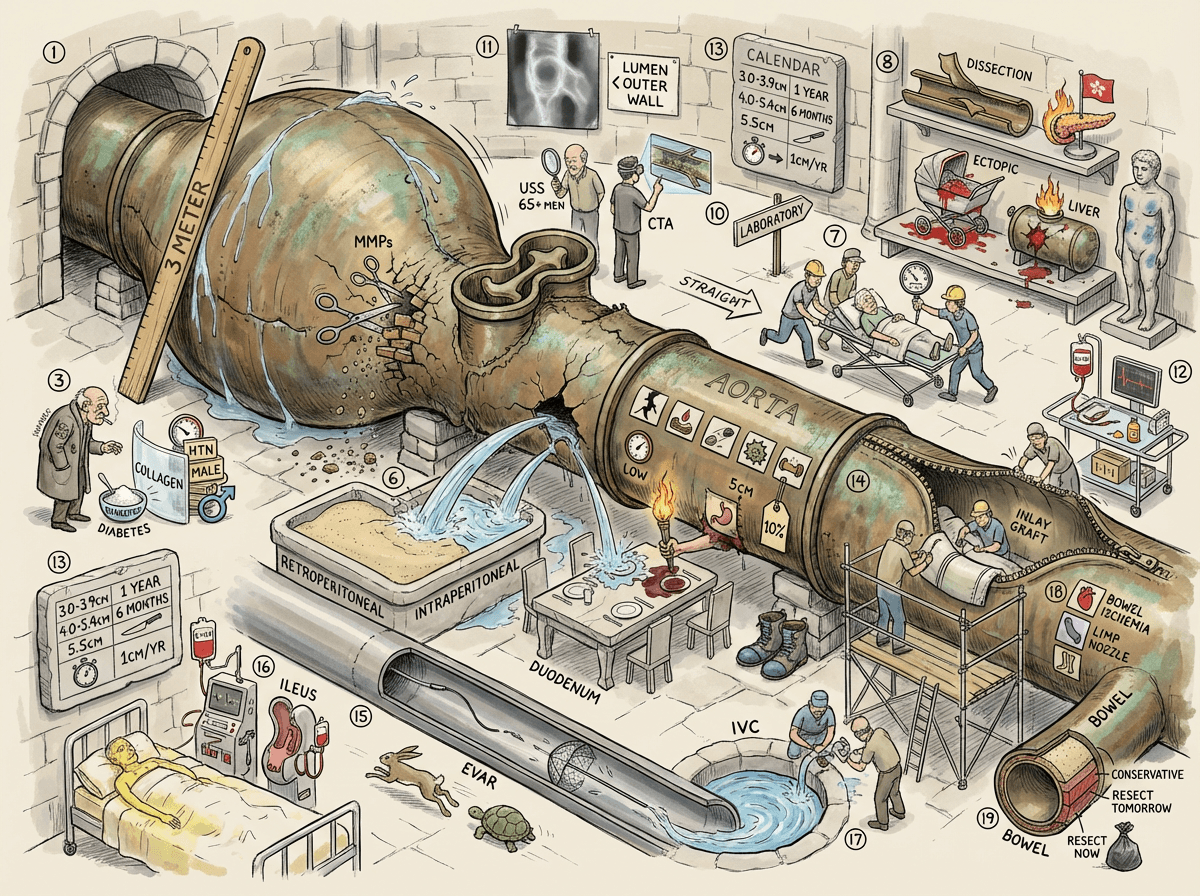
Sketchy memory palace for Abdominal Aortic Aneurysm
| No. | Visual Cue | Meaning |
|---|---|---|
| 1 | A giant 3-meter measuring stick leaning against a bulging pipe that is inflating further like a balloon as water pressure rises. | - AAA = permanent, localised dilation of abdominal aorta ≥ 3 cm (≥ 50% of normal ~2 cm diameter); the most common true arterial aneurysm. - Laplace's Law explains the positive feedback loop: as radius increases and wall thins, tension rises → more dilation → more tension → rupture. |
| 2 | Tiny scissors (MMPs) cutting elastic bands and crumbling bricks (smooth muscle) in the wall of the pipe just below the renal valves and above the iliac fork. | - 97% are infrarenal due to fewer elastic lamellae, fewer vasa vasorum, and reflected pressure waves at the iliac bifurcation. - Pathology: loss of elastin and smooth muscle cells, disruption of ECM, elevated MMPs, adventitial collagen deposition, inflammatory infiltrate. |
| 3 | An elderly man holding a cigarette and a family crest, while a bowl of sugar (diabetes) is being pushed away with a protective collagen shield. | - 95% associated with atherosclerosis; M > F (9:1); risk increases with age, smoking (strongest modifiable RF), HT, FHx, and connective tissue diseases. - Diabetes is NOT a risk factor (inversely associated — collagen cross-linking protects wall). |
| 4 | A pulsing mass in the mid-section; the classic triad (abdominal pain, low pressure gauge, pulsing bulge). Peripheral pipes (femoral and popliteal) are also dilated. | - Most are asymptomatic (60%); symptomatic AAA (10%) presents with abdominal/back/flank pain or limb ischaemia from embolisation; ruptured AAA (30%) presents with the classic triad of sudden pain + hypotension + pulsatile mass. - The cardinal sign is a pulsatile, expansile mass in the epigastrium; always check for peripheral aneurysms (femoral 82% associated AAA, popliteal 62%). - Classic ruptured AAA triad = pain (abdomen/back) + pulsatile mass (may be masked) + shock (transient/profound) . Present in only ~50% of cases. - AAA is a listed differential for periumbilical pain and non-spinal back pain — always palpate the abdomen in elderly patients with back pain . |
| 5 | Five icons: a crack (rupture), a clog (thrombosis), a flying rock (embolism), mold (infection), and a crushed nearby pipe (pressure). A '10%' tag hangs at the 5cm mark. Blue-toed boots (trash foot) sit on the floor. | - Complications of aneurysms: rupture, thrombosis, embolism, infection, pressure effects. - Five complications of aneurysms (lecture slides): Rupture, Thrombosis, Embolism, Infection, Pressure effects . - Rupture risk at 5 years: 5 cm = 50% (10%/year) . Relationship is exponential per Laplace's Law. - Trash foot = cholesterol / micro-thrombus embolism from AAA → cyanotic toes with palpable pedal pulses . |
| 6 | Water leaking into a sand-filled container (retroperitoneal), spraying into an open pool (intraperitoneal), splashing into a dining table (duodenum), and flowing into a large blue drain (IVC). | - Ruptured AAA has ~80% overall mortality; retroperitoneal rupture may be temporarily contained → diagnostic window; intraperitoneal rupture causes rapid exsanguination. - Rupture directions: Retroperitoneal (contained), Intraperitoneal (free), Into duodenum (GI bleeding), Into IVC (heart failure) . |
| 7 | An elderly patient on a gurney being wheeled past a 'Laboratory' sign straight to the pipe crack; a pressure gauge is held at 80-100 mmHg. | - Always suspect ruptured AAA in elderly patients with acute abdominal/back pain and haemodynamic instability — do not delay for investigations. - Ruptured AAA in unstable patients = clinical diagnosis → immediate surgery: resuscitate, permissive hypotension (SBP 80–100), FAST scan at bedside, straight to OT . |
| 8 | A tearing pipe (dissection), a flaming pancreas, a bloody baby carriage (ectopic), and a bursting liver tank with a Hong Kong flag. A statue nearby has blue bruises on its flanks (Grey-Turner) and navel (Cullen). | - Symptomatic AAA differentials: aortic dissection, ulcerated aortic plaque, acute pancreatitis, acute peritonitis, acute MI — and also renal colic, mesenteric ischaemia, intestinal obstruction, musculoskeletal back pain. - Ruptured AAA differentials: ruptured HCC, ruptured ectopic pregnancy — plus perforated viscus, severe pancreatitis, acute mesenteric ischaemia, ruptured aortic dissection. - Grey-Turner / Cullen signs are shared by ruptured AAA, pancreatitis, ruptured ectopic pregnancy, and ruptured HCC — they indicate retroperitoneal/intraperitoneal haemorrhage, not a specific diagnosis . - In Hong Kong, ruptured HCC is a particularly important differential due to high HBV prevalence . |
| 9 | A fabric-patched pipe leaking blood onto a plate; a nearby torch represents fever and a hand clutches its stomach. | - Aortoenteric fistula presents with UGIB + fever + abdominal pain in patients with prior aortic graft — must be suspected until excluded . - Open repair late Cx: Graft infection, Anastomotic aneurysm, Graft-duodenal fistula . Aortoenteric fistula triad: UGIB + fever + abdominal pain → Mx: graft excision + extra-anatomical bypass . |
| 10 | A basic inspector with a hand-lens (USS) labeled '65+ Men Screening'; a high-tech inspector with X-ray goggles (CTA) showing the internal branches and mural sludge. | - AAA is defined by aortic diameter ≥ 3 cm; diagnosed definitively by imaging (USS for screening/surveillance, CTA for surgical planning). - USS is the initial diagnostic modality — non-invasive, cheap, high sensitivity/specificity. Used for screening (men > 65, MASS trial) and surveillance. Cannot diagnose rupture . - CTA is the gold standard for anatomical planning — shows proximal neck, renal artery relationship, iliac extent, mural thrombus, and detects rupture. Skip if haemodynamically unstable . - MASS trial (Lancet 2002): USS screening in men > 65 reduces AAA-related mortality . |
| 11 | An X-ray showing a white chalky outline of the pipe; a 'Lumen is smaller than outer wall' warning sign. | - CTA/MRA/DSA are NOT for size measurement because intramural thrombus makes the lumen appear smaller than the true aneurysm diameter . - Plain X-ray may show calcification of the aortic wall incidentally — trigger USS for confirmation. |
| 12 | A blood bag labeled 'G+XM', a flatline ECG (cardiac risk), an acid-spill (metabolic acidosis), and a '1:1:1' ration box. | - Lab tests: CBC (anaemia from haemorrhage), clotting (DIC), inflammatory markers (infected/inflammatory AAA), ABG (metabolic acidosis in shock), G+XM (prepare blood) . - Pre-operative preparation: blood tests, ECG, CXR + cardiac assessment + blood preparation — because major operative mortality = myocardial infarction . |
| 13 | 3.0-3.9cm = 1 year; 4.0-5.4cm = 6 months; 5.5cm = A surgeon's knife icon. A stopwatch icon shows the pipe expanding 1cm in a year. | - Surveillance: 3.0–3.9 cm → yearly USS; 4.0–5.4 cm → 6-monthly USS; ≥ 5.5 cm → CTA + surgical referral . - Conservative management: AAA < 5.5 cm (no survival benefit from early repair per UK Small Aneurysm Trial); CV risk factor modification (smoking cessation, BP control, statin, aspirin); USG surveillance yearly (3.0–3.9 cm) or 6-monthly (4.0–5.4 cm) . - Surgical indications: ≥ 5.5 cm (5 cm HK consensus); rapidly expanding > 1 cm/yr or > 0.5 cm/6mo; symptomatic of any size; saccular aneurysm . - Operative considerations: Any symptoms = urgent; Size ~5 cm; Medical risk from associated diseases; Life expectancy; Age is NOT a contraindication . |
| 14 | A giant zipper on the pipe (transabdominal); workers are sewing a fabric tube (inlay graft) inside the cavity. | - Decision framework: Risk of rupture vs. risk of operation. Intact AAA operative mortality: 3–5%; Ruptured: > 50%; Unoperated rupture: 100% . - Open Repair: Aneurysmectomy + inlay graft (tube or bifurcated); transabdominal or retroperitoneal approach . |
| 15 | A wire threading a metal mesh umbrella through a small hole; a hare (fast recovery) is racing a tortoise (long-term durability). | - EVAR: Aortic stent graft — requires suitable anatomy: neck length > 1.5 cm, diameter 7 mm ; lifelong CTA surveillance required . - EVAR vs. Open: EVAR has lower 30-day mortality (1.7% vs. 4.7%), shorter stay, faster recovery; Open has lower re-intervention and rupture rate long-term; no difference in overall long-term mortality . |
| 16 | A yellow-tinted patient (jaundice), a stopped gut-shaped machine (ileus), and a kidney-shaped machine failing after a massive transfusion. | - Ruptured AAA management: Treat shock → large-bore IV → cross-match blood/FFP → permissive hypotension (SBP 80–100) → immediate operation; do not waste time in investigations . Massive transfusion pRBC:PLT:FFP = 1:1:1 . EVAR preferred if stable + suitable anatomy . - Ruptured AAA post-op Cx: Cardiac/Respiratory/Renal (Shock); Bleeding tendency (Massive transfusion); Paralytic ileus (Retroperitoneal haematoma); Jaundice (Bleeding + transfusion) . |
| 17 | Leaks at the top/bottom of the umbrella (Types I/III) are being fixed immediately, while a leak through the mesh (Type II) is just being watched. | - Endoleaks: Types I and III → re-operate (direct flow into sac); Type II (most common) → observe unless sac expanding; Types IV and V → observe . - EVAR-specific Cx: Endoleaks (Types I–V). Types I and III = direct flow → re-operate. Type II = most common → observe unless sac expanding . |
| 18 | A heart-shaped pump stopping, a purple-discolored pipe segment (bowel ischemia), a limp nozzle (impotence), and a set of paralyzed legs (spinal cord ischemia). | - Early complications: Cardiac (clamp/declamp), respiratory, haemorrhage, bowel ischaemia, impotence, renal failure, distal embolism, paraplegia . Late: graft infection, anastomotic aneurysm, graft-duodenal fistula . - Open repair early general Cx: Cardiac (clamp/declamp) — major operative mortality = MI; Respiratory . - Open repair early specific Cx: Haemorrhage, Bowel ischaemia (IMA ligation), Impotence (sympathetic plexus damage), Renal failure, Distal embolism, Paraplegia (spinal cord ischaemia) . |
| 19 | A wall with three layers: Surface layer (conservative), Muscle layer (resect tomorrow), and All layers damaged (resect now + a waste bag). | - Bowel ischaemia grading: mucosal → conservative; muscularis → delayed resection; transmural → immediate resection + end colostomy . |
Adrenocortical Carcinoma
Adrenocortical carcinoma is a rare, aggressive malignant neoplasm arising from the adrenal cortex, often presenting with hormonal excess (particularly cortisol or androgens) and/or a large abdominal mass.
Acute Limb Ischemia
Acute limb ischemia is a sudden decrease in limb perfusion, typically due to thrombosis or embolism, threatening tissue viability if not revascularized within hours.