
Carotid Artery Stenosis
Narrowing of the carotid artery lumen, usually due to atherosclerotic plaque, that reduces cerebral blood flow and increases the risk of ischemic stroke.
| Exam domain | One-glance essentials |
|---|---|
| Definition / diagnosis |
|
| Epidemiology / risks |
|
| Core mechanism |
|
| Clinical picture |
|
| Investigations |
|
| Management |
|
| Complications |
|
| Prevention / follow-up |
|
| Exam traps |
|
References
[1] Senior notes: felixlai.md (Carotid artery stenosis section, pages 892–900)
Carotid Artery Stenosis
Carotid artery stenosis (CAS) refers to the narrowing of the lumen of the carotid arteries — most commonly the internal carotid artery (ICA) — due to atherosclerotic plaque formation. The stenosis occurs most frequently at the carotid bifurcation, where the common carotid artery (CCA) divides into the ICA and external carotid artery (ECA), often with extension into the proximal ICA [1][2].
Why the bifurcation? This is a region of disturbed laminar flow — the blood stream splits, creating areas of low shear stress and flow separation at the outer wall of the carotid bulb. Low shear stress promotes endothelial dysfunction, lipid deposition, and inflammatory cell recruitment — the initiation steps of atherogenesis. This is why atherosclerosis has a predilection for arterial branch points throughout the body.
Key Distinction — Symptomatic vs Asymptomatic [1]:
- Symptomatic carotid stenosis: Focal neurological symptoms in the ipsilateral carotid territory (i.e., referable to the appropriate carotid artery distribution) occurring within the previous 6 months. This includes ≥1 TIA (including amaurosis fugax) OR ≥1 minor non-disabling ischaemic stroke.
- Asymptomatic carotid stenosis: Atherosclerotic narrowing of the extracranial ICA in an individual without a history of recent ipsilateral carotid territory ischaemic stroke or TIA. The estimated risk of ipsilateral stroke is 0.5–1.0% annually.
Common Exam Pitfall
Vertigo and syncope are NOT generally caused by carotid stenosis and should not be considered indicative of symptomatic carotid disease [1]. Vertigo is a posterior circulation (vertebrobasilar) symptom. Syncope is a global cerebral hypoperfusion phenomenon — a unilateral carotid stenosis does not cause global hypoperfusion because the Circle of Willis provides collateral flow. Students frequently make this mistake.
2. Epidemiology
- Carotid stenosis of ≥50% is found in approximately 4–8% of the general population over 65 years of age.
- Significant stenosis (≥70%) is found in approximately 1–3% of the general population.
- Carotid stenosis accounts for approximately 10–20% of all ischaemic strokes — making it one of the most important treatable causes of stroke [3].
- Stroke is the 4th leading cause of death in Hong Kong (after cancer, pneumonia, and cardiovascular disease).
- Intracranial atherosclerotic disease (ICAD) is more prevalent in Asian populations (including Hong Kong Chinese) compared with Caucasians, where extracranial carotid disease predominates. However, extracranial carotid stenosis remains a significant contributor to stroke in Hong Kong, particularly in patients with multiple cardiovascular risk factors [3][4].
- The ageing population and high prevalence of hypertension, diabetes, and smoking in Hong Kong mean that carotid stenosis remains highly relevant.
- Age: Prevalence increases sharply after age 65 [1][2].
- Sex: More common in men than women (except at extremes of age — ages 35–44 and > 85 years) [1].
- Race/Ethnicity: Higher risk in Black populations compared with White populations for stroke overall. Asian populations have relatively more intracranial disease, but extracranial carotid stenosis is still common [1].
3. Risk Factors
Atherosclerosis is a systemic disease [5]. The risk factors for carotid stenosis are essentially the same cardiovascular risk factors that drive atherosclerosis everywhere in the body — coronary, cerebral, peripheral.
| Risk Factor | Explanation |
|---|---|
| Age > 65 | Cumulative endothelial damage and plaque progression over time [1][2] |
| Male sex | Oestrogen is relatively protective against atherosclerosis pre-menopause; the gap narrows post-menopause [1] |
| Family history | Genetic predisposition to dyslipidaemia, hypertension, diabetes, or intrinsic endothelial vulnerability [1] |
| Previous TIA or stroke | Marker of existing cerebrovascular atherosclerotic disease [1] |
| Race | Black > White for stroke risk overall [1] |
| Risk Factor | Mechanism / Explanation |
|---|---|
| Smoking | Directly injures endothelium, promotes oxidative stress, increases LDL oxidation, enhances platelet aggregation, and raises fibrinogen. Strong dose-response relationship. Risk declines after cessation and can be eliminated by ~5 years [1][5] |
| Hypertension | Promotes formation of atherosclerotic lesions through endothelial shear stress injury. Also predisposes to lacunar infarcts. The most important modifiable risk factor for stroke overall [1][5] |
| Diabetes mellitus | Approximately 2× the risk of ischaemic stroke. Accelerates atherosclerosis through advanced glycation end-products (AGEs), endothelial dysfunction, and a pro-inflammatory, pro-thrombotic state. Risk is higher in diabetic women than men [1][5] |
| Hyperlipidaemia | Cholesterol is an established risk factor for atherosclerosis but appears to be only a weak independent risk factor for ischaemic stroke specifically (unlike its strong role in coronary artery disease). Statins still reduce stroke risk — likely through plaque stabilisation and anti-inflammatory effects [1][5] |
| Alcoholism | Heavy intake increases BP and promotes AF; moderate intake may be mildly protective [1] |
| Lack of exercise | Sedentary lifestyle worsens all other metabolic risk factors [1] |
| Oral contraceptive use | Oestrogen promotes a hypercoagulable state [1] |
Systemic Disease Concept
Atherosclerosis is a systemic disease [5]. A patient with carotid stenosis likely has co-existing coronary artery disease (CAD) and peripheral arterial disease (PAD). This is why pre-operative cardiac evaluation is essential before carotid endarterectomy — the leading cause of perioperative death is myocardial infarction, not stroke [1][2].
4. Anatomy and Function
4.1 The Carotid Arterial System
Understanding carotid anatomy is essential for understanding the clinical features, surgical approach, and complications.
- The right CCA arises from the brachiocephalic trunk (innominate artery).
- The left CCA arises directly from the aortic arch.
- Both CCAs ascend in the neck within the carotid sheath (which also contains the internal jugular vein, vagus nerve (CN X), and deep cervical lymph nodes) [2].
- The CCA divides into the ICA and ECA at the level of the superior border of the thyroid cartilage, corresponding to the C3/4 intervertebral disc space [1].
- The carotid bulb (sinus) is the slight dilation at the terminal CCA / proximal ICA — this is where atherosclerosis preferentially develops due to disturbed flow dynamics.
- Has NO extracranial branches — this is a classic anatomy fact and surgically important (it means any branch encountered during dissection belongs to the ECA, not the ICA) [1].
- Enters the skull through the carotid canal in the petrous temporal bone.
- Intracranially, gives off the ophthalmic artery (supplying the retina — hence amaurosis fugax in ICA disease) and then terminates by dividing into the anterior cerebral artery (ACA) and middle cerebral artery (MCA).
- Has multiple extracranial branches supplying the face and scalp.
- Provides collateral circulation to the brain (e.g., via the ophthalmic artery anastomosis with branches of the ECA, and via meningeal branches) [1]. This is why patients can sometimes tolerate even complete ICA occlusion without stroke — if collaterals are robust.
High Yield Anatomy Fact
The MCA is NOT considered part of the Circle of Willis [1]. The Circle of Willis is formed by: ACA (A1 segments) + anterior communicating artery + ICA (terminal segments) + posterior communicating arteries + posterior cerebral arteries (P1 segments). The MCA is a terminal branch of the ICA that branches off before the Circle.
The Circle of Willis is the principal collateral network for cerebral blood flow. However, a complete Circle of Willis is present in only ~25–50% of people — anatomical variants are extremely common.
Five key anastomotic pathways [1]:
- Right ↔ Left (via anterior communicating artery)
- Carotid ↔ Vertebral (via posterior communicating artery)
- Internal carotid ↔ External carotid (via ophthalmic artery and ECA facial/maxillary branches)
- Subclavian ↔ Carotid (via thyrocervical trunk and ECA branches)
- Subclavian ↔ Vertebral (via muscular branches)
Why do collaterals matter? A patient with a slowly progressive carotid stenosis has time to develop robust collateral flow. This is why some patients with even 90–99% stenosis can be asymptomatic. Conversely, if the Circle of Willis is incomplete (variant anatomy) or if the stenosis progresses quickly, the risk of symptomatic ischaemia is much higher.
- Located within the adventitia of the origin of the ICA (carotid sinus) [1].
- They are stretch-sensitive mechanoreceptors that respond to alterations in blood pressure.
- Innervated by the carotid sinus nerve, a branch of the glossopharyngeal nerve (CN IX) (also known as the nerve of Hering).
- Mechanism: When BP rises → wall stretches → baroreceptor firing increases → signals via CN IX to the nucleus tractus solitarius in the medulla → parasympathetic activation (vagal tone ↑) + sympathetic inhibition → heart rate ↓ + vasodilation → BP falls. Conversely, low BP → decreased firing → sympathetic activation → HR ↑ + vasoconstriction → BP rises [1].
Clinical relevance: During carotid endarterectomy (CEA) or carotid artery stenting (CAS), manipulation of the carotid bifurcation can stimulate these baroreceptors, causing bradycardia and hypotension (a vasovagal-type response). This may require atropine administration. Post-operatively, haemodynamic instability (both hypertension and hypotension) is common for the same reason [1].
- The vagus nerve (CN X) is located posterior to the CCA in 90–95% of individuals [1].
- This is surgically critical — injury to the vagus nerve or its recurrent laryngeal branch during CEA causes hoarseness (vocal cord paralysis).
Understanding the territories helps you predict the clinical features:
| Artery | Territory | Deficit if Occluded |
|---|---|---|
| Ophthalmic artery (from ICA) | Retina | Amaurosis fugax (transient monocular blindness) or permanent monocular vision loss |
| MCA (from ICA) | Lateral cerebral hemisphere: motor/sensory cortex (face, arm > leg), Broca's area (dominant), Wernicke's area (dominant), parietal association cortex | Contralateral hemiparesis (face + arm > leg), hemisensory loss, aphasia (dominant hemisphere), neglect/constructional apraxia (non-dominant) |
| ACA (from ICA) | Medial cerebral hemisphere: motor/sensory cortex (leg > arm, face) | Contralateral leg weakness/sensory loss |
| Lenticulostriate arteries (from MCA) | Basal ganglia, internal capsule | Contralateral pure motor hemiparesis or lacunar syndromes |
5. Etiology
Atherosclerotic occlusive disease is by far the most common cause of carotid stenosis. The process is identical to atherosclerosis in any other vascular bed [5].
Pathogenesis of Carotid Atherosclerosis (from First Principles)
-
Endothelial injury/dysfunction: Risk factors (hypertension, smoking, diabetes, dyslipidaemia) damage the endothelial lining, particularly at sites of disturbed flow (carotid bifurcation).
-
Lipid accumulation: LDL cholesterol infiltrates the subendothelial space and undergoes oxidation. Oxidised LDL is toxic and pro-inflammatory.
-
Inflammatory cell recruitment: Monocytes are recruited into the intima, differentiate into macrophages, and engulf oxidised LDL → forming foam cells (the hallmark of the fatty streak, the earliest visible lesion).
-
Smooth muscle cell migration and proliferation: Smooth muscle cells migrate from the media to the intima, proliferate, and secrete extracellular matrix (collagen, elastin) → forming a fibrous cap over the lipid core.
-
Advanced plaque formation: The mature plaque has a lipid-rich necrotic core covered by a fibrous cap. Calcification, haemorrhage into the plaque, and neovascularisation within the plaque can occur.
-
Plaque complications:
- Plaque ulceration, thrombosis and embolism are important in the pathogenesis of clinical manifestations [1]. Rupture or erosion of the fibrous cap exposes the thrombogenic lipid core to the bloodstream → platelet aggregation and thrombus formation.
- The thrombus can:
- Grow locally → further narrowing or complete occlusion of the ICA.
- Embolise distally → travel to intracranial vessels (MCA, ACA, ophthalmic artery) → causing TIA or stroke. Artery-to-artery embolism is the dominant mechanism of stroke in carotid stenosis.
- Haemodynamic compromise: Very high-grade stenosis (> 90%) can reduce distal perfusion pressure to the point where watershed (border zone) ischaemia occurs, especially if collaterals are inadequate.
Two Mechanisms of Stroke in Carotid Stenosis
- Artery-to-artery thromboembolism (the dominant mechanism) — plaque rupture → thrombus → emboli to intracranial vessels.
- Haemodynamic failure (less common) — critical reduction in distal perfusion pressure causing watershed infarction.
Most strokes from carotid stenosis are embolic, not purely haemodynamic. This is why even moderate stenosis with an ulcerated, unstable plaque can be more dangerous than a smooth, stable high-grade stenosis.
These are uncommon but important to recognise because they occur in younger patients and require different management:
| Cause | Key Features |
|---|---|
| Carotid artery dissection | Tear in the intima → intramural haematoma → luminal narrowing. Often in younger patients. Associated with trauma (even minor), connective tissue disorders (Marfan, Ehlers-Danlos), or spontaneous. Presents with neck pain, Horner syndrome, and stroke/TIA [1] |
| Fibromuscular dysplasia (FMD) | Non-inflammatory, non-atherosclerotic disorder causing alternating stenosis and dilation ("string of beads" on angiography). Predominantly affects young to middle-aged women. Can cause stenosis, dissection, or aneurysm [1] |
| Vasculitis | Takayasu arteritis (large vessel, young Asian women), Giant cell arteritis (temporal arteritis; age > 50, associated with polymyalgia rheumatica) [1] |
| Radiation-induced stenosis | Accelerated atherosclerosis following head/neck radiation therapy. Often occurs years to decades after treatment |
| Moyamoya disease | Chronic progressive stenosis/occlusion of arteries around the Circle of Willis with prominent collaterals ("puff of smoke" on angiography). More common in East Asian populations (including Hong Kong) [1] |
Acute ischaemic stroke results from cardioembolism, critical arterial stenosis, or arterial dissection [4]. Carotid stenosis falls under the "critical arterial stenosis" category — one of the major stroke subtypes.
For completeness, the aetiological classification of ischaemic stroke relevant to carotid stenosis includes [1]:
- Large-vessel atherosclerosis (extracranial): Carotid stenosis, aortic arch atheroma
- Large-vessel atherosclerosis (intracranial): Intracranial atherosclerotic disease (particularly important in Asian populations)
- Cardioembolism: AF, valvular disease, MI with mural thrombus
- Small-vessel disease: Lacunar infarcts from lipohyalinosis
- Other determined aetiology: Dissection, FMD, vasculitis, hypercoagulable states
- Cryptogenic: No identified cause despite workup
6. Pathophysiology — Detailed Mechanisms
Acute cell death and loss of function occur in the core. Cells in the penumbra are potentially salvageable. The aim is timely restoration of perfusion. [4]
- The ischaemic core receives blood flow below the threshold for cell survival (~10 mL/100g/min) → irreversible neuronal death within minutes.
- The ischaemic penumbra surrounds the core — it receives reduced but not zero blood flow (~10–22 mL/100g/min). Neurons here are electrically silent (non-functional) but structurally intact. If perfusion is restored in time, these cells can recover. If not, they undergo infarction and the core expands.
- This is the basis of the "time is brain" concept and why acute stroke is treated as a medical emergency.
| Feature | Thromboembolic | Haemodynamic |
|---|---|---|
| Mechanism | Plaque rupture → thrombus → distal embolism | Critical stenosis → reduced distal perfusion |
| Frequency | Dominant mechanism (~80% of carotid-related strokes) | Less common (~20%) |
| Infarct pattern | Territorial (MCA, ACA territory) | Watershed / border zone (between ACA-MCA or MCA-PCA territories) |
| Clinical scenario | Moderate-to-severe stenosis with unstable plaque | Very severe (> 90%) or complete ICA occlusion with poor collaterals |
| Presentation | Sudden onset focal deficit | May be preceded by postural symptoms (worse on standing, better lying down) |
A TIA (transient ischaemic attack) is a warning sign — it represents a temporary embolus that occludes a vessel but then either fragments/dissolves (via endogenous fibrinolysis) or gets pushed distally into a smaller vessel where collaterals compensate, and the ischaemia resolves before infarction occurs (typically < 1 hour, by definition < 24 hours, though the modern tissue-based definition requires no evidence of infarction on imaging).
Why is this important? A TIA in the carotid territory signals an unstable plaque that is actively emitting emboli. The risk of subsequent completed stroke is highest in the first 48–72 hours after a TIA — this is why urgent investigation and treatment of carotid stenosis is critical after a TIA.
Amaurosis fugax ("fleeting blindness") is transient monocular blindness ipsilateral to the carotid stenosis.
- An embolus from the carotid plaque travels up the ICA → enters the ophthalmic artery → transiently occludes the retinal artery → painless monocular vision loss (classically described as a "curtain coming down" over the eye).
- It is essentially a retinal TIA.
- On fundoscopy, a Hollenhorst plaque (bright, refractile cholesterol crystal) may be seen at an arteriolar bifurcation in the retina.
7. Classification
| Category | Definition | Annual Ipsilateral Stroke Risk |
|---|---|---|
| Asymptomatic | No ipsilateral carotid territory TIA or stroke in the past 6 months | 0.5–1.0% per year (with best medical therapy; can be up to 2% without) [1] |
| Symptomatic | ≥1 ipsilateral carotid territory TIA or non-disabling stroke within the past 6 months | 10–15% at 2 years (for ≥70% stenosis without surgery; much higher in the first days-weeks after event) [1] |
The North American Symptomatic Carotid Endarterectomy Trial (NASCET) method is the most widely used. It compares the narrowest diameter of the residual lumen at the stenosis to the diameter of the normal distal ICA (beyond the bulb, where the walls are parallel):
\text\{Percent Stenosis\} = \left(1 - \frac\{\text\{Minimum residual lumen diameter\}\}\{\text\{Normal distal ICA diameter\}\}\right) \times 100\%
| NASCET Grade | Clinical Significance |
|---|---|
| Mild (< 50%) | Low stroke risk; medical therapy alone |
| Moderate (50–69%) | Marginal benefit of surgery in symptomatic patients (depends on risk factors) |
| Severe (70–99%) | Highest benefit from revascularisation (especially if symptomatic) [1][2] |
| Complete occlusion (100%) | No surgical intervention of proven benefit (absolute contraindication to CEA) [1] |
ECST vs NASCET Methods
The European Carotid Surgery Trial (ECST) method measures the stenosis relative to the estimated original lumen diameter at the point of maximal stenosis — this gives a higher percentage for the same lesion. An ECST 70% stenosis ≈ NASCET 50%. Always clarify which method is being used. NASCET criteria are now the international standard.
Not all stenoses are equal — plaque vulnerability matters as much as (or more than) the degree of stenosis:
| Feature | Stable Plaque | Vulnerable (Unstable) Plaque |
|---|---|---|
| Fibrous cap | Thick, intact | Thin, prone to rupture |
| Lipid core | Small | Large, necrotic |
| Inflammation | Minimal | Dense macrophage infiltration |
| Calcification | Heavy, diffuse (stabilising) | Spotty, superficial |
| Surface | Smooth | Ulcerated, irregular |
| Intraplaque haemorrhage | Absent | Present |
| Stroke risk | Lower for a given degree of stenosis | Higher — even moderate stenosis can be dangerous |
8. Clinical Features
The clinical features of carotid stenosis are best understood by dividing them into symptoms and signs, with their pathophysiological basis explained inline.
8.1 Symptoms
- No neurological symptoms — the stenosis is discovered incidentally (e.g., a carotid bruit heard on routine examination, or stenosis found on imaging done for other reasons).
- Even unilateral complete occlusion can be asymptomatic if collateral supply (via Circle of Willis, ECA anastomoses) is adequate [2].
- This is remarkable and clinically important — it demonstrates the power of collateral circulation.
Symptoms are caused by ischaemia in the ipsilateral carotid territory — either transient (TIA) or permanent (stroke).
i. Transient Ischaemic Attack (TIA)
- Definition: Sudden-onset focal neurological deficit lasting < 24 hours (clinical definition) or, by the modern tissue-based definition, a transient episode of neurological dysfunction caused by focal brain or retinal ischaemia without acute infarction on imaging.
- Mechanism: Embolus from carotid plaque → transient occlusion of intracranial artery → spontaneous lysis or fragmentation → symptoms resolve.
Specific TIA presentations from carotid stenosis:
| Symptom | Mechanism |
|---|---|
| Amaurosis fugax (transient monocular blindness) | Embolus to the ophthalmic/retinal artery ipsilateral to the stenosis. Classically described as a "curtain descending over the eye." Painless. Lasts seconds to minutes [1] |
| Contralateral hemiparesis (weakness of arm/face > leg) | Embolus to MCA territory → motor cortex ischaemia. MCA supplies the lateral cortex (face + arm representation), explaining the face/arm predominance over leg [1] |
| Contralateral hemisensory loss | Embolus to MCA territory → sensory cortex ischaemia |
| Dysphasia / Aphasia (if dominant hemisphere, usually left) | Embolus to MCA territory → Broca's area (expressive aphasia) or Wernicke's area (receptive aphasia) or both (global aphasia). This is a cortical sign specific to the dominant hemisphere [1] |
| Contralateral homonymous hemianopia | Embolus to MCA or PCA territory → visual cortex or optic radiation ischaemia [1] |
ii. Minor / Non-Disabling Ischaemic Stroke
- Same symptoms as TIA but they persist beyond 24 hours (or there is evidence of infarction on imaging), though the deficit is mild enough that the patient retains functional independence.
iii. Major Ischaemic Stroke
- Sudden-onset severe neurological deficit that is disabling.
- Large MCA territory stroke: dense contralateral hemiplegia + hemisensory loss + homonymous hemianopia + higher cortical dysfunction (aphasia if dominant, neglect if non-dominant).
Cortical Signs in Carotid Territory Stroke
The presence of cortical signs helps localise the lesion to the carotid (anterior circulation) territory [1]:
- Aphasia (dominant hemisphere — usually left)
- Apraxia (inability to perform learned motor tasks despite intact motor function)
- Agnosia (inability to recognise objects, people, or stimuli despite intact sensory function)
- Neglect (non-dominant hemisphere — usually right) — the patient ignores one side of space
- Homonymous hemianopia (visual field cut)
If a patient has only vertigo, ataxia, diplopia, bilateral visual loss, or bilateral motor/sensory symptoms — think posterior circulation (vertebrobasilar), NOT carotid.
8.2 Signs
| Sign | Pathophysiology / Explanation |
|---|---|
| Carotid bruit | A bruit is a turbulent flow sound heard with the stethoscope over the carotid bifurcation. It is typically heard when stenosis is ≥50–70% — at this degree, blood velocity through the narrowed segment increases enough to generate turbulence. However, it is a poor predictor of the degree of stenosis: very tight stenoses (near occlusion) may have a soft or absent bruit because flow velocity drops when the residual lumen is extremely small. Complete occlusion produces NO bruit — there is no flow to generate turbulence [1]. Therefore: no bruit ≠ no disease. |
| Diminished/absent carotid pulse | Very severe stenosis or complete occlusion reduces the palpable pulse. Compare both sides |
| Signs of generalised atherosclerosis | Check for absent peripheral pulses, AAA (pulsatile abdominal mass), signs of PAD (trophic changes in limbs). Atherosclerosis is a systemic disease [5] |
| Sign | Pathophysiology |
|---|---|
| Partial or complete blindness in one eye | Ocular ischaemia ipsilateral to the carotid stenosis — embolus to ophthalmic/retinal artery [1] |
| Absence of pupillary light response (relative afferent pupillary defect — RAPD) | Ipsilateral retinal ischaemia damages the afferent limb of the pupillary light reflex [1] |
| Hollenhorst plaque on fundoscopy | Bright, refractile cholesterol crystal lodged at an arteriolar bifurcation — direct evidence of upstream atheroembolism from the carotid plaque |
| Retinal arterial occlusion / ischaemic changes on fundoscopy | Branch or central retinal artery occlusion from carotid embolism [1] |
| Sign | Pathophysiology |
|---|---|
| Contralateral hemiparesis (face + arm > leg) | MCA territory ischaemia — lateral motor cortex (face/arm homunculus) |
| Contralateral hemisensory loss | MCA territory — lateral sensory cortex |
| Aphasia (if dominant hemisphere) | Left hemisphere ischaemia (Broca's = non-fluent; Wernicke's = fluent; Global = both) [1] |
| Visuospatial neglect / Constructional apraxia | Right hemisphere ischaemia (non-dominant in most people) [1] |
| Homonymous hemianopia | Ischaemia of optic radiation or visual cortex in the affected hemisphere [1] |
| Upper motor neuron signs (in established stroke) | Hyperreflexia, upgoing plantar (Babinski), spasticity — from damage to the corticospinal tract |
Key Point — Lateralisation
The carotid artery supplies the ipsilateral hemisphere. The hemisphere controls the contralateral body. Therefore:
- Right carotid stenosis → right hemisphere ischaemia → left-sided motor/sensory deficits + right eye amaurosis fugax + neglect (if right-hemisphere dominant for spatial attention, as in most people)
- Left carotid stenosis → left hemisphere ischaemia → right-sided motor/sensory deficits + left eye amaurosis fugax + aphasia (if left-hemisphere dominant for language, as in most people)
A common exam mistake is getting the laterality wrong — always trace from the stenosis → ipsilateral hemisphere → contralateral body.
9. Relevant Associated Conditions
- Approximately 40–60% of patients with significant carotid stenosis have concomitant CAD.
- MI is the leading cause of long-term mortality in patients with carotid stenosis — not stroke.
- This is why cardiac evaluation (e.g., ECG, echocardiography, stress testing) is part of the pre-operative workup before CEA [1].
- PAD and carotid stenosis share the same risk factor profile.
- Patients with PAD should be screened for carotid disease and vice versa.
- Atherosclerotic risk factors also predispose to AAA [5].
- Consider screening for AAA in patients with carotid stenosis, particularly older men who smoke.
High Yield Summary
Definition: Narrowing of the carotid artery (usually at the bifurcation / proximal ICA) predominantly due to atherosclerosis. Classified as symptomatic (ipsilateral TIA/stroke within 6 months) or asymptomatic.
Epidemiology: Accounts for 10–20% of ischaemic strokes. More common in males, age > 65, with cardiovascular risk factors. Intracranial atherosclerosis is relatively more common in Asian (including Hong Kong) populations, but extracranial carotid disease remains highly relevant.
Key Risk Factors: Smoking, hypertension, diabetes mellitus, hyperlipidaemia, family history — atherosclerosis is a systemic disease.
Anatomy: CCA bifurcates at C3/4 into ICA (no extracranial branches) and ECA (multiple branches, provides collateral flow). MCA is NOT part of the Circle of Willis. Vagus nerve lies posterior to CCA (90–95%). Carotid baroreceptors at ICA origin are innervated by CN IX — manipulation causes bradycardia/hypotension.
Pathophysiology: Atherosclerotic plaque → plaque rupture/ulceration → thrombosis → artery-to-artery thromboembolism (dominant mechanism) or haemodynamic failure (less common, very high-grade stenosis). The ischaemic penumbra is potentially salvageable with timely reperfusion.
Clinical Features:
- Asymptomatic: No symptoms; found incidentally. Even complete occlusion can be silent if collaterals are adequate.
- Symptomatic: Amaurosis fugax (ipsilateral), contralateral hemiparesis (face/arm > leg), hemisensory loss, aphasia (dominant hemisphere), neglect (non-dominant), homonymous hemianopia.
- Signs: Carotid bruit (poor predictor — absent in complete occlusion), Hollenhorst plaque on fundoscopy, contralateral UMN signs, cortical signs.
- Vertigo and syncope are NOT carotid symptoms.
Classification: By symptom status (symptomatic vs asymptomatic), by NASCET grade (mild < 50%, moderate 50–69%, severe 70 –99%, complete occlusion 100%), by plaque vulnerability.
Active Recall - Carotid Artery Stenosis (Definition, Epidemiology, Anatomy, Etiology, Pathophysiology, Clinical Features)
[1] Senior notes: felixlai.md (Carotid artery stenosis section, pages 892–899; Stroke section, pages 1137–1163) [2] Senior notes: maxim.md (Carotid artery disease section, page 169; Chronic limb ischaemia section, pages 151–157) [3] Harrison's Principles of Internal Medicine (standard reference for stroke epidemiology and carotid disease prevalence) [4] Lecture slides: GC 109. Headache and loss of consciousness Acute stroke, subarachnoid haemorrhage and vascular malformation.pdf (pages 9, 17–18) [5] Lecture slides: WCS 002 - Toe gangrene and leg ulcer - by Prof SWK Cheng.pdf (page 2)
Differential Diagnosis of Carotid Artery Stenosis
When a patient presents with symptoms in the carotid territory — transient or permanent focal neurological deficits, amaurosis fugax, or a carotid bruit is found — the question is: is this actually carotid atherosclerotic stenosis, or is something else mimicking it?
The differential diagnosis operates at two levels:
- Other causes of carotid artery narrowing (i.e., the stenosis is real but the aetiology is not atherosclerosis).
- Other conditions that mimic carotid territory symptoms (i.e., the patient has focal neurological deficits or visual loss, but the cause is not carotid stenosis at all).
Let's work through both systematically.
These conditions produce genuine ICA stenosis or occlusion but through a completely different pathological process than atherosclerosis. Recognising them is critical because they occur in different demographics (often younger patients without cardiovascular risk factors) and require different management.
| Condition | Mechanism | Key Distinguishing Features |
|---|---|---|
| Carotid artery dissection | Tear in the intima → intramural haematoma → luminal narrowing or occlusion. Ischaemia from arterial occlusion or embolism [4]. | Spontaneous — connective tissue disorder. Traumatic — fall, sports, chiropractic. ICA — retroorbital pain, Horner's syndrome (disruption of the sympathetic plexus running along the ICA) [4]. Young or middle-aged patient. History of trauma (even minor — chiropractic manipulation, sports). Anticoagulation if no bleeding [4]. May form a dissecting aneurysm that can rupture and cause SAH intracranially [4]. |
| Fibromuscular dysplasia (FMD) | Non-inflammatory, non-atherosclerotic disorder → alternating stenosis and dilation of the arterial wall due to abnormal fibrous and muscular tissue in the vessel wall [1]. | "String of beads" appearance on angiography. Young to middle-aged women. No cardiovascular risk factors. Can also cause dissection or aneurysm. Often bilateral. |
| Vasculitis — Takayasu arteritis | Large-vessel granulomatous vasculitis → intimal fibrosis and stenosis of the aorta and its major branches (including CCA and subclavian arteries) [1]. | Young Asian women ( < 40 years). Constitutional symptoms (fever, malaise, weight loss). Absent pulses ("pulseless disease"). Raised inflammatory markers (ESR, CRP). |
| Vasculitis — Giant cell (temporal) arteritis | Large-vessel vasculitis → granulomatous inflammation of medium/large arteries. Can affect extracranial carotid branches and vertebral arteries [1]. | Age > 50. Headache, jaw claudication, scalp tenderness, visual loss (anterior ischaemic optic neuropathy). Associated with polymyalgia rheumatica. ESR markedly raised. Temporal artery biopsy diagnostic. |
| Radiation-induced stenosis | Accelerated atherosclerosis and fibrosis in irradiated arterial segments. Direct endothelial damage + chronic inflammation → premature plaque formation. | History of head/neck radiation (e.g., nasopharyngeal carcinoma — very relevant in Hong Kong). Onset years to decades after treatment. The "woody fibrosis" of surrounding tissues makes CEA difficult → CAS often preferred [1]. |
| Moyamoya disease | Congenital ICA stenosis with compensatory proliferation of vascular collaterals ("puff of smoke") [4]. Progressive stenosis/occlusion of terminal ICA and proximal Circle of Willis vessels. | Young — ischaemic symptoms. Older — bleeding (fragile collaterals). [4] More common in East Asian populations (including Hong Kong). Bilateral ICA involvement. Characteristic angiographic appearance. Revascularisation surgery might help [4]. |
| Carotid body tumour (paraganglioma) | Tumour of the chemoreceptor tissue at the carotid bifurcation → external compression and encasement of the carotid artery rather than intrinsic stenosis. | Pulsatile neck mass at the angle of the jaw. Transmitted pulsation. Moves side-to-side but not up-and-down (Fontaine sign). Usually does not cause TIA/stroke unless very large. |
Hong Kong Relevance
In Hong Kong, two non-atherosclerotic causes deserve special attention:
- Radiation-induced carotid stenosis — nasopharyngeal carcinoma (NPC) is endemic in southern China / Hong Kong, and head/neck radiotherapy is the mainstay of treatment. These patients develop accelerated carotid atherosclerosis 5–20 years post-radiation.
- Moyamoya disease — more prevalent in East Asian (including Chinese) populations. Always consider in a young patient with ischaemic or haemorrhagic stroke without typical cardiovascular risk factors.
A patient presenting with acute focal neurological deficit may not have carotid stenosis or even a stroke at all. The differential for acute focal neurological symptoms is broad. The mnemonic below helps structure the approach:
Organised by Category [1]
| Category | Condition | Why It Mimics Carotid Stenosis | How to Distinguish |
|---|---|---|---|
| Vascular | Cardioembolism (AF, valvular disease, MI with mural thrombus) | Emboli from the heart lodge in the same intracranial vessels (MCA, ACA) as emboli from the carotid, producing identical neurological deficits [4][1]. | ECG showing AF/flutter, echocardiogram showing valvular disease or mural thrombus, recent MI. Carotid imaging shows no significant stenosis. This is the most important differential — the treatment is anticoagulation, not carotid revascularisation. |
| Vascular | Intracranial atherosclerotic disease (ICAD) | Stenosis of the intracranial ICA, MCA, or other intracranial vessels produces identical territory symptoms. Particularly important in Asian populations where ICAD is more prevalent than extracranial carotid disease. | CTA/MRA showing intracranial stenosis with normal or mild extracranial disease. Managed medically (dual antiplatelet therapy ± intracranial stenting in selected cases). |
| Vascular | Intracerebral haemorrhage (ICH) | Sudden hemiparesis, aphasia, or other focal deficits can be identical to ischaemic stroke in the hyperacute phase. | Urgent non-contrast CT brain [2] — haemorrhage appears as a hyperdense (bright white) lesion. Management is completely different (BP control, reversal of anticoagulation, possible surgery). |
| Vascular | Subdural haematoma | Gradual onset hemiparesis, confusion, headache. Can mimic a slowly progressive or fluctuating stroke [1]. | History of trauma (may be trivial, especially in elderly on anticoagulants). CT shows crescent-shaped extra-axial collection. |
| Vascular | Aortic dissection | Type A dissection can propagate into the CCA/ICA → acute carotid occlusion → stroke. Presents with focal neurological deficits from propagation of dissection involving brachiocephalic arteries [6]. | Acute tearing chest/back pain, pulse deficits, BP differential between arms. CT aortogram diagnostic. This is a surgical emergency — stroke treatment alone misses the underlying catastrophe. |
| Infection | Brain abscess | Space-occupying lesion causing focal deficits, headache, and possibly seizures [1]. | Subacute course (days to weeks). Fever, raised inflammatory markers. CT/MRI shows ring-enhancing lesion with surrounding oedema. |
| Infection | Encephalitis (viral, autoimmune) | Can cause focal deficits, altered consciousness, seizures [1]. | Fever, altered behaviour preceding focal signs. CSF analysis (lymphocytic pleocytosis). MRI shows temporal lobe involvement (in HSV encephalitis). |
| Neoplastic | Brain tumour (primary or metastatic) | Slowly progressive focal deficit. Occasionally sudden onset if tumour haemorrhages or causes a seizure [1]. | Subacute/chronic course. Headache worse in morning, progressive. CT/MRI shows mass lesion with enhancement ± surrounding oedema. |
| Degenerative | Multiple sclerosis | Acute demyelinating episode can cause sudden-onset focal neurological deficit resembling stroke [1]. | Young patient. History of prior episodes with different neurological territories (dissemination in time and space). MRI shows periventricular white matter lesions. CSF shows oligoclonal bands. |
| Metabolic | Hypoglycaemia | Neuroglycopenia can cause focal neurological deficits (hemiparesis, aphasia) that perfectly mimic stroke [1]. | Always check blood glucose — this is the most important bedside test before anything else. Immediate resolution with glucose administration. History of diabetes, insulin, or oral hypoglycaemics [1]. |
| Epileptic | Seizure with Todd's paralysis | A seizure (which may be unwitnessed) can be followed by post-ictal focal weakness (Todd's paralysis) lasting minutes to hours, mimicking stroke [1]. | History of epilepsy, witnessed seizure activity, tongue bite, incontinence. Resolves spontaneously. EEG may show epileptiform activity. |
| Other | Migraine with aura (hemiplegic migraine) | Aura can produce transient hemiparesis, hemisensory loss, aphasia, or visual symptoms mimicking TIA [1]. | Gradual onset and "march" of symptoms over 20–60 minutes (unlike the sudden onset of vascular events). Followed by headache. History of similar episodes. Younger patient. |
| Other | Syncope / Presyncope | Loss of consciousness can be confused with stroke, but syncope is due to global cerebral hypoperfusion, not focal ischaemia. | No focal neurological deficit on recovery. Brief duration. Prodrome (lightheadedness, visual dimming, sweating). Vertigo and syncope are NOT generally caused by carotid stenosis [1]. |
| Other | Functional neurological disorder (conversion disorder) | Non-organic weakness, sensory loss, or visual symptoms. | Inconsistent examination findings (e.g., Hoover's sign, give-way weakness). Normal investigations. Diagnosis of exclusion but positive clinical signs of functional disorder. |
The Big Three Stroke Mimics to Exclude at the Bedside
Before attributing focal deficits to carotid stenosis (or any stroke), immediately exclude:
- Hypoglycaemia — check fingerprick glucose. Focal deficits from neuroglycopenia are completely reversible with glucose.
- Intracranial haemorrhage — urgent NCCT brain. You cannot distinguish ischaemic from haemorrhagic stroke clinically; CT is mandatory.
- Seizure with Todd's paralysis — ask about seizure history and witness accounts.
Getting any of these wrong leads to potentially fatal mismanagement (e.g., giving thrombolysis to a patient with ICH or hypoglycaemia).
A carotid bruit is often the finding that triggers investigation. But not all bruits indicate carotid stenosis, and not all carotid stenosis produces a bruit [1].
| Cause of Carotid Bruit | Explanation |
|---|---|
| Carotid atherosclerotic stenosis | The most important cause. Turbulent flow through the narrowed segment. Typically heard when stenosis ≥50–70%. Absent in complete occlusion [1]. |
| Transmitted cardiac murmur | Aortic stenosis produces a systolic ejection murmur that radiates to the carotids. Differentiate by listening at the aortic area and noting the murmur character (crescendo-decrescendo). |
| External carotid artery stenosis | Less clinically significant than ICA stenosis but can produce a bruit at the bifurcation. |
| Carotid body tumour | Tumour at the bifurcation creating turbulence. Palpable pulsatile mass. |
| High-output states | Anaemia, thyrotoxicosis, pregnancy — increased cardiac output causes flow murmurs in otherwise normal vessels. These are typically bilateral and symmetrical. |
| Cervical venous hum | Continuous murmur from the internal jugular vein. Abolished by light compression of the IJV or by turning the head. |
This is a specific symptom highly associated with carotid stenosis, but other causes must be considered:
| Cause | Mechanism | Distinguishing Feature |
|---|---|---|
| Carotid atherosclerotic embolism | Cholesterol/platelet embolus to retinal artery | Painless, "curtain descending." Hollenhorst plaque on fundoscopy. Ipsilateral carotid bruit. |
| Giant cell arteritis | Inflammation of ophthalmic/posterior ciliary arteries → ischaemic optic neuropathy | Age > 50, headache, jaw claudication, scalp tenderness, raised ESR/CRP. Can cause permanent visual loss — an ophthalmic emergency. |
| Central retinal artery occlusion (CRAO) | Complete occlusion (often embolic) → sudden painless monocular blindness (persistent, not transient) | Cherry-red spot at macula on fundoscopy. If transient, may be retinal TIA from carotid source. |
| Central retinal vein occlusion (CRVO) | Venous outflow obstruction → retinal haemorrhages | "Blood and thunder" fundoscopy (widespread flame-shaped haemorrhages). Gradual onset. Associated with glaucoma, hypertension. |
| Optic neuritis | Inflammatory demyelination of optic nerve (e.g., MS) | Painful eye movement (distinguishes from painless carotid embolism). RAPD. Young patient. Often recovers over weeks. |
| Papilloedema | Raised ICP → optic disc swelling → transient visual obscurations | Bilateral (unlike the unilateral amaurosis of carotid disease). Provoked by Valsalva or postural changes. |
| Retinal migraine | Vasospasm of retinal vasculature during migraine aura | Followed by headache. Recurrent, stereotyped episodes. Young patient. Diagnosis of exclusion. |
The following Mermaid diagram illustrates the systematic approach when a patient presents with carotid territory neurological symptoms:
Acute ischaemic stroke is caused by cardioembolism, critical arterial stenosis, or arterial dissection [4]. This three-category framework from the lecture slides is the essential starting point for differential diagnosis:
| Category | Examples | Key Investigation |
|---|---|---|
| Cardioembolism | AF, valvular disease, MI with mural thrombus, prosthetic valves, infective endocarditis, patent foramen ovale [1][4] | ECG, 24–72 hour Holter monitor, transthoracic ± transoesophageal echocardiography |
| Critical arterial stenosis | Extracranial carotid atherosclerosis (the topic at hand), intracranial atherosclerosis, aortic arch atheroma [1][4] | Carotid duplex USG, CTA, MRA, cerebral angiography |
| Arterial dissection | Carotid dissection, vertebral artery dissection [4] | CTA or MRA showing intramural haematoma, "flame-shaped" tapering, or double lumen. ICA — retroorbital pain, Horner's syndrome. VA — occipital pain and vertebrobasilar symptoms [4] |
Don't Forget the Heart
Approximately 75% of ischaemic strokes are embolic [1], and a large proportion of those emboli come from the heart, not the carotid. Even when significant carotid stenosis is found, always perform a cardiac workup — patients can have dual pathology (e.g., AF + carotid stenosis). The management is different: cardioembolism requires anticoagulation, while carotid stenosis is managed with antiplatelet therapy ± revascularisation.
| Differential | Key Feature That Distinguishes from Atherosclerotic Carotid Stenosis |
|---|---|
| Cardioembolism | AF on ECG, valvular disease on echo, normal carotid imaging |
| Intracranial atherosclerosis | Intracranial stenosis on CTA/MRA; extracranial carotids normal/mild |
| Carotid dissection | Young patient, neck pain/trauma, Horner syndrome, intramural haematoma on imaging |
| Fibromuscular dysplasia | Young woman, "string of beads," no CV risk factors |
| Takayasu arteritis | Young Asian woman, absent pulses, raised ESR, aortic arch involvement |
| Giant cell arteritis | Age > 50, headache, jaw claudication, ESR > 50 |
| Radiation-induced stenosis | History of prior head/neck radiation |
| Moyamoya disease | Young, bilateral ICA stenosis, "puff of smoke" collaterals |
| Intracerebral haemorrhage | Hyperdense lesion on NCCT |
| Subdural haematoma | Crescent-shaped extra-axial collection on CT |
| Brain tumour / abscess | Mass lesion with enhancement on CT/MRI, subacute course |
| Hypoglycaemia | Low blood glucose, rapid reversal with dextrose |
| Todd's paralysis | Post-ictal, preceded by seizure, resolves spontaneously |
| Migraine with aura | Gradual "march" of symptoms, followed by headache |
| Aortic dissection | Tearing chest/back pain, pulse deficits, BP differential |
High Yield Summary — Differential Diagnosis
Three aetiological buckets for ischaemic stroke (from lecture slides): cardioembolism, critical arterial stenosis, arterial dissection. Carotid stenosis falls under "critical arterial stenosis" — but you must exclude the other two.
Non-atherosclerotic causes of carotid narrowing: dissection (trauma/connective tissue disorder, Horner syndrome, retroorbital pain), FMD (young women, string of beads), vasculitis (Takayasu, GCA), radiation-induced stenosis (NPC in HK), Moyamoya (young, East Asian, puff of smoke).
Top stroke mimics to exclude urgently: hypoglycaemia (check glucose first), ICH (NCCT brain), Todd's paralysis (seizure history).
Cardioembolism is the most important differential: AF, valvular disease, mural thrombus. Always do ECG + echo + Holter even if carotid stenosis is found.
In Hong Kong: have a low threshold for considering intracranial atherosclerosis (more common in Asians than Caucasians), radiation-induced carotid stenosis (post-NPC treatment), and Moyamoya disease.
Active Recall — Differential Diagnosis of Carotid Artery Stenosis
References
[1] Senior notes: felixlai.md (Carotid artery stenosis section, pages 892–899; Stroke section, pages 1137–1163) [2] Senior notes: maxim.md (Carotid artery disease section, page 169) [4] Lecture slides: GC 109. Headache and loss of consciousness Acute stroke, subarachnoid haemorrhage and vascular malformation.pdf (pages 9, 17–18, 47–50) [5] Lecture slides: WCS 002 - Toe gangrene and leg ulcer - by Prof SWK Cheng.pdf (page 2) [6] Senior notes: felixlai.md (Aortic dissection section, page 903–904)
Diagnostic Criteria, Diagnostic Algorithm, and Investigations for Carotid Artery Stenosis
1. Diagnostic Criteria — Defining the Disease
Carotid artery stenosis does not have a single "diagnostic criteria" set like, say, rheumatic fever (Jones criteria) or SLE (ACR/EULAR criteria). Instead, the diagnosis is established through a combination of clinical classification (symptomatic vs. asymptomatic) and imaging-based quantification of the degree of stenosis. The diagnosis fundamentally answers three questions:
- Is there a stenosis? (confirmed by imaging)
- How severe is it? (graded by NASCET criteria)
- Is it symptomatic? (determined by clinical history)
These three answers together determine management.
This distinction is the single most important classification, because it determines the urgency and aggressiveness of treatment [1].
| Symptomatic | Asymptomatic | |
|---|---|---|
| Definition | Focal neurological symptoms in the ipsilateral carotid artery territory (referable to the appropriate carotid distribution) within the previous 6 months. Includes ≥1 TIA (focal neurological dysfunction or amaurosis fugax) OR ≥1 minor non-disabling ischaemic stroke [1] | Atherosclerotic narrowing of the extracranial ICA in an individual without a history of recent ipsilateral carotid territory ischaemic stroke or TIA [1] |
| Key exclusions | Vertigo and syncope are NOT generally caused by carotid stenosis and should NOT be considered indicative of symptomatic disease [1] | — |
| Annual stroke risk | 10–15% at 2 years (for ≥70% stenosis without intervention) — much higher in the first days/weeks after the index event | 0.5–1.0% per year with best medical therapy [1] |
Why 6 Months?
The 6-month window is used because beyond this period, the plaque that caused the initial event has likely stabilised (re-endothelialised, fibrous cap healed). The risk of recurrent embolism from that specific plaque drops substantially after 6 months, approaching the risk profile of an asymptomatic stenosis. This is also why revascularisation should ideally be performed within 2 weeks of a symptomatic event — the benefit diminishes with time.
The North American Symptomatic Carotid Endarterectomy Trial (NASCET) method is the internationally accepted standard for grading carotid stenosis severity. It compares the minimum residual lumen diameter at the point of maximum stenosis to the diameter of the normal distal ICA (where the walls are parallel, beyond the bulb):
\text\{NASCET \% Stenosis\} = \left(1 - \frac\{d_{\text\{min\}\}\}\{d_{\text\{distal ICA\}\}\}\right) \times 100\%
| NASCET Grade | Stenosis | Clinical Significance |
|---|---|---|
| Mild | < 50% | Low stroke risk. Medical therapy alone. |
| Moderate | 50–69% | Marginal benefit of CEA in symptomatic patients (depends on additional risk features: male sex, recent symptoms, hemispheric vs. retinal event, ulcerated plaque) [1][7] |
| Severe | 70–99% | Greatest benefit from revascularisation, especially if symptomatic [1] |
| Near-occlusion | > 99% (string sign) | Paradoxically, benefit of surgery is less clear — very low residual flow means the territory is already supplied by collaterals |
| Complete occlusion | 100% | Absolute contraindication to CEA — no surgical treatment has been proven to prevent subsequent stroke in patients with complete carotid artery occlusion [1] |
Why does NASCET use the distal ICA as the reference? Because the carotid bulb is naturally dilated — using it as the denominator (as the ECST method does) would overestimate the degree of stenosis. The distal ICA, where the walls are parallel and the vessel has a consistent calibre, provides a more reliable and reproducible reference diameter.
Carotid duplex USG does not directly visualise the lumen diameter like angiography; instead, it measures blood flow velocities. The principle is simple: as a vessel narrows, blood must travel faster through the stenotic segment to maintain the same volume flow (think of putting your thumb over a garden hose — the water shoots out faster). This is the Bernoulli principle / continuity equation.
The key velocity parameters and their correlation with NASCET stenosis grades [1][7]:
| Parameter | Normal | 50–69% Stenosis | ≥70% Stenosis | Near-occlusion | Complete Occlusion |
|---|---|---|---|---|---|
| Peak systolic velocity (PSV) of ICA | < 125 cm/s | 125–230 cm/s | > 230 cm/s | Variable (may be low or high) | No flow detected |
| End-diastolic velocity (EDV) of ICA | < 40 cm/s | 40–100 cm/s | > 100 cm/s | Variable | No flow |
| ICA/CCA PSV ratio (carotid index) | < 2.0 | 2.0–4.0 | > 4.0 | Variable | N/A |
| B-mode plaque | No significant plaque | Visible plaque | Significant plaque, reduced lumen | Barely visible lumen ("string sign") | No lumen visible |
High Yield: The peak systolic velocity (PSV) is the single most important parameter. PSV > 230 cm/s indicates ≥70% stenosis — this is the threshold that typically triggers consideration for revascularisation [1].
Exam Pearl — Carotid Index
The carotid index (ICA PSV / CCA PSV ratio) is particularly useful because it normalises for patient-to-patient variation in cardiac output. A patient with high cardiac output (e.g., anaemia, sepsis) will have high velocities everywhere — the ratio corrects for this. A ratio > 4.0 strongly suggests ≥70% ICA stenosis [1].
The following algorithm maps out how you approach a patient in whom carotid stenosis is suspected — whether they present acutely with neurological symptoms or are found incidentally to have a carotid bruit.
Key principles in this algorithm:
- Acute presentations go through the stroke pathway first — exclude mimics (hypoglycaemia, ICH), then image the vessels. Urgent NCCT brain is the first brain imaging modality [2][4].
- Carotid duplex USG is always the first-line vascular investigation — it is non-invasive, inexpensive, safe, and accurate for high-grade stenosis [1].
- Cross-sectional imaging (CTA or MRA) is used to confirm the duplex findings before committing to intervention, especially in the moderate (50–69%) range where duplex accuracy drops [1].
- Always look for a cardiac source in parallel — cardioembolism accounts for a large proportion of ischaemic strokes, and patients can have dual pathology (carotid stenosis + AF) [1][4].
- Pre-operative workup before revascularisation must include cardiac evaluation — because MI is the leading cause of perioperative death [1].
3. Investigation Modalities — Detailed Breakdown
These are the "zero-cost" investigations you perform before ordering any imaging.
| Examination | Findings in Carotid Stenosis | Pathophysiology / Interpretation |
|---|---|---|
| Carotid auscultation | Bruit heard over the origin of the ICA (angle of jaw / anterior to sternocleidomastoid) | Turbulent flow through stenotic segment. Typically heard when stenosis ≥50–70%. Poor predictor of degree of stenosis — complete occlusion produces no bruit [1] |
| Fundoscopy | Hollenhorst plaque (bright refractile crystal at retinal arteriolar bifurcation), retinal arterial occlusion, ischaemic retinal changes | Direct evidence of atheroembolism from an upstream carotid plaque [1] |
| Pupillary examination | Relative afferent pupillary defect (RAPD) ipsilateral to stenosis | Retinal ischaemia damages the afferent limb (optic nerve) of the pupillary reflex [1] |
| Neurological examination | Contralateral hemiparesis (face/arm > leg), hemisensory loss, aphasia (dominant), neglect (non-dominant), homonymous hemianopia | Cortical signs localise to carotid (anterior circulation) territory. Left hemisphere = aphasia; Right hemisphere = visuospatial neglect / constructional apraxia [1] |
| Peripheral vascular examination | Absent pedal pulses, femoral bruits, pulsatile abdominal mass | Atherosclerosis is a systemic disease — coexisting PAD and AAA are common [5] |
| Blood pressure in both arms | BP differential > 15 mmHg | Suggests subclavian or aortic arch disease — important for surgical planning and to exclude aortic dissection |
Why is this first-line? It combines B-mode (brightness mode) ultrasound for anatomical imaging of the vessel wall and plaque with Doppler ultrasonography for haemodynamic assessment of flow velocities. Together, these provide both structural and functional information non-invasively [1][7].
Components:
- B-mode USG: Visualises plaque morphology (echogenicity, ulceration, surface irregularity, calcification), vessel wall thickness, and lumen.
- Colour-flow Doppler: Maps blood flow direction and velocity in real time. Aliasing (colour change) occurs at the stenotic segment due to high velocity.
- Spectral (pulsed-wave) Doppler: Quantifies peak systolic velocity (PSV), end-diastolic velocity (EDV), and the carotid index (ICA PSV / CCA PSV ratio) — the key parameters for grading stenosis [1].
Transcranial Doppler (TCD) is commonly used in conjunction with carotid duplex to examine the major intracerebral arteries (MCA, ACA, PCA, basilar) through the temporal bone window and orbit [1][7]:
- Detects intracranial stenosis and emboli (microembolic signals)
- Identifies collateral pathways (e.g., reversed flow in the ophthalmic artery suggesting ICA occlusion with ECA-to-ICA collateral flow)
- Monitors reperfusion after thrombolysis [7]
| Feature | Details |
|---|---|
| Advantages | Non-invasive, inexpensive, safe, convenient, no radiation, no contrast. Accurate for detecting high-grade stenosis (sensitivity/specificity > 90% for ≥70% stenosis) [1] |
| Disadvantages | Operator-dependent. Less accurate for low-grade stenosis. Not reliable in cases with severe vessel kinking, heavy calcification (acoustic shadowing obscures the lumen), short neck, or high carotid bifurcation (above the angle of the mandible — transducer cannot reach) [1] |
Normal Arterial Waveform
A normal arterial Doppler waveform is triphasic: (1) rapid systolic forward flow, (2) brief early diastolic flow reversal, (3) late diastolic forward flow. In stenosis, the waveform becomes monophasic or biphasic with elevated velocities [7][8]. The ICA normally has a low-resistance pattern (continuous forward diastolic flow — because the brain is a low-resistance vascular bed that needs constant perfusion), while the ECA has a high-resistance pattern (minimal diastolic flow — because the facial/scalp muscles are high-resistance beds at rest).
CT angiogram: if endovascular therapy is considered [2]. CTA is typically performed as a confirmatory test when duplex suggests significant stenosis, or as part of the acute stroke workup.
Principle: IV iodinated contrast is injected, and CT images are acquired during the arterial phase. The contrast-filled lumen is reconstructed in 3D, providing an anatomical depiction of the vessel lumen and wall.
CT angiography is a non-invasive intracranial vascular study recommended for patients if either IA fibrinolysis or mechanical thrombectomy is considered BUT should not delay IV fibrinolysis [7].
Key findings on CTA:
- Degree of stenosis: Direct measurement of residual lumen diameter at the point of maximal stenosis (NASCET method)
- Plaque morphology: Calcified vs. soft plaque, ulceration, intraluminal thrombus
- Tandem lesions: Simultaneous intracranial stenosis or occlusion (e.g., dense MCA sign — hyperdense MCA on non-contrast CT or filling defect on CTA indicating acute MCA occlusion — potential large infarction) [4]
- Aortic arch anatomy: Important for surgical planning (type of arch, tortuosity, great vessel origins)
- Adjacent structures: Bony anatomy (high bifurcation?), soft tissues
| Feature | Details |
|---|---|
| Advantages | Provides anatomical depiction of the carotid artery lumen and allows imaging of adjacent soft tissues and bony structures. Fast, widely available. Can image from the aortic arch to the Circle of Willis in one acquisition [1] |
| Disadvantages | Relatively contraindicated in patients with impaired renal function due to iodinated contrast administration. Radiation exposure. Heavy calcification can cause "blooming artefact" that overestimates stenosis [1] |
Principle: Two main techniques:
- Time-of-flight (TOF) MRA (2D or 3D): Exploits the "flow-related enhancement" phenomenon — moving blood entering an imaging slice gives a bright signal against the suppressed stationary background tissue. No contrast needed.
- Gadolinium-enhanced MRA (CE-MRA): IV gadolinium contrast shortens T1, making blood appear bright. More accurate than TOF, less susceptible to flow artefacts.
Key points [1]:
- Advantages: Accurate in detecting high-grade stenosis. Less operator-dependent than duplex. No ionising radiation. Can simultaneously acquire brain MRI (DWI to detect acute infarction).
- Disadvantages: High cost, time-consuming, less readily available. Not applicable if the patient is severely ill, unable to lie supine, has claustrophobia, a pacemaker, or ferromagnetic implants [1]. TOF-MRA tends to overestimate stenosis severity (signal loss at the stenotic segment due to turbulent flow).
DWI-MRI (diffusion-weighted imaging) is particularly valuable — it can detect acute ischaemic infarction within minutes (restricted diffusion appears bright on DWI, dark on ADC map), and can be used as the sole initial imaging modality to evaluate acute stroke patients including candidates for fibrinolytic treatment [7].
Cerebral angiography is the GOLD standard for imaging the carotid arteries and intracranial atherosclerotic disease but is rarely performed nowadays [1].
Principle: A catheter (usually via the femoral artery) is advanced into the carotid artery, iodinated contrast is injected, and serial X-ray images are taken. Digital subtraction removes the background bony structures, leaving only the contrast-filled vessel lumen — hence "digital subtraction angiography" [7][8].
Digital subtraction angiography (DSA) is indicated only in patients with planned intervention [7][8]. It is also the definitive test when non-invasive imaging is inconclusive or discordant.
Indications for cerebral angiography [1]:
- Suspected non-atherosclerotic disease such as dissection or vasculitis
- Suspected disease in the proximal CCA or the origins of the great vessels from the aortic arch
- Poor quality or discordant results of non-invasive imaging
- Pre-procedural planning for complex endovascular interventions
| Feature | Details |
|---|---|
| Advantages | Permits evaluation of the entire carotid artery system, providing information about tandem atherosclerotic disease, plaque morphology, and collateral circulation. Highest spatial resolution. Can be combined with intervention (angioplasty/stenting) in the same session [1] |
| Disadvantages | High cost. Invasive with risk of neurological complication such as stroke (~1% risk of permanent neurological deficit). Limited number of projections can lead to underestimation of stenosis degree if the stenosis is asymmetrical rather than concentric [1] |
| Modality | Role | Sensitivity for ≥70% | Advantages | Disadvantages |
|---|---|---|---|---|
| Carotid Duplex USG | First-line screening | > 90% | Non-invasive, cheap, no radiation, portable, repeatable | Operator-dependent, poor for low-grade, limited by calcification/anatomy [1] |
| CTA | Confirmatory / acute stroke | > 95% | Fast, anatomical detail, arch to Circle of Willis, widely available | Contrast nephropathy, radiation, calcification blooming artefact [1] |
| MRA | Confirmatory / alternative to CTA | > 90% (CE-MRA) | No radiation, less operator-dependent, can add brain MRI | Costly, slow, overestimates stenosis (TOF), contraindicated with pacemakers [1] |
| DSA | Gold standard / pre-intervention | ~100% | Highest resolution, dynamic flow information, can combine with intervention | Invasive, stroke risk ~1%, expensive, limited availability [1] |
Two-Modality Concordance Rule
Current guidelines recommend that before revascularisation, the degree of stenosis should be confirmed by at least two concordant non-invasive imaging modalities (e.g., duplex + CTA, or duplex + MRA). If the results are discordant, DSA may be needed. This avoids unnecessary surgery based on a single potentially inaccurate test.
The purpose of brain imaging is to determine what has already happened — is there an acute infarction, an old infarct, or no infarction at all?
| Modality | Key Findings | When to Use |
|---|---|---|
| Urgent non-contrast CT (NCCT) brain | Excludes haemorrhage (hyperdense lesion). Early ischaemic signs: loss of grey-white differentiation, sulcal effacement (insular ribbon sign), obscuration of lentiform nucleus, obscuration of Sylvian fissure, hypodense area. Dense MCA sign (hyperdense MCA trunk indicating acute thrombus). Normal CT does NOT exclude ischaemic stroke (CT may be normal in the first 6–12 hours) [2][4][7] | First imaging in ANY acute stroke/TIA. Mandatory before thrombolysis to exclude haemorrhage |
| CT perfusion | Core infarct (↓CBV, ↓CBF) vs. penumbra (↓CBF but maintained CBV). Mismatch ratio helps select patients for late-window thrombectomy | Extended window thrombectomy decisions (6–24 hours) |
| MRI brain with DWI | Acute infarction appears bright on DWI / dark on ADC within minutes (restricted diffusion due to cytotoxic oedema). More sensitive than CT for diagnosing ischaemic stroke [7]. MRI can also detect prior silent infarcts | When CT is equivocal, or for pre-operative assessment to assess degree of cerebral infarction before CEA [1] |
Cardioembolism is one of the three main causes of acute ischaemic stroke [4]. Even when carotid stenosis is found, cardiac investigations must be performed to exclude a concurrent cardiac source:
| Investigation | What It Looks For | Why |
|---|---|---|
| 12-lead ECG | Atrial fibrillation / flutter, MI changes, LVH | AF is the most common cardiac source of embolism. Recent MI → mural thrombus [1][7] |
| 24–72 hour Holter monitor / extended cardiac monitoring | Paroxysmal AF (intermittent, may not be captured on a single ECG) | Up to 25% of cryptogenic strokes have occult paroxysmal AF |
| Transthoracic echocardiography (TTE) | Valvular disease (rheumatic, prosthetic), LV function (wall motion abnormalities, mural thrombus), patent foramen ovale (PFO) | Identifies structural cardiac embolic sources [1] |
| Transoesophageal echocardiography (TOE) | Aortic arch atheroma, left atrial appendage thrombus, PFO with atrial septal aneurysm | More sensitive than TTE for posterior structures. Used when TTE is non-diagnostic or in younger patients with cryptogenic stroke |
| Test | Purpose |
|---|---|
| Full blood count (FBC) | Anaemia (can cause high-output bruits), polycythaemia (hyperviscosity → thrombosis), thrombocytopenia/thrombocytosis |
| Fasting glucose / HbA1c | Screen for diabetes mellitus — major risk factor for carotid atherosclerosis [1][5] |
| Fasting lipid profile | Dyslipidaemia assessment. Guides statin therapy |
| Renal function (Cr, eGFR) | Essential before contrast administration (CTA, DSA). Contrast-induced nephropathy risk [1] |
| Coagulation (PT/INR, aPTT) | Baseline before anticoagulation or surgery. Also identifies coagulopathy as a stroke risk factor |
| ESR / CRP | Raised in vasculitis (Takayasu, GCA) — helps differentiate non-atherosclerotic causes |
| Thrombophilia screen | Young patients, cryptogenic stroke — antiphospholipid antibodies, protein C/S, antithrombin III, Factor V Leiden |
Once a decision for revascularisation is made, a specific pre-operative workup is required [1]:
| Investigation | Rationale |
|---|---|
| Cardiac evaluation (ECG, echocardiography, stress testing) | Association with coronary heart disease — MI is the leading cause of perioperative death. Exercise testing or dobutamine stress echo to unmask occult CAD [1] |
| CXR | Association with smoking and coronary heart disease. Assess for cardiomegaly, pulmonary disease [1] |
| Brain CT or MRI | Assess degree of existing cerebral infarction — a large completed infarct makes revascularisation futile and increases the risk of haemorrhagic transformation / hyperperfusion syndrome [1] |
| Carotid duplex (repeat if needed) | Ascertain the carotid artery is not totally occluded — complete occlusion is an absolute contraindication to CEA [1] |
| Otolaryngologic examination (laryngoscopy) | In patients with a residual voice disturbance after prior neck surgery — to document pre-existing vocal cord function before operating near the vagus / recurrent laryngeal nerve [1] |
Let's trace through two common clinical scenarios:
Scenario A: Acute TIA / Minor Stroke
- Patient presents with sudden-onset right arm weakness and aphasia lasting 45 minutes, now resolved.
- Bedside: Fingerprick glucose normal. BP 165/95. Auscultation → left carotid bruit.
- Urgent NCCT brain: No haemorrhage, no early ischaemic signs.
- ECG: Sinus rhythm (no AF).
- Carotid duplex USG (urgent, same day): Left ICA PSV 310 cm/s, EDV 135 cm/s, ICA/CCA ratio 5.2 → ≥70% left ICA stenosis.
- CTA (confirmatory): Confirms 80% left ICA stenosis (NASCET). No intracranial occlusion.
- Echocardiography: No valvular disease, no mural thrombus.
- Diagnosis: Symptomatic left carotid artery stenosis (80%, NASCET) — strong indication for revascularisation (CEA or CAS) within 2 weeks, plus best medical therapy.
Scenario B: Incidental Carotid Bruit
- A 72-year-old man with hypertension and diabetes is found to have a right carotid bruit on routine examination. No neurological symptoms.
- Carotid duplex USG: Right ICA PSV 260 cm/s, EDV 110 cm/s, ICA/CCA ratio 4.5 → ≥70% right ICA stenosis.
- CTA (confirmatory): Confirms 75% right ICA stenosis. Left ICA < 50%.
- Cardiac workup: ECG sinus rhythm. Echo normal LV function.
- Diagnosis: Asymptomatic right carotid artery stenosis (75%, NASCET) — best medical therapy for all. Consider CEA if life expectancy ≥5 years, surgically fit, and surgical risk < 3%.
High Yield Summary — Diagnosis
There are no formal "diagnostic criteria" like Jones criteria. The diagnosis is made by:
- Clinical classification: Symptomatic (ipsilateral TIA/stroke within 6 months) vs. asymptomatic.
- Imaging quantification: NASCET grade — mild ( < 50%), moderate (50–69%), severe (70–99%), occlusion (100%).
Diagnostic algorithm:
- Acute presentation → exclude mimics (glucose, NCCT) → urgent carotid duplex → confirm with CTA/MRA → cardiac workup in parallel.
- Incidental finding → carotid duplex → confirm with CTA/MRA if significant → classify and risk-stratify.
First-line vascular imaging: Carotid duplex USG — PSV > 230 cm/s and ICA/CCA ratio > 4.0 suggest ≥70% stenosis.
Confirmatory imaging: CTA or MRA. Two concordant non-invasive tests preferred before surgery.
Gold standard: DSA (cerebral angiography) — rarely used, reserved for discordant results or suspected non-atherosclerotic disease.
Brain imaging: Urgent NCCT to exclude haemorrhage. MRI DWI more sensitive for ischaemic infarction.
Cardiac workup: ECG + Holter + Echo — essential to exclude cardioembolism (especially AF).
Pre-operative workup: Cardiac evaluation (MI is the leading perioperative killer), CXR, brain CT/MRI, repeat duplex to confirm ICA is not totally occluded, laryngoscopy if prior neck surgery.
Active Recall — Diagnosis of Carotid Artery Stenosis
References
[1] Senior notes: felixlai.md (Carotid artery stenosis section, pages 892–900) [2] Senior notes: maxim.md (Carotid artery disease section, page 169) [4] Lecture slides: GC 109. Headache and loss of consciousness Acute stroke, subarachnoid haemorrhage and vascular malformation.pdf (pages 9, 17–18, 21–22) [5] Lecture slides: WCS 002 - Toe gangrene and leg ulcer - by Prof SWK Cheng.pdf (page 2, 15) [7] Senior notes: felixlai.md (Stroke section, pages 1149–1150) [8] Senior notes: maxim.md (Investigations for PVD section, page 150; Cerebrovascular disease section, page 162)
Management of Carotid Artery Stenosis
The entire purpose of treating carotid stenosis is stroke prevention. We are not treating the stenosis for its own sake — we are preventing the catastrophic downstream consequence of plaque rupture, thromboembolism, and cerebral infarction.
Three pillars of management:
- Best medical therapy (BMT) — for ALL patients, regardless of symptom status or stenosis grade.
- Carotid revascularisation — CEA or CAS — added on top of BMT in selected patients where the procedural risk is outweighed by the stroke risk reduction.
- Cardiovascular risk factor modification — because atherosclerosis is a systemic disease [5] and the leading cause of long-term death in these patients is myocardial infarction, not stroke.
The CREST-2 and ECST-2 Era
The landmark trials (NASCET, ECST, ACAS, ACST) were conducted in the 1990s–2000s when medical therapy was suboptimal. Modern best medical therapy (high-intensity statins, aggressive BP control, antiplatelet therapy) has dramatically reduced the annual stroke risk in asymptomatic stenosis to approximately 0.5–1.0% per year [1]. This means the bar for surgical benefit in asymptomatic disease is now very high — the procedure must carry an even lower complication rate to justify itself.
3. Best Medical Therapy (BMT) — The Foundation for ALL Patients
Every single patient with carotid stenosis — symptomatic or asymptomatic, mild or severe — receives best medical therapy. Even if revascularisation is planned, BMT must be initiated immediately and continued indefinitely [1][2].
| Intervention | Rationale / Mechanism |
|---|---|
| Smoking cessation | Smoking directly injures the endothelium, promotes LDL oxidation, raises fibrinogen, and enhances platelet aggregation. Strong dose-response relationship with stroke risk. Risk eliminated ~5 years after quitting [1][9] |
| Weight control | Obesity worsens all metabolic risk factors (hypertension, insulin resistance, dyslipidaemia) [1] |
| Mediterranean diet | Rich in olive oil, fish, vegetables, nuts. Reduces cardiovascular events through anti-inflammatory and antioxidant mechanisms [1] |
| Regular aerobic physical activity | Moderate-to-vigorous activity for ~40 minutes, 3–4 times per week. Improves endothelial function, insulin sensitivity, lipid profile, and BP. Stimulates collateral vessel formation [1][9] |
| Limited alcohol consumption | Heavy alcohol raises BP and promotes AF. Light-moderate intake may be mildly protective, but recommending alcohol initiation is inappropriate [1] |
| Drug Class | Specific Agent(s) | Mechanism & Rationale | Key Points |
|---|---|---|---|
| Antiplatelets | Aspirin (75–325 mg daily) | Irreversibly inhibits COX-1 → blocks thromboxane A2 production → reduces platelet aggregation. Prevents thrombus formation on unstable atherosclerotic plaques. Decreases death and recurrence of stroke [1][2][9] | Indicated in non-cardioembolic stroke/TIA. Recommended for ALL patients with carotid stenosis. Started pre-operatively for CEA and continued for at least 3 months post-operatively [1] |
| Clopidogrel (75 mg daily) | Irreversibly blocks P2Y12 ADP receptor on platelets → inhibits ADP-mediated platelet activation. Marginally superior to aspirin monotherapy [9] | Alternative to aspirin if aspirin-intolerant. Aspirin + Clopidogrel (DAPT): NOT recommended for long-term secondary prevention (increases ICH risk without proportionate benefit) [9]. Can be used short-term (21–90 days) after minor stroke/TIA, and is required for 3 months after CAS [2] | |
| Statins | High-intensity statin (e.g., atorvastatin 40–80 mg, rosuvastatin 20–40 mg) | HMG-CoA reductase inhibitor → reduces hepatic cholesterol synthesis → upregulates LDL receptors → lowers LDL. Beyond lipid-lowering: plaque stabilisation (thickens fibrous cap, reduces lipid core, suppresses inflammation), anti-inflammatory, improves endothelial function. Use statins with intensive lipid-lowering effect to reduce risk of stroke and cardiovascular events in patients with ischaemic stroke or TIA of presumed atherosclerotic origin [9] | Started regardless of baseline lipid levels — the benefit is pleiotropic, not just cholesterol reduction [2][8] |
| Antihypertensives | ACEI (e.g., perindopril, ramipril) or ARB; may add thiazide diuretic or CCB | Reduces BP → reduces endothelial shear stress → slows atherogenesis. Target BP < 140/90 mmHg (or < 130/80 in high-risk patients / recent lacunar stroke) [2][9] | Antihypertensive (ACEI) specifically mentioned as part of medical therapy for carotid disease [2]. Avoid excessive BP lowering in the acute phase of stroke (risk of watershed infarction) |
| Antidiabetic agents | As appropriate for glycaemic control | Good glycaemic control (HbA1c < 7%) reduces microvascular and macrovascular complications, slows atherosclerosis progression | Target HbA1c individualised. SGLT2 inhibitors and GLP-1 receptor agonists have proven cardiovascular benefit beyond glycaemic control |
Antiplatelet vs Anticoagulant — A Critical Distinction
Non-cardioembolic stroke/TIA (including carotid stenosis): Use antiplatelets (aspirin or clopidogrel). Anticoagulants are NOT superior and increase bleeding risk [9].
Cardioembolic stroke/TIA (e.g., AF): Use anticoagulants (NOACs or warfarin). Antiplatelets alone are inadequate [9].
If a patient has BOTH carotid stenosis AND AF — the anticoagulation for AF takes priority, and the carotid stenosis is still considered for revascularisation. This is a common clinical scenario.
Two techniques exist. The choice between them depends on patient anatomy, comorbidities, and institutional expertise:
| Feature | Carotid Endarterectomy (CEA) | Carotid Angioplasty and Stenting (CAS) |
|---|---|---|
| Approach | Open surgical: neck incision, clamp ICA, open artery, physically remove atherosclerotic plaque [5] | Endovascular: percutaneous via femoral artery, balloon dilation + stent deployment [1] |
| Anaesthesia | LA or GA | Usually LA with minimal sedation (most procedures) [1] |
| Effectiveness | More effective overall; gold standard [2] | Alternative to CEA; comparable long-term outcomes [1] |
| Periprocedural stroke risk | Lower (~3% symptomatic, ~1.5% asymptomatic) | Higher short-term periprocedural stroke/death risk than CEA [1] |
| MI risk | Slightly higher (general anaesthesia, haemodynamic stress) | Lower |
| Post-op antiplatelet | Aspirin alone (no need for DAPT) [2] | DAPT (aspirin + clopidogrel) for 3 months [2] |
| Preferred when | Standard patients, tortuous vessels [2] | Re-stenosis after CEA, radiation-induced stenosis, high surgical risk, surgically inaccessible lesion [1][2] |
5. Carotid Endarterectomy (CEA) — Detailed
Endarterectomy is a local procedure for larger vessels, short segments, stenosis — e.g., iliac, carotid [5].
"Endarterectomy" literally means: "endo" = within, "arter" = artery, "ectomy" = cutting out. You open the artery and physically cut out / peel out the atherosclerotic plaque from the intima and inner media, restoring a smooth, wide lumen.
A. Symptomatic Carotid Stenosis [1][7][9]:
| Stenosis Grade | Recommendation | Evidence Base |
|---|---|---|
| 70–99% | Strong indication for CEA + BMT. Benefit is greatest when performed within 2 weeks of the index event | NASCET: 65% relative risk reduction of ipsilateral stroke at 2 years. NNT ~6 at 2 years |
| 50–69% | Moderate benefit from CEA, particularly in patients with: male sex, recent hemispheric (not retinal) symptoms, irregular/ulcerated plaque, no diabetes. Moderate carotid artery stenosis of 50–69% also has slight benefit for carotid endarterectomy [7] | NASCET: 29% relative risk reduction. NNT ~15 at 5 years. Benefit is marginal — patient selection is critical |
| < 50% | No benefit from CEA. BMT alone | NASCET: No significant difference between surgery and medical therapy |
B. Asymptomatic Carotid Stenosis [1]:
- Medical therapy ALONE for all patients [1]
- CEA in SELECTED patients who meet ALL of the following [1]:
- Medically stable patients who have a life expectancy of ≥ 5 years
- High-grade (≥ 70%) asymptomatic carotid stenosis at baseline OR progression to ≥ 70% stenosis despite intensive medical therapy
- Surgically accessible carotid lesion
- No prior ipsilateral endarterectomy
- Absence of clinically significant cardiac, pulmonary or other disease that would greatly increase the risk of anaesthesia and surgery
Morbidity/mortality thresholds [1][7]:
- Overall perioperative morbidity and mortality must be < 6% in symptomatic patients and < 3% in asymptomatic patients. If the surgical centre cannot meet these benchmarks, the procedure should not be offered — the risks outweigh the benefits.
| Contraindication | Rationale |
|---|---|
| Asymptomatic complete carotid occlusion (ABSOLUTE) | No surgical treatment has been proven to be of benefit for preventing subsequent stroke in patients with complete carotid artery occlusion [1]. The territory is already supplied by collaterals; reopening carries high embolisation risk with no proven benefit |
| Surgically inaccessible location (high bifurcation above C2) | Cannot safely expose the ICA high enough to clamp and perform endarterectomy [1] |
| Prior neck irradiation resulting in "woody fibrosis" | Fibrotic tissues make surgical dissection extremely difficult and increase wound complications [1] |
| Prior radical neck dissection (± irradiation) | Distorted anatomy, fibrosis, absent tissue planes [1] |
| Recurrent carotid stenosis after prior CEA | Re-do surgery has higher complication rates (fibrosis, altered anatomy). CAS is preferred in this setting [1][2] |
| Unacceptably high medical risk | Severe CAD, unstable angina, recent MI, severe COPD, etc. — anaesthetic and surgical risk too high [1] |
This is a structured checklist — each item exists for a specific reason [1]:
| Investigation | Why |
|---|---|
| Cardiac evaluation (ECG, echo, exercise/stress testing) | CAD coexists in 40–60%. MI is the leading cause of perioperative death [1] |
| CXR | Assess cardiopulmonary status (association with smoking and CHD) [1] |
| Brain CT or MRI | Assess degree of existing cerebral infarction — a large completed infarct increases risk of hyperperfusion syndrome and haemorrhagic conversion [1] |
| Carotid duplex | Confirm ICA is not totally occluded — complete occlusion = absolute contraindication [1] |
| Otolaryngologic examination (laryngoscopy) | In patients with residual voice disturbance after prior neck surgery — document baseline vocal cord function before operating near the vagus/recurrent laryngeal nerve [1] |
| Preparation | Rationale |
|---|---|
| Low-dose aspirin | Recommended for all CEA patients. Start prior to surgery and continue for at least 3 months post-op. Prevents platelet aggregation on the newly endarterectomised surface [1] |
| Statins | Plaque stabilisation, anti-inflammatory effects, cardiovascular risk reduction [1] |
| Antibiotics | Prophylactic antibiotics for surgical site infection — especially because prosthetic patch material is frequently used [1] |
CEA can be performed under either local (regional) anaesthesia or general anaesthesia [1]:
| Local Anaesthesia (LA) | General Anaesthesia (GA) | |
|---|---|---|
| Advantages | Fewer alterations in BP (GA reduces BP during induction, may require pressors) [1]. Awake patient allows real-time neurological monitoring during carotid clamping — if the patient develops contralateral weakness or dysphasia, a shunt is inserted immediately | Comfortable for the patient. Better surgical access (no patient movement). Allows controlled ventilation |
| Disadvantages | Uncomfortable for patients. Urgent conversion to GA may be necessary if the patient becomes uncooperative or complications arise [1] | Cannot directly monitor neurological status — requires indirect monitoring (EEG, TCD, stump pressure). BP fluctuations are more pronounced |
Step-by-step surgical technique:
- Incision: Along the anterior border of sternocleidomastoid muscle.
- Dissection: Identify and expose the CCA, ICA, and ECA. Carefully identify and preserve the vagus nerve (posterior to CCA), hypoglossal nerve (CN XII, crosses over ICA/ECA), and other adjacent nerves.
- Heparinisation: Systemic heparin before clamping to prevent thrombus formation on the denuded vessel wall.
- Clamping: CCA, ICA, and ECA are clamped → the brain relies on collateral flow (Circle of Willis) during this period.
- Arteriotomy: Longitudinal incision in the CCA extending into the ICA.
- Plaque removal: The atherosclerotic plaque is carefully peeled out from the intima/inner media using a dissector. The distal intimal edge must be cleanly tapered to prevent intimal flap formation (which would cause dissection or embolisation).
- Closure: Two options — primary closure or patch angioplasty.
Routine vs Selective shunting [1]:
- Shunt: A temporary tube placed from CCA to ICA to maintain cerebral blood flow during the clamping period.
- Routine shunting: Shunt placed in all cases. Cerebral blood flow is assured without needing neurological monitoring. Simpler protocol.
- Selective shunting: Shunt placed only if there is evidence of cerebral ischaemia during clamping. Requires monitoring — EEG monitoring is required for patients under GA; awake neurological testing for patients under LA [1].
Patch angioplasty vs Primary closure [1]:
- Patch angioplasty (using saphenous vein or prosthetic material like Dacron/PTFE): Associated with a decrease in frequency of restenosis and lower rate of ipsilateral stroke [1]. Now generally preferred.
- Primary closure: Simpler but higher restenosis rate. Acceptable if the ICA lumen is already large.
| Aspect | Details | Rationale |
|---|---|---|
| BP management | Maintained between 100–150 mmHg [1]. Arterial line monitoring is standard of care. BP lability is common 12–24 hours post-operatively [1] | Hypertension → neck haematoma, hyperperfusion syndrome. Hypotension → cerebral ischaemia in the freshly revascularised territory. The carotid baroreceptors are disrupted by surgery — they cannot regulate BP normally in the acute post-operative period [1] |
| Neurological monitoring | Frequent neuro-obs (GCS, pupil response, limb power) | Detect stroke, hyperperfusion syndrome early |
| Duplex USG surveillance | Repeat duplex USG 3–6 weeks post-CEA to obtain a baseline, then surveillance at 6 months and annually [1] | Detect restenosis early. Restenosis occurs in 2–10% at 5 years [1] |
| Complication | Mechanism | Key Details |
|---|---|---|
| Stroke | Plaque emboli, improper flushing, poor cerebral protection, or relative hypotension [1] | The very complication we are trying to prevent. Risk must be < 6% (symptomatic) or < 3% (asymptomatic) |
| Hyperperfusion syndrome | Chronically ischaemic brain has maximally dilated small vessels to maintain CBF. After revascularisation, perfusion pressure suddenly rises in the previously hypoperfused hemisphere. Dilated vessels are unable to vasoconstrict sufficiently to protect the capillary bed due to loss of cerebral blood flow autoregulation. Breakthrough perfusion pressure causes haemorrhage and oedema [1] | Presents with ipsilateral headache, seizures, focal deficits, or ICH. Occurs days to weeks post-op. Prevented by strict BP control post-operatively |
| Myocardial infarction | Atherosclerosis is systemic. Perioperative haemodynamic stress triggers coronary plaque rupture or demand ischaemia | Leading cause of perioperative mortality |
| Carotid restenosis | Neointimal hyperplasia (early, < 2 years) or recurrent atherosclerosis (late, > 2 years) | Occurs in 2–10% at 5 years [1]. Patch angioplasty reduces risk. Detected by surveillance duplex |
| Nerve injury | Surgical trauma to nerves in the operative field during dissection | CN XII (hypoglossal) is most frequently involved → tongue deviates to the ipsilateral side. Marginal mandibular branch of CN VII → lower lip weakness. Laryngeal nerve from CN X → hoarseness (vocal cord paralysis). CN IX (glossopharyngeal) → swallowing difficulty. Sympathetic nerves → Horner's syndrome (ptosis, miosis, anhidrosis) [1] |
| Cervical haematoma | Bleeding from the arteriotomy site or small vessels in the surgical bed | Can result in abrupt airway obstruction [1] — a surgical emergency requiring immediate wound re-exploration and haematoma evacuation |
| Infection | Surgical wound infection and parotitis can occur following manipulation of the parotid gland during the procedure [1] | Parotid gland lies near the upper extent of the incision |
Nerve Injury Mnemonic — CEA
Remember the nerves at risk during CEA as "7, 9, 10, 12 + Sympathetics":
- CN VII (marginal mandibular branch) — lip droop
- CN IX (glossopharyngeal) — dysphagia
- CN X (vagus / recurrent laryngeal) — hoarseness
- CN XII (hypoglossal) — tongue deviation (most common)
- Sympathetic chain — Horner's syndrome
6. Carotid Artery Angioplasty and Stenting (CAS) — Detailed
CAS is the endovascular alternative to CEA. A balloon is inflated within the stenotic segment to widen the lumen, and a stent (metallic mesh scaffold) is deployed to maintain luminal patency.
Stenting reduces the risk of embolisation, thrombosis, and long-term restenosis [1] — compared to balloon angioplasty alone, the stent provides a scaffold that holds the plaque against the vessel wall and prevents elastic recoil.
CAS is generally not first-line — it is reserved for situations where CEA is contraindicated, high-risk, or technically unfavourable [1][2][7]:
| Indication | Rationale |
|---|---|
| Surgically inaccessible location (high bifurcation) | Cannot safely expose the ICA surgically above C2. Endovascular approach avoids the need for surgical exposure [1][7] |
| Radiation-induced stenosis | Prior head/neck radiation causes "woody fibrosis" → hostile surgical field. Endovascular approach avoids dissecting through irradiated tissue [1][7] |
| Restenosis after endarterectomy | Re-do CEA has higher complication rates due to scar tissue. CAS is preferred if re-stenosis after CEA [2][7] |
| Clinically significant cardiac, pulmonary or other disease that greatly increases the risk of anaesthesia and surgery | CAS can be performed under LA with minimal sedation — avoids the haemodynamic stress of GA. Preferred if unfit for GA [2][7] |
| Type | Specific Contraindications | Rationale |
|---|---|---|
| Absolute | Active infection | Risk of stent infection / septic embolism [1] |
| Inability to gain vascular access | Severe aortoiliac occlusive disease prevents femoral access [1] | |
| Visible thrombus within the lesion | Manipulation would dislodge the thrombus causing stroke [1] | |
| Relative | Age > 80 years | Higher periprocedural stroke risk with CAS in the elderly (CREST trial data) [1] |
| Severe carotid tortuosity | Cannot navigate guidewires/catheters safely. CEA preferred if tortuous vessels [2][1] | |
| Near-occlusion of carotid artery | Minimal residual lumen makes wire passage dangerous [1] | |
| Heavily calcified aortic arch | Catheter manipulation in a calcified arch risks atheroembolism [1] | |
| Severe plaque calcification, circumferential carotid plaque | Non-compliant, rigid plaque may not respond to balloon dilation and risks vessel rupture [1] |
| Preparation | Rationale |
|---|---|
| Aspirin and clopidogrel (DAPT) | Both started before the procedure. Dual antiplatelet therapy prevents stent thrombosis — bare-metal stents are thrombogenic until endothelialised [1][2] |
| Statins | Same cardiovascular benefit as for CEA [1] |
| Antibiotic prophylaxis | Prevent prosthetic device infection [1] |
- Percutaneous access is typically obtained via the common femoral artery [1].
- Catheter navigated through the aortic arch into the CCA/ICA under fluoroscopic guidance.
- Patient should be anticoagulated with heparin before manipulation of guidewires and catheters within the carotid artery — prevents thrombus formation on foreign material [1].
- Placement of embolic protection device — a filter or distal balloon placed beyond the stenosis to catch debris dislodged during the procedure. This is critical for preventing stroke during CAS [1].
- Pre-dilation with a small balloon (optional).
- Stent placement and dilation — self-expanding nitinol stent is deployed across the stenosis, then post-dilated with a balloon to achieve full expansion [1].
- Bradycardia due to baroreceptor activation can occur and lead to hypotension. The reaction is usually transient and may require administration of atropine [1].
Why does baroreceptor-mediated bradycardia happen during CAS? The stent is deployed at the carotid bulb, directly where the baroreceptors reside. Balloon inflation and stent expansion mechanically stretch the carotid sinus wall → baroreceptors interpret this as a sudden rise in BP → fire massively → vagal activation → bradycardia and hypotension. This is the same reflex as during a carotid sinus massage, but much more intense.
| Aspect | Details |
|---|---|
| Haemodynamic monitoring | Control of haemodynamic instability — both hypotension (baroreceptor activation) and hypertension (baroreceptor denervation) can occur [1] |
| Duplex USG surveillance | Repeat duplex USG 3–6 weeks following the procedure to obtain baseline, then surveillance at 6 months and annually [1] |
| DAPT duration | Aspirin + clopidogrel for 3 months [2], then aspirin monotherapy indefinitely |
| Complication | Mechanism | Key Details |
|---|---|---|
| Stroke | Short-term periprocedural risk of stroke and death is higher in CAS than CEA whereas long-term outcomes are similar [1]. Result of thromboembolism, hypoperfusion due to bradycardia or baroreceptor stimulation, cerebral hyperperfusion, intracerebral haemorrhage [1] | Embolic protection devices reduce but do not eliminate this risk |
| Myocardial infarction | Haemodynamic instability, systemic atherosclerosis | Risk actually lower with CAS than CEA (less haemodynamic stress) |
| Hyperperfusion syndrome | Same mechanism as post-CEA: loss of autoregulation → breakthrough perfusion pressure → haemorrhage and oedema [1] | Managed with strict BP control |
| Contrast-related complications | Contrast-induced nephropathy — but renal dysfunction can also be due to renal atheroemboli or renal hypoperfusion in patients with haemodynamic instability [1] | Pre-hydration, minimise contrast volume, check renal function |
| Access-related complications | Bleeding or haematoma, pseudoaneurysm, peripheral embolisation at the femoral puncture site [1] | Standard endovascular risks |
| Stent-related complications | Stent fracture, stent restenosis [1] | In-stent restenosis from neointimal hyperplasia; detected on surveillance duplex |
Summary of CEA vs CAS selection:
| Favour CEA | Favour CAS |
|---|---|
| Standard anatomy, surgically accessible | Surgically inaccessible (high bifurcation) |
| Tortuous vessels (wire navigation difficult) [2] | Radiation-induced stenosis |
| Age ≥ 80 (lower CAS stroke risk in this age group) | Re-stenosis after CEA [2] |
| No need for DAPT (aspirin alone) [2] | Unfit for GA [2] |
| Lower periprocedural stroke/death rate | Lower periprocedural MI rate |
| Need DAPT for 3 months [2] |
| Scenario | Management |
|---|---|
| Symptomatic, 70–99% | BMT + CEA (preferred) or CAS within 2 weeks of index event. Strongest evidence of benefit. Perioperative morbidity/mortality must be < 6% [1][7] |
| Symptomatic, 50–69% | BMT + consider CEA in selected patients (male, hemispheric symptoms, ulcerated plaque). Marginal benefit [7] |
| Symptomatic, < 50% | BMT alone. No benefit from revascularisation [1] |
| Symptomatic, 100% occlusion | BMT alone. CEA and CAS both contraindicated [1] |
| Asymptomatic, ≥70% | BMT for all. CEA in selected patients: life expectancy ≥5 years, low surgical risk ( < 3% morbidity/mortality), high-grade stenosis or progression despite medical therapy [1] |
| Asymptomatic, < 70% | BMT alone. Monitor with serial duplex [1] |
| Asymptomatic, 100% occlusion | BMT alone [1] |
This is a critical point often tested in exams:
Usefulness of urgent carotid endarterectomy in acute stroke is NOT well-established. CEA/CAS is ONLY indicated in secondary prevention of stroke [7]. In the acute phase of ischaemic stroke, the treatment is IV tPA thrombolysis within 3–4.5 hours and endovascular mechanical thrombectomy within 6 hours [4] — not CEA.
After the acute phase has stabilised, patients with significant carotid stenosis should be assessed for secondary prevention revascularisation (ideally within 2 weeks of a symptomatic event).
Both CEA and CAS patients require long-term duplex surveillance [1]:
| Timing | Purpose |
|---|---|
| 3–6 weeks post-procedure | Baseline duplex — establishes the post-operative reference velocities |
| 6 months | Early surveillance for restenosis |
| Annually thereafter | Long-term surveillance. Restenosis occurs in 2–10% at 5 years [1] |
If restenosis is detected:
- Asymptomatic restenosis < 70%: Continue BMT, monitor more frequently.
- Symptomatic restenosis or asymptomatic ≥70%: Consider re-intervention — CAS is generally preferred for post-CEA restenosis; re-do CEA or CAS for post-CAS restenosis (case-by-case).
High Yield Summary — Management
All patients: Best medical therapy (BMT) = lifestyle modification + aspirin + statin (high-intensity, regardless of lipid levels) + antihypertensive (ACEI).
Symptomatic 70–99%: BMT + revascularisation (CEA preferred in most; CAS if high surgical risk / anatomical contraindication). Aim within 2 weeks of event. Perioperative morbidity/mortality must be < 6% for symptomatic patients.
Symptomatic 50–69%: BMT ± CEA in selected patients (moderate benefit).
Symptomatic < 50% or 100% occlusion: BMT alone. Complete occlusion is an absolute contraindication to surgery.
Asymptomatic ≥70%: BMT for all. CEA in selected patients (life expectancy ≥5y, surgical risk < 3%).
CEA vs CAS: CEA is preferred in standard cases, age ≥80, tortuous vessels; CAS is preferred if surgically inaccessible, prior radiation, re-stenosis after CEA, unfit for GA. CAS needs DAPT for 3 months; CEA needs aspirin alone.
Key CEA complications: Stroke, hyperperfusion syndrome, MI, nerve injury (CN XII most common), cervical haematoma, restenosis (2–10% at 5 years).
Key CAS complications: Higher periprocedural stroke than CEA, baroreceptor-mediated bradycardia/hypotension (treat with atropine), contrast nephropathy, access-site complications, stent restenosis.
Post-op: BP control (100–150 mmHg). Duplex surveillance at 3–6 weeks (baseline), 6 months, then annually.
Acute stroke: CEA/CAS is NOT for acute treatment — only for secondary prevention.
Active Recall — Management of Carotid Artery Stenosis
References
[1] Senior notes: felixlai.md (Carotid artery stenosis section, pages 892–900) [2] Senior notes: maxim.md (Carotid artery disease section, page 169) [4] Lecture slides: GC 109. Headache and loss of consciousness Acute stroke, subarachnoid haemorrhage and vascular malformation.pdf (pages 9, 17–18, 21–22) [5] Lecture slides: WCS 002 - Toe gangrene and leg ulcer - by Prof SWK Cheng.pdf (pages 2, 15) [7] Senior notes: felixlai.md (Stroke section — secondary prevention and CEA indications, pages 1155–1161) [8] Senior notes: maxim.md (Chronic limb ischaemia management section, page 154) [9] Senior notes: felixlai.md (Stroke section — secondary prevention, pages 1160–1161)
Complications of Carotid Artery Stenosis
Complications can be organised into two major domains:
- Complications of the disease itself (i.e., what happens if carotid stenosis is left untreated or progresses).
- Complications of treatment (i.e., procedural complications of CEA and CAS, and side effects of medical therapy).
Both are clinically important and frequently tested. Let's work through each systematically from first principles.
1. Complications of the Disease Itself
The entire rationale for treating carotid stenosis is to prevent its downstream consequences. If untreated, the natural history of significant carotid stenosis is progressive plaque instability, thromboembolism, and ultimately stroke.
- Mechanism: Embolus from an unstable carotid plaque temporarily occludes an intracranial vessel → focal ischaemia → symptoms resolve spontaneously as the embolus fragments or lyses.
- Why it matters: A TIA is a warning shot. The risk of subsequent completed stroke is highest in the first 48–72 hours after a TIA (~5% at 48 hours, ~10% at 7 days). This is why TIA in the setting of carotid stenosis is a medical urgency requiring expedited investigation and treatment [1].
- Clinical features: Ipsilateral amaurosis fugax, contralateral hemiparesis (face + arm > leg), hemisensory loss, aphasia (dominant hemisphere), neglect (non-dominant hemisphere). All symptoms resolve completely, typically within 1 hour.
- Mechanism: Same as TIA, but the embolus causes sustained occlusion of an intracranial artery for long enough to cause irreversible neuronal death (infarction). The ischaemic core expands to consume the penumbra if reperfusion is not achieved in time [1].
- Stroke subtypes from carotid stenosis:
- Territorial infarction (most common): Large MCA or ACA territory infarct from artery-to-artery thromboembolism.
- Watershed (border-zone) infarction: From haemodynamic failure in very high-grade stenosis with inadequate collaterals — occurs at the boundary between ACA/MCA and MCA/PCA territories.
- Retinal infarction: Central retinal artery occlusion (CRAO) — permanent monocular blindness.
Once a stroke occurs, the complications cascade [7]:
| Category | Complications | Pathophysiology |
|---|---|---|
| CNS complications | Seizures | Ischaemic cortex becomes irritable → abnormal electrical discharges. More common with cortical involvement. Prophylactic anticonvulsants are NOT recommended [7][10] |
| Cerebral oedema | Cytotoxic oedema (intracellular swelling from energy failure) → peaks at 3–5 days → can cause midline shift and herniation. Large MCA territory infarcts are at highest risk (malignant MCA syndrome — massive infarct with eye deviation, dense hemiplegia, progressive drowsiness ± unequal pupil size) [10] | |
| Hydrocephalus | Swollen infarcted cerebellum or large hemispheric infarct can obstruct CSF pathways → obstructive hydrocephalus [7][10] | |
| Herniation | Uncal herniation (temporal lobe through tentorium) or tonsillar herniation (cerebellar tonsils through foramen magnum) → brainstem compression → death if untreated [7] | |
| Haemorrhagic transformation | Ischaemic tissue becomes reperfused (either spontaneously or after thrombolysis) → damaged blood-brain barrier allows blood to leak into the infarct. Risk increased by anticoagulation, large infarct size, and late reperfusion | |
| Systemic complications | Myocardial infarction (MI) | Atherosclerosis is systemic — coexisting CAD. Haemodynamic stress of acute stroke triggers demand ischaemia or plaque rupture in coronary arteries. MI is a leading cause of death in the post-stroke period [7] |
| Heart failure | Stress cardiomyopathy, takotsubo, or decompensation of pre-existing cardiac disease | |
| Dysphagia | Brainstem or bilateral cortical stroke impairs the swallowing reflex (CN IX, X, XII nuclei) [7] | |
| Aspiration pneumonia | Direct consequence of dysphagia — silent aspiration of oropharyngeal secretions and food into the lungs → chemical pneumonitis → bacterial superinfection [7] | |
| Urinary tract infection | Neurogenic bladder from stroke → urinary retention → catheterisation → catheter-associated UTI [7] | |
| Deep vein thrombosis (DVT) / Pulmonary embolism (PE) | Immobilisation of the paretic limb → venous stasis → thrombosis. DVT prophylaxis (LMWH, compression stockings) is essential [7] | |
| Pressure sores | Immobility + impaired sensation → prolonged pressure on bony prominences → skin necrosis [7] | |
| Dehydration / Malnutrition | Dysphagia limits oral intake; reduced consciousness impairs thirst mechanisms [7] | |
| Orthopaedic complications and contractures | Prolonged immobility → joint stiffness, muscle shortening, frozen shoulder on the hemiplegic side [7] |
This is common and clinically underappreciated [7]:
- Prevalence: 29% of patients at any time after stroke [7].
- Timing: Depression at 3 months after stroke is correlated with a poor outcome at 1 year [7] — it impairs rehabilitation, reduces medication compliance, and increases mortality.
- Predictors: Disability, anxiety, pre-stroke depression, cognitive impairment, increased severity of stroke [7].
- Mechanism: Multifactorial — structural damage to serotonergic/noradrenergic pathways, psychosocial response to disability, and neuroinflammation.
- Management: SSRI antidepressants (e.g., sertraline, citalopram), psychological support, neurorehabilitation.
Post-Stroke Depression — Don't Forget It
Post-stroke depression is the most common psychiatric complication of stroke. It is frequently under-diagnosed and under-treated. Always screen for depression in stroke patients at follow-up. Early treatment improves functional outcomes and quality of life.
2. Complications of Treatment — Carotid Endarterectomy (CEA)
CEA is an open surgical procedure at a critical anatomical site (the neck) with multiple vital structures in close proximity. Understanding the complications requires understanding the surgical anatomy.
- Incidence: ~2–3% for symptomatic stenosis (acceptable if < 6%); ~1–1.5% for asymptomatic stenosis (acceptable if < 3%) [1].
- Mechanism: Factors contributing to stroke include plaque emboli, improper flushing, poor cerebral protection, or relative hypotension [1].
- Plaque emboli: During dissection and manipulation of the carotid bifurcation, friable plaque fragments can dislodge and embolise to the brain.
- Improper flushing: Before restoring flow after endarterectomy, the artery must be "back-bled" (flushed) to expel any debris. Inadequate flushing allows residual debris to embolise distally.
- Poor cerebral protection: If the Circle of Willis is incomplete and a shunt is not used during carotid clamping, the ipsilateral hemisphere may become critically ischaemic during the clamping period.
- Relative hypotension: Baroreceptor disruption during surgery, effects of general anaesthesia, or blood loss can cause hypotension → reduced collateral perfusion to the clamped hemisphere.
This is one of the most important and frequently tested complications:
- Incidence: ~1–3% after CEA or CAS.
- Pathophysiology (from first principles) [1]:
- In chronic carotid stenosis, the cerebral small vessels downstream are chronically maximally dilated — this is a compensatory mechanism to maintain cerebral blood flow (CBF) despite reduced perfusion pressure. The vessels have lost the ability to autoregulate (i.e., they can no longer constrict in response to increased perfusion pressure).
- After revascularisation (CEA or CAS), blood flow is suddenly restored to a high perfusion pressure in the previously hypoperfused hemisphere.
- Dilated vessels are unable to vasoconstrict sufficiently to protect the capillary bed due to loss of cerebral blood flow autoregulation.
- Breakthrough perfusion pressure thus causes haemorrhage and oedema [1].
- Clinical features: Typically presents days to weeks after the procedure:
- Severe ipsilateral headache (most common early symptom)
- Seizures (focal or generalised)
- Focal neurological deficits
- Intracerebral haemorrhage (most severe manifestation — can be fatal)
- Risk factors: Very high-grade pre-operative stenosis (> 90%), contralateral ICA occlusion (maximally stressed autoregulatory capacity), poor collateral circulation, post-operative hypertension.
- Prevention: Strict post-operative BP control — maintain BP between 100–150 mmHg [1]. Arterial line monitoring is standard of care.
- Treatment: Aggressive BP lowering (IV labetalol or nicardipine), seizure control (IV levetiracetam or phenytoin), and ICU monitoring. If ICH occurs, manage as for any intracerebral haemorrhage.
Why Does the Brain Bleed After We Fix the Stenosis?
Think of it like a garden hose connected to a sprinkler system that has been running on low water pressure for years. The sprinkler heads have been opened to maximum to compensate. Now you suddenly turn the water pressure up to full. The sprinkler heads cannot close fast enough — the system overflows and bursts. The same principle applies: chronically dilated cerebral arterioles cannot constrict fast enough when perfusion pressure is suddenly restored, so the capillary bed is overwhelmed.
- Incidence: ~1–2% perioperatively. Leading cause of perioperative mortality after CEA.
- Mechanism: Atherosclerosis is systemic. Perioperative haemodynamic fluctuations (hypotension during clamping, hypertension post-operatively), sympathetic activation, and fluid shifts can precipitate demand ischaemia or acute plaque rupture in coronary arteries.
- Prevention: Pre-operative cardiac evaluation (stress testing, echo), optimisation of cardiac medications (beta-blockers, statins), careful perioperative haemodynamic management.
- Incidence: Occurs in 2–10% at 5 years [1].
- Pathophysiology: Two temporal patterns:
- Early restenosis ( < 2 years): Predominantly neointimal hyperplasia — smooth muscle cell proliferation and extracellular matrix deposition at the endarterectomy site. This is the vessel wall's "healing response" to surgical injury. Often clinically benign (smooth, stable lesion).
- Late restenosis ( > 2 years): Predominantly recurrent atherosclerosis — the same disease process that caused the original stenosis. More likely to be symptomatic (ulcerated, unstable plaque).
- Detection: Duplex USG surveillance at 3–6 weeks (baseline), 6 months, and annually [1].
- Management: Asymptomatic < 70% → continue BMT and surveillance. Symptomatic or asymptomatic ≥70% → consider re-intervention (CAS preferred for post-CEA restenosis due to hostile neck).
- Prevention: Patch angioplasty (rather than primary closure) is associated with a decrease in frequency of restenosis and lower rate of ipsilateral stroke [1].
This is the most characteristic complication of CEA — unique to this operation because of the dense concentration of cranial nerves in the surgical field:
| Nerve | Incidence | Clinical Manifestation | Anatomical Basis |
|---|---|---|---|
| CN XII (hypoglossal) | Most frequently involved [1] | Tongue deviates towards the side of injury (ipsilateral) on protrusion. Difficulty with speech and mastication | The hypoglossal nerve crosses over the ICA and ECA at approximately the level of the carotid bifurcation — it is directly in the surgical field and vulnerable to retraction injury |
| CN VII (marginal mandibular branch) | Less common | Ipsilateral lower lip weakness → asymmetric smile, drooling. The patient cannot depress the lower lip on the affected side | The marginal mandibular branch runs superficially along the inferior border of the mandible and may be injured during superior retraction for high carotid bifurcation exposure [1] |
| CN X (vagus — recurrent laryngeal nerve) | Important | Hoarseness (ipsilateral vocal cord paralysis) | The vagus nerve runs posterior to the CCA in 90–95% of individuals. The superior laryngeal nerve (branch of X) and recurrent laryngeal nerve are at risk during dissection [1] |
| CN IX (glossopharyngeal) | Less common | Difficulty swallowing, loss of gag reflex | Runs deep in the carotid sheath, can be injured during high dissection [1] |
| Sympathetic chain | Uncommon | Horner's syndrome — ipsilateral ptosis, miosis, anhidrosis | The cervical sympathetic chain runs posterior to the carotid sheath and can be damaged during deep dissection [1] |
- Prognosis: Most cranial nerve injuries after CEA are from traction/retraction (neuropraxia) rather than transection, and therefore most recover spontaneously within weeks to months. Permanent injury is rare ( < 1%).
- Incidence: ~3–5%.
- Mechanism: Bleeding from the arteriotomy suture line, small venous tributaries, or disrupted surgical planes in the neck.
- Can result in abrupt airway obstruction [1] — this is the most immediately life-threatening complication of CEA. The neck is a confined space; an expanding haematoma compresses the trachea and cannot be absorbed quickly enough.
- Presentation: Rapidly expanding neck swelling, stridor, dyspnoea, desaturation, agitation.
- Management: This is a surgical emergency — the wound must be re-opened immediately (sometimes at the bedside before even reaching the operating theatre) to evacuate the haematoma and achieve haemostasis. Intubation may be extremely difficult due to tracheal deviation and airway oedema.
- Prevention: Meticulous surgical haemostasis, strict post-operative BP control (hypertension strains the suture line), reversal of heparin with protamine if indicated.
- Surgical wound infection and parotitis can occur following manipulation of the parotid gland during the procedure [1].
- The parotid gland lies near the upper extent of the CEA incision. Retraction or direct trauma to the gland can cause inflammation (parotitis) or create a nidus for infection.
- Management: Antibiotics (prophylactic antibiotics are given pre-operatively to mitigate this risk, especially because prosthetic material (patch) is frequently used [1]). Parotitis may require drainage if an abscess forms.
- BP lability is common 12–24 hours post-operatively [1].
- Mechanism: The carotid baroreceptors have been surgically disrupted. Normally, they provide continuous feedback to the brainstem to regulate BP. After CEA, this feedback loop is impaired:
- Hypertension: Baroreceptors are damaged or desensitised → brain "thinks" BP is low → sympathetic drive increases → BP rises.
- Hypotension: Paradoxically, some patients develop hypotension — possibly from baroreceptor over-stimulation (especially after stent deployment in CAS) or from vagal activation.
- Management: BP is maintained between 100–150 mmHg. Standard of care is arterial line monitoring [1]. IV agents (labetalol for hypertension, fluids ± vasopressors for hypotension).
3. Complications of Treatment — Carotid Artery Stenting (CAS)
CAS shares several complications with CEA (stroke, hyperperfusion syndrome, MI) but also has unique endovascular-specific complications:
- Short-term periprocedural risk of stroke and death is higher in CAS than CEA, whereas long-term outcomes are similar [1].
- Mechanism: Result of thromboembolism, hypoperfusion due to bradycardia or baroreceptor stimulation, cerebral hyperperfusion, intracerebral haemorrhage [1].
- The embolic risk during CAS is higher because the catheter, guidewire, and balloon/stent physically traverse and manipulate the plaque — every contact point risks dislodging debris. Embolic protection devices (distal filters or proximal occlusion balloons) reduce but do not eliminate this risk.
- Mechanism: Balloon inflation and stent deployment at the carotid bulb mechanically stretch the baroreceptors → massive vagal activation → bradycardia → hypotension. This was explained in detail in the management section.
- Reaction is usually transient and may require administration of atropine [1].
- In some patients, haemodynamic depression persists for 24–48 hours post-procedure, requiring vasopressor support or temporary pacing.
- Identical mechanism to post-CEA hyperperfusion (see Section 2.2 above) [1].
- Same risk factors, presentation, prevention, and management.
- Contrast-induced nephropathy (CIN): Renal dysfunction can also be due to renal atheroemboli or renal hypoperfusion in patients with haemodynamic instability [1]. CIN is defined as a rise in serum creatinine > 25% or > 44 μmol/L within 48–72 hours of contrast administration.
- Risk factors: Pre-existing chronic kidney disease, diabetes, dehydration, large contrast volume.
- Prevention: Pre-procedural hydration (IV normal saline), minimise contrast volume, withhold metformin 48 hours post-procedure (risk of lactic acidosis if renal function deteriorates).
- Contrast allergy: Anaphylactoid reactions (urticaria, bronchospasm, hypotension). Patients with known contrast allergy require pre-medication (corticosteroids + antihistamines).
These are common to all endovascular procedures performed via the femoral artery [1]:
| Complication | Mechanism |
|---|---|
| Bleeding or haematoma | Arterial puncture site fails to seal properly. Compounded by anticoagulation (heparin) and DAPT |
| Pseudoaneurysm | Incomplete sealing of the arterial wall defect → blood tracks into surrounding tissue forming a pulsatile, contained haematoma with a communicating neck to the artery |
| Peripheral embolisation | Catheter manipulation dislodges aortic, iliac, or femoral plaque → distal limb ischaemia (trash foot / blue toe syndrome) |
| Complication | Mechanism |
|---|---|
| Stent fracture | Repeated mechanical stress from neck movement can cause fatigue fracture of the stent struts. Rare but can lead to restenosis or vessel injury [1] |
| Stent restenosis (in-stent restenosis) | Neointimal hyperplasia within the stent → progressive re-narrowing. Detected on surveillance duplex. Managed with repeat balloon angioplasty ± drug-eluting balloon [1] |
| Stent thrombosis | Acute thrombotic occlusion of the stent. Prevented by DAPT (aspirin + clopidogrel for 3 months) [2] |
| Complication | CEA | CAS |
|---|---|---|
| Perioperative stroke | Lower | Higher (short-term) [1] |
| MI | Higher (haemodynamic stress, GA) | Lower |
| Cranial nerve injury | Yes (CN VII, IX, X, XII, sympathetics) | No (no surgical dissection) |
| Cervical haematoma / airway compromise | Yes | No |
| Wound infection / parotitis | Yes | No |
| Contrast nephropathy | No | Yes |
| Access-site complications | No | Yes (femoral haematoma, pseudoaneurysm, embolisation) |
| Baroreceptor-mediated bradycardia | Less pronounced | More pronounced (direct stent expansion at carotid sinus) |
| Hyperperfusion syndrome | Yes | Yes (similar incidence) |
| Restenosis | 2–10% at 5 years | Similar |
| Long-term outcomes | Similar [1] | Similar [1] |
Even best medical therapy carries risks:
| Drug | Complication | Mechanism |
|---|---|---|
| Aspirin / Clopidogrel | GI bleeding, haemorrhagic stroke | Impaired platelet aggregation → reduced haemostasis → bleeding from mucosal erosions or cerebral small vessel disease |
| Statins | Myalgia, rhabdomyolysis (rare), hepatotoxicity, new-onset diabetes | Myopathy from impaired mitochondrial function in skeletal muscle (statin-related CoQ10 depletion). Hepatotoxicity from idiosyncratic drug reaction. Diabetes from impaired insulin secretion |
| Antihypertensives (ACEI) | Dry cough, hyperkalaemia, angioedema, first-dose hypotension | Cough from accumulated bradykinin (ACEI blocks its degradation). Hyperkalaemia from reduced aldosterone secretion |
| Anticoagulants (if AF coexists) | Major bleeding, intracranial haemorrhage | Impaired coagulation cascade (warfarin: vitamin K antagonism; NOACs: direct factor Xa or thrombin inhibition) |
High Yield Summary — Complications
Complications of the disease:
- TIA (warning sign — highest stroke risk in first 48–72 hours)
- Ischaemic stroke (territorial or watershed infarction)
- Post-stroke complications: cerebral oedema, herniation, seizures, haemorrhagic transformation, MI, aspiration pneumonia, DVT/PE, pressure sores, post-stroke depression (29% prevalence)
CEA complications (the "Big Six"):
- Stroke (plaque emboli, improper flushing, hypotension, poor cerebral protection)
- Hyperperfusion syndrome (loss of autoregulation → breakthrough haemorrhage/oedema; prevented by BP control 100–150 mmHg)
- MI (leading cause of perioperative mortality — atherosclerosis is systemic)
- Cranial nerve injury (CN XII most common → tongue deviation; also CN VII, IX, X, sympathetics)
- Cervical haematoma (can cause abrupt airway obstruction — surgical emergency)
- Carotid restenosis (2–10% at 5 years; early = neointimal hyperplasia, late = recurrent atherosclerosis)
CAS complications (unique to endovascular):
- Higher periprocedural stroke than CEA (but similar long-term outcomes)
- Baroreceptor-mediated bradycardia/hypotension (treat with atropine)
- Contrast-induced nephropathy
- Access-site complications (haematoma, pseudoaneurysm, peripheral embolisation)
- Stent-related (fracture, in-stent restenosis, thrombosis)
Surveillance: Duplex at 3–6 weeks (baseline), 6 months, then annually for both CEA and CAS.
Active Recall — Complications of Carotid Artery Stenosis
References
[1] Senior notes: felixlai.md (Carotid artery stenosis section, pages 892–900) [2] Senior notes: maxim.md (Carotid artery disease section, page 169) [5] Lecture slides: WCS 002 - Toe gangrene and leg ulcer - by Prof SWK Cheng.pdf (page 2, 15) [7] Senior notes: felixlai.md (Stroke section — complications and prognosis, pages 1162–1163) [10] Senior notes: felixlai.md (Stroke section — acute complications and decompressive craniectomy, page 1155–1156)
High Yield Summary
Definition: Narrowing of the carotid artery (usually at the bifurcation / proximal ICA) predominantly due to atherosclerosis. Classified as symptomatic (ipsilateral TIA/stroke within 6 months) or asymptomatic.
Epidemiology: Accounts for 10–20% of ischaemic strokes. More common in males, age > 65, with cardiovascular risk factors. Intracranial atherosclerosis is relatively more common in Asian (including Hong Kong) populations, but extracranial carotid disease remains highly relevant.
Key Risk Factors: Smoking, hypertension, diabetes mellitus, hyperlipidaemia, family history — atherosclerosis is a systemic disease.
Anatomy: CCA bifurcates at C3/4 into ICA (no extracranial branches) and ECA (multiple branches, provides collateral flow). MCA is NOT part of the Circle of Willis. Vagus nerve lies posterior to CCA (90–95%). Carotid baroreceptors at ICA origin are innervated by CN IX — manipulation causes bradycardia/hypotension.
Pathophysiology: Atherosclerotic plaque → plaque rupture/ulceration → thrombosis → artery-to-artery thromboembolism (dominant mechanism) or haemodynamic failure (less common, very high-grade stenosis). The ischaemic penumbra is potentially salvageable with timely reperfusion.
Clinical Features:
- Asymptomatic: No symptoms; found incidentally. Even complete occlusion can be silent if collaterals are adequate.
- Symptomatic: Amaurosis fugax (ipsilateral), contralateral hemiparesis (face/arm > leg), hemisensory loss, aphasia (dominant hemisphere), neglect (non-dominant), homonymous hemianopia.
- Signs: Carotid bruit (poor predictor — absent in complete occlusion), Hollenhorst plaque on fundoscopy, contralateral UMN signs, cortical signs.
- Vertigo and syncope are NOT carotid symptoms.
Classification: By symptom status (symptomatic vs asymptomatic), by NASCET grade (mild < 50%, moderate 50–69%, severe 70 –99%, complete occlusion 100%), by plaque vulnerability.
High Yield Summary — Differential Diagnosis
Three aetiological buckets for ischaemic stroke (from lecture slides): cardioembolism, critical arterial stenosis, arterial dissection. Carotid stenosis falls under "critical arterial stenosis" — but you must exclude the other two.
Non-atherosclerotic causes of carotid narrowing: dissection (trauma/connective tissue disorder, Horner syndrome, retroorbital pain), FMD (young women, string of beads), vasculitis (Takayasu, GCA), radiation-induced stenosis (NPC in HK), Moyamoya (young, East Asian, puff of smoke).
Top stroke mimics to exclude urgently: hypoglycaemia (check glucose first), ICH (NCCT brain), Todd's paralysis (seizure history).
Cardioembolism is the most important differential: AF, valvular disease, mural thrombus. Always do ECG + echo + Holter even if carotid stenosis is found.
In Hong Kong: have a low threshold for considering intracranial atherosclerosis (more common in Asians than Caucasians), radiation-induced carotid stenosis (post-NPC treatment), and Moyamoya disease.
High Yield Summary — Diagnosis
There are no formal "diagnostic criteria" like Jones criteria. The diagnosis is made by:
- Clinical classification: Symptomatic (ipsilateral TIA/stroke within 6 months) vs. asymptomatic.
- Imaging quantification: NASCET grade — mild ( < 50%), moderate (50–69%), severe (70–99%), occlusion (100%).
Diagnostic algorithm:
- Acute presentation → exclude mimics (glucose, NCCT) → urgent carotid duplex → confirm with CTA/MRA → cardiac workup in parallel.
- Incidental finding → carotid duplex → confirm with CTA/MRA if significant → classify and risk-stratify.
First-line vascular imaging: Carotid duplex USG — PSV > 230 cm/s and ICA/CCA ratio > 4.0 suggest ≥70% stenosis.
Confirmatory imaging: CTA or MRA. Two concordant non-invasive tests preferred before surgery.
Gold standard: DSA (cerebral angiography) — rarely used, reserved for discordant results or suspected non-atherosclerotic disease.
Brain imaging: Urgent NCCT to exclude haemorrhage. MRI DWI more sensitive for ischaemic infarction.
Cardiac workup: ECG + Holter + Echo — essential to exclude cardioembolism (especially AF).
Pre-operative workup: Cardiac evaluation (MI is the leading perioperative killer), CXR, brain CT/MRI, repeat duplex to confirm ICA is not totally occluded, laryngoscopy if prior neck surgery.
High Yield Summary — Management
All patients: Best medical therapy (BMT) = lifestyle modification + aspirin + statin (high-intensity, regardless of lipid levels) + antihypertensive (ACEI).
Symptomatic 70–99%: BMT + revascularisation (CEA preferred in most; CAS if high surgical risk / anatomical contraindication). Aim within 2 weeks of event. Perioperative morbidity/mortality must be < 6% for symptomatic patients.
Symptomatic 50–69%: BMT ± CEA in selected patients (moderate benefit).
Symptomatic < 50% or 100% occlusion: BMT alone. Complete occlusion is an absolute contraindication to surgery.
Asymptomatic ≥70%: BMT for all. CEA in selected patients (life expectancy ≥5y, surgical risk < 3%).
CEA vs CAS: CEA is preferred in standard cases, age ≥80, tortuous vessels; CAS is preferred if surgically inaccessible, prior radiation, re-stenosis after CEA, unfit for GA. CAS needs DAPT for 3 months; CEA needs aspirin alone.
Key CEA complications: Stroke, hyperperfusion syndrome, MI, nerve injury (CN XII most common), cervical haematoma, restenosis (2–10% at 5 years).
Key CAS complications: Higher periprocedural stroke than CEA, baroreceptor-mediated bradycardia/hypotension (treat with atropine), contrast nephropathy, access-site complications, stent restenosis.
Post-op: BP control (100–150 mmHg). Duplex surveillance at 3–6 weeks (baseline), 6 months, then annually.
Acute stroke: CEA/CAS is NOT for acute treatment — only for secondary prevention.
High Yield Summary — Complications
Complications of the disease:
- TIA (warning sign — highest stroke risk in first 48–72 hours)
- Ischaemic stroke (territorial or watershed infarction)
- Post-stroke complications: cerebral oedema, herniation, seizures, haemorrhagic transformation, MI, aspiration pneumonia, DVT/PE, pressure sores, post-stroke depression (29% prevalence)
CEA complications (the "Big Six"):
- Stroke (plaque emboli, improper flushing, hypotension, poor cerebral protection)
- Hyperperfusion syndrome (loss of autoregulation → breakthrough haemorrhage/oedema; prevented by BP control 100–150 mmHg)
- MI (leading cause of perioperative mortality — atherosclerosis is systemic)
- Cranial nerve injury (CN XII most common → tongue deviation; also CN VII, IX, X, sympathetics)
- Cervical haematoma (can cause abrupt airway obstruction — surgical emergency)
- Carotid restenosis (2–10% at 5 years; early = neointimal hyperplasia, late = recurrent atherosclerosis)
CAS complications (unique to endovascular):
- Higher periprocedural stroke than CEA (but similar long-term outcomes)
- Baroreceptor-mediated bradycardia/hypotension (treat with atropine)
- Contrast-induced nephropathy
- Access-site complications (haematoma, pseudoaneurysm, peripheral embolisation)
- Stent-related (fracture, in-stent restenosis, thrombosis)
Surveillance: Duplex at 3–6 weeks (baseline), 6 months, then annually for both CEA and CAS.
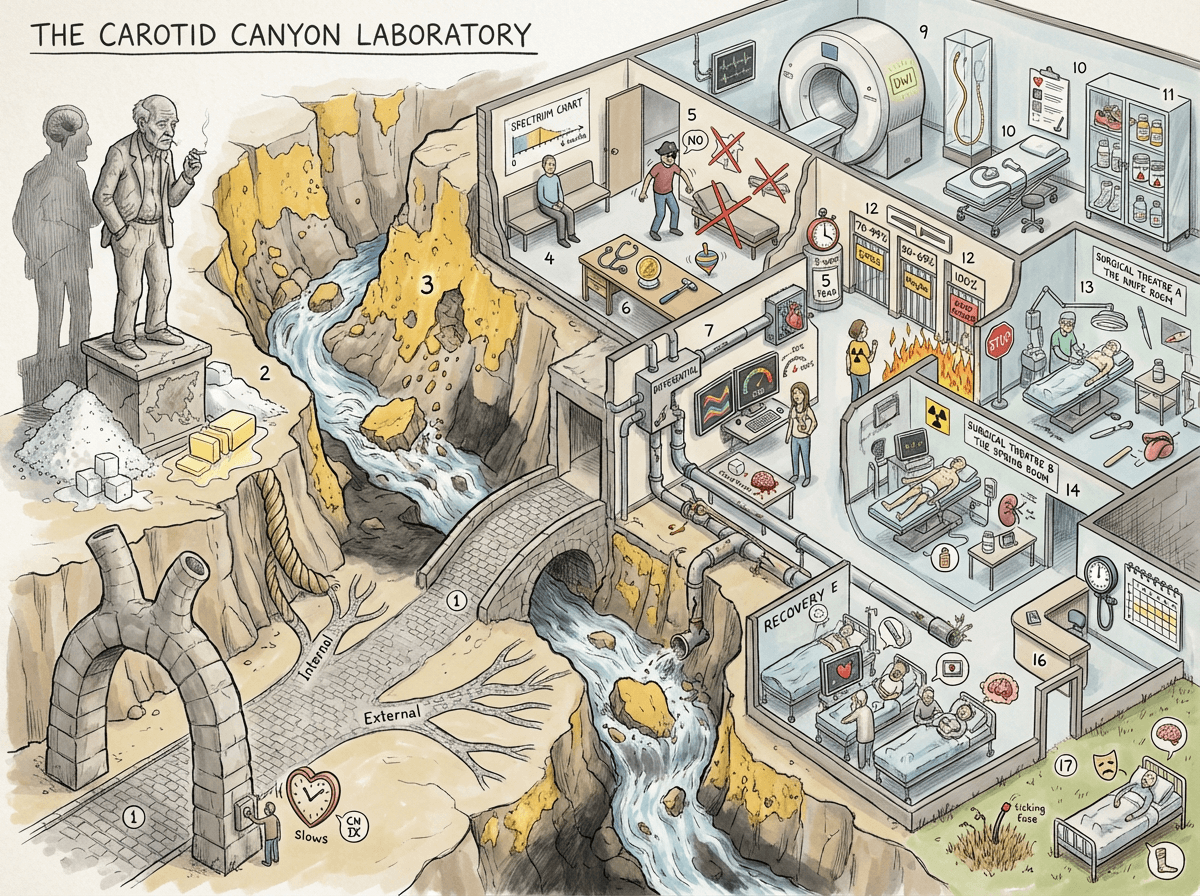
Sketchy memory palace for Carotid Artery Stenosis
| No. | Visual Cue | Meaning |
|---|---|---|
| 1 | A fork in the road labeled C3/C4; the main road has no side exits. A person is pressing a button at the fork (baroreceptor) causing a nearby heart-shaped clock to slow down (CN IX reflex). | - Definition: Narrowing of the carotid artery (usually at the bifurcation / proximal ICA) predominantly due to atherosclerosis. Classified as symptomatic (ipsilateral TIA/stroke within 6 months) or asymptomatic. - Anatomy: CCA bifurcates at C3/4 into ICA (no extracranial branches) and ECA (multiple branches, provides collateral flow). MCA is NOT part of the Circle of Willis. Vagus nerve lies posterior to CCA (90–95%). Carotid baroreceptors at ICA origin are innervated by CN IX — manipulation causes bradycardia/hypotension. |
| 2 | An old man smoking; 10-20% of his shadow is shaped like a stroke. A map of Asia is engraved on the pedestal. | - Epidemiology: Accounts for 10–20% of ischaemic strokes. More common in males, age >65, with cardiovascular risk factors. Intracranial atherosclerosis is relatively more common in Asian (including Hong Kong) populations, but extracranial carotid disease remains highly relevant. - Key Risk Factors: Smoking, hypertension, diabetes mellitus, hyperlipidaemia, family history — atherosclerosis is a systemic disease. |
| 3 | Yellow wall crumbling into a stream; a 'shadowy zone' on the ground represents the salvageable penumbra. | - Pathophysiology: Atherosclerotic plaque → plaque rupture/ulceration → thrombosis → artery-to-artery thromboembolism (dominant mechanism) or haemodynamic failure (less common, very high-grade stenosis). The ischaemic penumbra is potentially salvageable with timely reperfusion. |
| 4 | A calm patient on a bench (asymptomatic). A 6-month calendar defines symptomatic status (ipsilateral TIA/stroke within 6 months). | - Clinical Features - Asymptomatic: No symptoms; found incidentally. Even complete occlusion can be silent if collaterals are adequate. - Classification: By symptom status (symptomatic vs asymptomatic), by NASCET grade (mild < 50%, moderate 50–69%, severe 70 –99%, complete occlusion 100%), by plaque vulnerability. - Clinical classification: Symptomatic (ipsilateral TIA/stroke within 6 months) vs. asymptomatic. |
| 5 | Eyepatch (amaurosis fugax); limp opposite arm/face (contralateral hemiparesis/sensory loss); aphasia/neglect signs. A spinning top and fainting couch have large 'X' marks over them. | - Symptomatic: Amaurosis fugax (ipsilateral), contralateral hemiparesis (face/arm > leg), hemisensory loss, aphasia (dominant hemisphere), neglect (non-dominant), homonymous hemianopia. - Vertigo and syncope are NOT carotid symptoms. |
| 6 | A stethoscope on a neck (bruit); a golden coin inside a glass eye (Hollenhorst plaque); a hammer pointing to upward-pointing toes (UMN signs). | - Signs: Carotid bruit (poor predictor — absent in complete occlusion), Hollenhorst plaque on fundoscopy, contralateral UMN signs, cortical signs. |
| 7 | Heart pump (cardioembolism); cracked pipe (dissection with Horner's); young woman (FMD/Moyamoya/NPC radiation). A sugar cube and a bloody brain model (mimics) sit on a 'Check First' tray. | - Three aetiological buckets for ischaemic stroke (from lecture slides): cardioembolism, critical arterial stenosis, arterial dissection. Carotid stenosis falls under "critical arterial stenosis" — but you must exclude the other two. - Non-atherosclerotic causes of carotid narrowing: dissection (trauma/connective tissue disorder, Horner syndrome, retroorbital pain), FMD (young women, string of beads), vasculitis (Takayasu, GCA), radiation-induced stenosis (NPC in HK), Moyamoya (young, East Asian, puff of smoke). - Top stroke mimics to exclude urgently: hypoglycaemia (check glucose first), ICH (NCCT brain), Todd's paralysis (seizure history). - Cardioembolism is the most important differential: AF, valvular disease, mural thrombus. Always do ECG + echo + Holter even if carotid stenosis is found. - In Hong Kong: have a low threshold for considering intracranial atherosclerosis (more common in Asians than Caucasians), radiation-induced carotid stenosis (post-NPC treatment), and Moyamoya disease. |
| 8 | Double-screen USG; speedometer at 230 (PSV); ICA/CCA ratio > 4.0; NASCET grades (50%, 70%, 100%) listed on a dial. | - Imaging quantification: NASCET grade — mild ( < 50%), moderate (50–69%), severe (70–99%), occlusion (100%). - Acute presentation → exclude mimics (glucose, NCCT) → urgent carotid duplex → confirm with CTA/MRA → cardiac workup in parallel. - First-line vascular imaging: Carotid duplex USG — PSV > 230 cm/s and ICA/CCA ratio > 4.0 suggest ≥70% stenosis. |
| 9 | CT ring; MRI with a glowing 'DWI' light; heart monitor (ECG/Echo/Holter); gold-plated catheter (DSA gold standard). | - Incidental finding → carotid duplex → confirm with CTA/MRA if significant → classify and risk-stratify. - Confirmatory imaging: CTA or MRA. Two concordant non-invasive tests preferred before surgery. - Gold standard: DSA (cerebral angiography) — rarely used, reserved for discordant results or suspected non-atherosclerotic disease. - Brain imaging: Urgent NCCT to exclude haemorrhage. MRI DWI more sensitive for ischaemic infarction. - Cardiac workup: ECG + Holter + Echo — essential to exclude cardioembolism (especially AF). |
| 10 | Heart icon (MI risk); chest X-ray; laryngoscope (vocal cord check). A repeat ultrasound probe sits on the gurney. | - Pre-operative workup: Cardiac evaluation (MI is the leading perioperative killer), CXR, brain CT/MRI, repeat duplex to confirm ICA is not totally occluded, laryngoscopy if prior neck surgery. |
| 11 | Sneakers (lifestyle); Aspirin; 'Statin' (high intensity); 'Pril' bottle (ACEI). | - All patients: Best medical therapy (BMT) = lifestyle modification + aspirin + statin (high-intensity, regardless of lipid levels) + antihypertensive (ACEI). |
| 12 | Gate 70-99%: 2-week timer; Gate 50-69%: a 'Maybe' sign; Gate 100%: a 'Keep Closed' sign (contraindication). A '5 Year' clock for asymptomatic patients. | - Symptomatic 70–99%: BMT + revascularisation (CEA preferred in most; CAS if high surgical risk / anatomical contraindication). Aim within 2 weeks of event. Perioperative morbidity/mortality must be < 6% for symptomatic patients. - Symptomatic 50–69%: BMT ± CEA in selected patients (moderate benefit). - Symptomatic < 50% or 100% occlusion: BMT alone. Complete occlusion is an absolute contraindication to surgery. - Asymptomatic ≥70%: BMT for all. CEA in selected patients (life expectancy ≥5y, surgical risk < 3%). - Acute stroke: CEA/CAS is NOT for acute treatment — only for secondary prevention. |
| 13 | Surgical knife; 80+ year old patient; a tongue sticking out crookedly (CN XII injury). Aspirin-only bottle nearby. | - CEA vs CAS: CEA is preferred in standard cases, age ≥80, tortuous vessels; CAS is preferred if surgically inaccessible, prior radiation, re-stenosis after CEA, unfit for GA. CAS needs DAPT for 3 months; CEA needs aspirin alone. - Cranial nerve injury (CN XII most common → tongue deviation; also CN VII, IX, X, sympathetics) |
| 14 | Spring/Stent; groin bandage with a leak (access-site complication); black-inked kidney (contrast nephropathy); a slow heart rhythm on a monitor (bradycardia/atropine); DAPT bottle (double antiplatelets). | - Key CAS complications: Higher periprocedural stroke than CEA, baroreceptor-mediated bradycardia/hypotension (treat with atropine), contrast nephropathy, access-site complications, stent restenosis. - Higher periprocedural stroke than CEA (but similar long-term outcomes) - Baroreceptor-mediated bradycardia/hypotension (treat with atropine) - Contrast-induced nephropathy - Access-site complications (haematoma, pseudoaneurysm, peripheral embolisation) - Stent-related (fracture, in-stent restenosis, thrombosis) |
| 15 | Bulging neck bandage (cervical hematoma - airway emergency); heart clench (MI - top killer); brain with a red 'overflow' (hyperperfusion/hemorrhage); a weed growing in a clean pipe (restenosis). | - Key CEA complications: Stroke, hyperperfusion syndrome, MI, nerve injury (CN XII most common), cervical haematoma, restenosis (2–10% at 5 years). - Stroke (plaque emboli, improper flushing, hypotension, poor cerebral protection) - Hyperperfusion syndrome (loss of autoregulation → breakthrough haemorrhage/oedema; prevented by BP control 100–150 mmHg) - MI (leading cause of perioperative mortality — atherosclerosis is systemic) - Cervical haematoma (can cause abrupt airway obstruction — surgical emergency) - Carotid restenosis (2–10% at 5 years; early = neointimal hyperplasia, late = recurrent atherosclerosis) |
| 16 | Pressure gauge showing 100-150 mmHg. A calendar with 3-6 weeks, 6 months, and 1 year highlighted. | - Post-op: BP control (100–150 mmHg). Duplex surveillance at 3–6 weeks (baseline), 6 months, then annually. - Surveillance: Duplex at 3–6 weeks (baseline), 6 months, then annually for both CEA and CAS. |
| 17 | Ticking fuse (TIA 48-72hr risk); dead territorial patch (ischemic stroke); a sad theater mask (depression 29%); swollen brain icon; leg wrap (DVT). | - TIA (warning sign — highest stroke risk in first 48–72 hours) - Ischaemic stroke (territorial or watershed infarction) - Post-stroke complications: cerebral oedema, herniation, seizures, haemorrhagic transformation, MI, aspiration pneumonia, DVT/PE, pressure sores, post-stroke depression (29% prevalence) |
Aortic Dissection
Aortic dissection is a life-threatening condition in which a tear in the aortic intima allows blood to enter and separate the layers of the aortic wall, creating a false lumen.
Chronic Arterial Insufficiency
Chronic arterial insufficiency is a progressive narrowing or occlusion of the arterial lumen, most commonly due to atherosclerosis, resulting in inadequate blood flow to the distal tissues and manifesting as intermittent claudication, rest pain, and eventual tissue loss.