
Hepatocellular Carcinoma
Hepatocellular carcinoma is a primary malignant neoplasm of the liver arising from hepatocytes, most commonly occurring in the setting of chronic liver disease and cirrhosis.
| Exam domain | One-glance essentials |
|---|---|
| Definition / diagnosis |
|
| Epidemiology / risks |
|
| Core mechanism |
|
| Clinical picture |
|
| Investigations |
|
| Management |
|
| Complications |
|
| Prevention / follow-up |
|
| Exam traps |
|
References
[1] Senior notes: felixlai.md (Hepatocellular carcinoma sections, pp. 473–497)
Hepatocellular carcinoma (HCC) is a primary malignant neoplasm arising from hepatocytes — the principal parenchymal cells of the liver. Let's break the name down:
- Hepato- (Greek hēpar) = liver
- -cellular = of cells
- Carcinoma (Greek karkinos = crab + -oma = tumour) = malignant epithelial neoplasm
So the name literally tells you: a malignant tumour of liver cells.
It is the most common primary liver cancer (~80%), with intrahepatic cholangiocarcinoma (ICC) accounting for ~15% and other rare subtypes making up the remainder [1][2][3].
HCC characteristically develops in a background of chronic liver disease and cirrhosis, making it almost unique among solid malignancies — the organ harbouring the cancer is itself already diseased and dysfunctional. This dual pathology (cancer + liver failure) is what makes HCC so challenging to manage and so lethal.
Key Concept
HCC is one of the few cancers where the patient may die from the underlying organ failure (cirrhosis) rather than from the cancer itself. Treatment must always account for both the tumour burden AND the liver function reserve.
2. Epidemiology
- HCC is the 6th most common cancer worldwide and the 3rd leading cause of cancer-related death globally (after lung and colorectal cancer) [1][2].
- Globally ~900,000 new cases/year and ~830,000 deaths/year (2020 GLOBOCAN data), reflecting the very high case-fatality ratio.
- There is a striking geographic variation linked to the prevalence of underlying aetiologies:
| Region | Incidence | Dominant Aetiology |
|---|---|---|
| East Asia (China, HK), Southeast Asia, Sub-Saharan Africa | High | HBV |
| Japan, Southern Europe, Egypt | Intermediate–High | HCV |
| UK, North America, Australia | Low (but rising) | HCV, NAFLD/NASH, Alcohol |
- The rising incidence in Western countries is driven by the NAFLD/NASH epidemic (obesity, metabolic syndrome) and ageing HCV cohorts [2].
This is extremely high-yield for HKUMed exams.
- HCC is exceedingly common in Hong Kong [1][4].
- Second commonest cancer death in Hong Kong [4] (some older data cites 3rd — the ranking fluctuates between 2nd and 3rd with lung and colorectal cancer; as of recent data, it is the 3rd most common cause of cancer death in HK, but lecture slides from Prof Poon state second [4]).
- 5th most common cancer in HK overall by incidence [2].
- HCC is 6× more common than cholangiocarcinoma (HCC:CC = 6:1) [1].
- HCC constitutes 78.7% of primary malignant liver tumours in HK, CC = 9.7% [1].
- M:F = 4:1 [4] (some older data quotes 6:1 — the key point is a strong male predominance, partly explained by higher HBV carrier rates in males, androgen-related pathways, and higher rates of alcohol use).
- Most patients age > 50 years, but can occur in young patients [4].
- Peak age of mortality = 45–55 years in HK [1].
- 80% of HCC in Hong Kong are HBsAg-positive — i.e. Hepatitis B is the overwhelmingly dominant aetiology in HK [3][4].
- Frequent association with cirrhosis (80% in Hong Kong) [4].
High Yield — Hong Kong Focus
In HK, think HBV → Cirrhosis → HCC. About 80% of HCC patients are HBsAg+, and 80% have underlying cirrhosis. This is the bread-and-butter clinical scenario you will see on the wards at Queen Mary Hospital.
- Insidious onset with rapidly progressing course which is fatal [1].
- Median survival of untreated HCC = 2–4 months (for symptomatic, advanced disease) [1].
- 5-year survival varies dramatically by stage:
- Early stage (BCLC 0/A) with curative treatment: 50–70%
- Intermediate stage (BCLC B): ~20%
- Advanced/Terminal stage: < 5%
3. Anatomy and Function — Relevant Hepatic Anatomy
Understanding liver anatomy is critical for HCC because it determines resectability, blood supply for locoregional therapy, and patterns of spread.
The liver is divided into 8 functionally independent segments (I–VIII), each with its own:
- Portal pedicle (portal vein branch, hepatic artery branch, bile duct)
- Hepatic venous drainage
This segmental anatomy is the basis for anatomical hepatic resection — you can remove segments independently because each is a self-contained unit.
| Division | Segments | Notes |
|---|---|---|
| Right lobe | V, VI, VII, VIII | Separated from left by the middle hepatic vein (Cantlie's line) |
| Left lobe | II, III, IV | Segment IV is the quadrate lobe |
| Caudate lobe | I | Unique: drains directly into IVC via short hepatic veins; has dual portal blood supply from both right and left portal branches |
The liver has a unique dual blood supply, which is essential for understanding HCC biology and treatment:
- Portal vein (~75% of hepatic blood flow): carries nutrient-rich, relatively deoxygenated blood from the GI tract
- Hepatic artery (~25% of hepatic blood flow): carries oxygenated blood from the coeliac trunk
Why does this matter for HCC?
- Normal hepatocytes derive most of their blood supply from the portal vein.
- HCC tumour nodules derive > 90% of their blood supply from the hepatic artery (neoangiogenesis is predominantly arterial).
- This differential supply is the basis for:
- Arterial enhancement on CT/MRI (tumour "lights up" in arterial phase → washes out in portal venous/delayed phase — the hallmark imaging feature of HCC)
- Transarterial chemoembolisation (TACE) — you deliver chemotherapy and embolic material via the hepatic artery, selectively starving the tumour while relatively sparing normal liver parenchyma
Three major hepatic veins (right, middle, left) drain into the inferior vena cava (IVC). This is relevant because:
- HCC has a high propensity for venous invasion (portal and hepatic veins) [4]
- Spread through portal vein branches → intrahepatic metastasis (the most common route of intrahepatic spread)
- Spread through hepatic vein branches → IVC → right heart → lungs [1]
- Portal vein tumour thrombus (PVTT) is one of the most significant adverse prognostic features
The liver is enveloped by Glisson's capsule (a thin layer of connective tissue derived from the peritoneum). The liver parenchyma itself has no pain fibres — pain only occurs when Glisson's capsule is stretched or invaded by tumour. This explains why:
- Small HCCs are painless (they don't stretch the capsule)
- Large HCCs cause RUQ pain ± referred right shoulder pain (diaphragmatic irritation via phrenic nerve, C3-C5) [2]
- Ruptured HCC causes sudden severe abdominal pain and peritonism
- Hilum (porta hepatis): where the portal vein, hepatic artery, and common hepatic duct enter/exit. HCC spread to hilar lymph nodes occurs here [1].
- Diaphragm: the liver dome is in close proximity; large HCCs can invade or irritate the diaphragm.
4. Etiology (Focus on Hong Kong)
Framework for HCC Aetiology
Think of it as: Anything that causes chronic liver injury → inflammation → fibrosis → cirrhosis → HCC. The carcinogenic "highway" is: Chronic injury → Regeneration → Mutation accumulation → Dysplasia → HCC. However, HBV is unique because it can cause HCC even WITHOUT cirrhosis (via direct DNA integration).
Hepatitis B virus is responsible for ~80% of HCC cases in Hong Kong [3][4].
Why does HBV cause HCC? Two mechanisms:
-
Indirect (via cirrhosis): Chronic HBV infection → chronic hepatic inflammation → hepatocyte necrosis and regeneration → progressive fibrosis → cirrhosis → HCC
- Risk of cirrhosis = 20–30% of chronically infected adults will develop cirrhosis over 10–15 years [1]
-
Direct oncogenic effect (unique to HBV, not HCV):
- HBV DNA integrates into the host hepatocyte genome — this can activate proto-oncogenes or disrupt tumour suppressor genes [5]
- HBV-encoded X antigen (HBxAg), Pre-S1, Pre-S2 proteins are responsible for carcinogenesis [1]:
- HBx protein → transactivates cellular oncogenes, inhibits p53 tumour suppressor function, promotes cell proliferation, inhibits DNA repair, activates NF-κB and MAPK pathways
- Pre-S mutants → cause ER stress, oxidative DNA damage, and genomic instability
- Because of this direct oncogenic effect, HCC complicating HBV can present on a non-cirrhotic liver (20% of cases) [1]
HBV vs HCV in HCC
A common exam mistake: students assume all HCC arises in cirrhotic livers. This is true for HCV (100% cirrhotic) but NOT for HBV (80% cirrhotic, 20% non-cirrhotic). HBV has a direct oncogenic effect through DNA integration — it doesn't need cirrhosis as an intermediate step. This is a favourite exam question.
Risk factors for HCC in HBV carriers:
- Male sex
- Older age (> 40 years)
- Family history of HCC
- High HBV DNA viral load (> 2000 IU/mL)
- HBeAg positivity
- Genotype C (common in HK)
- Co-infection with HCV, HDV, or HIV
- Active inflammation (elevated ALT)
- Presence of cirrhosis
- Aflatoxin exposure (synergistic with HBV)
- Common in Japan and Western countries [4] but accounts for only ~4% of HCC in HK [1].
- HCC complicating HCV ALWAYS presents on a cirrhotic liver (100%) [1] — HCV is an RNA virus that does not integrate into host DNA (unlike HBV). Therefore HCV causes HCC purely through the indirect pathway: chronic inflammation → cirrhosis → HCC.
- HCV causes HCC at a rate of ~1–4% per year in cirrhotic patients.
- With the advent of direct-acting antivirals (DAAs), HCV can now be cured in > 95% of cases, but the risk of HCC persists even after viral eradication (especially if cirrhosis is already established).
- Cirrhosis is present in 70–90% of HCC cases overall; 80% in HK [1][4].
- Any cause of cirrhosis can lead to HCC, because the final common pathway is: chronic hepatocyte injury → regenerative hyperplasia → dysplastic nodules → HCC.
- The annual risk of HCC development in a cirrhotic liver is 1–6%/year depending on the aetiology.
- Accounts for ~4% of HCC cases in HK [1] but is a major cause in Western countries.
- HCC develops on top of alcoholic cirrhosis (100%) — alcohol does not have a direct oncogenic effect comparable to HBV [1].
- Mechanism: Chronic alcohol → acetaldehyde (toxic metabolite) → oxidative stress + lipid peroxidation → hepatocyte injury → inflammation → fibrosis → cirrhosis → HCC.
- High but NOT moderate level of alcohol consumption is the risk factor [1].
- Alcohol can also act synergistically with HBV or HCV to accelerate cirrhosis and HCC development.
- Now renamed MASLD (2023 nomenclature), encompassing:
- Non-alcoholic fatty liver (NAFL) / metabolic dysfunction-associated steatotic liver (MASL)
- Non-alcoholic steatohepatitis (NASH) / metabolic dysfunction-associated steatohepatitis (MASH)
- The fastest-growing cause of HCC worldwide, driven by the global obesity/metabolic syndrome epidemic.
- NASH-related HCC can occur without cirrhosis in up to 20–30% of cases — similar to HBV. This is thought to be due to the pro-inflammatory, pro-oxidative environment of steatohepatitis driving direct DNA damage.
- Key metabolic risk factors: obesity, type 2 diabetes mellitus, dyslipidaemia, metabolic syndrome [1][2].
- Mycotoxins produced by Aspergillus flavus which contaminates corn, soybeans, and peanuts [1].
- Leads to mutation of the p53 tumour suppressor gene (specifically the R249S hotspot mutation — an arginine-to-serine substitution at codon 249) [1].
- Risk factor in Africa and rural areas of China but NOT Hong Kong [1][4].
- Aflatoxin has a synergistic effect with HBV: the combination of HBV + aflatoxin exposure increases HCC risk multiplicatively (up to 60× compared to neither alone).
- Autoimmune hepatitis (AIH): chronic inflammation → cirrhosis → HCC
- Primary biliary cholangitis (PBC): progressive bile duct destruction → biliary cirrhosis → HCC
- Primary sclerosing cholangitis (PSC): biliary stricturing and inflammation → biliary cirrhosis → both cholangiocarcinoma (more common) and HCC
- Hereditary haemochromatosis: excess iron deposition → oxidative stress → hepatocyte injury → cirrhosis → HCC. Iron itself is also a direct mutagen via Fenton chemistry (Fe²⁺ + H₂O₂ → OH• free radicals).
- Wilson's disease: copper overload → oxidative liver damage → cirrhosis → HCC (though interestingly, the risk of HCC in Wilson's disease is lower than expected, possibly because excess copper has some anti-tumour properties).
- α1-antitrypsin deficiency: misfolded protein accumulates in hepatocyte ER → ER stress → chronic liver injury → cirrhosis → HCC.
| Risk Factor | Mechanism |
|---|---|
| Obesity [1] | Insulin resistance → hyperinsulinaemia → ↑IGF-1 → hepatocyte proliferation; also promotes NASH |
| Diabetes mellitus [1] | Hyperinsulinaemia → mitogenic effect; DM independently ↑ HCC risk 2–3× |
| Smoking [1] | Tobacco carcinogens (nitrosamines, polycyclic aromatic hydrocarbons) → direct DNA damage in hepatocytes |
| Oral contraceptives / Androgens | Rare; associated with hepatic adenoma → malignant transformation |
Exam Summary — HCC Aetiology in HK
The "Big 3" in HK: (1) HBV (80%), (2) HCV (4%), (3) Alcohol (4%). The remainder is NASH, cryptogenic, and rare causes. Always ask about HBV status first in any patient with a liver mass in HK.
5. Pathophysiology
HCC develops through a well-characterised multistep process, beautifully illustrated on the lecture slide showing the progression from chronic liver disease to HCC [5]:
Chronic Liver Injury → Hepatocyte Proliferation → Fibrosis/Cirrhosis →
Hyperplastic Nodule → Dysplastic Nodule (Low → High Grade) →
Well-Differentiated HCC → Moderately Differentiated → Poorly Differentiated HCC
Let's walk through each step:
- Chronic liver injury (HBV, HCV, alcohol, NASH, etc.) → ongoing hepatocyte death
- Stellate cell activation → extensive scarring (collagen deposition) → fibrosis → cirrhosis [5]
- Hepatocyte regeneration under proliferative pressure → telomere shortening with each cell division [5]
- Hyperplastic nodules → still polyclonal, no dysplasia
- Moderate genomic instability → Dysplastic nodules → monoclonal, contain cytological atypia [5]
- Telomerase reactivation → cells escape senescence and gain replicative immortality [5]
- Marked genomic instability → Loss of p53 and other tumour suppressors → HCC [5]
- Progressive dedifferentiation: well-differentiated → moderately differentiated → poorly differentiated
The Telomere Story
This is elegant: chronic liver injury forces hepatocytes to divide repeatedly. Each division shortens telomeres (the protective DNA caps). Eventually, critically short telomeres trigger genomic instability — chromosomes break and fuse abnormally. To escape this crisis, some cells reactivate telomerase (TERT promoter mutations are found in > 60% of HCC). These cells now have unlimited replication + genomic instability = cancer.
| Pathway | Alteration | Effect |
|---|---|---|
| TERT promoter | Activating mutation (most common, ~60%) | Telomerase reactivation → replicative immortality |
| TP53 | Loss-of-function mutation [5] | Loss of cell cycle checkpoint → uncontrolled proliferation |
| CTNNB1 (β-catenin) | Activating mutation (~30%) | Wnt/β-catenin pathway activation → proliferation |
| HBV DNA integration | Insertional mutagenesis | Disrupts tumour suppressors or activates oncogenes |
| VEGF / FGF | Overexpression | Neoangiogenesis → hypervascular tumour |
| RAS/MAPK | Activation | Cell proliferation and survival |
| PI3K/AKT/mTOR | Activation | Growth signalling |
HCC is a vascular tumour with a high propensity for venous invasion (portal and hepatic veins) [4].
- Neoangiogenesis: HCC secretes high levels of VEGF, creating a rich network of abnormal arterial vessels → this is why HCC is a hypervascular tumour
- Arterial blood supply: as hepatocytes become dysplastic and then malignant, they progressively lose their portal venous supply and become increasingly dependent on hepatic artery branches via unpaired arteries (arteries not accompanied by portal tracts). This arterialisation is a hallmark of HCC.
- Sinusoidal capillarisation: normal liver sinusoids are fenestrated (with gaps); in HCC, sinusoids become capillarised (endothelium becomes continuous) → contributes to the imaging characteristics.
5.4 Pathology
Three macroscopic types: massive, nodular, diffuse [4]:
| Type | Description | Features |
|---|---|---|
| Massive | Single large mass, often in right lobe | Most common type; may have satellite nodules |
| Nodular | Multiple discrete nodules scattered throughout liver | Often in cirrhotic livers; can be confused with regenerative/dysplastic nodules |
| Diffuse | Innumerable small nodules permeating entire liver | Worst prognosis; difficult to distinguish from cirrhotic nodules; essentially unresectable |
Other gross features [1]:
- Soft in texture
- Light-brown or tan-coloured masses
- Yellow patches of necrosis — because the tumour outgrows its blood supply (central necrosis is common in large tumours)
- Extensive haemorrhagic areas — because the tumour is highly vascular and derives blood supply from sinusoids and hepatic artery [1]
- Green discolouration of tumour — production of bile by tumour cells → this is a diagnostic feature of HCC (because only hepatocytes make bile; if you see a green liver tumour, it's HCC until proven otherwise) [1]
- Formation of clear cells → secretion of insulin-like peptide (ILP) → induces attacks of hypoglycaemia → excess glycogen in the tumour (clear cells) [1]
- Trabecular pattern of hepatocytes (80%) — the most common pattern; tumour cells arranged in plates/cords resembling normal hepatic architecture, separated by sinusoidal vascular spaces [1]
- Pseudoglandular pattern — tumour cells form gland-like structures (acini) [1]
- Vascular sinusoids — lined by endothelium; prominent vascularity [1]
- Compact/solid pattern — sheets of tumour cells with minimal sinusoidal framework
- Tumour cells resemble hepatocytes to varying degrees (well → moderately → poorly differentiated)
- Mallory-Denk bodies, fat, glycogen, and bile may be seen within tumour cells
- Most common in younger women (and young patients generally) [4]
- Good prognosis compared to conventional HCC [4]
- Not associated with HBV or cirrhosis [2]
- Characterised by large eosinophilic tumour cells with abundant mitochondria, separated by dense lamellar fibrosis (parallel bands of collagen) — hence "fibro-lamellar"
- Often has a central scar (can mimic focal nodular hyperplasia on imaging)
- Pathognomonic molecular feature: DNAJB1-PRKACA fusion gene
6. Classification and Staging
| Stage | T | N | M | Description |
|---|---|---|---|---|
| IA | T1a | N0 | M0 | Solitary ≤ 2 cm, ± vascular invasion |
| IB | T1b | N0 | M0 | Solitary > 2 cm, without vascular invasion |
| II | T2 | N0 | M0 | Solitary with vascular invasion > 2 cm, OR multiple ≤ 5 cm |
| IIIA | T3 | N0 | M0 | Multiple, at least one > 5 cm |
| IIIB | T4 | N0 | M0 | Invasion of major branch of portal/hepatic vein, or direct invasion of adjacent organs (excluding gallbladder), or perforation of visceral peritoneum |
| IVA | Any T | N1 | M0 | Regional lymph node metastasis |
| IVB | Any T | Any N | M1 | Distant metastasis |
This is the most widely used staging system for HCC because, unlike TNM, it integrates tumour burden + liver function + performance status and links directly to treatment recommendations.
| BCLC Stage | Tumour Status | Liver Function | PS | Treatment |
|---|---|---|---|---|
| 0 (Very Early) | Single ≤ 2 cm | Child-Pugh A | 0 | Resection / Ablation / Transplant |
| A (Early) | Single or ≤ 3 nodules (each ≤ 3 cm) | Child-Pugh A–B | 0 | Resection / Ablation / Transplant |
| B (Intermediate) | Multinodular, large | Child-Pugh A–B | 0 | TACE |
| C (Advanced) | Portal invasion, N1, M1 | Child-Pugh A–B | 1–2 | Systemic therapy |
| D (Terminal) | Any | Child-Pugh C | 3–4 | Best supportive care |
This is indispensable for HCC management. It uses 5 parameters ("ABCDE" mnemonic: Albumin, Bilirubin, Clotting/PT-INR, Distension/ascites, Encephalopathy):
| Parameter | 1 point | 2 points | 3 points |
|---|---|---|---|
| Albumin (g/L) | > 35 | 28–35 | < 28 |
| Bilirubin (µmol/L) | < 34 | 34–51 | > 51 |
| PT-INR | < 1.7 | 1.7–2.3 | > 2.3 |
| Ascites | None | Mild/controlled | Moderate–severe |
| Encephalopathy | None | Grade I–II | Grade III–IV |
| Class | Score | 1-year Survival | 2-year Survival |
|---|---|---|---|
| A | 5–6 | 100% | 85% |
| B | 7–9 | 80% | 60% |
| C | 10–15 | 45% | 35% |
Developed at Queen Mary Hospital, HKU — tailored for the Hong Kong/Asian HBV-dominant population. It differs from BCLC by being more aggressive with surgical/locoregional treatments in intermediate-advanced stages, reflecting the better outcomes observed in Asian centres with high surgical expertise. It classifies patients based on:
- ECOG performance status
- Child-Pugh classification
- Tumour extent (intra/extrahepatic, vascular invasion)
7. Patterns of Spread
- The most common route of spread
- Via portal venous circulation — tumour invades a portal vein branch, and tumour cells seed downstream portal territories
- This is why you often see satellite nodules around the main tumour and in other segments
- High propensity for portal vein invasion [4]
- Can extend from segmental branches → main portal vein → even into the superior mesenteric vein
- Consequences:
- Worsens portal hypertension (→ variceal bleeding, ascites)
- Makes the non-tumorous liver completely dependent on hepatic arterial supply
- Major caution for TACE, especially main portal-vein occlusion: loss of both inflows risks ischaemic liver failure. Branch involvement requires individual expert assessment
- Spread through hepatic vein branches → IVC → right atrium
- Can form a tumour "tongue" extending into the IVC (similar to renal cell carcinoma)
- Lung metastasis via hepatic vein dissemination [4]
- Lung (most common extrahepatic site) — via hepatic veins/systemic circulation
- Bone — often osteolytic, can present with pathological fractures or cord compression
- Lymph nodes (porta hepatis) [1] — regional spread
- Peritoneal metastasis [4] — especially after rupture
- Adrenal glands [1]
- Brain — rare but possible
- Usually death precedes extensive metastasis [1] — most patients die of liver failure or variceal bleeding before metastases become clinically dominant
8. Clinical Features
Key Clinical Principle
Clinical features: late presentation + absence of pathognomonic symptoms → difficult diagnosis [2]. Most patients are asymptomatic until the tumour is large ( > 8 cm) or liver function decompensates. This is why screening in high-risk groups is so important.
The lecture slide from Prof Poon lists 4 major clinical presentations [4]:
- Subclinical (detected on screening with AFP and USG in HBsAg carriers or cirrhotic patients)
- RUQ pain, hepatomegaly
- Decompensation of cirrhosis (ascites, variceal bleeding, hepatic encephalopathy)
- Intraperitoneal haemorrhage (rupture of HCC)
- Paraneoplastic features: fever, hypercalcaemia, hypoglycaemia, erythrocytosis
8.2 Symptoms
| Symptom | Pathophysiological Basis |
|---|---|
| RUQ pain ± right shoulder pain [2][4] | Distension of Glisson's capsule by the expanding tumour mass. Glisson's capsule is innervated by the lower intercostal nerves and phrenic nerve. Right shoulder pain = referred pain via the phrenic nerve (C3-C5) when the tumour irritates the diaphragmatic surface of the liver. |
| Dull aching/heaviness in RUQ | Gradual capsular stretching by slow tumour growth |
| Sudden severe abdominal pain | Rupture of HCC → intraperitoneal haemorrhage → acute peritonism. This is a surgical emergency. HCC is highly vascular, and large subcapsular tumours can rupture spontaneously. |
| Loss of appetite (LOA), loss of weight (LOW) [2] | Tumour cachexia — mediated by pro-inflammatory cytokines (TNF-α, IL-6) secreted by the tumour and host immune system; also mechanical early satiety from hepatomegaly compressing the stomach |
| Abdominal distension | Ascites — from (a) portal hypertension (cirrhosis ± PVTT), (b) peritoneal carcinomatosis, (c) hypoalbuminaemia (failing liver can't synthesise albumin → ↓ oncotic pressure) |
| Nausea/vomiting | Liver capsule stretching; also may be due to raised intracranial pressure if brain metastases (rare) |
| Early satiety | Hepatomegaly displacing the stomach |
When HCC develops in a cirrhotic liver, the additional metabolic demand and mass effect can push a previously compensated cirrhosis into decompensation:
| Symptom | Mechanism |
|---|---|
| Ascites [4] | Portal hypertension (↑ hydrostatic pressure in portal venous system) + hypoalbuminaemia (↓ oncotic pressure) + RAAS activation (Na+ and water retention). PVTT from HCC dramatically worsens portal HT. |
| Variceal bleeding (haematemesis/melaena) [4] | Portal hypertension → portosystemic collaterals → oesophageal/gastric varices → rupture → life-threatening UGIB |
| Hepatic encephalopathy (confusion, drowsiness, asterixis) [4] | Liver failure → inability to clear ammonia and other neurotoxins → accumulation in CNS → astrocyte swelling (via glutamine synthesis) → cerebral oedema and dysfunction |
| Jaundice | Either (a) failing liver can't conjugate/excrete bilirubin, or (b) tumour invasion of biliary tree or compression of intrahepatic ducts [2] — obstructive jaundice is NOT common in HCC [2] (unlike cholangiocarcinoma) |
| Peripheral oedema | Hypoalbuminaemia + portal HT + secondary hyperaldosteronism |
| Easy bruising / bleeding | Coagulopathy from ↓ synthesis of clotting factors (II, VII, IX, X) by failing liver + thrombocytopenia from hypersplenism |
| Symptom | Mechanism |
|---|---|
| Fatigue, malaise | Chronic disease; cytokine-mediated (IL-6, TNF-α); anaemia |
| Fever [4] | Tumour necrosis releasing pyrogens; also tumour cells themselves can produce IL-6. Fever of unknown origin can be a presentation of HCC (so-called "tumour fever"). Must exclude infection (e.g. SBP, cholangitis) in a cirrhotic patient. |
| Night sweats | Cytokine-mediated, similar to lymphoma |
8.3 Signs
| Sign | Pathophysiological Basis |
|---|---|
| Hepatomegaly [2][4] | Direct tumour mass effect. The liver may be massively enlarged, hard, irregular, and tender on palpation. A liver that was previously small and cirrhotic now becoming palpably enlarged should raise suspicion for HCC. |
| Hepatic bruit / arterial bruit over liver | Hypervascular tumour → turbulent arterial flow → audible bruit on auscultation over the liver. This is a relatively specific sign for HCC (though uncommon). |
| Hepatic friction rub | Tumour involving the liver surface → inflammation of overlying peritoneum → palpable/audible friction rub |
| Hard, irregular, nodular liver | Tumour nodules within the liver parenchyma |
Since 80% of HCC in HK occurs on a cirrhotic background, look for:
| Sign | Mechanism |
|---|---|
| Jaundice (scleral icterus) | ↓ bilirubin conjugation/excretion (hepatocellular) or biliary obstruction |
| Spider naevi (> 5 abnormal) | Hyperestrogenism (failing liver can't metabolise oestrogen) → arteriolar vasodilation |
| Palmar erythema | Hyperestrogenism → peripheral vasodilation |
| Gynaecomastia, testicular atrophy | Hyperestrogenism + ↓ sex hormone-binding globulin synthesis |
| Caput medusae | Portal HT → recanalization of umbilical vein → visible periumbilical veins |
| Splenomegaly | Portal HT → splenic congestion |
| Ascites (shifting dullness, fluid thrill) | Portal HT + hypoalbuminaemia + RAAS activation |
| Asterixis (liver flap) | Hepatic encephalopathy → ammonia-mediated disruption of diencephalic motor centres |
| Fetor hepaticus | Dimethyl sulfide (from failed hepatic metabolism of mercaptans) in expired air — a sweet, musty odour |
| Dupuytren's contracture | Associated with alcoholic liver disease (palmar fibromatosis) |
| Leuconychia (white nails) | Hypoalbuminaemia |
| Clubbing | Hepatopulmonary syndrome (intrapulmonary vascular dilatation) |
| Muscle wasting | Protein-calorie malnutrition; impaired hepatic protein synthesis |
- Sudden haemodynamic collapse: tachycardia, hypotension, pallor, diaphoresis
- Acute abdomen: diffuse peritonism (guarding, rigidity, rebound tenderness)
- This is a life-threatening emergency (mortality 30–70%)
- Occurs in ~10% of HCC patients, more common with large, subcapsular tumours
- Mechanism: the tumour erodes through Glisson's capsule and bleeds into the peritoneal cavity
These are non-metastatic systemic manifestations caused by bioactive substances secreted by tumour cells. They occur in ~5–10% of HCC patients and can sometimes be the presenting feature.
| Paraneoplastic Syndrome | Mechanism | Clinical Feature |
|---|---|---|
| Erythrocytosis (polycythaemia) [2][4] | Tumour secretes erythropoietin (EPO) → stimulates erythropoiesis in bone marrow → ↑ RBC mass. Normal liver doesn't produce significant EPO (kidneys do), but HCC cells can ectopically produce it. | Plethoric facies, elevated Hb/Hct |
| Hypoglycaemia [2][4] | Two mechanisms: (a) High metabolic demands of tumour consuming glucose, (b) Tumour secretes IGF-2 (insulin-like growth factor 2) [2] — a large peptide with insulin-like activity that drives glucose uptake. Also, secretion of insulin-like peptide (ILP) [1] → excess glycogen in tumour (clear cells) [1]. Additionally, the failing cirrhotic liver has reduced glycogen stores and impaired gluconeogenesis. | Sweating, confusion, seizures, LOC — can be recurrent and severe |
| Hypercalcaemia [2][4] | Tumour secretes PTHrP (parathyroid hormone-related peptide) → mimics PTH → activates osteoclasts → bone resorption → ↑ serum Ca²⁺. Also ↑ renal calcium reabsorption. | Stones, bones, moans, groans, thrones (renal calculi, bone pain, depression, abdominal pain, polyuria) |
| Hypercholesterolaemia [2] | Autonomous cholesterol synthesis by tumour cells — the normal feedback inhibition (via LDL receptor pathway) is lost in malignant hepatocytes. | Elevated serum cholesterol (usually an incidental lab finding) |
| Watery diarrhoea [2] | Tumour secretes VIP (vasoactive intestinal peptide) → stimulates intestinal secretion of water and electrolytes → secretory diarrhoea (similar to VIPoma). | Profuse watery diarrhoea, hypokalaemia, achlorhydria (WDHA syndrome) |
| Dermatomyositis [2] | Autoimmune paraneoplastic phenomenon — tumour antigens cross-react with skin and muscle proteins → immune-mediated inflammation | Heliotrope rash (purple eyelids), Gottron's papules (knuckles), proximal muscle weakness |
| Leser-Trélat sign [2] | Explosive onset of multiple seborrheic keratoses — mediated by tumour secretion of growth factors (TGF-α, EGF) stimulating keratinocyte proliferation | Sudden appearance of many "stuck on" warty lesions |
| Fever [4] | Tumour necrosis → release of endogenous pyrogens (IL-1, IL-6, TNF-α) | Unexplained pyrexia (diagnosis of exclusion) |
Paraneoplastic Syndromes — Exam Tip
Students often forget the paraneoplastic features of HCC. The examiners love asking about erythrocytosis (because it's counterintuitive — you'd expect anaemia in cancer!) and hypoglycaemia (because it's counterintuitive — you'd expect hyperglycaemia in a liver mass!). Know the mechanisms.
| Site | Signs |
|---|---|
| Lung | Cough, haemoptysis, dyspnoea, pleural effusion |
| Bone | Bone pain, pathological fractures, cord compression |
| Brain | Headache, focal neurological deficits, seizures |
| Peritoneum | Ascites (bloody/exudative), Virchow's node (left supraclavicular) |
| Adrenals | Usually asymptomatic; rarely adrenal insufficiency if bilateral |
9. Screening for HCC
Screening with AFP and USG in HBsAg carriers or cirrhotic patients [4].
| Population | Recommendation |
|---|---|
| HBV carriers > 40 years old | USG + AFP every 6 months |
| HBV carriers with cirrhosis (any age) | USG + AFP every 6 months |
| HBV/HCV co-infected with HIV | USG + AFP every 6 months |
| Cirrhosis of any aetiology | USG ± AFP every 6 months |
| Family history of HCC in HBV carrier | USG + AFP every 6 months (start earlier, e.g. age 20–30) |
- Ultrasound (USG): sensitivity ~60–80% for early HCC. Limited by operator dependence, body habitus, and cirrhotic liver background.
- Alpha-fetoprotein (AFP): see below.
- CUHK-HCC score: a validated risk prediction model incorporating age, albumin, bilirubin, cirrhosis, HBV DNA level [2] — helps stratify which HBV carriers need more intensive screening.
Why Screen?
Symptoms usually appear only when the tumour is > 8 cm [1]. At that size, curative options are limited. Screening aims to detect HCC at BCLC 0/A stage when curative treatments (resection, ablation, transplant) are feasible and 5-year survival is 50–70%.
This was explicitly addressed in the senior notes and is a favourite exam question:
- Patients present with symptoms at late stage — symptoms usually don't appear until the tumour is > 8 cm [1]
- Majority have underlying cirrhosis which limits scope for resection or other interventions — you can't resect half the liver if the remaining half is cirrhotic and can barely function [1]
- Early or pre-malignant lesions are present in other parts of the liver — "field cancerisation" — the entire liver is exposed to the oncogenic influence of HBV/HCV/cirrhosis, so even after curative treatment, there's a high risk of a 2nd primary HCC developing [1]
- Early IV spread leads to early metastasis or portal vein thrombosis [1]
High Yield Summary
Definition: HCC = primary malignant tumour of hepatocytes; most common primary liver cancer (~80%).
Epidemiology (HK Focus):
- 3rd–2nd commonest cancer death in HK; M:F = 4–6:1; peak 45–55 years
- 80% HBsAg-positive; 80% have cirrhosis
- HCC:CC = 6:1
Aetiology:
- HBV (80% in HK) — both indirect (cirrhosis) and direct (HBx, DNA integration) oncogenesis; 20% develop HCC WITHOUT cirrhosis
- HCV — 100% develop HCC on cirrhotic liver (no direct oncogenic effect)
- Alcohol — HCC only via cirrhosis (100%)
- NAFLD/NASH — rising globally; can cause HCC without cirrhosis
- Aflatoxin → p53 R249S mutation (NOT a risk factor in HK)
Pathogenesis: Chronic injury → regeneration → telomere shortening → genomic instability → telomerase reactivation → loss of p53 → HCC
Pathology: Massive/nodular/diffuse; hypervascular; green (bile production); trabecular histology (80%); fibrolamellar variant (young, no cirrhosis, good prognosis)
Spread: Intrahepatic (portal vein) > lung (hepatic vein → IVC) > bone > LN > peritoneum > adrenals
Clinical Presentation:
- Often asymptomatic until late (> 8 cm)
- RUQ pain (capsular stretch) ± right shoulder (phrenic nerve)
- Decompensated cirrhosis (ascites, variceal bleed, encephalopathy)
- Ruptured HCC (surgical emergency)
- Paraneoplastic: erythrocytosis (EPO), hypoglycaemia (IGF-2), hypercalcaemia (PTHrP), hypercholesterolaemia, watery diarrhoea (VIP)
Screening: USG + AFP every 6 months in HBV carriers > 40 years and all cirrhotics
Prognosis is poor because: late presentation, cirrhosis limits treatment, field cancerisation, early vascular invasion
Active Recall — HCC (Definition to Clinical Features)
[1] Senior notes: felixlai.md (Hepatocellular carcinoma sections, pp. 473–497) [2] Senior notes: maxim.md (Hepatocellular carcinoma section, p. 260, 271) [3] Lecture slides: HCC and Gallstone acute cholangitis_Prof TT Cheung.pdf (p. 3) [4] Lecture slides: WCS 064 - A large liver - by Prof R Poon [20191108].doc.pdf (p. 3) [5] Lecture slides: GC 202. Surgery may cure your cancer Surgical oncology.pdf (p. 3 — multistep carcinogenesis diagram)
Differential Diagnosis of a Liver Mass / Suspected HCC
Diagnostic correction: AFP alone cannot diagnose HCC, and biopsy is not restricted to unresectable disease. Apply the risk-population and imaging criteria in the Diagnosis tab. AASLD guidance.
When you encounter a patient with a liver mass — whether detected incidentally on imaging, found during screening of a chronic HBV carrier, or presenting with RUQ pain and hepatomegaly — you need a systematic framework to work through the differential diagnosis. The critical first question is always: Is this mass malignant or benign? If malignant, is it primary or secondary (metastatic)?
Let's build this framework from first principles, then work through each entity, explaining why it can mimic HCC and how to distinguish it.
The lecture slide from Prof Poon provides a clean framework for the differential diagnosis of hepatomegaly [4]:
Malignancy:
- Primary liver malignancies
- Metastasis
- Haematological malignancies (lymphoma, leukaemia, myeloproliferative disease)
Benign disease:
- Benign neoplasms (haemangioma, adenoma, focal nodular hyperplasia)
- Cyst (simple cyst, polycystic disease)
- Alcoholic cirrhosis
- Others (e.g. liver abscess)
The senior notes [1] present a slightly more granular version:
Benign primary liver tumours:
- Hepatic haemangioma
- Hepatic adenoma
- Focal nodular hyperplasia
Malignant primary liver tumours:
- Hepatocellular carcinoma
- Cholangiocarcinoma
- Fibrolamellar carcinoma
- Haemangioendothelioma
Metastatic or disseminated tumours:
- Leukaemia
- Lymphoma
- Myeloma
- Metastatic solid tumour
Let me now walk through each of these in clinical detail, explaining what they are, why they enter the differential, and the key distinguishing features from HCC.
1. Benign Primary Liver Tumours
- What it is: A congenital vascular malformation composed of dilated blood-filled vascular spaces lined by endothelium. It is the most common benign liver tumour [2][6].
- Why it enters the differential: Both haemangioma and HCC are hypervascular on imaging. Both can present as incidental liver masses. A large haemangioma can cause RUQ pain and hepatomegaly.
- Key distinguishing features:
| Feature | Haemangioma | HCC |
|---|---|---|
| Demographics | Female predominance; any age | Male predominance; > 50 years; HBV/cirrhosis |
| AFP | Normal | Raised in ~70% |
| Triphasic CT | Peripheral nodular enhancement in arterial phase with progressive centripetal "fill-in" in portal/delayed phases — contrast "pools" in the vascular spaces and slowly fills inward (like pouring honey into a bowl from the edges) | Arterial hyperenhancement with portal venous/delayed washout — contrast washes OUT |
| MRI T2 | Very bright ("light bulb" sign) — because blood in dilated spaces has long T2 | Moderately bright |
| Biopsy | Contraindicated — risk of catastrophic haemorrhage (it's literally a bag of blood) | When histology is needed after appropriate imaging; resectability alone does not determine biopsy |
Exam Pearl
The hallmark of haemangioma on triphasic CT is centripetal fill-in (from periphery to centre) in the delayed phase. This is the exact opposite of HCC, which shows centrifugal washout (contrast leaves the tumour). If the CT shows delayed phase enhancement → think haemangioma, not HCC.
- What it is: A hyperplastic regenerative nodule that forms in response to a pre-existing arterial malformation (an aberrant "feeding" artery). It is not a true neoplasm — it's a hyperplastic response to abnormal blood flow [6].
- Why it enters the differential: Arterially enhancing liver mass in a young/middle-aged patient. Can be mistaken for HCC especially if a background liver disease is present.
- Key distinguishing features:
| Feature | FNH | HCC |
|---|---|---|
| Demographics | Female; 20–50 years; OCP use (but NOT caused by OCP) | Male; > 50 years; HBV/cirrhosis |
| AFP | Normal | Raised in ~70% |
| Characteristic imaging | Central stellate scar (a fibrous scar containing the anomalous artery, bile ductules, and Kupffer cells); arterial enhancement but NO washout (or very mild). The scar enhances on delayed phase. | Arterial enhancement WITH washout |
| Kupffer cells | Present (this is key — FNH contains functioning Kupffer cells) → takes up hepatospecific contrast (Primovist/gadoxetate) on MRI and technetium-99m sulphur colloid on scintigraphy | Absent or dysfunctional Kupffer cells → does NOT take up hepatospecific contrast |
| Size | Usually solitary and < 5 cm [6] | Variable, often > 5 cm at diagnosis |
| Malignant potential | None — no risk of malignant transformation | N/A (already malignant) |
| Management | Observation (no treatment needed unless symptomatic) | Surgical/locoregional treatment |
- What it is: A benign proliferation of hepatocytes (a true neoplasm, unlike FNH). The name "hepat-oma" literally means liver tumour — confusingly, some older texts use "hepatoma" for HCC, but strictly it should refer to this benign lesion [6].
- Why it enters the differential: Arterially enhancing solid liver mass, can be large, and importantly can rupture (like HCC) causing haemoperitoneum. Also has malignant potential → can transform into HCC.
- Key distinguishing features:
| Feature | Hepatic Adenoma | HCC |
|---|---|---|
| Demographics | Female, 25–50 years, OCP use (oestrogen-driven) [6] | Male; > 50 years; HBV/cirrhosis |
| AFP | Normal | Raised in ~70% |
| Background liver | Normal (no cirrhosis) | Usually cirrhotic |
| Risk of rupture | Yes — rupture → haemoperitoneum [6] | Yes |
| Malignant transformation | Yes (especially β-catenin-activating subtype) — reason for recommending resection | N/A |
| Imaging | Arterial enhancement, may have internal haemorrhage/fat; NO central scar (unlike FNH); variable washout | Classic arterial enhancement + washout |
| Management | Stop OCP + consider resection (especially if > 5 cm or β-catenin subtype) | Treat as HCC |
Adenoma vs FNH — The Management Crux
FNH = observe (no malignant potential, no rupture risk). Adenoma = stop OCP and consider resection (risk of rupture AND malignant transformation). Don't mix these up — the management is completely different despite both being "benign liver lesions in young women."
2. Malignant Primary Liver Tumours
- What it is: Adenocarcinoma of the bile duct epithelium (cholangio- = bile duct, carcinoma = malignant epithelial tumour). > 90% are adenocarcinoma [7][8].
- Intrahepatic cholangiocarcinoma (ICC) accounts for 5–20% of primary liver malignancy [7] and is the second most common primary liver cancer after HCC [2].
- Why it enters the differential: Intrahepatic cholangiocarcinoma presents as a liver mass, often in a patient with chronic liver disease (HCV, PSC), and can be difficult to distinguish from HCC on imaging.
| Feature | Cholangiocarcinoma | HCC |
|---|---|---|
| Cell of origin | Cholangiocyte (bile duct epithelium) | Hepatocyte |
| Association | Ulcerative colitis/PSC (Western), recurrent pyogenic cholangitis (Oriental) [7] | HBV, HCV, cirrhosis |
| AFP | Normal (bile duct cells don't make AFP) | Raised in ~70% |
| Tumour markers | CEA, CA 19-9 (may or may not be elevated, nonspecific) [7] | AFP |
| Triphasic CT | Peripheral rim enhancement in arterial phase, progressive centripetal enhancement in delayed phase (because of the dense desmoplastic stroma that slowly takes up contrast) — the opposite of HCC washout | Arterial hyperenhancement + washout |
| Histology (IHC) | CK7+, CK19+ (biliary markers); HepPar-1 negative | HepPar-1+, Glypican-3+; CK7 variable |
| Bile production (gross) | No green discolouration (cholangiocytes don't make bile pigment; they secrete mucin) | Green discolouration (bile production) |
| Clinical | RUQ pain, hepatomegaly, jaundice (extrahepatic obstruction) [7] | RUQ pain, hepatomegaly, jaundice less common |
| Mucin | Mucin-producing (desmoplastic, scirrhous tumour) | No mucin |
AFP as the Key Discriminator
If AFP is significantly elevated ( > 400 ng/mL), the mass is almost certainly HCC, not cholangiocarcinoma. Conversely, if AFP is normal and CA 19-9 is elevated, think cholangiocarcinoma. However, there exists a rare combined hepatocellular-cholangiocarcinoma that may have elevated AFP [8].
- Already discussed in the pathology section but worth reiterating as a differential:
- Histologic variant of HCC; most common in younger women, good prognosis [4]
- Not associated with HBV or cirrhosis [2]
- AFP is typically normal (because the well-differentiated tumour cells don't secrete AFP efficiently)
- Imaging: large mass with central calcified scar (unlike FNH, the scar does NOT enhance on delayed phase)
- If you see a large liver mass in a young patient without cirrhosis and normal AFP → think fibrolamellar HCC
- Epithelioid haemangioendothelioma (EHE): a rare low-to-intermediate grade vascular malignancy
- Presents as multiple liver lesions, often at the periphery with capsular retraction (a fairly characteristic finding)
- Can mimic metastatic disease on imaging
- Distinguished from HCC by: no association with HBV/cirrhosis, normal AFP, IHC positive for vascular markers (CD31, CD34, Factor VIII)
- In children, infantile haemangioendothelioma is a distinct entity (benign vascular tumour of infancy)
- Extremely rare, highly aggressive malignant vascular tumour
- Associated with Thorotrast (thorium dioxide — an old radiological contrast agent), vinyl chloride, arsenic, and anabolic steroids
- Presents with rapidly enlarging liver mass, haemoperitoneum (rupture), consumptive coagulopathy
- Prognosis is dismal
- Rare; liver is more commonly involved secondarily in systemic lymphoma
- Can present as a solitary mass or diffuse infiltration
- Distinguished from HCC by: LDH elevation, normal AFP, imaging may show a "low density" mass, and diagnosis requires biopsy with IHC (CD20+ for B-cell lymphoma)
3. Metastatic / Secondary Liver Tumours [4][9]
Metastatic carcinoma to the liver is commoner than primary liver cancer [9]. The exact ratio depends on the population and background liver disease; do not apply a universal 20-fold ratio in an HBV-endemic clinic.
Why? Because the liver receives the entire portal venous drainage from the GI tract — any cancer shedding cells into the portal circulation has direct access to the liver sinusoids. The liver also has a dual blood supply and a rich sinusoidal network that acts as a "filter" trapping circulating tumour cells.
The mnemonic from the senior notes is helpful: "Some GU Cancers Produce Bumpy Lumps" [2]:
- Stomach
- GU: kidney, ovary, uterus
- Colon (most common — accounts for ~1/3 of liver metastases) [2]
- Pancreas
- Breast
- Lung
Commonest site is from GI tract (portal venous circulation): colorectal, stomach, pancreas [9].
| Feature | Liver Metastasis | HCC |
|---|---|---|
| History | Known primary cancer elsewhere; change of bowel habit (CRC); breast lump | HBV carrier, cirrhosis |
| Number | Usually multiple (bilateral involvement) | Often solitary or oligonodular (though multifocal possible) |
| Liver parenchyma | Normal (no cirrhosis) | Usually cirrhotic |
| AFP | Normal (unless primary is germ cell tumour or gastric) | Raised in ~70% |
| Tumour markers | CEA (CRC, gastric), CA 19-9 (pancreatic, biliary), CA 125 (ovarian), chromogranin A (neuroendocrine) [2][9] | AFP |
| Triphasic CT | Hypodense on ALL phases [2] (most metastases are hypovascular — in contrast to HCC which is hypervascular) | Arterial hyperenhancement + washout |
| Exception | Hypervascular metastases (RCC, neuroendocrine tumours, melanoma, thyroid, breast) may show arterial enhancement — can mimic HCC | — |
| Clinical | Hard nodular hepatomegaly, RUQ tenderness, obstructive jaundice (if metastasis to porta hepatis LN) [2] | Variable |
The Triphasic CT 'Cheat Sheet'
| Lesion | Arterial Phase | Portovenous Phase | Delayed Phase |
|---|---|---|---|
| HCC | Hyperdense | Washout (hypodense) | Hypodense |
| Haemangioma | Peripheral nodular enhancement | Progressive centripetal fill-in | Isodense or hyperdense (fill-in complete) |
| Liver metastasis | Hypodense | Hypodense | Hypodense |
| Cholangiocarcinoma | Peripheral rim enhancement | Progressive delayed enhancement | Hyperdense (desmoplastic stroma) |
| FNH | Hyperdense (except scar) | Iso/slightly hyperdense | Scar enhances late |
This table alone will answer a huge number of exam questions. Memorise it.
Cysts (simple cyst, polycystic disease) [4] should be mentioned:
| Entity | Features | Why in DDx |
|---|---|---|
| Simple hepatic cyst | Thin-walled, anechoic on USG, no internal septations or solid components | Common incidental finding; easy to distinguish from HCC on USG |
| Polycystic liver disease | Multiple cysts, often associated with autosomal dominant polycystic kidney disease (ADPKD) | Can cause massive hepatomegaly; distinguished by cystic nature |
| Hydatid cyst (Echinococcus) | Thick-walled, may have "daughter cysts," calcification, "water lily" sign | Endemic in sheep-farming areas; eosinophilia, positive serology |
| Biliary cystadenoma / cystadenocarcinoma | Multiloculated cystic mass with mural nodules, thick septae | Rare; malignant potential; middle-aged women |
| Liver abscess [4] | Pyogenic (polymicrobial, often post-biliary surgery) or amoebic (Entamoeba histolytica); fever, RUQ pain, leucocytosis | Can mimic necrotic HCC on imaging; distinguished by clinical context (fever, leucocytosis), aspiration (pus) |
While not true "liver masses," these conditions cause hepatomegaly and may enter the differential on physical examination:
- Alcoholic cirrhosis [4] — early cirrhosis can cause hepatomegaly (fatty, enlarged liver); later it becomes shrunken
- Congestive hepatopathy (right heart failure) — smooth, tender hepatomegaly; pulsatile if tricuspid regurgitation
- Budd-Chiari syndrome — hepatic vein thrombosis → congestive hepatomegaly, ascites, abdominal pain
- Amyloidosis — diffuse infiltration → massive firm hepatomegaly
- Glycogen storage diseases — paediatric; massive hepatomegaly
The lecture slides give a structured approach that you should follow on the wards:
History [4]:
- Pain, change of bowel habit, other GI symptoms, tea-colour urine
- Systemic symptoms of malignancy (anorexia, nausea, weight loss), fever
- Systemic review of other systems
- Past history of chronic liver disease
- Social history: alcohol
- Family history: any malignancy
Physical Examination [4]:
- General examination: cachexia, pallor, jaundice, lymphadenopathy, chronic stigmata of liver disease
- Abdominal examination: hepatomegaly — size, tenderness, consistency, surface, edge, bruit
- Other organomegaly (spleen), mass, ascites
- PR examination
Investigations [4]:
- Blood tests: complete blood count, liver function test, coagulation, hepatitis serology (B and C), tumour markers (AFP, CEA, CA 19.9)
- Imaging: chest X-ray, ultrasound, CT scan, MRI
- Endoscopy (for suspected GI primary): upper endoscopy, colonoscopy
- Biopsy: fine needle aspiration cytology (FNAC), Trucut biopsy
The Systematic Approach to a Liver Mass — Summary
- History: HBV status, alcohol, chronic liver disease, known cancer, constitutional symptoms
- Examination: Characterise the hepatomegaly (size, consistency, surface, tenderness, bruit); look for stigmata of CLD; check for splenomegaly and ascites
- Bloods: AFP, CEA, CA 19-9, LFT, hepatitis serology, coagulation
- Imaging: USG first → Triphasic CT (gold standard) → MRI if needed
- Biopsy: when tissue is needed for diagnosis or management, with individual assessment of bleeding and seeding risk
| Diagnosis | Age/Sex | Background | AFP | Key Imaging Feature | Other Markers |
|---|---|---|---|---|---|
| HCC | M > 50 | HBV, cirrhosis | ↑↑ | Arterial enhancement + washout | HBV serology |
| Haemangioma | F, any age | None | Normal | Peripheral fill-in on delayed | None |
| FNH | F, 20–50 | None | Normal | Central scar, no washout | None |
| Hepatic adenoma | F, 25–50, OCP | None | Normal | Arterial enhancement, heterogeneous | None |
| Cholangiocarcinoma | > 50 | PSC, RPC | Normal | Delayed enhancement (desmoplasia) | CA 19-9, CEA |
| Fibrolamellar HCC | Young | No cirrhosis | Normal | Central calcified scar | None |
| Liver metastasis | Any | Known primary | Normal | Hypodense all phases (most) | CEA, CA 19-9 |
| Liver abscess | Any | Biliary disease, travel | Normal | Rim-enhancing collection, air | Leucocytosis, CRP |
| Haemangioendothelioma | Any | Thorotrast | Normal | Peripheral capsular retraction | CD31, CD34 |
High Yield Summary
Framework: Liver mass DDx = Benign primary (haemangioma, FNH, adenoma) vs Malignant primary (HCC, cholangiocarcinoma, fibrolamellar, haemangioendothelioma) vs Metastatic (most common: CRC, stomach, pancreas, breast, lung) vs Cystic (simple cyst, abscess, hydatid) vs Non-neoplastic (cirrhosis, congestion).
Key discriminators:
- AFP >400 ng/mL → concerning, but not diagnostic; use validated imaging criteria or histology
- Triphasic CT is the gold standard: HCC = arterial enhancement + washout; haemangioma = peripheral fill-in; metastases = variable enhancement, including hypervascular primaries; cholangiocarcinoma = delayed enhancement
- Background liver: HCC almost always has cirrhosis/HBV; metastases and benign tumours have normal liver
- Liver metastases are common; the relative frequency depends on population and underlying liver disease
- Biopsy when tissue is needed: indeterminate/non-HCC imaging or outside the validated imaging-only population. Resectability is not the gate; assess bleeding and seeding risk
Clinical approach to hepatomegaly (Prof Poon): History (CLD, alcohol, malignancy) → Examination (characterise liver, stigmata of CLD, spleen, ascites) → Bloods (AFP, CEA, CA19-9, LFT, Hep serology) → Imaging (USG → CT → MRI) → Endoscopy if GI primary suspected → Biopsy only if indicated.
Active Recall — Differential Diagnosis of HCC / Liver Mass
References
[1] Senior notes: felixlai.md (Hepatocellular carcinoma — Etiology and Differential Diagnosis sections) [2] Senior notes: maxim.md (Hepatocellular carcinoma section; Liver metastasis section; Benign liver neoplasm table) [4] Lecture slides: WCS 064 - A large liver - by Prof R Poon [20191108].doc.pdf (p. 2–3, 5–6) [6] Senior notes: maxim.md (Benign liver neoplasm comparative table) [7] Lecture slides: WCS 064 - A large liver - by Prof R Poon [20191108].doc.pdf (p. 5 — Cholangiocarcinoma) [8] Senior notes: felixlai.md (Cholangiocarcinoma sections) [9] Lecture slides: WCS 064 - A large liver - by Prof R Poon [20191108].doc.pdf (p. 6 — Metastatic Carcinoma to Liver)
Diagnostic Criteria, Diagnostic Algorithm, and Investigation Modalities for HCC
HCC holds a remarkable position in oncology: it is one of the very few solid malignancies that can be diagnosed definitively by imaging alone, without biopsy. Why?
- Characteristic vascular signature: HCC derives > 90% of its blood supply from the hepatic artery (normal liver parenchyma is ~75% portal vein-supplied). This creates a characteristic imaging pattern in an appropriate at-risk population — arterial hyperenhancement followed by portal venous/delayed washout — that is essentially diagnostic.
- Clinical context narrows the differential: HCC almost always occurs in a known high-risk population (HBV carriers, cirrhotic patients). A new arterially enhancing nodule in a cirrhotic liver is HCC until proven otherwise.
- Biopsy carries real risks: the tumour is hypervascular (bleeding risk) and there is a risk of needle tract tumour seeding that could upstage the disease and make liver transplantation unsuitable [1][2].
The Golden Rule of HCC Diagnosis
In the validated at-risk population, a ≥1 cm nodule meeting LR-5 criteria can establish HCC without biopsy. Distinguish non-rim APHE/non-peripheral washout from targetoid enhancement, and apply the size- and contrast-specific rules below. AFP is supportive, not diagnostic.
2. Diagnostic Criteria
The diagnosis of HCC can be established non-invasively when ALL of the following are met:
- Appropriate at-risk population: adults with cirrhosis or at-risk chronic HBV (or prior HCC), applying the chosen imaging algorithm. Chronic HCV/MASLD without cirrhosis does not automatically qualify for imaging-only diagnosis
- Nodule ≥ 1 cm on surveillance imaging
- Characteristic enhancement pattern on one dynamic contrast-enhanced imaging study (triphasic CT or dynamic MRI):
- Non-rim arterial phase hyperenhancement (APHE): the nodule "lights up" brighter than the surrounding liver in the arterial phase
- Non-peripheral "washout": the nodule becomes hypo-attenuating/intense relative to the surrounding liver in the portal venous and/or delayed phase
- Additional supporting features (for MRI): enhancing "capsule" appearance on delayed phase, restricted diffusion, T2 mild hyperintensity
If both APHE + washout are present → HCC is diagnosed. No biopsy required.
LI-RADS was developed by the ACR (American College of Radiology) to standardise the reporting of liver observations in at-risk patients. It assigns a category from LR-1 to LR-5:
| LI-RADS Category | Interpretation | Action |
|---|---|---|
| LR-1 | Definitely benign | No further workup |
| LR-2 | Probably benign | Consider follow-up |
| LR-3 | Intermediate probability of HCC | Follow-up or alternative imaging |
| LR-4 | Probably HCC | Discuss in MDT; consider biopsy or short-interval follow-up |
| LR-5 | Definitely HCC | Diagnostic — treat as HCC |
| LR-M | Probably or definitely malignant, but not specific for HCC | Biopsy to distinguish HCC vs cholangiocarcinoma vs other |
| LR-TIV | Tumour in vein | Indicates macrovascular invasion |
CT/MRI LI-RADS v2018: non-rim APHE is required for LR-5. For a 10–19 mm observation, non-peripheral washout or threshold growth can establish LR-5; capsule alone cannot. At ≥20 mm, one additional major feature (non-peripheral washout, enhancing capsule or threshold growth) suffices. Apply the complete size-dependent table and population exclusions. With gadoxetate, assess washout in the portal venous phase; hepatobiliary hypointensity alone is not washout. ACR core algorithm.
- AFP >400 ng/mL is concerning but is not diagnostic of HCC [4] in the right clinical context (HBV carrier, cirrhosis)
- However, normal AFP level in 30% of patients (i.e. < 20 ng/mL) [4] — so a normal AFP does not exclude HCC
- AFP alone is insufficient for diagnosis — it must be combined with imaging
AFP Pitfalls
AFP sensitivity is only ~60–70% — 30% of HCC patients have normal AFP [4]. Conversely, AFP can be falsely elevated in: pregnancy, germ cell tumours, hepatitis (acute or chronic), liver cirrhosis, gastric cancer [1]. An acute exacerbation of hepatitis B can transiently raise AFP to levels mimicking HCC. The key differentiator: serial AFP measurements every 2–4 weeks — AFP decreases after hepatitis flare but remains elevated or rises in HCC [1].
3. Diagnostic Algorithm
Surveillance should be performed at intervals of 6 months (doubling time of HCC ≈ 3–4 months) [1][2][10].
Surveillance targets: cirrhosis in patients who could benefit from HCC treatment, and selected noncirrhotic chronic HBV according to age, sex, origin, family history and validated risk. AASLD examples for people from endemic countries are men >40 and women >50; earlier surveillance may be indicated by family history or other risk. Child–Pugh C patients generally benefit only if transplant-eligible. HCV cure does not remove surveillance need in established cirrhosis. AASLD guidance.
Screening method: USG + AFP every 6 months [2][4][10]
Rationale for 6-month interval [1]:
- Based on expected HCC growth rates (doubling time ≈ 3–4 months [2])
- No difference in outcomes compared with 3-month interval surveillance [1]
- Better survival compared with 12-month interval surveillance [1]
- USG has higher sensitivity than AFP alone [1]
The data from the HKU screening study (Chan AC et al., Ann Surg 2008) [10] demonstrates the clear advantage of screening vs symptomatic presentation:
| Parameter | Screened Group | Symptomatic Group |
|---|---|---|
| Child class A | 78.7% | 70.8% |
| Serum AFP (median, ng/mL) | 82 | 327 |
| Tumour size (median, cm) | 3.2 | 7.0 |
| Bilobar disease | 15.2% | 38.7% |
| Distant metastasis | 0.7% | 5.9% |
This is the power of screening — patients are caught with smaller tumours, better liver function, and less advanced disease, translating into more curative treatment options.
Subcentimetre observations use 3–6-month reassessment, not an automatic six-month wait. Stable findings on two short-interval examinations can return to routine surveillance. AFP ≥20 ng/mL or a concerning rise may prompt CT/MRI even with no ultrasound-visible mass. US LI-RADS 2024 update.
4. Investigation Modalities — Detailed Breakdown
I'll organise this systematically: Blood tests → Tumour markers → Liver function assessment → Imaging → Biopsy → Staging investigations.
Blood tests: CBP, LFT, alpha fetoprotein (A markedly elevated level is concerning but not diagnostic of HCC, normal AFP level in 30% of patients i.e. < 20 ng/mL), hepatitis B and C serology [4].
| Test | What It Tells You | Key Findings in HCC |
|---|---|---|
| CBP (Complete Blood Picture) [4] | Baseline haematology; detect pancytopenia from hypersplenism (portal HT) | Anaemia (chronic disease, GI bleed); thrombocytopenia (hypersplenism/cirrhosis); polycythaemia (paraneoplastic EPO secretion — rare) |
| LFT [2][4] | Hepatocellular function + cholestasis | ↑ AST/ALT (may be normal with small HCC [1]); ↑ ALP/GGT (cholestasis or infiltration); ↑ bilirubin; ↓ albumin (synthetic failure); ↑ PT/INR (coagulopathy) |
| Clotting profile [2] | Synthetic function of liver | ↑ PT/INR — reflects degree of hepatic decompensation |
| Renal function [2] | Baseline; detect hepatorenal syndrome | ↑ Creatinine in hepatorenal syndrome |
| Hepatitis B serology [4] | Establish underlying aetiology | HBsAg+, HBV DNA level, HBeAg (↑ risk of HCC [2]) |
| Hepatitis C serology [4] | Establish underlying aetiology | Anti-HCV IgG+, HCV RNA level |
4.2 Tumour Markers
AFP is a glycoprotein (molecular weight ~72 kDa) normally produced by the fetal liver and yolk sac. In adults, it should be < 10 ng/mL (some labs use < 6 or < 20 as the upper limit of normal).
| Property | Detail |
|---|---|
| Half-life | 3–6 days [1] |
| Diagnostic threshold | AFP >400 ng/mL is concerning but not diagnostic [4]; some sources use > 200 ng/mL |
| Sensitivity | ~60–70% (raised in ~70–80% of HCC patients) [2]; normal AFP in 30% of patients [4] |
| Prognostic value | AFP level correlates with prognosis [2]; AFP > 1000 ng/mL → higher risk of recurrent disease following liver transplantation regardless of tumour size [1] |
| False positive AFP [1][2] | Pregnancy (fetal liver production); Germ cell tumours/teratoma (yolk sac component); Hepatitis (acute or chronic); Liver cirrhosis; Gastric cancer |
| Serial monitoring | AFP should be measured serially: decreases after acute hepatitis exacerbation but not if due to HCC [1]; also used to follow tumour progression or regression after treatment [1] |
AFP Subtypes — AFP-L3%
AFP-L3 is a subfraction of AFP that binds Lens culinaris agglutinin (a lectin). It is more specific for HCC than total AFP because it is produced primarily by malignant hepatocytes rather than regenerating hepatocytes or inflammatory tissue. AFP-L3% > 10% strongly suggests HCC rather than cirrhosis/hepatitis as the cause of AFP elevation. Not routinely tested in HK but good to know.
PIVKA-II is an abnormal, incompletely carboxylated prothrombin produced by malignant hepatocytes. Normal hepatocytes use vitamin K-dependent gamma-carboxylation to convert the prothrombin precursor into functional prothrombin. HCC cells can develop a post-translational carboxylation defect, so they release des-gamma-carboxyprothrombin (DCP) into serum instead [11].
| Feature | AFP | PIVKA-II / DCP |
|---|---|---|
| What it reflects | Fetal protein re-expression by malignant hepatocytes | Abnormal vitamin K-dependent prothrombin carboxylation in HCC cells |
| Strength | Widely available; useful for surveillance and serial monitoring | Better adjunct for AFP-negative or small/early HCC; may also reflect microvascular invasion risk [11][12] |
| Limitation | Normal in ~30% of HCC; false positives with hepatitis flares, cirrhosis, pregnancy, germ cell tumours [1][4] | Can be raised by vitamin K deficiency or vitamin K antagonists (eg, warfarin); cut-offs vary by assay and population [11][12] |
| Best use | USG + AFP every 6 months remains standard surveillance [2][4][10] | Add to AFP in selected high-risk patients; it complements rather than replaces AFP/USG [11] |
Hong Kong practice update — PIVKA-II is now used as an adjunct
A 2024 Hong Kong Medical Journal commentary from the HKASLD HCC Surveillance Expert Meeting reported a 2022–2023 Hong Kong pilot using PIVKA-II + AFP in several acute hospitals for HBV carriers, patients with advanced fibrosis/cirrhosis, chronically raised AFP, abnormal imaging, or high suspicion of HCC [11]. Their audit of 165 tested patients showed sensitivity 85.7%, specificity 96.2%, PPV 50%, and NPV 99.3% [11].
The practical message: PIVKA-II is no longer just a "Japan-only" marker. In Hong Kong, experts recommend considering it in addition to AFP for selected high-risk groups, especially cirrhosis, MASLD/alcohol-related cirrhosis, difficult/borderline cases, and normal-AFP suspected or newly diagnosed HCC [11]. It still does not replace 6-monthly liver USG; cost, assay cut-offs, and access limit routine use for everyone [11].
Why combine with AFP? They measure different tumour biology. In a Hong Kong-cited assay study, PIVKA-II had higher early-stage sensitivity than AFP (77.9% vs 36.4%) but AFP had higher specificity (98.1% vs 83.7%); using both increased overall HCC detection sensitivity to 92% [11]. An Asia-Pacific expert consensus similarly concluded that PIVKA-II + AFP improves detection versus either marker alone and is particularly valuable for AFP-negative HCC [12].
| Marker | Role in HCC Workup |
|---|---|
| CEA [4] | Not elevated in HCC (useful for ruling in colorectal liver metastasis or cholangiocarcinoma) |
| CA 19-9 [4] | Not elevated in HCC (useful for cholangiocarcinoma or pancreatic cancer) |
| PIVKA-II / DCP [11][12] | See section above — increasingly used in Hong Kong as an adjunct to AFP for selected high-risk patients and AFP-negative/small HCC. |
4.3 Liver Function Reserve Assessment
This is critical because in HCC, you're treating two diseases — the cancer and the cirrhosis. Before planning any intervention (especially resection), you must know whether the liver remnant can sustain life.
ICG clearance test: a special dye excreted solely by the liver, best test for liver function reserve if planning for surgical excision [4].
How it works:
- ICG (indocyanine green) is an inert fluorescent dye injected intravenously
- It is taken up exclusively by hepatocytes (via organic anion transporter OATP1B3) and excreted unchanged into bile — it is NOT metabolised, conjugated, or excreted by kidneys
- After injection, serum ICG levels are measured over time (typically at 15 minutes)
- The ICG retention rate at 15 minutes (ICG-R15) reflects how well the liver can clear the dye
| ICG-R15 | Interpretation | Surgical Implication |
|---|---|---|
| < 10% | Excellent liver function | May support major resection if remnant volume, portal pressure and overall assessment permit |
| 10–19% | Good function | May support limited resection after full assessment |
| 20–29% | Moderate impairment | Often favours a smaller resection or a non-resection approach; centre-specific assessment |
| ≥ 30% | Significant impairment | Usually poor resection reserve; consider ablation, transplant or other treatment as appropriate |
Why is ICG superior to Child-Pugh score for surgical planning? Because Child-Pugh uses subjective parameters (ascites severity, encephalopathy grade) and coarse categories (A/B/C), whereas ICG-R15 provides a continuous, objective, quantitative measurement of liver function along the entire excretory pathway. It's particularly useful for distinguishing patients within Child-Pugh A who may still have marginal reserve.
Already covered in detail in the prior section. Quick recap — ABCDE: Albumin, Bilirubin, Clotting (INR), Distension (ascites), Encephalopathy [2].
| Class | Score | Surgical Implication |
|---|---|---|
| A (5–6) | Good reserve | May be candidate for resection (if ICG-R15 acceptable) |
| B (7–9) | Moderate impairment | Consider TACE, ablation, or transplant; resection risky |
| C (10–15) | Severe impairment | Best supportive care or transplant only |
ALBI (Albumin-Bilirubin) score [2]: uses only albumin and bilirubin — purely objective, no subjective assessment of ascites or encephalopathy. Increasingly used as it removes inter-observer variability.
Formula: ALBI = (log₁₀ bilirubin × 0.66) + (albumin × −0.085)
| ALBI Grade | Score | Interpretation |
|---|---|---|
| 1 | ≤ −2.60 | Good liver function |
| 2 | > −2.60 to ≤ −1.39 | Intermediate |
| 3 | > −1.39 | Poor liver function |
4.4 Imaging Modalities
| Feature | Detail |
|---|---|
| Role | Used for screening patients with HCC [1]; first-line surveillance tool |
| What it assesses | Patency of hepatic blood supply and presence of vascular invasion by tumour [1]; liver size and morphology; ascites; splenomegaly |
| Diagnostic principle | Any dominant solid nodule that is not clearly a haemangioma should be considered HCC unless proven otherwise [1][2] |
| Sensitivity | ~60–80% for detecting HCC (depends on operator skill, body habitus, and background liver echotexture in cirrhosis) |
| USG findings of HCC [1] | Poorly-defined margins; coarse irregular internal echoes; hypoechoic in small tumours but hyperechoic/isoechoic in large tumours |
| Limitations | Operator-dependent; obesity; bowel gas; cirrhotic nodularity creates a "noisy" background making small HCCs hard to detect |
This is the most commonly used diagnostic imaging [4] and is essentially the gold standard for HCC diagnosis.
What is "triphasic"? It refers to scanning the liver at three specific time points after IV contrast injection, each capturing a different phase of hepatic perfusion:
| Phase | Timing Post-Injection | What It Shows | HCC Appearance |
|---|---|---|---|
| Arterial phase | ~25–35 seconds | Hepatic artery and its branches opacify; portal vein still dark | HCC is BRIGHT (hyperdense) — because HCC gets its blood supply predominantly from the hepatic artery, so it enhances avidly when arterial contrast arrives [1] |
| Portal venous phase | ~60–80 seconds | Portal vein opacifies; normal liver parenchyma enhances brightly (because normal liver gets 75% blood from portal vein) | HCC is DARK (hypodense) — "WASHOUT" — contrast has already washed out of the tumour via its arterial supply, while the surrounding normal liver is now enhancing from portal venous blood [1] |
| Delayed/Equilibrium phase | ~3–5 minutes | Contrast equilibrates; normal liver begins to de-enhance | HCC remains DARK (hypodense) — progressive decrease in contrast intensity of lesion [1] |
Key explanation from first principles [1]:
- Normal liver has 1/3 blood supply from hepatic artery and 2/3 from portal vein
- HCC has its majority of blood supply from hepatic artery
- Therefore: HCC appears hypervascular during arterial phase and usually not in the portal venous phase
- HCC appears hypodense during delayed phases due to early washout of contrast medium by the arterial blood
Comparison with other lesions [1][2]:
| Lesion | Arterial Phase | Portal Venous Phase | Delayed Phase |
|---|---|---|---|
| HCC | Hyperdense [2] | Washout (hypodense) [2] | Hypodense [2] |
| Liver metastasis | Variable: hypovascular or hypervascular | Often hypoenhancing | Variable; hypervascular metastases can mimic HCC |
| Haemangioma | Peripheral nodular enhancement | Progressive centripetal fill-in | Persistent blood-pool enhancement with centripetal fill-in; not an HCC-type enhancing capsule |
Why Does Haemangioma Show 'Fill-In'?
A haemangioma is a tangle of dilated blood-filled vascular spaces. Contrast enters slowly at the periphery (the "feeding" vessels are at the edges) and gradually "pools" inward through the cavernous spaces. Because the spaces are large and flow is slow, it takes minutes for the contrast to fill the centre — hence the classic centripetal fill-in on delayed phase. This is the exact opposite of HCC, where contrast rushes in fast (arterial) and rushes out fast (washout).
MRI is an alternative to CT scan and may also be useful in uncertain diagnosis after CT scan [4].
| Feature | Detail |
|---|---|
| Indications | Patients with contrast allergy; CT findings equivocal [1]; renal impairment (gadolinium-based contrast can be used in some formulations); better characterisation of small nodules |
| Typical features of HCC [1][2] | High-intensity on T2-weighted images (tumour has more water content than normal liver); low-intensity on T1-weighted images; enhances in arterial phase; becomes hypointense in delayed phase due to contrast washout after gadolinium injection |
| Hepatospecific contrast: Primovist/gadoxetate | MRI liver with Primovist contrast (hepatospecific contrast) [2] — this is a game-changer for difficult cases |
Why is Primovist (gadoxetate disodium) special?
- It is a gadolinium-based contrast agent that is taken up by functioning hepatocytes via OATP1B1/B3 transporters and excreted into bile
- In the hepatobiliary phase (20 minutes post-injection), normal liver parenchyma retains the contrast and appears bright, while:
- Most HCC has reduced hepatocyte-transporter activity and appears hypointense; some well-differentiated/β-catenin-associated tumours retain uptake
- FNH: contains functioning hepatocytes → takes up Primovist → appears bright (isointense or hyperintense)
- Dysplastic nodule vs early HCC: Primovist can distinguish these because early HCC starts losing hepatocyte transporter function
- This is superior to CT in detecting small HCC vs regenerative nodules [6]
- Uses microbubble contrast agents (e.g. SonoVue/Lumason) injected IV
- Allows real-time assessment of arterial, portal venous, and late phases — similar principle to triphasic CT
- HCC shows: arterial hyperenhancement + late/mild washout
- Advantages: no radiation, no nephrotoxic contrast, can be done at bedside
- Limitations: operator-dependent, limited by body habitus
- Accepted by APASL guidelines as a diagnostic modality for HCC (not yet endorsed by AASLD as first-line)
Rarely performed nowadays [1] but important to know for exams as it appears on Prof Poon's slides.
Hepatic arteriography (typical neovascularization, for uncertain cases after CT scan) [4]:
- Contrast injected intra-arterially (usually via SMA, hepatic, or splenic artery) [1] immediately prior to CT scan
- Identification of: neovascularization, portal vein thrombosis, tumour staining, AV shunting [1]
Post-Lipiodol CT scan [4]:
- Lipiodol injected via arteriogram, repeat CT scan in 2 weeks for uptake by tumour [4]
- Lipiodol is retained in HCC because HCC does not contain Kupffer cells to ingest lipiodol [1][2]
- Why? Lipiodol is an iodinated poppy seed oil. Normal liver has abundant Kupffer cells (resident macrophages) that phagocytose lipiodol within days. HCC lacks functioning Kupffer cells, so lipiodol persists in the tumour for weeks — appearing as a bright spot on follow-up CT (HCC shows up on Day 10 [2])
- May pick up areas of tumour not demonstrated by pre-lipiodol CT scan [1]
- Used for uncertain cases after CT scan and hepatic arteriography [4]
PET-CT has limited sensitivity as HCC does not take up FDG well and the liver has high background metabolic activity [2].
Why doesn't standard FDG-PET work well for HCC?
- FDG (¹⁸F-fluorodeoxyglucose) is a glucose analogue. It is taken up by metabolically active cells. However, well-differentiated HCC cells retain glucose-6-phosphatase activity (like normal hepatocytes), so they can dephosphorylate FDG and excrete it — hence low FDG uptake.
- The normal liver also has high background FDG metabolism, making it hard to distinguish tumour from background.
Solution: Dual-tracer PET [1][2]:
- ¹¹C-acetate: picks up well-differentiated HCC [1] — these tumours preferentially use fatty acid metabolism (acetate is incorporated into lipid synthesis), which standard FDG misses
- Half-life of ¹¹C ≈20 minutes [1] (very short — must be produced on-site by cyclotron)
- ¹⁸F-FDG: picks up poorly differentiated HCC [1] — these have high glycolytic activity (Warburg effect)
- Half-life of FDG = 2 hours [1]
- By combining both tracers, sensitivity is dramatically improved because well-differentiated and poorly differentiated components are captured by complementary metabolic pathways [2]
Biopsy is unnecessary when an observation meets definitive imaging criteria in an eligible at-risk population. It is appropriate for LR-M, selected LR-4/indeterminate lesions, a mass outside the validated imaging-only population, or when tissue changes treatment. Resectability does not itself prohibit biopsy. Discuss route and diagnostic yield with radiology/hepatobiliary specialists; negative biopsy does not always exclude HCC.
Bleeding, seeding and non-diagnostic sampling are relevant risks. INR >1.2 is not a universal contraindication: INR poorly predicts procedural bleeding in cirrhosis. Assess platelet count, anticoagulants, renal failure, infection, lesion location and procedure/route rather than applying that isolated cutoff. AASLD procedural guidance.
Faculty pathology checkpoint (liver pathology deck pp. 13–29): malignant hepatocytes may form trabeculae/pseudoglands and produce bile; stromal invasion helps distinguish early HCC from dysplasia. HepPar-1, arginase-1 and glypican-3 support hepatocellular differentiation as a panel. Cholangiocarcinoma forms glands in desmoplastic stroma and often expresses CK7/CK19. CK7 or CK19 alone cannot identify a metastasis's primary site; use morphology and panels such as TTF-1/Napsin A, GATA3/ER, or CDX2/SATB2 in clinical context.
Once HCC is confirmed, staging determines treatment allocation.
| Investigation | Purpose |
|---|---|
| Triphasic CT [2] | Define tumour number, size, vascular invasion, intrahepatic metastases |
| CXR / CT thorax [1] | Detect lung metastases |
| Bone scan [1][2] | Detect bone metastases (osteolytic) |
| Dual-tracer PET-CT [2] | Whole-body staging; particularly useful for extrahepatic disease |
| CT brain (if symptomatic) | Detect brain metastases (rare) |
| Child-Pugh score / ALBI score [2] | Assess liver function reserve for treatment planning |
| ICG clearance test [4] | Quantitative liver function if resection planned |
| ECOG Performance Status | Functional status (0–4 scale) — part of BCLC staging |
The diagnostic journey for HCC follows a clear, stepwise algorithm:
| Step | Action | Key Findings |
|---|---|---|
| 1. Screening | USG + AFP every 6 months in at-risk population | New nodule or rising AFP |
| 2. Characterisation | Triphasic CT (or MRI if CT CI/equivocal) | APHE + washout = HCC (LR-5) |
| 3. Liver function | Child-Pugh, ALBI, ICG-R15 | Determines treatment eligibility |
| 4. Staging | CT chest, bone scan, PET-CT | Extrahepatic disease assessment |
| 5. Biopsy | Indeterminate/non-HCC pattern, outside validated population, or tissue needed for decisions | Histology + IHC |
| 6. MDT Discussion | Integrate tumour stage + liver function + performance status | BCLC or HKLC staging → treatment allocation |
High Yield Summary
Diagnostic Criteria: In an at-risk patient, a nodule ≥ 1 cm with arterial hyperenhancement + portal venous/delayed washout on CT or MRI = HCC. No biopsy needed.
AFP: A markedly elevated level is concerning but not diagnostic; BUT 30% of HCC has normal AFP. False positives: pregnancy, germ cell tumours, hepatitis, cirrhosis, gastric cancer. Half-life = 3–6 days. AFP > 1000 → poor prognosis/transplant recurrence risk.
Triphasic CT:
- HCC: arterial bright → portal/delayed dark (washout)
- Haemangioma: peripheral fill-in → delayed fill-in complete
- Metastasis: variable; hypervascular metastases can enhance arterially
ICG clearance test: Best test for liver function reserve before surgery. ICG-R15 <10% is favourable, but safety also requires adequate remnant volume, portal-pressure and overall liver assessment.
Post-Lipiodol CT: HCC retains lipiodol (no Kupffer cells). Used for uncertain cases.
Dual-tracer PET: ¹¹C-acetate (well-diff) + FDG (poorly-diff) — compensates for HCC's poor FDG uptake.
Biopsy: NOT routine. Risk of bleeding + needle tract seeding. Use when tissue is needed, including indeterminate/non-HCC patterns or outside validated imaging-only populations. Assess procedural risk individually; INR >1.2 alone is not a universal contraindication.
Surveillance: USG + AFP every six months for treatment-eligible cirrhosis and selected chronic HBV by age, sex, origin, family history and risk. Child–Pugh C generally only if transplant-eligible; continue after HCV cure when cirrhosis remains. AASLD.
Active Recall — HCC Diagnosis and Investigations
References
[1] Senior notes: felixlai.md (HCC — Diagnosis, Prevention, and Case Study sections) [2] Senior notes: maxim.md (HCC — Investigations for diagnosis and staging sections; HCC Screening; Benign liver neoplasm) [4] Lecture slides: WCS 064 - A large liver - by Prof R Poon [20191108].doc.pdf (p. 2–3) [6] Senior notes: maxim.md (HBP investigations section; MRI liver with Primovist) [10] Lecture slides: Advanced liver surgery for HBP malignancy_ACY Chan.pdf (p. 3 — Screening table, Chan AC et al. Ann Surg 2008) [11] Lui RNS, Mak LLY, Kung KN, et al. Protein induced by vitamin K absence-II for the surveillance and monitoring of hepatocellular carcinoma in Hong Kong. Hong Kong Med J 2024;30(5):418–421. https://doi.org/10.12809/hkmj2411783 [12] Kim DY, Toan BN, Tan CK, et al. Utility of combining PIVKA-II and AFP in the surveillance and monitoring of hepatocellular carcinoma in the Asia-Pacific region. Clin Mol Hepatol 2023;29(2):277–292. https://doi.org/10.3350/cmh.2022.0212
Management of Hepatocellular Carcinoma
Faculty trial interpretation checkpoint: Treatment of Advanced Liver Cancer pp. 17–34 distinguishes REFLECT non-inferiority, the non-significant primary OS comparison in CheckMate 459, and survival benefits in IMbrave150/HIMALAYA. The slide calling CheckMate 9DW “ongoing” is historical; its positive result and 2025 first-line approval are incorporated below. Post-sorafenib RESORCE enrolled sorafenib-tolerant patients, and REACH-2 selected AFP ≥400 ng/mL; those trial populations do not automatically establish identical sequencing after modern first-line immunotherapy.
Nivolumab + ipilimumab is also a first-line option for unresectable/metastatic HCC following its April 2025 FDA approval (CheckMate 9DW). The pivotal population had Child–Pugh A liver function and ECOG 0–1; do not extrapolate combination immunotherapy indiscriminately to decompensated cirrhosis. FDA CheckMate 9DW.
Choose among immunotherapy combinations and TKI alternatives using liver reserve, performance status, bleeding/variceal risk, autoimmune disease, transplant status and access. A contraindication to bevacizumab does not automatically contraindicate immunotherapy; a contraindication to immunotherapy is not solved by durvalumab monotherapy. Maintain surveillance after curative resection/ablation; routine adjuvant systemic therapy is not established. NCI treatment overview.
HCC management is uniquely complex because you are always treating two diseases simultaneously: the cancer itself AND the underlying chronic liver disease. Before selecting any treatment, you must perform a triple assessment [3][11]:
- General status — patient fitness (ECOG performance status), comorbidities
- Tumour status — number, size, location, vascular invasion, extrahepatic spread
- Liver function status — Child-Pugh class, ICG clearance, portal hypertension
This triple assessment determines whether a patient gets curative vs palliative treatment, and which specific modality is appropriate. No other solid tumour requires this level of integration between oncological staging and organ function assessment.
The Harsh Reality
Of 100 HCC patients presenting at a major centre, only about 20 will be eligible for surgery, 15 for RFA, 5 for liver transplantation, 20 for TACE, and 35 for systemic treatment only [11]. The majority present too late or with liver function too poor for curative therapy.
The treatment options for HCC [3][11][15][16]:
- Partial hepatectomy (liver resection)
- Liver transplantation
- Local ablation (radiofrequency ablation, etc.)
Palliative / locoregional options [1][2][15][16]:
- Transarterial oily chemoembolisation (TOCE/TACE)
- Stereotactic body radiotherapy (SBRT)
- Systemic therapy (immunotherapy-based combinations preferred first line; TKIs remain important alternatives and later-line options)
- Best supportive care
Other treatments listed by Prof Cheung [11]:
- Percutaneous intralesional alcohol injection
- Local ablative therapy
3. Management Algorithm — HKLC Staging System
The Hong Kong Liver Cancer (HKLC) Staging System is the locally preferred staging and treatment allocation system [1][3][11]. It is more aggressive than BCLC — particularly in intermediate and locally advanced disease — reflecting the high surgical expertise at centres like Queen Mary Hospital and the HBV-dominant patient population.
The HKLC classification of liver tumour status [1]:
| Tumour Status | Published Definition |
|---|---|
| Early | ≤ 5 cm, ≤ 3 nodules, and no intrahepatic venous invasion |
| Intermediate | ≤ 5 cm with either > 3 nodules or intrahepatic venous invasion, or > 5 cm with ≤ 3 nodules and no intrahepatic venous invasion |
| Locally advanced | ≤ 5 cm with > 3 nodules + intrahepatic venous invasion, or > 5 cm with > 3 nodules or intrahepatic venous invasion, or diffuse tumour |
Published HKLC preferred-treatment allocation [1][3][11]:
| HKLC Stage | Profile | Preferred Treatment |
|---|---|---|
| Stage 1 | Early tumour, no EVM, ECOG 0 + Child A | Resection / Ablation / Transplant |
| Stage 2A | Early tumour, no EVM, ECOG 1 or Child B | Resection / Ablation / Transplant |
| Stage 2B | Intermediate tumour, no EVM, Child A | Resection |
| Stage 3A | Intermediate tumour, no EVM, Child B | TACE |
| Stage 3B | Locally advanced tumour, no EVM | TACE |
| Stage 4A | EVM present, Child A | Systemic therapy |
| Stage 4B | EVM present, Child B | Systemic therapy / Palliative |
| Stage 5A | ECOG 2-4 or Child C, early tumour, no EVM | Transplant |
| Stage 5B | ECOG 2-4 or Child C with intermediate / locally advanced tumour or EVM | Palliative |
Key difference from BCLC: HKLC is more aggressive in selected patients. It still offers resection for Stage 2B intermediate tumours (Child A, no EVM) and TACE for Stage 3B locally advanced tumours without EVM, whereas BCLC would usually channel these groups toward non-surgical therapy earlier. This reflects the fact that multiple tumours and limited intrahepatic vascular invasion are NOT always treated as absolute contraindications to resection [2] in Hong Kong practice.
BCLC algorithm — for reference, different from local management approach [2]:
4. Curative Treatment Modalities
4.1 Partial Hepatectomy (Liver Resection) [1][2][4][11]
Surgical resection is the first-choice treatment [4] for HCC. It offers the best chance of long-term cure for patients with preserved liver function and favourable tumour characteristics. However, only 20% of patients are resectable [4][11].
Indication for partial hepatectomy [11]:
- Unilobular involvement
- No invasion into IVC or main portal vein
- Acceptable liver function for major hepatectomy
- Child's A
- ICG retention at 15 minutes < 14%
- No severe chronic medical illness
| Factor | Requirements | Rationale |
|---|---|---|
| Liver factor | Adequate future liver remnant (FLR): ≥ 30% for non-cirrhotic liver, ≥ 40% for cirrhotic liver [2]; assessed by CT hepatic volumetry [1]; ICG retention at 15 min < 14% for major resection [1][4]; ICG-15 < 21% for minor resection [2]; Contraindicated if Child's C or portal hypertension [2] | A cirrhotic liver has less regenerative capacity per unit volume → needs a larger remnant to avoid post-hepatectomy liver failure. ICG quantifies actual hepatocyte function (not just volume). |
| Tumour factor | Size < 5 cm is the usual threshold but tumour number and size itself is NOT a contraindication [1][2]; NO distant metastasis; NO invasion of main portal vein or IVC [1][4] (branch portal vein invasion may still be resectable) | Larger tumours have higher risk of microvascular invasion and satellite nodules, but experienced centres can safely resect large tumours if liver function permits. Main portal vein involvement means tumour has already spread widely. |
| Patient factor | General fitness for GA; medical comorbidities (DM, renal function, cardiopulmonary reserve) [1][2] | Hepatic resection is major surgery with significant physiological stress. |
Resectability — Must Know!
Students commonly make the mistake of thinking that multifocal HCC or tumours > 5 cm are absolute contraindications to resection. In Hong Kong practice, multiple tumours and intrahepatic vascular invasion are NOT considered absolute contraindications for liver resection [2]. The critical question is always: can the remnant liver sustain life? This is determined by FLR volume and ICG clearance.
If the planned FLR is too small, several techniques can grow the remnant before definitive resection:
| Technique | Mechanism | Details |
|---|---|---|
| Portal vein embolisation (PVE) [2] | Obliterate portal blood flow to the tumour-bearing side → redirects portal flow to the future remnant → elicits physiological hypertrophy of the remnant (typically 20–40% volume increase over 4–6 weeks) | Done percutaneously under IR guidance. The embolised lobe atrophies while the remnant hypertrophies — like redirecting a river to water a field. |
| Portal vein ligation [2] | Same principle as PVE but done surgically | Usually combined with tumour resection in a staged approach. |
| ALPPS (Associating Liver Partition and Portal Vein Ligation for Staged Hepatectomy) [2] | A two-stage procedure for initially unresectable liver tumours | Stage 1: Tumour resection from left lateral segment; ligate right portal vein but preserve right hepatic artery, hepatic vein and bile duct (to prevent liver failure during interval); parenchymal transection removes collateral portal veins → accelerated hypertrophy [2]. Stage 2: Right trisectionectomy after 1–2 weeks [2]. This achieves much faster hypertrophy (1–2 weeks) compared to PVE (4–6 weeks), but carries higher morbidity (risk of bile leakage [2]). |
| Technique | Purpose |
|---|---|
| Head up position and keep CVP low | Reduces bleeding — lower central venous pressure means less back-pressure in the hepatic veins, reducing intraoperative blood loss from the hepatic vein tributaries during parenchymal transection [2] |
| No-touch technique | Separation of hemi-liver and tumour from IVC before mobilisation — prevents squeezing tumour cells into the venous circulation during manipulation [2] |
| Pringle's manoeuvre at Foramen of Winslow | Intermittent clamping of the hepatoduodenal ligament (portal vein + hepatic artery) — 15 minutes on → 5 minutes rest [2] — temporarily interrupts inflow to reduce bleeding during parenchymal division. Named after J. Hogarth Pringle (1908). Intermittent clamping allows brief reperfusion to prevent ischaemic injury. |
| Intraoperative USG | Localise tumour and detect additional satellite lesions not seen on preoperative imaging [2] |
| Anatomical resection | Follow Couinaud segments to remove potential satellite nodules — HCC spreads via portal vein branches within segments, so removing the entire segment (not just the visible tumour) improves oncological clearance [2] |
| CUSA (Cavitron Ultrasonic Surgical Aspirator) | For parenchymal transection — uses ultrasonic vibration to fragment and aspirate hepatocytes while preserving vessels and bile ducts (which are more fibrous and resistant to ultrasonic disruption) [2] |
| Parameter | Value |
|---|---|
| Operative mortality | 1–5% [4]; < 5% [1][2] |
| Morbidity | ~30% [1] |
| 5-year overall survival | 40–50% [1][4][11] |
| 5-year disease-free survival | ~25% [4] |
| 5-year recurrence rate | ~50% [1] — mainly due to "field cancerisation" and intrahepatic metastasis via portal vein [4] |
Postresection recurrence occurs in about 50% (mainly in the liver remnant due to intrahepatic metastasis via portal vein or multicentric tumours) [4]. Recurrence is classified as:
Current AASLD guidance advises against adjuvant or neoadjuvant systemic therapy for patients undergoing curative-intent resection or local ablation. The updated IMbrave050 analysis found that the early recurrence-free survival signal for adjuvant atezolizumab + bevacizumab was not sustained, and overall survival remained non-significant. Therefore, surveillance remains the standard after curative-intent resection or ablation while ongoing trials mature.
| Complication | Definition/Details |
|---|---|
| Bile leakage | Drain bilirubin concentration ≥ 3× serum bilirubin on or after post-op Day 3 [2] |
| Post-hepatectomy liver failure | Day 5 bilirubin > 50 µmol/L AND INR > 1.7 ("50-50 rule") = high risk of liver failure [2]. This is because the remnant liver is unable to adequately conjugate bilirubin and synthesise clotting factors by Day 5. |
| Ischaemic damage to liver remnant | Prolonged rotation → twisting of inflow and outflow pedicles [2] |
4.2 Liver Transplantation [1][2][4][11]
Liver transplantation is the only treatment that addresses both the tumour AND the underlying liver disease (removes the diseased liver entirely and replaces it with a healthy one). This eliminates the problem of "field cancerisation" and treats the portal hypertension/cirrhosis simultaneously.
Liver transplantation is indicated for [4][11]:
- HCC < 5 cm solitary tumour (or < 3 cm if 2–3 tumours) [4][11] — i.e. Milan criteria
- With no macroscopic venous invasion in imaging studies [4]
- Especially for those in association with cirrhosis [4] — patients with poor liver function (Child B/C) who are NOT candidates for resection
- ≤ 65 years with Child C cirrhosis / unresectable HCC who meet transplant criteria [2]
| Criteria | Details | Role |
|---|---|---|
| Milan criteria [1] | Single lesion ≤ 5 cm in diameter OR ≤ 3 lesions each ≤ 3 cm; NO gross vascular invasion (portal vein thrombosis); NO regional nodal or distant metastasis | Bonus score on waitlist if fulfilled; > 75% 5-year survival [2] |
| UCSF criteria [1] | Single lesion ≤ 6.5 cm OR ≤ 3 lesions each ≤ 4.5 cm, sum of diameters ≤ 8.0 cm | Drop-off criteria: only those fulfilled remain on the waitlist [2]; slightly more generous than Milan |
| MELD score [2] | Uses Creatinine (hepatorenal syndrome), Bilirubin, INR ± Na | Prioritises the waitlist — benefit if score > 18 [2]; continuous scale with no subjective measurements, superior to Child-Pugh for allocation |
NOT for tumours > 5 cm, presence of macroscopic venous invasion, or presence of distant metastasis [4]:
Bridging controls tumour already within transplant criteria while waiting; downstaging reduces initially excessive tumour burden to accepted criteria. Locoregional options include RFA, TACE, TARE and SBRT in selected patients [2][15][16]. The waiting time for a deceased donor liver in HK can be prolonged (median ~12 months), during which the tumour may grow beyond transplant criteria. Bridging therapy keeps the tumour in check.
HBV carriers: antivirals × 2 months before transplant + long-term HBIG after transplant [2] — to prevent HBV reinfection of the graft.
- Deceased Donor Liver Transplant (DDLT): whole liver from a brain-dead donor
- Living Donor Liver Transplant (LDLT): right lobe graft from a living donor (exploits the liver's regenerative capacity — both the donor remnant and recipient graft regenerate to near-normal volume within weeks). Particularly important in HK given the chronic shortage of deceased donor organs.
| Complication | Details |
|---|---|
| Graft failure | Primary non-function or early dysfunction |
| Acute and chronic rejection | Immune-mediated graft injury despite immunosuppression |
| Vascular complications | Hepatic artery or portal vein thrombosis, IVC obstruction |
| Immunosuppression-related | Hypertension, DM, hyperlipidaemia, osteoporosis, infection |
| HCC recurrence | Even within criteria, recurrence rate is ~10–15% at 5 years; AFP > 1000 at transplant is a risk factor |
5-year survival rate for transplantation: 75% [11] — the best long-term survival of any HCC treatment, because the entire diseased liver is removed.
4.3 Local Ablation [1][2][4]
Ablation destroys tumour tissue in situ using various energy sources, without removing it surgically. It is potentially curative for small tumours and is also used as bridge therapy to transplant or palliative treatment [2].
- Insert a single needle electrode into the tumour via percutaneous, laparoscopic, or open route and induce tumour destruction by heating tissue to temperatures exceeding 60°C [1]
- At > 60°C, irreversible protein denaturation occurs → coagulative necrosis
- Heating to even higher temperatures will lead to char formation which is a heat insulator and decreases effectiveness in heat transmission [1] — this is why there's a "sweet spot" of temperature
Indications [2]:
- Small single tumour < 2 cm (as alternative to resection — resection is preferred if 2–5 cm [2])
- Inoperable solitary HCC < 5 cm
- Inoperable ≤ 3 nodules ≤ 3 cm where transplant not feasible [2]
Contraindications [2]:
- Too close to major vessels (heat-sink effect — flowing blood in adjacent large vessels dissipates heat, reducing ablation efficacy and increasing risk of incomplete treatment)
- Too close to major bile ducts (risk of bile duct injury → stricture)
- Too close to diaphragm (if percutaneous route — risk of diaphragmatic injury/pneumothorax)
Complications [2]:
- Bile duct injury
- Thermal injury to surrounding tissues
5-year survival rate: 40% [11]
| Technique | Key Features |
|---|---|
| High-intensity focused ultrasound (HIFU) [1] | Not a standard treatment but currently practised at QMH [1]; uses externally generated sonic waves to create a sharply delineated area of thermal energy; advantages over RFA: favourable in patients with ascites, precise localisation, no adhesions in subsequent operations, no needle tracks [1] |
| Percutaneous ethanol injection (PEI) [4] | USG-guided injection of absolute ethanol into tumour; causes chemical coagulative necrosis by dehydrating tumour cells, denaturing proteins, and inducing microvascular thrombosis; used for lesions ≤ 3 cm, number ≤ 3 [1]; NOT used at QMH since injection of liquid into solid leads to leakage requiring multiple sessions, and alcohol is irritant to liver capsule and peritoneum [1]; 5-year survival: 20% [11] |
| Microwave ablation | Similar principle to RFA but uses microwave energy; heats tissue faster and achieves larger ablation zones; less susceptible to heat-sink effect |
| Cryoablation | Freezes tumour tissue using argon gas to −40°C; less commonly used due to cryoshock complications |
| Histotripsy [18][19][20] | Emerging non-invasive, non-thermal, non-ionising focused ultrasound ablation. It mechanically disrupts tumour tissue by acoustic cavitation rather than heat or radiation. Early trials and case reports in primary/metastatic liver tumours show technical feasibility and favourable short-term safety, but long-term HCC oncological outcomes are still limited. It should be regarded as investigational / highly selected MDT therapy rather than routine HKLC guideline management. |
5. Palliative Treatment Modalities
5.1 Transarterial Chemoembolisation (TACE) [1][2][4][11]
TACE is the cornerstone palliative treatment for unresectable HCC. Understanding TACE requires understanding the dual blood supply concept:
- Normal liver → 75% portal vein, 25% hepatic artery
- HCC → > 90% hepatic artery
- TACE exploits this difference: you deliver chemotherapy + embolisation via the hepatic artery → selectively kills tumour while relatively sparing normal parenchyma (which survives on portal venous flow)
- Access via femoral artery through aorta into the coeliac trunk and hepatic artery [1]
- Chemotherapeutic agents (e.g. cisplatin, doxorubicin) are directly infused into hepatic artery branches that feed the tumours [1][2] — this is regional chemotherapy that minimises systemic drug adverse effects as they are subject to first-pass effect [1]
- Agents are mixed with lipiodol by emulsification [1] — lipiodol is an oily contrast agent that promotes intratumoural chemotherapy retention because lipiodol is retained in HCC as HCC does not contain Kupffer cells and lymphatics to ingest lipiodol [1]
- Partial embolisation of the major tumour artery with gelfoam [1][2]:
- Promotes tumour necrosis by decreasing blood supply
- Delays flushing out of agents to prevent rapid clearance of chemotherapy [1]
Indications for TOCE [11]:
- Bilobar involvement without distant spread, without complete portal vein obstruction or IVC involvement
- Unilobular involvement but liver function not acceptable for hepatectomy
More specifically [1]:
- Unresectable tumours (bilobar or unilobar with inadequate liver function)
- Reasonable liver function (bilirubin < 50 µmol/L [4]) — to prevent liver failure from ischaemic damage
- NO evidence of vascular invasion (IVC or portal vein) [1]
- NO distant metastasis [1]
- Repeat TACE according to viable tumour response, liver reserve and tolerance; avoid a rigid schedule or repeated ineffective treatment
Contraindications to TACE [1]:
- Distant metastasis [1]
- Moderate or severe liver function impairment — Child-Pugh Class C [1][2]
- Portal vein thrombosis — embolisation of hepatic artery will lead to liver ischaemia in the presence of complete obstruction of the portal vein [1] (because the non-tumorous liver is then entirely dependent on the hepatic artery; embolise that, and the entire liver dies)
- AV shunting around the tumour [1]:
- Shunting to portal vein is acceptable
- Shunting to hepatic vein is contraindicated since systemic lipiodol embolus can potentially cause pulmonary embolism [1]
- Diffuse HCC — response is very unlikely [1]
| Complication | Mechanism |
|---|---|
| Post-embolisation syndrome (within 14 days) | Liver injury due to tumour lysis or ischaemic damage to normal liver tissue; S/S: fever, RUQ pain, anorexia; resolves spontaneously after 1 week [2] |
| Liver failure | Infarction of normal liver tissues [2] — if too much normal parenchyma is embolised |
| Bile duct injury [2] | Ischaemic damage to biliary epithelium |
| GI bleeding | Cytotoxic reflux into other arterial supply to stomach [2] — if chemotherapy refluxes into the left gastric or gastroduodenal artery during injection |
TARE uses Yttrium-90 microspheres (TheraSphere) which induce extensive tumour necrosis with acceptable safety profile [1].
- Radioactive microspheres are directly injected into hepatic artery branches that supply the tumour and deliver doses of high-energy, low-penetration radiation selectively to the tumour [1]
- Y-90 is a pure β-emitter with a tissue penetration of only ~2.5 mm — so radiation is highly localised to the tumour bed
Key advantage over TACE:
- Preferred over TACE ONLY in the setting of HCC complicated by malignant branch or lobar portal vein thrombosis [1] — less arterial ischaemia induced by radioembolisation because of the smaller particle size, suggesting it should be safer in the setting of portal vein thrombosis [1]
- This is a critical distinction: Main portal-vein occlusion increases the risk of ischaemic liver failure with TACE. Selected branch involvement may be treated in expert MDT pathways; TARE can be considered with suitable liver reserve and dosimetry because its effect is predominantly radiation rather than embolic occlusion.
5.3 Stereotactic Body Radiotherapy (SBRT) [15][16][17]
SBRT means stereotactic body radiotherapy (not "whole body" radiotherapy). It is a highly conformal external beam radiotherapy technique that delivers a large ablative dose to the tumour in a small number of fractions while sparing uninvolved liver.
SBRT is a locoregional liver-directed option for selected patients, especially when surgery, ablation, or TACE are unsuitable:
- Unresectable HCC with preserved liver function — Hong Kong consensus states SBRT is a viable option for Child-Pugh A patients with unresectable HCC and may be considered as an alternative to other liver-directed therapies [15].
- Large HCC (> 5 cm) — individualized-dose SBRT may be used for large tumours and may occasionally downstage initially unresectable HCC to resectability [15].
- Combination with planned TACE — in Child-Pugh A patients with large unresectable HCC, TACE + SBRT may improve response rate, local control, and overall survival compared with TACE alone [15][17].
- Bridge to liver transplantation — SBRT can stabilize or downstage tumours while waiting for transplant, particularly when RFA or TACE is difficult or contraindicated [16][17].
- Unfavourable tumour location for ablation — useful when the tumour is close to major vessels or bile ducts, where RFA is limited by heat-sink effect or risk of biliary injury [16].
- Portal vein tumour thrombosis / vascular invasion — selected patients may benefit from radiotherapy as part of MDT-directed multimodality treatment, although systemic therapy or TARE may still be preferred depending on stage, liver reserve, and local expertise [17].
Local HKLC review describes typical SBRT criteria as:
- Child-Pugh B8 or below
- Up to 5 lesions
- Uninvolved liver volume ≥ 700 mL
- Platelet count ≥ 50 × 10⁹/L
SBRT — Exam Take-Home
SBRT is not one of the classic "3 curative treatments" in older surgical notes, but it is now part of modern HK HCC management as a locoregional option. Think of it when HCC is unresectable, not suitable for RFA/TACE, near vessels or bile ducts, used as bridge/downstaging before transplant, or combined with TACE for large unresectable tumours.
Histotripsy is a novel focused ultrasound ablation technique. Unlike RFA, microwave ablation, HIFU, or SBRT, it is:
- Non-invasive — no needle track
- Non-thermal — less heat-sink limitation near vessels in theory
- Non-ionising — no radiation dose to normal liver
- Mechanical — creates cavitation bubbles that liquefy the targeted tissue
It has FDA-authorised device availability for non-invasive destruction of liver tumours based on early primary and metastatic liver tumour data, including the #HOPE4LIVER trial, but this approval is for liver tumour destruction and does not by itself establish HCC-specific survival benefit or a standard place in HCC algorithms [19].
Current HCC role:
- May be considered only in highly selected patients through MDT discussion, especially when standard locoregional options are unsuitable.
- Potential future roles include bridge/downstaging before transplant, treatment near vessels/bile ducts, and combination with systemic immunotherapy, but evidence is still early.
- Not currently a routine HKLC / Hong Kong consensus treatment category for HCC management.
Histotripsy — How to Say It in Exams
Mention histotripsy only as an emerging non-thermal focused ultrasound ablation. Do not list it beside resection, transplant, RFA, TACE/TARE, SBRT, and systemic therapy as established standard care unless the question specifically asks about novel therapies.
5.5 Systemic Therapy [1][2][11]
For patients with advanced or metastatic disease where curative treatments and TACE are not feasible.
| Agent | Class | Typical Use | Key Details |
|---|---|---|---|
| Atezolizumab + Bevacizumab | Anti-PD-L1 + anti-VEGF | Preferred 1st line | Current first-line standard for many patients with unresectable/advanced HCC; superior to sorafenib in IMbrave150. Assess bleeding risk and treat high-risk varices before bevacizumab-containing therapy |
| Durvalumab + Tremelimumab | Anti-PD-L1 + anti-CTLA-4 | First line | HIMALAYA; useful when bevacizumab is unsuitable and immunotherapy is appropriate |
| Nivolumab + Ipilimumab | Anti-PD-1 + anti-CTLA-4 | First line | CheckMate 9DW; FDA approval April 2025, with liver reserve and immune toxicity assessment |
| Sorafenib [1][2][4][11] | Multi-kinase inhibitor (targets Raf, VEGF, PDGF) [2] | Alternative 1st line or later-line TKI | No longer the default first-line standard, but still used when preferred immunotherapy-based regimens are contraindicated or unsuitable; side effects: hand-foot syndrome, fatigue, diarrhoea [1] |
| Lenvatinib [1][11] | Multi-kinase inhibitor | Alternative 1st line or later-line TKI | Non-inferior to sorafenib in REFLECT; often preferred over sorafenib among TKI options because of better response rates |
| Durvalumab | Anti-PD-L1 monotherapy | Alternative 1st line in selected patients | May be considered when combination immunotherapy or bevacizumab-containing therapy is not suitable |
| Regorafenib [2][11] | Multi-kinase inhibitor | Later line | For patients who progressed on sorafenib and tolerated it previously |
| Cabozantinib [2][11] | Multi-kinase inhibitor (MET, VEGFR, AXL) | Later line | Later-line option after prior systemic therapy |
| Ramucirumab [2] | Anti-VEGFR2 monoclonal antibody | Later line if AFP ≥ 400 | Biomarker-selected option for AFP ≥ 400 |
| Nivolumab [1][11] | Immune checkpoint inhibitor — fully human monoclonal antibody targeting PD-1 receptor, restoring T-cell immune activity directed against tumour cells [1] | Later line in selected patients | Also pembrolizumab (similar mechanism); sequencing depends on prior regimen and access |
Practical take-home message [12][13][14]: for fit patients with advanced HCC, sorafenib is no longer the preferred first-line systemic therapy. Preferred first-line regimens are now atezolizumab + bevacizumab or durvalumab + tremelimumab. Sorafenib, lenvatinib, or durvalumab monotherapy remain important first-line alternatives when immunotherapy-based combinations are contraindicated or unsuitable (for example because of bleeding risk, untreated varices, autoimmune disease, or other clinical factors).
Sequencing after first-line therapy [12]:
- After atezolizumab + bevacizumab: use a TKI (sorafenib, lenvatinib, cabozantinib) or ramucirumab if AFP ≥ 400; durvalumab + tremelimumab or nivolumab + ipilimumab may be considered for selected patients.
- After durvalumab + tremelimumab: use a TKI; atezolizumab + bevacizumab may be considered if there is no bevacizumab contraindication.
- After sorafenib or lenvatinib: options include cabozantinib, regorafenib (if sorafenib tolerated), ramucirumab if AFP ≥ 400, nivolumab + ipilimumab, durvalumab, or access to atezolizumab + bevacizumab / durvalumab + tremelimumab if not previously used.
Sorafenib — Break Down the Mechanisms
Sorafenib = "sora-" (from Raf kinase) + "-fenib" (kinase inhibitor suffix). It blocks:
- Raf/MEK/ERK pathway → inhibits tumour cell proliferation
- VEGFR → inhibits angiogenesis (cuts off blood supply)
- PDGFR → inhibits tumour stroma formation
The hand-foot syndrome occurs because the drug concentrates in the capillary beds of palms/soles (areas of high pressure and friction), causing keratinocyte damage → painful erythema, blistering, and desquamation.
6. Management of Ruptured HCC [2][4][11]
Ruptured HCC is a surgical emergency occurring in 5–10% of HCC patients [2], typically in large, peripherally located tumours [2].
- Increased intra-tumoural pressure with occlusion of hepatic veins by tumour thrombi or invasion
- Rapid tumour growth and necrosis
- Vascular dysfunction → friable vessels
- Sudden onset of epigastric pain with abdominal distension
- Hypovolaemic shock
- Increased likelihood of peritoneal seeding
- Prognosis poor: mortality 25–100%
First-choice treatment for ruptured HCC is transarterial embolisation (TAE) [4][2]:
- TAE if portal vein is patent and reasonable liver function [2]
- Complications of TAE: liver failure, embolism, arterial dissection [2]
If uncontrolled bleeding — laparotomy [4]:
- Perihepatic packing + suture plication (small bleeding site only)
- Absolute alcohol injection
- Selective hepatic artery ligation (HAL)
- Staged liver resection [2]
Acute management principles [2]:
- Admit ICU
- NPO, IV access, fluid resuscitation ± blood products transfusion, monitor vitals, I/O, CVP
- CBC, LRFT, clotting, cross-match, HBsAg (may need entecavir cover)
- CXR, USG
- CT scan when stabilised to rule out portal vein thrombosis [2]
For BCLC Stage D (Child-Pugh C, ECOG 3–4), HKLC Stage 5B, or selected HKLC Stage 4B patients who are not fit for systemic therapy.
- Symptom management: pain control (WHO analgesic ladder), management of ascites (diuretics, paracentesis), encephalopathy (lactulose, rifaximin), nutritional support
- Palliative care referral
- Median survival: 3 months [2]
High Yield Summary
Triple assessment before treatment: General status (ECOG) + Tumour status (number, size, vascular invasion, metastasis) + Liver function (Child-Pugh, ICG, MELD).
Curative treatments (3): Hepatic resection, RFA, Liver transplantation.
Resection (1st choice, 20% eligible): Requires unilobar disease, no main PV/IVC invasion, Child A, ICG-R15 < 14%. FLR ≥ 30% (non-cirrhotic) / ≥ 40% (cirrhotic). 5-year survival 50%, recurrence 50% (field cancerisation). In HK, multiple tumours and intrahepatic vascular invasion are NOT absolute contraindications.
Transplant: Milan criteria (single ≤ 5 cm or ≤ 3 each ≤ 3 cm, no macrovascular invasion, no mets). 5-year survival 75%. Bridging therapy with RFA/TACE/TARE/SBRT while waiting.
RFA: For small tumours (< 5 cm), inoperable. Preferred over PEI. Avoid near major vessels/bile ducts.
Histotripsy: Emerging non-invasive, non-thermal focused ultrasound ablation; promising for selected liver tumours but still investigational / highly selected for HCC, not routine HKLC standard care.
TACE: Unresectable + reasonable liver function + no main PV thrombosis + no distant mets. Contraindicated in Child C, PVT, AV shunting to hepatic vein, diffuse HCC.
TARE (Y-90): Preferred over TACE when portal vein thrombosis is present (smaller particles → less ischaemia).
SBRT: Stereotactic body radiotherapy; selected locoregional option for unresectable HCC with preserved liver function, large tumours (often with TACE), bridge/downstaging before transplant, lesions unsuitable for RFA because of location, and selected vascular invasion/PVTT cases after MDT discussion.
Systemic therapy: Preferred 1st line = Atezolizumab + Bevacizumab, Durvalumab + Tremelimumab or Nivolumab + Ipilimumab in Child-Pugh A / ECOG 0-1 advanced HCC. Sorafenib, Lenvatinib, or Durvalumab are alternatives when combinations are unsuitable. Later-line therapy is sequence-dependent: TKI after IO combinations; cabozantinib/regorafenib/ramucirumab (AFP ≥ 400) or selected immunotherapy after prior TKI.
Adjuvant/neoadjuvant systemic therapy: Not recommended after curative-intent resection or ablation; updated IMbrave050 data do not support routine adjuvant atezolizumab + bevacizumab, so surveillance remains standard [14].
HKLC stage-treatment map: 1/2A = resection/ablation/transplant; 2B = resection; 3A/3B = TACE; 4A = systemic therapy; 4B = systemic therapy/palliative; 5A = transplant; 5B = palliative.
Ruptured HCC: Emergency. First-choice = TAE. If fails → laparotomy (packing, HAL, staged resection).
Of 100 patients: 20 surgery, 15 RFA, 5 transplant, 20 TACE, 35 systemic/supportive only.
Active Recall — HCC Management
References
[1] Senior notes: felixlai.md (HCC — Treatment, Case Study, Prevention sections) [2] Senior notes: maxim.md (HCC — Management overview, Liver resection, Liver transplantation, Local ablation, TACE, Ruptured HCC sections) [3] Lecture slides: HCC and Gallstone acute cholangitis_Prof TT Cheung.pdf (p. 25, 73, 74 — Treatment protocol, HKLC staging) [4] Lecture slides: WCS 064 - A large liver - by Prof R Poon [20191108].doc.pdf (p. 4 — Treatment) [10] Lecture slides: Advanced liver surgery for HBP malignancy_ACY Chan.pdf (p. 7 — BCLC staging) [11] Lecture slides: HCC and Gallstone acute cholangitis_Prof TT Cheung.pdf (p. 24, 33, 42, 64, 65, 66, 67 — Treatment modalities, indications, outcomes, systemic therapy) [12] Rose MG, et al. Systemic Therapy for Advanced Hepatocellular Carcinoma: ASCO Guideline Update. Journal of Clinical Oncology. 2024. https://ascopubs.org/doi/10.1200/JCO.23.02745 [13] ESMO Clinical Practice Guideline: Hepatocellular carcinoma diagnosis, treatment and follow-up. Annals of Oncology. 2025. https://www.annalsofoncology.org/article/S0923-7534(25)00073-0/fulltext [14] AASLD Critical Update: Practice Guidance on Prevention, Diagnosis, and Treatment of Hepatocellular Carcinoma. Hepatology. 2025. [15] Hong Kong consensus statements on unresectable hepatocellular carcinoma: narrative review and update for 2021. https://pmc.ncbi.nlm.nih.gov/articles/PMC10282685/ [16] An overview in management of hepatocellular carcinoma in Hong Kong using the Hong Kong Liver Cancer (HKLC) staging system. https://pmc.ncbi.nlm.nih.gov/articles/PMC7731182/ [17] Clinical practice guidelines and real-life practice on hepatocellular carcinoma: the Hong Kong perspective. https://e-cmh.org/journal/view.php?number=1758 [18] The emerging role of histotripsy in liver cancer treatment: a scoping review. Cancers. 2025. https://pubmed.ncbi.nlm.nih.gov/40149252/ [19] The #HOPE4LIVER single-arm pivotal trial for histotripsy of primary and metastatic liver tumors: one-year update. https://pmc.ncbi.nlm.nih.gov/articles/PMC12594125/ [20] Bridging therapy with histotripsy prior to liver transplantation for hepatocellular carcinoma: a first case report. Experimental Hematology & Oncology. 2025. https://ehoonline.biomedcentral.com/article/10.1186/s40164-025-00604-z
Complications of Hepatocellular Carcinoma
HCC is a disease that kills through multiple, often overlapping pathways. The complications arise from three interconnected sources: (A) the tumour itself (local effects, spread, rupture), (B) the underlying chronic liver disease/cirrhosis (which is present in 80% of HCC patients in HK), and (C) treatment-related complications. Let's work through each systematically, explaining the "why" from first principles.
1. Complications of the Tumour Itself
This is the single most dramatic and life-threatening complication of HCC. Rupture occurs in 5–10% of HCC patients [2] and carries a mortality of 25–100% [2].
Pathogenesis [2]:
- Tend to occur in large and peripherally located tumours — subcapsular tumours have less surrounding parenchyma to contain them
- Increased intra-tumoural pressure with occlusion of hepatic veins by tumour thrombi or invasion — venous outflow obstruction raises pressure within the tumour, like a balloon with a blocked outlet
- Rapid tumour growth and necrosis — the tumour outgrows its blood supply, leading to central necrosis with softening and structural weakness
- Vascular dysfunction → friable vessels — HCC neoangiogenesis produces structurally abnormal, thin-walled vessels that lack the smooth muscle and elastic layers of normal vessels; these are prone to spontaneous rupture
- Leads to intraperitoneal haemorrhage [1]
- Presents with severe abdominal pain with peritoneal signs and shock [1]
- Sudden onset of epigastric pain with abdominal distension [2]
- Hypovolaemic shock — tachycardia, hypotension, pallor, diaphoresis, altered consciousness
- Increased likelihood of peritoneal seeding [2] — rupture exposes tumour cells directly to the peritoneal cavity, dramatically increasing the risk of peritoneal carcinomatosis. Even patients who survive the acute event face a much worse long-term prognosis.
- Treatment of choice is transarterial embolisation (TAE) [1][4] — if portal vein is patent and liver function is reasonable
- Uncontrolled bleeding should proceed directly to laparotomy [1][4]:
- Perihepatic packing + suture plication
- Absolute alcohol injection
- Selective hepatic artery ligation (HAL)
- Staged liver resection
Ruptured HCC — Why Is Mortality So High?
Three reasons compound each other: (1) the patient is already cirrhotic with impaired coagulation (↓ clotting factors + thrombocytopenia from hypersplenism), so bleeding is harder to control; (2) haemorrhagic shock further damages the already compromised liver (ischaemic hepatitis); (3) the underlying HCC is usually large and advanced if it has ruptured, limiting definitive treatment options even after haemostasis.
HCC is a vascular tumour with a high propensity for venous invasion (portal and hepatic veins) [4]. Portal vein tumour thrombus is found in 30–60% of HCC patients at diagnosis or during disease course.
Why does HCC invade the portal vein?
- HCC grows into the path of least resistance. The portal vein branches run through the liver parenchyma immediately adjacent to hepatocytes. Malignant hepatocytes can directly invade through the thin sinusoidal walls into portal venule tributaries, then grow "upstream" along the portal vein like ivy growing along a pipe.
Consequences of PVTT (each explained from first principles):
| Consequence | Mechanism |
|---|---|
| Worsened portal hypertension | Tumour thrombus physically obstructs portal venous flow → ↑ portal venous pressure → worsened ascites, oesophageal/gastric varices, splenomegaly |
| Variceal bleeding | ↑ Portal pressure → portosystemic collaterals dilate further → varices enlarge → risk of catastrophic UGIB |
| Hepatic decompensation | Portal vein supplies ~75% of hepatic blood flow. Obstruction → ischaemic injury to non-tumorous hepatocytes → accelerated liver failure |
| Contraindication to TACE | If portal vein is blocked, the non-tumorous liver depends entirely on hepatic artery. Embolising the artery (TACE) → total ischaemia → liver death [1] |
| Worse prognosis | PVTT indicates early IV spread [1] with circulating tumour cells → high risk of intrahepatic and distant metastasis |
Spread through hepatic vein branches and spread to IVC, right heart and lungs [1][4].
- Tumour can grow as a "tongue" of tissue extending from hepatic veins into the IVC and even into the right atrium
- Budd-Chiari-like syndrome: hepatic venous outflow obstruction → hepatic congestion, worsened ascites, hepatomegaly
- Right atrial tumour extension: can cause acute right heart obstruction → cardiogenic shock, sudden death
- Pulmonary tumour embolism: tumour fragments can embolise to the lungs → acute dyspnoea, right heart failure
Spread of HCC [3]:
- Local invasion: portal vein, hepatic vein, bile duct
- Lymphatic spread: one quarter of patients
- Transperitoneal spread: rare
- Haematogenous spread: lung and bone
| Metastatic Site | Mechanism | Clinical Consequences |
|---|---|---|
| Intrahepatic metastasis [4] | Via portal venous circulation — tumour cells shed into portal vein branches and seed distant segments | Multiple new tumour nodules; the most common pattern of spread; responsible for high post-resection recurrence |
| Lung [1][3][4] | Via hepatic vein dissemination — tumour cells enter hepatic veins → IVC → right heart → pulmonary arteries | Secondaries in lung [3]: cough, haemoptysis, dyspnoea, pleural effusion |
| Bone [1][3] | Haematogenous via systemic circulation | Secondaries in bone [3]: pain, pathological fractures, cord compression; osteolytic lesions on imaging |
| Lymph nodes (porta hepatis) [1] | Direct lymphatic drainage from liver hilum | May cause obstructive jaundice if compressing the CBD |
| Peritoneum [4] | Peritoneal metastasis — especially after spontaneous rupture of HCC or transperitoneal seeding during interventions | Malignant ascites (bloody, exudative); peritoneal carcinomatosis |
| Adrenals [1] | Haematogenous | Usually asymptomatic; rarely bilateral adrenal insufficiency |
| Brain | Haematogenous (rare) | Headache, focal neurological deficits, seizures |
Why Does Death Usually Precede Extensive Metastasis?
Usually death precedes extensive metastasis [1]. This is a key exam point. Unlike many solid cancers where metastatic burden is the cause of death, in HCC the underlying liver failure (from cirrhosis + tumour burden replacing hepatic parenchyma) typically kills the patient before metastases have time to become clinically dominant. The liver is just too critical an organ — lose it and you lose everything.
Local invasion into bile duct [3]:
- HCC can invade the biliary tree causing obstructive jaundice (though this is NOT common [2])
- Haemobilia — tumour eroding into bile ducts causes bleeding into the biliary system → melaena, jaundice, RUQ pain (Quincke's triad)
- Biliary obstruction can precipitate ascending cholangitis (Charcot's triad: fever, jaundice, RUQ pain)
These were covered extensively in the Clinical Features section but represent a category of "complications" in their own right:
- Hypoglycaemia — can be severe and recurrent, causing seizures, LOC, and even death if not recognised. Occurs via IGF-2 secretion and high metabolic tumour demand [2][3]
- Hypercalcaemia — via PTHrP secretion; can cause cardiac arrhythmias, delirium, renal failure [2][3][4]
- Erythrocytosis — secondary polycythaemia from ectopic EPO; increases blood viscosity → risk of thrombosis [2][4]
- Diarrhoea — from VIP secretion; causes dehydration and electrolyte derangement [2][3]
2. Complications of the Underlying Liver Disease (Cirrhosis)
Since 80–100% of HCC patients have underlying cirrhosis [1], the complications of cirrhosis run in parallel with — and are worsened by — the tumour. HCC accelerates cirrhotic decompensation through several mechanisms:
- Mass effect replacing functioning hepatic parenchyma → ↓ functional reserve
- Portal vein invasion → worsened portal hypertension
- Increased metabolic demands of the tumour → metabolic stress on the failing liver
| Complication | Pathophysiology |
|---|---|
| Ascites [4] | ↑ Portal venous pressure (hydrostatic) + ↓ albumin (↓ oncotic pressure) + splanchnic vasodilation activating RAAS (Na⁺/H₂O retention) + PVTT worsening outflow obstruction |
| Variceal bleeding [4] | Portal HT → portosystemic collaterals (oesophageal, gastric, rectal) → varices → rupture → massive UGIB. HCC + PVTT dramatically increases variceal pressure. |
| Splenomegaly / Hypersplenism | Splenic congestion from portal HT → splenomegaly → ↑ sequestration and destruction of blood cells → pancytopenia (↓ Hb, ↓ WBC, ↓ Plt) [2] |
| Hepatorenal syndrome (HRS) [2] | Extreme splanchnic vasodilation (mediated by NO) → ↓ effective circulating volume → renal vasoconstriction → oliguric renal failure. Type 1 HRS (rapidly progressive) carries > 80% mortality within 2 weeks without transplant. |
Decompensation of cirrhosis: ascites, variceal bleeding, hepatic encephalopathy [4].
- The cirrhotic liver cannot adequately clear ammonia (from GI bacterial metabolism and deamination of amino acids)
- Ammonia crosses the blood-brain barrier → astrocytes convert it to glutamine (via glutamine synthetase) → ↑ intracellular osmolality → astrocyte swelling → cerebral oedema → altered consciousness
- HCC worsens this by: (a) further reducing functional hepatic mass, (b) portal vein thrombosis creating more portosystemic shunting of ammonia-rich blood
- Precipitants in HCC patients: GI bleeding (blood = protein load in gut → ↑ ammonia production), infection (SBP), constipation, sedatives
- The cirrhotic liver has ↓ synthesis of clotting factors (II, V, VII, IX, X, fibrinogen) AND ↓ synthesis of anticoagulant proteins (protein C, S, antithrombin)
- Thrombocytopenia from hypersplenism compounds this
- Result: "rebalanced" haemostasis that is fragile — patients can bleed OR clot unpredictably
- In the context of HCC: surgery, biopsy, or ruptured HCC can provoke life-threatening haemorrhage
- Cirrhotic ascites provides a culture medium for bacteria; impaired hepatic reticuloendothelial function (↓ Kupffer cell activity) fails to clear portal bacteraemia
- Presents with fever, abdominal pain, worsening ascites, encephalopathy
- Diagnosis: ascitic fluid PMN ≥ 250/mm³
- Common in HCC patients because they often have refractory ascites requiring frequent paracentesis (entry point for infection)
3. Treatment-Related Complications
| Complication | Definition / Mechanism | Key Points |
|---|---|---|
| Post-hepatectomy liver failure (PHLF) | Impairment in the liver's ability to maintain its synthetic, excretory, and detoxifying functions characterised by ↑ INR and hyperbilirubinaemia after post-operative day 5 [1]. Day 5 bilirubin > 50 µmol/L AND INR > 1.7 ("50-50 rule") = high risk [2]. | Cirrhotic patients have 2× higher risk than non-cirrhotic patients [1]. Prevented by ensuring sufficient FLR [1]. The most feared complication of hepatic resection. |
| Bile leakage | Drain bilirubin concentration ≥ 3× serum bilirubin on or after post-op Day 3 [1][2]. Occurs when small bile ducts on the raw cut surface are not adequately sealed. | May require ERCP with sphincterotomy/stenting or percutaneous drainage |
| Ischaemic damage to liver remnant | Prolonged rotation → twisting of inflow and outflow pedicles [1][2]. During mobilisation, the remnant liver can rotate on its vascular pedicle, kinking the hepatic artery, portal vein, and/or hepatic vein. | Prevented by careful fixation of the remnant; may require re-operation |
| Portal vein and hepatic artery thrombosis | Uncommon but serious complication due to technical issues during operation [1]. Low-flow states post-resection, vessel wall injury, or hypercoagulability. | Can cause acute liver failure; requires urgent anticoagulation or thrombectomy |
| Subphrenic abscess / collection | Infected fluid collection in the dead space left after resection | Fever, ↑ WCC; requires percutaneous drainage + antibiotics |
| Pleural effusion | Right-sided effusion is common after right hepatectomy (diaphragmatic irritation + post-surgical inflammation) | Usually self-limiting; may need thoracocentesis if large |
| Complication | Mechanism / Details |
|---|---|
| Graft failure [2] | Primary non-function (graft never works) or early allograft dysfunction; requires urgent re-transplantation |
| Acute and chronic rejection [2] | T-cell mediated immune attack on the donor liver despite immunosuppression; acute rejection (days–weeks) vs chronic ductopenic rejection (months–years) |
| Hepatic artery thrombosis [2] | The hepatic artery is an end-artery for the biliary system (bile ducts depend on arterial supply, unlike hepatocytes which have dual supply). Thrombosis → biliary ischaemia → ischaemic cholangiopathy → graft loss |
| Portal vein thrombosis, IVC obstruction [2] | Technical vascular complications at the anastomotic sites |
| Immunosuppression-related complications [2] | Hypertension, diabetes mellitus, hyperlipidaemia, osteoporosis, opportunistic infections — the price of preventing rejection. Tacrolimus/cyclosporine cause nephrotoxicity, new-onset diabetes, neurotoxicity. |
| HCC recurrence | Even within Milan criteria, recurrence in the graft occurs in ~10–15% at 5 years. AFP > 1000 pre-transplant is a risk factor. |
| De novo malignancy | Long-term immunosuppression increases risk of skin cancers, PTLD (post-transplant lymphoproliferative disorder, EBV-related), and other solid tumours |
| Complication | Mechanism |
|---|---|
| Bile duct injury [2] | Thermal energy damages the biliary epithelium → stricture or biliary leak. Particularly problematic for centrally located tumours near the hilum. |
| Thermal injury to surrounding tissues [2] | Damage to adjacent structures: diaphragm (→ diaphragmatic perforation, pneumothorax), bowel, gallbladder |
| Liver abscess | Necrotic tumour tissue becomes secondarily infected |
| Needle tract seeding | Similar to biopsy — tumour cells deposited along the needle path (risk ~1–2%) |
| Post-ablation syndrome | Low-grade fever, malaise, local pain lasting days — due to inflammatory response to tumour necrosis (self-limiting) |
| Complication | Mechanism | Key Points |
|---|---|---|
| Post-embolisation syndrome [2] | Liver injury due to tumour lysis or ischaemic damage to normal liver tissue; S/S: fever, RUQ pain, anorexia; resolves spontaneously after ~1 week | Occurs within 14 days. The most common complication. Supportive treatment only (analgesia, antiemetics, hydration). |
| Liver failure [2] | Infarction of normal liver tissues — if embolisation is too aggressive or liver function is borderline | The reason TACE is contraindicated in Child-Pugh C |
| Bile duct injury [2] | Ischaemic damage to biliary epithelium (bile ducts depend exclusively on arterial supply) | Can cause biliary strictures, bilomas |
| GI bleeding [2] | Cytotoxic reflux into other arterial supply to stomach — if chemotherapy/lipiodol inadvertently refluxes into the left gastric artery or gastroduodenal artery during injection | Gastric/duodenal ulceration → UGIB |
| Hepatic artery dissection/thrombosis | Catheter-related vascular injury during the procedure | Can compromise future TACE sessions and hepatic arterial supply |
| Agent | Key Side Effects | Mechanism |
|---|---|---|
| Sorafenib | Hand-foot syndrome (acral erythema/palmar-plantar erythrodysaesthesia) [2]; fatigue; diarrhoea; hypertension | Drug concentrates in palms/soles capillary beds → keratinocyte damage. VEGFR inhibition → ↑ SVR → hypertension |
| Atezolizumab + Bevacizumab | GI bleeding (especially variceal — bevacizumab is anti-VEGF, impairs mucosal healing); hypertension; proteinuria; immune-related adverse events (hepatitis, colitis, pneumonitis, thyroiditis) | Anti-PD-L1 unleashes T-cell activity → autoimmune-like tissue damage. Anti-VEGF → impaired angiogenesis in normal tissues. Must screen for and treat varices before starting bevacizumab — untreated varices are a contraindication. |
| Nivolumab / Pembrolizumab | Immune-related hepatitis (can be severe in a patient with already compromised liver); endocrinopathies (thyroid, adrenal, pituitary); pneumonitis; colitis | Checkpoint inhibition removes the "brakes" on T-cells → they can attack normal tissues. |
| Lenvatinib | Hypertension, diarrhoea, palmar-plantar erythrodysaesthesia, hypothyroidism | Multi-kinase inhibition including thyroid peroxidase pathway → hypothyroidism |
This is a favourite exam question. The senior notes explicitly outline 4 reasons for poor prognosis [1]:
-
Present in the late stage [1]
- Asymptomatic when the tumour is < 8 cm — no nerve fibres in the liver parenchyma itself; pain only occurs when Glisson's capsule is stretched, which requires a sizeable tumour
- By the time symptoms develop, the tumour is usually too advanced for curative treatment
-
Presence of underlying liver diseases [1]
- 80–100% of patients with HCC have underlying cirrhosis (80% HBV, 100% HCV/alcohol)
- This limits the scope for resection — you can't remove half a cirrhotic liver
- Predisposes patients to post-treatment liver failure [1]
-
Early venous permeation [1]
- High recurrence rate due to circulating tumour cells
- HCC's propensity for portal and hepatic vein invasion means microscopic vascular invasion is often already present at the time of "curative" resection
-
Field cancerisation effect [1]
- Whole liver is exposed to oncogenic influence of HBV/HCV or cirrhosis
- Presence of multiple small tumours in sites that are not identified on preoperative imaging
- Even after complete resection, a second primary HCC can develop from the remaining at-risk liver parenchyma
- This explains the 5-year recurrence rate of ~50% after hepatectomy [1][4]
Recurrence Timeline — Two Populations
Post-resection recurrence can be classified into two types [2]:
- Early recurrence (< 2 years): predominantly intrahepatic metastasis — tumour cells that had already invaded portal vein branches before surgery but were undetectable on imaging
- Late recurrence (> 2 years): predominantly de novo HCC — a new primary cancer arising from the field cancerisation effect in the remaining cirrhotic liver
This distinction matters because early recurrence reflects aggressive tumour biology (poor prognostic sign), while late recurrence reflects the ongoing oncogenic environment (supports the case for liver transplantation over resection in selected patients, as transplant removes the entire at-risk field).
| Category | Complications |
|---|---|
| Tumour-related | Ruptured HCC; PVTT and consequences; hepatic vein/IVC invasion; metastasis (intrahepatic, lung, bone, LN, peritoneum, adrenals); biliary invasion/haemobilia; paraneoplastic syndromes |
| Cirrhosis-related | Portal hypertension (ascites, variceal bleeding, splenomegaly); hepatic encephalopathy; coagulopathy; hepatorenal syndrome; SBP |
| Post-hepatectomy | Liver failure (50-50 rule); bile leakage; ischaemic damage; vascular thrombosis; pleural effusion; abscess |
| Post-transplant | Graft failure; rejection; vascular thrombosis; immunosuppression effects; recurrence |
| Post-ablation | Bile duct injury; thermal injury; abscess; needle tract seeding; post-ablation syndrome |
| Post-TACE | Post-embolisation syndrome; liver failure; bile duct injury; GI bleeding; arterial injury |
| Systemic therapy | Hand-foot syndrome; GI bleeding (bevacizumab); immune-related adverse events; hypertension |
High Yield Summary
Ruptured HCC: Occurs in 5–10%, mortality 25–100%. Caused by large peripheral tumours with friable neovasculature. Presents with acute abdomen + shock. First-line = TAE; laparotomy if bleeding uncontrolled. Increases peritoneal seeding risk.
Portal vein tumour thrombus: Present in 30–60% of HCC. Worsens portal hypertension, causes variceal bleeding, accelerates liver failure, and contraindicates TACE. Indicates early IV spread with circulating tumour cells.
Metastasis: Intrahepatic (portal vein, most common) > Lung (hepatic vein → IVC) > Bone > LN > Peritoneum > Adrenals. Death usually precedes extensive metastasis due to liver failure.
Post-hepatectomy liver failure: Defined by Day 5 bilirubin > 50 + INR > 1.7 (50-50 rule). 2× higher risk in cirrhotics. Prevented by ensuring adequate FLR.
4 Reasons for Poor Prognosis: (1) Late presentation (asymptomatic until > 8 cm); (2) Underlying cirrhosis limits treatment and predisposes to liver failure; (3) Early venous permeation; (4) Field cancerisation (entire liver is at risk → 50% recurrence at 5 years).
Recurrence after resection: Early (< 2 years) = intrahepatic metastasis; Late (> 2 years) = de novo HCC from field change.
Active Recall — HCC Complications
References
[1] Senior notes: felixlai.md (HCC — Complications, Prognosis, Post-hepatectomy complications, Case Study Q6) [2] Senior notes: maxim.md (HCC — Ruptured HCC, Post-operative care, Liver transplantation complications, TACE complications, RFA complications, Systemic therapy) [3] Lecture slides: HCC and Gallstone acute cholangitis_Prof TT Cheung.pdf (p. 13 — Spread; p. 23 — Presentation; p. 65 — Survival rates) [4] Lecture slides: WCS 064 - A large liver - by Prof R Poon [20191108].doc.pdf (p. 3–4 — Pathology, Clinical Presentation, Treatment, Prognosis) [11] Lecture slides: HCC and Gallstone acute cholangitis_Prof TT Cheung.pdf (p. 65 — Long-term survival rates)
High Yield Summary
Definition: HCC = primary malignant tumour of hepatocytes; most common primary liver cancer (~80%).
Epidemiology (HK Focus):
- 3rd–2nd commonest cancer death in HK; M:F = 4–6:1; peak 45–55 years
- 80% HBsAg-positive; 80% have cirrhosis
- HCC:CC = 6:1
Aetiology:
- HBV (80% in HK) — both indirect (cirrhosis) and direct (HBx, DNA integration) oncogenesis; 20% develop HCC WITHOUT cirrhosis
- HCV — 100% develop HCC on cirrhotic liver (no direct oncogenic effect)
- Alcohol — HCC only via cirrhosis (100%)
- NAFLD/NASH — rising globally; can cause HCC without cirrhosis
- Aflatoxin → p53 R249S mutation (NOT a risk factor in HK)
Pathogenesis: Chronic injury → regeneration → telomere shortening → genomic instability → telomerase reactivation → loss of p53 → HCC
Pathology: Massive/nodular/diffuse; hypervascular; green (bile production); trabecular histology (80%); fibrolamellar variant (young, no cirrhosis, good prognosis)
Spread: Intrahepatic (portal vein) > lung (hepatic vein → IVC) > bone > LN > peritoneum > adrenals
Clinical Presentation:
- Often asymptomatic until late (> 8 cm)
- RUQ pain (capsular stretch) ± right shoulder (phrenic nerve)
- Decompensated cirrhosis (ascites, variceal bleed, encephalopathy)
- Ruptured HCC (surgical emergency)
- Paraneoplastic: erythrocytosis (EPO), hypoglycaemia (IGF-2), hypercalcaemia (PTHrP), hypercholesterolaemia, watery diarrhoea (VIP)
Surveillance: six-monthly USG + AFP for appropriate at-risk patients; HBV thresholds depend on sex/age/origin and cirrhosis surveillance requires potential treatment benefit
Prognosis is poor because: late presentation, cirrhosis limits treatment, field cancerisation, early vascular invasion
High Yield Summary
Framework: Liver mass DDx = Benign primary (haemangioma, FNH, adenoma) vs Malignant primary (HCC, cholangiocarcinoma, fibrolamellar, haemangioendothelioma) vs Metastatic (most common: CRC, stomach, pancreas, breast, lung) vs Cystic (simple cyst, abscess, hydatid) vs Non-neoplastic (cirrhosis, congestion).
Key discriminators:
- AFP >400 ng/mL → concerning, but not diagnostic; use validated imaging criteria or histology
- Triphasic CT is the gold standard: HCC = arterial enhancement + washout; haemangioma = peripheral fill-in; metastases = variable enhancement, including hypervascular primaries; cholangiocarcinoma = delayed enhancement
- Background liver: HCC almost always has cirrhosis/HBV; metastases and benign tumours have normal liver
- Liver metastases are common; the relative frequency depends on population and underlying liver disease
- Biopsy when tissue is needed: indeterminate/non-HCC imaging or outside the validated imaging-only population. Resectability is not the gate; assess bleeding and seeding risk
Clinical approach to hepatomegaly (Prof Poon): History (CLD, alcohol, malignancy) → Examination (characterise liver, stigmata of CLD, spleen, ascites) → Bloods (AFP, CEA, CA19-9, LFT, Hep serology) → Imaging (USG → CT → MRI) → Endoscopy if GI primary suspected → Biopsy only if indicated.
High Yield Summary
Diagnostic Criteria: In an at-risk patient, a nodule ≥ 1 cm with non-rim arterial hyperenhancement + non-peripheral washout, meeting size- and contrast-specific LR-5 criteria, on CT or MRI = HCC. No biopsy needed.
AFP: A markedly elevated level is concerning but not diagnostic; BUT 30% of HCC has normal AFP. False positives: pregnancy, germ cell tumours, hepatitis, cirrhosis, gastric cancer. Half-life = 3–6 days. AFP > 1000 → poor prognosis/transplant recurrence risk.
Triphasic CT:
- HCC: arterial bright → portal/delayed dark (washout)
- Haemangioma: peripheral fill-in → delayed fill-in complete
- Metastasis: variable; hypervascular metastases can enhance arterially
ICG clearance test: Best test for liver function reserve before surgery. ICG-R15 <10% is favourable, but safety also requires adequate remnant volume, portal-pressure and overall liver assessment.
Post-Lipiodol CT: HCC retains lipiodol (no Kupffer cells). Used for uncertain cases.
Dual-tracer PET: ¹¹C-acetate (well-diff) + FDG (poorly-diff) — compensates for HCC's poor FDG uptake.
Biopsy: NOT routine. Risk of bleeding + needle tract seeding. Use when tissue is needed, including indeterminate/non-HCC patterns or outside validated imaging-only populations. Assess procedural risk individually; INR >1.2 alone is not a universal contraindication.
Surveillance: USG + AFP every six months for treatment-eligible cirrhosis and selected chronic HBV by age, sex, origin, family history and risk. Child–Pugh C generally only if transplant-eligible; continue after HCV cure when cirrhosis remains. AASLD.
High Yield Summary
Triple assessment before treatment: General status (ECOG) + Tumour status (number, size, vascular invasion, metastasis) + Liver function (Child-Pugh, ICG, MELD).
Curative treatments (3): Hepatic resection, RFA, Liver transplantation.
Resection (1st choice, 20% eligible): Requires unilobar disease, no main PV/IVC invasion, Child A, ICG-R15 < 14%. FLR ≥ 30% (non-cirrhotic) / ≥ 40% (cirrhotic). 5-year survival 50%, recurrence 50% (field cancerisation). In HK, multiple tumours and intrahepatic vascular invasion are NOT absolute contraindications.
Transplant: Milan criteria (single ≤ 5 cm or ≤ 3 each ≤ 3 cm, no macrovascular invasion, no mets). 5-year survival 75%. Bridging therapy with RFA/TACE while waiting.
RFA: For small tumours (< 5 cm), inoperable. Preferred over PEI. Avoid near major vessels/bile ducts.
TACE: Unresectable + reasonable liver function + no main PV thrombosis + no distant mets. Contraindicated in Child C, PVT, AV shunting to hepatic vein, diffuse HCC.
TARE (Y-90): Preferred over TACE when portal vein thrombosis is present (smaller particles → less ischaemia).
Systemic therapy: Preferred 1st line = Atezolizumab + Bevacizumab, Durvalumab + Tremelimumab, or Nivolumab + Ipilimumab in fit Child-Pugh A patients. Sorafenib, lenvatinib, or durvalumab are alternatives if combinations are unsuitable. Later lines are sequence-dependent: TKI after IO combinations; cabozantinib/regorafenib/ramucirumab (AFP ≥ 400) or selected immunotherapy after prior TKI.
Adjuvant/neoadjuvant systemic therapy: Not recommended after curative-intent resection or ablation; updated IMbrave050 data do not support routine adjuvant atezolizumab + bevacizumab, so surveillance remains standard.
Ruptured HCC: Emergency. First-choice = TAE. If fails → laparotomy (packing, HAL, staged resection).
Of 100 patients: 20 surgery, 15 RFA, 5 transplant, 20 TACE, 35 systemic/supportive only.
High Yield Summary
Ruptured HCC: Occurs in 5–10%, mortality 25–100%. Caused by large peripheral tumours with friable neovasculature. Presents with acute abdomen + shock. First-line = TAE; laparotomy if bleeding uncontrolled. Increases peritoneal seeding risk.
Portal vein tumour thrombus: Present in 30–60% of HCC. Worsens portal hypertension, causes variceal bleeding, accelerates liver failure, and contraindicates TACE. Indicates early IV spread with circulating tumour cells.
Metastasis: Intrahepatic (portal vein, most common) > Lung (hepatic vein → IVC) > Bone > LN > Peritoneum > Adrenals. Death usually precedes extensive metastasis due to liver failure.
Post-hepatectomy liver failure: Defined by Day 5 bilirubin > 50 + INR > 1.7 (50-50 rule). 2× higher risk in cirrhotics. Prevented by ensuring adequate FLR.
4 Reasons for Poor Prognosis: (1) Late presentation (asymptomatic until > 8 cm); (2) Underlying cirrhosis limits treatment and predisposes to liver failure; (3) Early venous permeation; (4) Field cancerisation (entire liver is at risk → 50% recurrence at 5 years).
Recurrence after resection: Early (< 2 years) = intrahepatic metastasis; Late (> 2 years) = de novo HCC from field change.
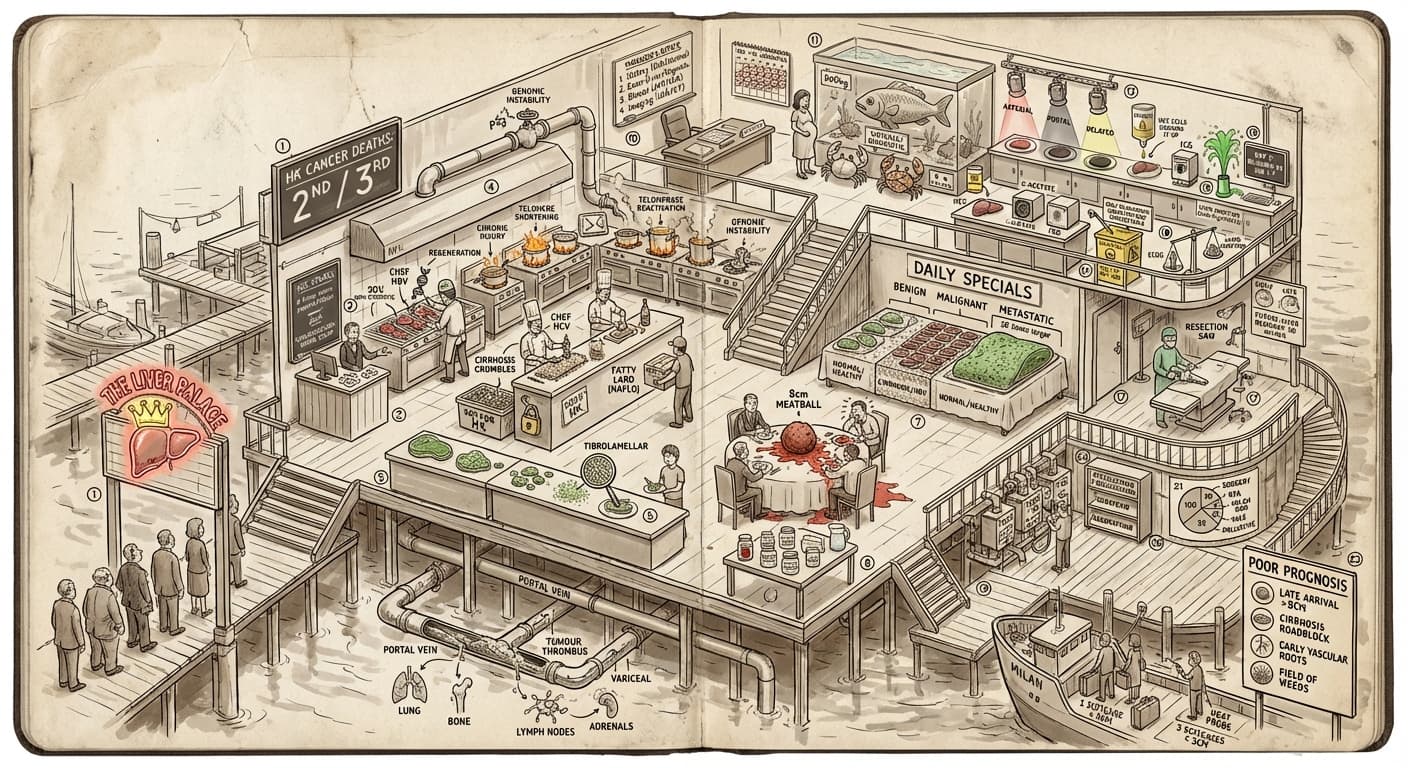
Sketchy memory palace for Hepatocellular Carcinoma
| No. | Visual Cue | Meaning |
|---|---|---|
| 1 | Liver neon sign with crown; 6:1 male-to-female queue; scoreboard ranking 2nd/3rd. | - Definition: HCC = primary malignant tumour of hepatocytes; most common primary liver cancer (~80%). - Epidemiology (HK Focus) - 3rd–2nd commonest cancer death in HK; M:F = 4–6:1; peak 45–55 years |
| 2 | HBsAg/Cirrhosis hand stamps; HCC:CC 6:1 ratio on a menu. | - 80% HBsAg-positive; 80% have cirrhosis - HCC:CC = 6:1 |
| 3 | DNA-injecting chef; HCV/Alcohol strictly on cirrhosis crumbles; Fat delivery; Moldy peanuts with p53 lock and HK ban label. | - Aetiology - HBV (80% in HK) — both indirect (cirrhosis) and direct (HBx, DNA integration) oncogenesis; 20% develop HCC WITHOUT cirrhosis - HCV — 100% develop HCC on cirrhotic liver (no direct oncogenic effect) - Alcohol — HCC only via cirrhosis (100%) - NAFLD/NASH — rising globally; can cause HCC without cirrhosis - Aflatoxin → p53 R249S mutation (NOT a risk factor in HK) |
| 4 | Injury flames; boiling regeneration pot; telomere timer; broken p53 gas valve. | - Pathogenesis: Chronic injury → regeneration → telomere shortening → genomic instability → telomerase reactivation → loss of p53 → HCC |
| 5 | Green-stained steak; massive/nodular/diffuse forms; trabecular lattice; young person's fibrolamellar dish. | - Pathology: Massive/nodular/diffuse; hypervascular; green (bile production); trabecular histology (80%); fibrolamellar variant (young, no cirrhosis, good prognosis) |
| 6 | Clogged portal vein pipe; backup into varices; leaks to lung, bone, LNs, and adrenals. | - Spread: Intrahepatic (portal vein) > lung (hepatic vein → IVC) > bone > LN > peritoneum > adrenals - Portal vein tumour thrombus: Present in 30–60% of HCC. Worsens portal hypertension, causes variceal bleeding, accelerates liver failure, and contraindicates TACE. Indicates early IV spread with circulating tumour cells. - Metastasis: Intrahepatic (portal vein, most common) > Lung (hepatic vein → IVC) > Bone > LN > Peritoneum > Adrenals. Death usually precedes extensive metastasis due to liver failure. |
| 7 | Silent diner with 8cm meatball; RUQ/Shoulder clutching; ascites/confusion; bursting meatball with red flood. | - Clinical Presentation - Often asymptomatic until late (> 8 cm) - RUQ pain (capsular stretch) ± right shoulder (phrenic nerve) - Decompensated cirrhosis (ascites, variceal bleed, encephalopathy) - Ruptured HCC (surgical emergency) - Ruptured HCC: Occurs in 5–10%, mortality 25–100%. Caused by large peripheral tumours with friable neovasculature. Presents with acute abdomen + shock. First-line = TAE; laparotomy if bleeding uncontrolled. Increases peritoneal seeding risk. |
| 8 | Jars labeled with blood, sugar, bone, fat, and water. | - Paraneoplastic: erythrocytosis (EPO), hypoglycaemia (IGF-2), hypercalcaemia (PTHrP), hypercholesterolaemia, watery diarrhoea (VIP) |
| 9 | Buffet with 20x larger metastatic section; cirrhosis pattern cloth vs healthy cloth. | - Framework: Liver mass DDx = Benign primary (haemangioma, FNH, adenoma) vs Malignant primary (HCC, cholangiocarcinoma, fibrolamellar, haemangioendothelioma) vs Metastatic (most common: CRC, stomach, pancreas, breast, lung) vs Cystic (simple cyst, abscess, hydatid) vs Non-neoplastic (cirrhosis, congestion). - Background liver: HCC almost always has cirrhosis/HBV; metastases and benign tumours have normal liver - Liver metastases are 20× more common than primary liver tumours — always consider a secondary cause |
| 10 | Protocol list 1-4; 6-month circled calendar for HBV/cirrhotics. | - Screening: USG + AFP every 6 months in HBV carriers > 40 years and all cirrhotics - Clinical approach to hepatomegaly (Prof Poon): History (CLD, alcohol, malignancy) → Examination (characterise liver, stigmata of CLD, spleen, ascites) → Bloods (AFP, CEA, CA19-9, LFT, Hep serology) → Imaging (USG → CT → MRI) → Endoscopy if GI primary suspected → Biopsy only if indicated. - Screening: USG + AFP Q6m in HBV carriers > 40, all cirrhotics. Screened patients: smaller tumours (3.2 vs 7 cm), better liver function, less metastasis, more curative options. |
| 11 | 400kg Alpha-Fish; pregnant woman/germ-cell/cirrhosis onlookers; 3-6 day timer; 30% empty tanks. | - Key discriminators - AFP > 400 → virtually diagnostic of HCC - AFP: > 400 ng/mL almost diagnostic; BUT 30% of HCC has normal AFP. False positives: pregnancy, germ cell tumours, hepatitis, cirrhosis, gastric cancer. Half-life = 3–6 days. AFP > 1000 → poor prognosis/transplant recurrence risk. |
| 12 | Three-phase lighting; HCC bright-then-dark; Haemangioma edge-bright; Mets dark-always; CC late-bright. | - Triphasic CT is the gold standard: HCC = arterial enhancement + washout; haemangioma = peripheral fill-in; metastasis = hypodense all phases; cholangiocarcinoma = delayed enhancement - Diagnostic Criteria: In an at-risk patient, a nodule ≥ 1 cm with arterial hyperenhancement + portal venous/delayed washout on CT or MRI = HCC. No biopsy needed. - Triphasic CT - HCC: arterial bright → portal/delayed dark (washout) - Haemangioma: peripheral fill-in → delayed fill-in complete - Metastasis: hypodense all phases |
| 13 | Lipiodol oil-soaking liver; C-acetate and FDG cameras. | - Post-Lipiodol CT: HCC retains lipiodol (no Kupffer cells). Used for uncertain cases. - Dual-tracer PET: ¹¹C-acetate (well-diff) + FDG (poorly-diff) — compensates for HCC's poor FDG uptake. |
| 14 | Discarded needle; seeding/bleeding warning; INR/Plt lock. | - Biopsy only if diagnosis uncertain AND lesion unresectable — risk of bleeding and tumour seeding - Biopsy: NOT routine. Risk of bleeding + needle tract seeding. Only for indeterminate imaging in unresectable cases. Contraindicated if INR > 1.2, Plt < 50K, or high-grade biliary obstruction. |
| 15 | Green dye fountain; <10% gauge; Bilirubin 50 / INR 1.7 monitor. | - ICG clearance test: Best test for liver function reserve before surgery. ICG-R15 < 10% → major resection safe. - Post-hepatectomy liver failure: Defined by Day 5 bilirubin > 50 + INR > 1.7 (50-50 rule). 2× higher risk in cirrhotics. Prevented by ensuring adequate FLR. |
| 16 | Triple-beam scale with fitness, tumor, and liver function pans. | - Triple assessment before treatment: General status (ECOG) + Tumour status (number, size, vascular invasion, metastasis) + Liver function (Child-Pugh, ICG, MELD). |
| 17 | Resection saw; Early/Late recurrence timer; Child A/FLR 30-40% label. | - Curative treatments (3): Hepatic resection, RFA, Liver transplantation. - Resection (1st choice, 20% eligible): Requires unilobar disease, no main PV/IVC invasion, Child A, ICG-R15 < 14%. FLR ≥ 30% (non-cirrhotic) / ≥ 40% (cirrhotic). 5-year survival 50%, recurrence 50% (field cancerisation). In HK, multiple tumours and intrahepatic vascular invasion are NOT absolute contraindications. - Recurrence after resection: Early ( 2 years) = de novo HCC from field change. |
| 18 | Milan ship; 1<5cm or 3<3cm luggage; RFA heat probe on deck. | - Transplant: Milan criteria (single ≤ 5 cm or ≤ 3 each ≤ 3 cm, no macrovascular invasion, no mets). 5-year survival 75%. Bridging therapy with RFA/TACE while waiting. - RFA: For small tumours (< 5 cm), inoperable. Preferred over PEI. Avoid near major vessels/bile ducts. |
| 19 | TACE pump (blocked if PVT/Child C); TARE Y-90 beads; TAE emergency plug. | - TACE: Unresectable + reasonable liver function + no main PV thrombosis + no distant mets. Contraindicated in Child C, PVT, AV shunting to hepatic vein, diffuse HCC. - TARE (Y-90): Preferred over TACE when portal vein thrombosis is present (smaller particles → less ischaemia). - Ruptured HCC: Emergency. First-choice = TAE. If fails → laparotomy (packing, HAL, staged resection). |
| 20 | Three-tiered medicine shelves with drug names; crossed-out adjuvant bottle. | - Systemic therapy: preferred 1st line = Atezolizumab + Bevacizumab or Durvalumab + Tremelimumab in fit Child-Pugh A patients. Sorafenib, lenvatinib, or durvalumab are alternatives if combinations are unsuitable. Later lines are sequence-dependent: TKI after IO combinations; cabozantinib/regorafenib/ramucirumab (AFP ≥ 400) or selected immunotherapy after prior TKI. - Adjuvant/neoadjuvant systemic therapy is not recommended after curative-intent resection or ablation; surveillance remains standard. |
| 21 | Pie chart with numbers: 20 Surgery, 15 RFA, 5 Transplant, 20 TACE, 35 Palliative. | - Of 100 patients: 20 surgery, 15 RFA, 5 transplant, 20 TACE, 35 systemic/supportive only. |
| 22 | Sign with: 8cm meatball, cirrhosis block, vascular roots, and weeds. | - Prognosis is poor because: late presentation, cirrhosis limits treatment, field cancerisation, early vascular invasion - 4 Reasons for Poor Prognosis: (1) Late presentation (asymptomatic until > 8 cm); (2) Underlying cirrhosis limits treatment and predisposes to liver failure; (3) Early venous permeation; (4) Field cancerisation (entire liver is at risk → 50% recurrence at 5 years). |