
Cholangiocarcinoma
Cholangiocarcinoma is a malignant neoplasm arising from the epithelial cells of the intrahepatic or extrahepatic bile ducts, often presenting with obstructive jaundice and carrying a poor prognosis.
| Exam domain | One-glance essentials |
|---|---|
| Definition / diagnosis |
|
| Epidemiology / risks |
|
| Core mechanism |
|
| Clinical picture |
|
| Investigations |
|
| Management |
|
| Complications |
|
| Prevention / follow-up |
|
| Exam traps |
|
References
[1] Senior notes: felixlai.md (Cholangiocarcinoma, sections I–III) [2] Senior notes: felixlai.md (Cholangiocarcinoma, sections IV–VI: Pathogenesis, Clinical manifestation, Diagnosis)
Cholangiocarcinoma (CCA) — let's break the name down: "cholangio" = bile duct (Greek cholē = bile + angeion = vessel), "carcinoma" = malignant epithelial tumour. So, quite literally, cancer arising from the epithelial lining of the bile ducts.
Key definitional points:
- Cholangiocarcinoma refers to bile duct cancer arising from epithelial cells of intrahepatic, perihilar, and distal extrahepatic bile ducts [1][2]
- > 90% are adenocarcinoma; the remainder are squamous cell carcinoma or other rare subtypes [2]
- Exclusive of gallbladder carcinoma and ampullary carcinoma — these are distinct entities even though they share the biliary tree. This is a common exam pitfall. [2]
- Perihilar cholangiocarcinoma involving the common hepatic duct (CHD) bifurcation is historically called a Klatskin tumour (named after Gerald Klatskin, 1965) [1][2]
Exam Pitfall
Students often confuse cholangiocarcinoma with other periampullary cancers. Remember: cholangiocarcinoma is ONLY bile duct epithelium. Ampullary carcinoma, pancreatic head carcinoma, and duodenal carcinoma are separate entities, though they may present similarly (painless jaundice). Gallbladder carcinoma is also distinct.
2. Epidemiology
- Adenocarcinoma of intrahepatic bile duct accounts for 5–20% of primary liver malignancy [3]
- Mostly occurs in patients > 50 years [3]
- Overall incidence is increasing worldwide, driven particularly by rising intrahepatic cholangiocarcinoma (iCCA) — thought to relate to metabolic risk factors (obesity, NAFLD, diabetes) and improved imaging/diagnosis [4]
- Perihilar CCA remains the most common subtype (~50–60%), followed by distal extrahepatic (~20–30%), then intrahepatic (~10–20%) [1][2]
- Geographic variation is striking:
- Southeast Asia (Thailand, especially Isan region): highest worldwide incidence due to endemic liver fluke (Opisthorchis viverrini) infection — incidence can be 85 per 100,000
- East Asia (including Hong Kong, China, Korea): elevated risk due to Clonorchis sinensis infection and recurrent pyogenic cholangitis (RPC)
- Western countries: PSC is the dominant risk factor; overall incidence lower (~1–2 per 100,000)
- Association with recurrent pyogenic cholangitis (common in Orientals) [3]
- Hepatitis B is endemic in Hong Kong — chronic HBV contributes to both HCC and iCCA
- Hepatolithiasis and RPC ("Hong Kong disease") are important local risk factors [5]
- PSC-associated CCA is common in Westerners but relatively uncommon in Hong Kong [3]
- Slight male predominance overall (M:F ≈ 1.2–1.5:1) for extrahepatic CCA
- Intrahepatic CCA has roughly equal sex distribution
- Increasing incidence with age; peak incidence in the 7th–8th decade [2]
3. Anatomy and Function
Understanding cholangiocarcinoma requires a solid grasp of biliary anatomy. Think of the biliary tree as a drainage system — like tributaries flowing into a river.
Key anatomical landmarks for classification:
| Region | Anatomical Boundaries | Tumour Type |
|---|---|---|
| Intrahepatic | Proximal to second-order bile ducts (i.e., proximal to CHD bifurcation) | Intrahepatic CCA (iCCA) |
| Perihilar | Between CHD bifurcation and the insertion of the cystic duct into the CBD | Perihilar CCA (pCCA) / Klatskin tumour |
| Distal extrahepatic | From cystic duct insertion to the ampulla of Vater | Distal CCA (dCCA) |
- Intrahepatic cholangiocarcinoma originates from: [2]
- Small intrahepatic ducts (peripheral cholangiocarcinoma) — these form a mass lesion within the liver parenchyma, behaving more like a liver mass
- Large intrahepatic ducts proximal to the bifurcation of left and right intrahepatic ducts — these behave more like perihilar tumours
- Divided into perihilar and distal segments with the transition occurring at the point where the CBD lies posterior to the duodenum, distal to the insertion of the cystic duct into the CBD [2]
- The bile ducts receive their blood supply from the hepatic arterial system (peribiliary vascular plexus), NOT the portal vein. This is important because:
- CCA tends to cause ischaemic-type strictures as it invades the arterial plexus
- Hepatic artery involvement is a key determinant of resectability
- Lymphatic drainage follows the hepatoduodenal ligament → coeliac, periportal, and para-aortic lymph nodes
- Common mode of spread includes lymphatic spread [2]
- The biliary tree has extensive perineural networks within the hepatoduodenal ligament
- This explains why CCA has a notorious tendency for perineural invasion (tumour spreads along nerve sheaths) — one of its hallmark histological features [2]
Cholangiocytes are not passive conduits. They:
- Modify bile composition (secrete bicarbonate, chloride; absorb water, glucose, amino acids)
- Participate in the cholehepatic shunt for bile salt recycling
- Express various receptors and growth factors that, when dysregulated, can promote carcinogenesis
4. Etiology and Pathophysiology
The unifying theme across most risk factors is chronic inflammation → cholestasis → DNA damage → malignant transformation of cholangiocytes. Think of it like any chronic inflammatory malignancy (e.g., Barrett's → oesophageal adenocarcinoma, UC → colorectal cancer).
4.1 Risk Factors (with Pathophysiology)
i. Primary Sclerosing Cholangitis (PSC)
- Strong association with cholangiocarcinoma, especially perihilar disease [2]
- PSC is an inflammatory disorder of the biliary tree that leads to fibrosis and stricturing of intrahepatic and extrahepatic bile ducts [2]
- PSC is strongly associated with ulcerative colitis [2]
- Association with ulcerative colitis (common in Westerners) [3]
- Pathophysiology: Chronic bile duct inflammation → oxidative stress → DNA damage in cholangiocytes → dysplasia → carcinoma. The strictured, stagnant bile environment promotes bacterial overgrowth and secondary bile acid formation, which are carcinogenic.
- Lifetime risk of CCA in PSC patients: 10–20%
- PSC is the strongest known risk factor in Western populations, but is less common in Asia [4]
PSC and CCA
PSC patients can develop CCA at ANY point — even early in their disease. This makes surveillance extremely difficult. Any dominant stricture in a PSC patient should raise suspicion for CCA until proven otherwise.
ii. Recurrent Pyogenic Cholangitis (RPC)
- Association with recurrent pyogenic cholangitis (common in Orientals) [3]
- Also known as "Hong Kong disease" or oriental cholangiohepatitis [5]
- Pathophysiology: Usually starts in left intrahepatic ducts [5]. Parasitic infestation (e.g., Clonorchis sinensis) → epithelial damage → bacterial translocation → stricture formation → biliary stasis → brown pigment stone formation → recurrent cholangitis → chronic inflammation → malignant transformation [5]
- RPC causes a cycle: stones → obstruction → infection → more stones → more damage → eventually CCA
iii. Cholelithiasis / Hepatolithiasis
- Cholelithiasis refers to gallstones; hepatolithiasis refers to chronic intrahepatic stone disease which leads to biliary stasis and recurrent pyogenic cholangitis [2]
- Hepatolithiasis is particularly relevant in East Asia
- Pathophysiology: Chronic mechanical irritation and inflammation of bile duct epithelium by stones → metaplasia → dysplasia → carcinoma. Biliary stasis also concentrates potentially carcinogenic substances in bile.
i. Choledochal Cysts
- Choledochal cysts are congenital cystic dilatation of bile ducts [2]
- Lifetime risk of CCA: 10–30%, increasing with age (hence why prophylactic excision is recommended)
- Associated with abnormal pancreaticobiliary junction (APBJ) in 70–90% of patients [6]
ii. Caroli's Disease
- Caroli's disease is a variant of choledochal cyst characterized by multiple cystic dilations of intrahepatic biliary ducts [2]
iii. Pathophysiology of Fibrocystic Disease → CCA
- Fibrocystic liver disease leads to cholangiocarcinoma by: [2]
- Biliary stasis — pooling of bile promotes bacterial overgrowth and formation of carcinogenic secondary bile acids
- Chronic inflammation from reflux of pancreatic juice — APBJ allows pancreatic enzymes (trypsin, lipase) to enter the biliary tree, causing chemical cholangitis
- Abnormalities in bile salt transporter proteins → unstable bile content
- Deconjugation of carcinogens previously conjugated in the liver → reactivation of carcinogens in bile
- Viral hepatitis (HBV/HCV) [2]
- Liver cirrhosis [2]
- Alcoholic liver disease [2]
- Pathophysiology: Chronic hepatic inflammation → hepatic stellate cell activation → fibrosis → altered microenvironment with growth factor dysregulation (TGF-β, PDGF, VEGF) → cholangiocyte proliferation and malignant transformation
- HCV has a particularly strong association with iCCA (adjusted OR ~4–5) [4]
- HBV is relevant in Hong Kong given endemic prevalence
Infection of liver flukes by consumption of undercooked freshwater fish which leads to adult worms inhabiting and laying eggs in the biliary system: [2]
- Clonorchis sinensis — endemic in southern China including Hong Kong, Korea, Vietnam
- Opisthorchis viverrini — endemic in Thailand, Laos, Cambodia
Induction of chronic inflammatory state in proximal biliary tree leading to malignant transformation of the lining epithelium [2]
Pathophysiology (detailed):
- Ingestion of metacercariae in raw/undercooked freshwater fish (e.g., grass carp, snakehead fish)
- Excystation in duodenum → larvae migrate up the ampulla of Vater into bile ducts
- Adult flukes reside in bile ducts for 15–25 years, feeding on bile duct epithelium
- Mechanical damage from fluke suckers + toxic metabolites + egg deposition → chronic periductal inflammation
- Cholangiocyte hyperplasia → goblet cell metaplasia → dysplasia → adenocarcinoma
- Additionally, fluke-secreted proteins (e.g., granulin-like growth factor) directly promote cell proliferation
Diagnosis of Clonorchis: stool microscopy for eggs, duodenal aspirate for eggs, USG for adult flukes, intra-op choledochoscopy for adult flukes [5] Treatment: praziquantel 25 mg/kg PO tds × 1 day [5]
Hong Kong Relevance
In Hong Kong, Clonorchis sinensis infection from eating raw freshwater fish (鯇魚 grass carp sashimi) is a well-known risk factor. Always ask about dietary history of raw freshwater fish consumption in a patient presenting with cholangiocarcinoma.
-
Lynch syndrome (Hereditary nonpolyposis colorectal cancer) [2]
- Autosomal dominant disorder caused by germline mutation in one of several DNA mismatch repair (MMR) genes (MLH1, MSH2, MSH6, PMS2) [2]
- Lifetime risk of CCA is elevated but still relatively low (~2%)
- The MMR deficiency leads to microsatellite instability → accumulation of mutations in cholangiocytes
-
Multiple biliary papillomatosis [2]
- Multiple adenomatous polyps of variable distribution and extent in intrahepatic bile ducts [2]
- These are premalignant lesions with high recurrence rate
- Obesity, Diabetes mellitus, Metabolic syndrome [2][4]
- Pathophysiology: Insulin resistance → hyperinsulinaemia → IGF-1 activation → cell proliferation. Adipose tissue inflammation → IL-6, TNF-α → pro-carcinogenic microenvironment. NAFLD/NASH → hepatic inflammation
- Thorotrast (thorium dioxide) exposure [2][4]
- Historical contrast agent used in the 1930s–50s for radiological imaging
- Alpha-emitting radioactive material deposited in the reticuloendothelial system → chronic radiation-induced DNA damage
- Latency period of 20–40 years before CCA development
- Now banned, but elderly patients may still present with Thorotrast-related cancers
| Category | Risk Factor | Relevance to HK |
|---|---|---|
| Inflammatory/Cholestatic | PSC | Less common in Asia |
| RPC | Very common in Orientals | |
| Hepatolithiasis | Common in East Asia | |
| Cholelithiasis | Universal | |
| Congenital | Choledochal cysts | Common in Asians |
| Caroli's disease | Uncommon | |
| Infectious | Clonorchis sinensis | Endemic in HK/South China |
| Opisthorchis viverrini | Southeast Asia | |
| HBV | Endemic in HK | |
| HCV | Less common in HK | |
| Metabolic | Obesity/DM/MetS | Increasing |
| NAFLD/NASH | Increasing | |
| ALD | Present | |
| Genetic | Lynch syndrome | Rare |
| Biliary papillomatosis | Rare | |
| Toxic | Thorotrast | Historical |
5. Pathogenesis and Histopathology
The carcinogenesis of CCA follows a multi-step model, similar to the adenoma–carcinoma sequence in colorectal cancer but occurring in cholangiocytes:
Normal cholangiocyte → Hyperplasia → Dysplasia → Carcinoma in situ → Invasive carcinoma
Key molecular pathways:
- Chronic inflammation → NF-κB activation → COX-2 upregulation → prostaglandin-mediated cell proliferation and inhibition of apoptosis
- IL-6/STAT3 pathway — IL-6 released by inflammatory cells activates STAT3 in cholangiocytes → promotes survival and proliferation
- Bile acid toxicity — hydrophobic bile acids cause oxidative DNA damage and activate EGFR/MAPK signalling
- Growth factor dysregulation — overexpression of VEGF, PDGF, HGF → angiogenesis and tumour growth
- Tumour suppressor loss — p53 mutations (especially in Thorotrast-related CCA), p16/CDKN2A silencing, SMAD4 loss
- Oncogenic mutations — IDH1/IDH2 mutations (especially in iCCA, ~15–20%), FGFR2 fusions (iCCA, ~15%), KRAS mutations (extrahepatic CCA)
Why IDH and FGFR2 Matter
These molecular targets are therapeutically actionable! Ivosidenib (IDH1 inhibitor) and pemigatinib/futibatinib (FGFR2 inhibitors) are now approved for advanced iCCA with these specific mutations. This is a major shift towards precision oncology in CCA.
Majority of cholangiocarcinoma (> 90%) are adenocarcinoma [2]
Cholangiocarcinoma is characterized by: [2]
- Slow growth
- High rate of local invasion
- Mucin production
- Tendency to invade perineural sheath and spread along nerves (perineural invasion is a hallmark and explains why margins are often positive even after seemingly complete resection)
Adenocarcinoma is further divided into 3 types: [2]
| Subtype | Characteristics | Clinical Significance |
|---|---|---|
| Sclerosing | Characterized by intense desmoplastic reaction with extensive fibrosis | Most common type for perihilar/distal CCA. The dense fibrosis makes biopsy difficult (low cellularity) and causes firm, constricting strictures |
| Nodular | Characterized by constricting annular lesion of bile duct | Causes circumferential narrowing of the duct lumen |
| Papillary | Characterized by bulky masses in CBD and cause biliary obstruction | Better prognosis — tends to grow intraluminally rather than invasively; more likely to be resectable |
Why does the sclerosing type have such dense fibrosis? Because the tumour cells secrete TGF-β and PDGF, which activate surrounding stromal fibroblasts (cancer-associated fibroblasts) to produce collagen. This desmoplastic reaction actually creates a protective microenvironment for the tumour and makes it resistant to chemotherapy penetration.
Particularly for iCCA, the WHO recognizes:
- Mass-forming — a discrete intrahepatic mass (most common pattern for iCCA)
- Periductal-infiltrating — tumour grows along bile duct walls causing strictures without a discrete mass
- Intraductal-growing — papillary growth within the bile duct lumen (best prognosis)
- Mixed patterns — combinations of the above
Cytokeratin-7 (CK7) positivity is consistent with biliary tract origin [2]
Typical IHC profile of CCA:
| Marker | CCA | HCC |
|---|---|---|
| CK7 | Positive | Negative |
| CK19 | Positive | Negative |
| CK20 | Variable | Negative |
| HepPar-1 | Negative | Positive |
| Glypican-3 | Negative | Positive |
| AFP | Negative | Often positive |
| Arginase-1 | Negative | Positive |
This IHC panel is critical when distinguishing iCCA from HCC, especially when a liver mass is identified and biopsy is performed.
6. Classification
Classification by site: [4]
| Type | Frequency | Location | Key Features |
|---|---|---|---|
| Intrahepatic (iCCA) | ~10% | Proximal to CHD bifurcation | Bulky tumour similar to HCC; increasing incidence |
| Perihilar (pCCA) | MC, ~60% | Between CHD bifurcation and cystic duct origin | Prone to cholangitis, resection difficult |
| Distal extrahepatic (dCCA) | ~20–30% | Distal to cystic duct origin | Decreasing incidence |
- Klatskin's tumour: cholangiocarcinoma that involves the common hepatic duct bifurcation (usually perihilar type) [4]
Key Anatomical Point
The CHD bifurcation (confluence of right and left hepatic ducts) is the most strategically important location. A tumour here blocks drainage from BOTH lobes of the liver → early jaundice. This is why perihilar CCA presents earlier than intrahepatic CCA.
This classification describes the extent of ductal involvement and is crucial for surgical planning:
Bismuth-Corlette classification for perihilar tumour: [2][4]
| Type | Description | Resectability |
|---|---|---|
| Type I | Tumour below the confluence of the left and right hepatic ducts | Usually resectable |
| Type II | Tumour reaching the confluence | Usually resectable |
| Type IIIa | Tumour occluding common hepatic and right hepatic ducts | May require right hepatectomy |
| Type IIIb | Tumour occluding common hepatic and left hepatic ducts | May require left hepatectomy |
| Type IV | Tumour that involves the confluence and both the right and left hepatic duct / Tumour that are multicentric | Often unresectable |
Bile duct tumours that involve common hepatic duct bifurcation are referred to as Klatskin tumour regardless of whether they arise from intrahepatic or extrahepatic portion of biliary tree [2]
Surgical Significance of Bismuth-Corlette
Types I and II are potentially curable with bile duct resection alone. Types IIIa/IIIb require major hepatectomy (right or left) combined with bile duct resection. Type IV is generally considered unresectable — these patients typically receive palliative biliary drainage and chemotherapy.
Note: iCCA, pCCA, and dCCA each have separate TNM staging systems because they behave as biologically distinct diseases.
Intrahepatic CCA (staged like liver tumours):
- T1a: Solitary ≤ 5 cm without vascular invasion
- T1b: Solitary > 5 cm without vascular invasion
- T2: Solitary with intrahepatic vascular invasion, OR multiple tumours
- T3: Tumour perforating visceral peritoneum
- T4: Direct invasion of local extrahepatic structures
Perihilar CCA:
- Staging considers depth of invasion into bile duct wall, hepatic artery, portal vein, and unilateral vs bilateral hepatic duct involvement
Distal CCA:
- Staged similarly to other pancreaticobiliary cancers, based on depth of invasion into bile duct wall and surrounding structures
Metastatic sites depend on type of cholangiocarcinoma: [2]
| Type | Common Metastatic Sites |
|---|---|
| Intrahepatic | Peritoneum / Lung / Pleura |
| Perihilar | Liver / Peritoneum / Lung / Brain / Bone |
| Distal extrahepatic | Liver / Peritoneum / Lung |
7. Clinical Features
The clinical presentation of CCA depends heavily on anatomical location:
- Intrahepatic CCA behaves like a liver mass — often silent until large
- Perihilar CCA causes early biliary obstruction — presents with jaundice
- Distal CCA presents like other periampullary tumours — painless obstructive jaundice
7.1 Symptoms
- ONLY in extrahepatic (perihilar/distal) cholangiocarcinoma, especially Klatskin tumour in which blockage of the bifurcation of left and right hepatic duct will cause jaundice in early stage [2]
- Intrahepatic cholangiocarcinoma will NOT cause jaundice since bilirubin can be reabsorbed into blood and re-excreted through unaffected parts of liver [2]
Pathophysiological explanation:
- The liver has enormous reserve capacity. If one segmental duct is blocked, the rest of the liver continues to excrete bilirubin normally. Only when the CHD bifurcation (or both main ducts) is blocked does conjugated bilirubin back up into the blood → jaundice
- Perihilar CCA (Klatskin tumour) blocks this critical junction early → early jaundice
- iCCA must grow very large or directly invade the hilum before causing jaundice
- The jaundice is typically progressive and painless (vs. the colicky, intermittent jaundice of choledocholithiasis)
This is a classic painless jaundice presentation — one of the most important clinical scenarios in surgery exams [7]
Dark urine and pale stools [2]
Pathophysiology:
- Dark urine: Conjugated bilirubin (water-soluble) that cannot drain into the duodenum backs up into the blood → filtered by kidneys → excreted in urine → dark "cola-coloured" or "tea-coloured" urine
- Pale stools: Normally, conjugated bilirubin reaches the gut → bacterial conversion to stercobilinogen → stercobilin (gives stool its brown colour). In obstruction, no bilirubin reaches the gut → acholic (pale/clay-coloured) stools
- These features together with jaundice = obstructive (post-hepatic) jaundice triad
Pruritus [2]
Pathophysiology:
- Bile salts that cannot be excreted into the gut accumulate in the blood → deposit in the skin → irritate cutaneous nerve endings
- The exact mechanism remains debated; lysophosphatidic acid (LPA) and autotaxin (bile salt metabolites) acting on itch-specific nerve fibres (via TGR5 receptors) may be involved
- Can be severe and debilitating — often worse at night, affecting palms and soles first
- Pruritus may precede jaundice (as sub-clinical cholestasis can cause bile salt accumulation before bilirubin rises enough to cause visible jaundice)
Pathophysiology:
- Intrahepatic CCA: Hepatomegaly from tumour growth stretches Glisson's capsule (the fibrous capsule of the liver) → dull, aching RUQ pain. The liver parenchyma itself has no pain receptors — it's the capsular distension that hurts
- Extrahepatic CCA: Biliary obstruction → upstream ductal dilatation → stretching of the bile duct wall. If superimposed cholangitis occurs, acute inflammation of the duct wall causes more intense pain
- Pain is typically dull and constant (unlike biliary colic which is episodic)
- Anorexia, weight loss [3]
- Pathophysiology: Cancer-related cachexia mediated by pro-inflammatory cytokines (TNF-α, IL-6) → increased basal metabolic rate, decreased appetite, muscle wasting. Additionally, bile salt malabsorption → fat malabsorption → steatorrhoea → weight loss
- Fever [2][3]
- Pathophysiology: Biliary obstruction → biliary stasis → bacterial colonisation of stagnant bile → ascending cholangitis. Tumour necrosis can also release pyrogens. Cholangitis occurs particularly in perihilar CCA where obstruction is proximal
Charcot's Triad in CCA
While Charcot's triad (fever, jaundice, RUQ pain) classically describes acute cholangitis from gallstone disease, CCA-related cholangitis can also produce this triad. The key difference: in CCA, the jaundice is progressive and the fever is recurrent, whereas in gallstone cholangitis, both tend to be episodic and fluctuating.
- Steatorrhoea (fatty, foul-smelling stools) — because bile salts cannot reach the duodenum → impaired fat emulsification → fat malabsorption
- Fat-soluble vitamin deficiency (A, D, E, K) — prolonged obstruction leads to:
- Vitamin K deficiency → coagulopathy (prolonged PT/INR) — this is important pre-operatively!
- Vitamin D deficiency → osteomalacia
- Vitamin A deficiency → night blindness (rare, requires prolonged obstruction)
7.2 Signs
- Jaundice — yellow discolouration of skin and sclera (scleral icterus is detectable at bilirubin > 35–40 µmol/L)
- Cachexia / wasting — evidence of advanced malignancy
- Scratch marks / excoriations — secondary to pruritus
- Xanthomata / xanthelasma — cholesterol deposits in skin, seen in chronic cholestasis
-
Hepatomegaly [3]
- iCCA: palpable liver mass from tumour itself
- Perihilar/distal CCA: hepatomegaly from biliary obstruction → hepatic congestion and bile duct dilatation
-
Palpable gallbladder (Courvoisier's sign)
- In distal CCA: the gallbladder distends because bile cannot drain past the obstruction. The cystic duct is patent → gallbladder fills with mucus → palpable, non-tender
- Courvoisier's Law: "In the presence of painless obstructive jaundice, a palpable gallbladder is unlikely to be due to gallstones" — because chronic gallstone disease causes fibrosis and a shrunken, non-distensible gallbladder. A palpable gallbladder + painless jaundice suggests malignant obstruction (pancreatic head cancer, distal CCA, ampullary cancer)
- Important: In perihilar CCA (Klatskin tumour), the obstruction is ABOVE the cystic duct entry → gallbladder does NOT distend → Courvoisier's sign is NEGATIVE [7]
Courvoisier's Sign — Location Matters!
A very common exam question: Courvoisier's sign is positive in distal CCA and pancreatic head cancer, but NEGATIVE in perihilar CCA (Klatskin tumour) because the obstruction is above the cystic duct insertion. The gallbladder cannot fill if bile cannot reach it!
- Ascites — suggests peritoneal metastasis (advanced disease) or portal hypertension in cirrhotic patients
- Splenomegaly — rare; suggests portal hypertension from advanced liver disease or portal vein involvement
- Spider naevi, palmar erythema, gynaecomastia, caput medusae, etc.
- Sister Mary Joseph nodule — periumbilical nodule suggesting peritoneal metastasis
- Virchow's node (left supraclavicular lymphadenopathy) — suggests distant lymphatic spread
- Blumer's shelf — drop metastasis in the rectovesical/rectouterine pouch (palpable on PR exam)
| Feature | Intrahepatic CCA | Perihilar CCA (Klatskin) | Distal CCA |
|---|---|---|---|
| Jaundice | Late/absent | Early (progressive, painless) | Early (progressive, painless) |
| Pain | RUQ dull ache (capsular stretch) | RUQ pain if cholangitis | Epigastric/RUQ |
| Mass | Hepatomegaly/palpable mass | Usually no mass | Usually no mass |
| Courvoisier's sign | Negative | Negative | Positive |
| Weight loss | Common (late presentation) | Variable | Variable |
| Cholangitis | Uncommon | Prone to cholangitis | Possible |
8. Differential Diagnosis of Cholangiocarcinoma
The differential depends on the clinical presentation:
Differential diagnosis: [2]
- Choledocholithiasis — intermittent jaundice, colicky pain, fluctuating LFTs
- Pancreatic cancer (head) — painless jaundice, Courvoisier's sign, weight loss
- Cancer of the ampulla of Vater — intermittent jaundice (tumour sloughs → obstruction relieved), better prognosis
- Viral hepatitis — hepatocellular pattern LFTs, viral markers positive
- Primary sclerosing cholangitis (PSC) — "beaded" appearance on MRCP, multifocal strictures
- Primary biliary cholangitis (PBC) — AMA positive, cholestatic LFTs, middle-aged women
- IgG4-related sclerosing cholangitis — important mimic! Responds to steroids; elevated IgG4 levels
- Mirizzi syndrome — extrinsic compression of CHD by impacted gallstone
- Benign biliary stricture — post-surgical, post-ERCP, chronic pancreatitis
- Hepatocellular carcinoma (HCC) — AFP elevated, arterial enhancement + washout on CT/MRI
- Liver metastases — look for primary tumour (CRC, breast, lung)
- Hepatic abscess — fever, leukocytosis, rim-enhancing lesion
- Haemangioma — peripheral nodular enhancement, centripetal fill-in
- Focal nodular hyperplasia — central scar, homogeneous enhancement
Key: Immunohistochemical stain is useful in differential diagnosis of cholangiocarcinoma with other malignancy [2] — CK7/CK19 positive for CCA vs. HepPar-1/Glypican-3/AFP positive for HCC
Key points from lecture slides [3]:
- Tumour markers: carcinoembryonic antigen (CEA), CA 19-9 (may or may not be elevated, nonspecific)
- USG, CT scan, MRI for diagnosis
- FNAC or Trucut biopsy (ONLY for unresectable cases) — because biopsy risks tumour seeding along the needle tract in potentially resectable disease
- Hepatic resection is the treatment of choice (resectability rate about 20%)
- Other treatment: no proven effect (this was 2019; now in 2025, gemcitabine-cisplatin ± durvalumab is standard for advanced CCA — TOPAZ-1 trial)
High Yield Summary
Definition: Cancer arising from bile duct epithelium; > 90% adenocarcinoma. Excludes gallbladder and ampullary carcinoma.
Classification by location:
- Intrahepatic (10%): behaves as liver mass, NO early jaundice
- Perihilar (60%, MC): Klatskin tumour if at bifurcation, EARLY jaundice, Courvoisier NEGATIVE
- Distal extrahepatic (20–30%): behaves like periampullary tumour, Courvoisier POSITIVE
Bismuth-Corlette (perihilar): I (below confluence) → II (at confluence) → IIIa (+ RHD) → IIIb (+ LHD) → IV (both/multicentric)
Key risk factors (HK): RPC, hepatolithiasis, Clonorchis sinensis (raw freshwater fish), HBV, choledochal cysts, obesity/DM. In West: PSC + UC.
Pathophysiology: Chronic inflammation → cholestasis → DNA damage → metaplasia → dysplasia → adenocarcinoma. Perineural invasion is hallmark.
Histology: Sclerosing (desmoplastic, MC), Nodular (annular), Papillary (bulky, best prognosis). CK7+/CK19+ on IHC.
Clinical features:
- Painless progressive jaundice (extrahepatic CCA)
- Dark urine + pale stools (obstructive)
- Pruritus (bile salt deposition in skin)
- RUQ pain, hepatomegaly (capsular stretch)
- Weight loss, fever (cholangitis)
- Intrahepatic CCA: NO jaundice until late
Tumour markers: CEA, CA 19-9 (non-specific, may be normal)
Resection: Only curative treatment; resectability rate ~20%. FNAC/biopsy ONLY for unresectable cases.
Active Recall - Cholangiocarcinoma (Definition to Clinical Features)
[1] Senior notes: felixlai.md (Cholangiocarcinoma, sections I–III) [2] Senior notes: felixlai.md (Cholangiocarcinoma, sections III–VI) [3] Lecture slides: WCS 064 - A large liver - by Prof R Poon [20191108].doc.pdf (p5, Cholangiocarcinoma) [4] Senior notes: maxim.md (Cholangiocarcinoma section) [5] Senior notes: maxim.md (Recurrent pyogenic cholangitis section) [6] Senior notes: felixlai.md (Biliary cysts / Choledochal cyst section) [7] Lecture slides: WCS 056 - Painless jaundice and epigastric mass - by Prof R Poon.ppt (1).pdf
Differential Diagnosis of Cholangiocarcinoma
The differential diagnosis of cholangiocarcinoma depends entirely on how the patient presents. Think about it from first principles: a patient walks into your clinic — what do they look like? There are essentially two main clinical scenarios:
- Obstructive jaundice (extrahepatic CCA — perihilar or distal)
- Liver mass / hepatomegaly (intrahepatic CCA)
Each scenario has its own differential. Let's work through them systematically.
A. Differential Diagnosis of Obstructive Jaundice (Extrahepatic CCA)
When a patient presents with painless progressive obstructive jaundice, you need to think about causes at three anatomical levels: intraluminal, mural, and extramural. This is the classic surgical approach [8].
Painless progressive obstructive jaundice in elderly is malignant biliary obstruction until proven otherwise [8]
This is one of the most important clinical distinctions to make at the bedside. The history alone often tells you the answer [8]:
| Feature | Stone | Tumour |
|---|---|---|
| Jaundice | Intermittent (stone may pass out) | Progressive. For HCC, jaundice only when functional liver reserve drops to 25% |
| Pain | Painful: as stones go through Ampulla of Vater | Painless (until advanced). Except CA pancreatic head: well innervated, spread to coeliac ganglion early |
| Infection (fever) | More likely: accumulation of bile refluxed from GI tract (normally prevented by ampulla of Vater) | Until late stage, malnourished |
| Others | Constitutional Sx: LOW, LOA, night sweats |
Why is stone jaundice intermittent but tumour jaundice progressive?
- A gallstone can act as a ball-valve — sometimes it obstructs the CBD, sometimes it dislodges and bile flows again. Hence the jaundice waxes and wanes.
- A tumour grows relentlessly. Once it narrows the duct, it only gets worse. The obstruction never relieves spontaneously.
Why is stone disease more commonly associated with fever?
- When a stone obstructs the CBD, stagnant bile becomes infected (bacteria from the duodenum reflux upwards). The stone creates a closed space → pressure builds → bacteria translocate into the bloodstream → cholangitis/sepsis.
- Tumours obstruct more gradually, and until the duct is completely occluded, some bile still flows → less stasis → less infection (until late stage).
Pathology causing malignant biliary obstruction: [9][10]
i. Cholangiocarcinoma at hilum (Klatskin tumour)
- Cholangiocarcinoma at hilum, Klatskin tumour [9]
- Obstruction to just left or right hepatic duct alone will not cause obstructive jaundice [1] — you need bilateral obstruction or obstruction at the confluence for clinical jaundice. Why? Because the contralateral liver lobe continues to excrete bilirubin through its unobstructed duct.
ii. Carcinoma of Head of Pancreas
- Carcinoma of pancreas [9]
- The most common cause of malignant obstructive jaundice overall
- 70% of pancreatic cancers are in the head → they compress or invade the intrapancreatic CBD → progressive painless jaundice
- Severe epigastric pain radiating to the back is characteristic (retroperitoneal infiltration of coeliac plexus) — but this is a feature of body/tail tumours rather than head tumours [11]
- Double duct sign on CT/MRCP: simultaneous dilatation of both the CBD and pancreatic duct — highly suggestive of pancreatic head cancer [11]
iii. Periampullary Carcinoma
- Periampullary carcinoma [9][10]
- This is a group term for tumours arising at or near the ampulla of Vater, including:
- Carcinoma of the ampulla of Vater — has the best prognosis among periampullary tumours because it presents earlier (even a small tumour at the ampulla blocks bile flow and causes jaundice) [1]
- Carcinoma of the duodenum [9][10]
- Carcinoma of lower end of (distal) CBD [1]
- Carcinoma of head of pancreas [1]
- These are grouped because their presentation (painless jaundice) and surgical management (Whipple procedure) are similar [1]
iv. Carcinoma of Gallbladder
- Carcinoma of gallbladder — cystic duct LN, direct infiltration of CBD, tumour fragments [9]
- Can cause obstructive jaundice by three mechanisms [1]:
- Spread to cystic duct lymph nodes → extrinsic compression of CBD
- Direct infiltration of CBD
- Tumour fragments breaking off into the CBD
v. Hepatocellular Carcinoma (HCC)
- HCC — direct infiltration, compression, tumour fragments in CBD [9]
- Usually occurs when mass is situated near confluence site of left and right intrahepatic ducts [1]
- HCC causing obstructive jaundice is NOT common — it is much more likely to cause jaundice from loss of hepatic reserve in the cirrhotic liver [12]
vi. Secondary Lymphadenopathy
- Porta lymphadenopathy [10]
- Lymph node metastases to the coeliac axis or porta hepatis [13]
- Carcinoma of stomach with metastatic lymph node in the porta hepatis [13]
- GI malignancy (CRC), Lymphoma [1]
- Extrinsic compression of the bile duct by enlarged lymph nodes at the hepatoduodenal ligament
Causes of MBO by Level of Obstruction
Think anatomically — what structure is obstructed and at which level? [1]
Hilum: CA gallbladder, HCC, Klatskin tumour, Mirizzi syndrome, Porta lymphadenopathy, PSC, RPC
Mid-CBD: CA CBD, CA head of pancreas, Lymphadenopathy
Distal CBD: Bile duct strictures, Periampullary carcinoma, Choledochal cysts, Pancreatic cysts, Chronic pancreatitis
Benign causes of biliary obstruction: [1]
i. Choledocholithiasis
- Choledocholithiasis [2]
- Most common benign cause of obstructive jaundice
- Key differentiating feature: intermittent jaundice with pain and fever (Charcot's triad) vs. the painless progressive jaundice of CCA
ii. Primary Sclerosing Cholangitis (PSC)
- Primary sclerosing cholangitis (PSC) [2]
- Creates multifocal strictures with a "beaded" appearance on MRCP
- Important: PSC itself is a risk factor for CCA, and a dominant stricture in PSC may represent superimposed CCA → always suspect malignancy in any PSC patient with worsening jaundice or a new dominant stricture
- Common in Westerners, less common in Asia [3]
iii. IgG4-Related Sclerosing Cholangitis
- A critical mimic of CCA! Can produce a stricture that looks identical to CCA on imaging
- Elevated serum IgG4 level is a clue
- Responds dramatically to corticosteroids — which CCA obviously does not
- Always check serum IgG4 before assuming a biliary stricture is malignant [2]
IgG4-Related Cholangitis vs CCA
This is a classic exam pitfall and a real clinical trap. IgG4-related sclerosing cholangitis can mimic CCA so closely that patients undergo unnecessary surgery. Always check IgG4 levels in any patient with a biliary stricture, especially if there is concurrent autoimmune pancreatitis (type 1). A trial of steroids may be warranted before committing to surgery.
iv. Primary Biliary Cholangitis (PBC)
- Primary biliary cirrhosis (PBC) [2] (now renamed Primary Biliary Cholangitis)
- Autoimmune destruction of small intrahepatic bile ducts
- Anti-mitochondrial antibody (AMA) positive
- Predominantly affects middle-aged women
- Causes intrahepatic cholestasis rather than extrahepatic obstruction — so it causes cholestatic LFTs and pruritus, but the bile ducts are NOT dilated on imaging
v. Other Benign Causes
- Blood clot (Haemobilia) / Mucus / Foreign body / Tumour thrombus [1]
- Benign strictures: TB, Autoimmune, Iatrogenic, RPC [1]
- Chronic pancreatitis, Pancreatic cysts [1]
- Mirizzi syndrome — common hepatic duct obstruction caused by extrinsic compression from an impacted stone in the cystic duct or Hartmann's pouch of the gallbladder [1]
B. Differential Diagnosis of Liver Mass / Hepatomegaly (Intrahepatic CCA)
When intrahepatic CCA presents as a liver mass, the differential is that of any hepatic space-occupying lesion [14]:
Malignant liver tumours: [14]
| Tumour | Key Distinguishing Features |
|---|---|
| Hepatocellular Carcinoma (HCC) | MC primary liver cancer (80%) [12]. AFP elevated. Arterial enhancement with portal venous washout on CT/MRI. Associated with HBV, cirrhosis. HepPar-1+, CK7− |
| Intrahepatic CCA | CK7+, CK19+, AFP negative. Peripheral rim enhancement, delayed central enhancement on CT. Desmoplastic stroma. Associated with PSC, RPC, flukes |
| Fibrolamellar carcinoma | Younger patients, not associated with HBV or cirrhosis; good prognosis [12]. Central scar with calcification. AFP usually normal |
| Hemangioendothelioma | Rare vascular tumour. Multiple hepatic nodules. Can occur in young adults |
| Combined HCC-CCA | Rare mixed tumour. AFP may be elevated. Behaves more aggressively than either alone |
How to distinguish iCCA from HCC on imaging?
- HCC: Arterial hyperenhancement → portal venous washout (the tumour "lights up then fades"). Classic LIRADS-5 pattern.
- iCCA: Peripheral arterial rim enhancement → progressive centripetal fill-in on delayed phase (because the dense desmoplastic stroma enhances slowly). Does NOT show washout.
| Tumour | Key Features |
|---|---|
| Haemangioma | Most common benign liver tumour. Peripheral nodular enhancement with centripetal fill-in (but slower and more complete than iCCA). Bright on T2 MRI |
| Hepatic adenoma | Associated with OCP use. Risk of haemorrhage and malignant transformation |
| Focal nodular hyperplasia (FNH) | Central scar. Homogeneous arterial enhancement. No malignant potential |
Metastatic carcinoma to liver is commoner than primary liver cancer [15] Commonest site from GI tract (portal venous circulation): colorectal, stomach, pancreas [15]
- Always look for a primary source — CRC is the most common (CEA elevated), followed by gastric, pancreatic, breast, lung
- Elevated CEA or CA 19-9 in some cases with primary GI malignancy [15]
- Investigation for primary: CXR, endoscopy, CT scan abdomen [15]
- Multiple liver lesions with a known primary → likely metastatic rather than primary liver cancer
i. Recurrent Pyogenic Cholangitis (RPC)
- Can cause biliary strictures that mimic CCA on cholangiography
- Complications of RPC include cholangiocarcinoma [5] — so RPC and CCA can coexist
- Key clue: intrahepatic pigment stones, left lobe predilection, middle-age onset, recurrent cholangitis episodes [5]
ii. Choledochal Cysts
- Complications: cholangiocarcinoma [6]
- A choledochal cyst with a mural nodule or wall thickening should raise suspicion for malignant transformation
iii. Viral Hepatitis
- Viral hepatitis [2]
- Acute viral hepatitis can cause cholestatic LFTs mimicking biliary obstruction
- Key differences: hepatocellular pattern (ALT >> ALP), positive viral serology, no bile duct dilatation on imaging
This is a specific clinical scenario worth highlighting as it comes directly from the lecture [13]:
Pathology producing jaundice and epigastric mass: [13]
- Hepatomegaly secondary to biliary obstruction
- Hepatomegaly due to metastases or HCC
- Lymph node metastases to the coeliac axis or porta hepatis
- Carcinoma of stomach with metastatic lymph node in the porta hepatis
- Distended stomach due to duodenal obstruction by tumour which obstructs the bile duct as well
Differential diagnosis of cholangiocarcinoma:
- Choledocholithiasis
- Viral hepatitis
- Hepatocellular carcinoma
- Malignant obstruction of biliary tract:
- Pancreatic cancer
- Cancer of the ampulla of Vater
- Intrahepatic cholestasis:
- Primary sclerosing cholangitis (PSC)
- Primary biliary cirrhosis (PBC)
When working up the differential, the following investigations help narrow the diagnosis:
| Investigation | What it tells you |
|---|---|
| LFT pattern | Cholestatic (ALP >> ALT) = obstruction; Hepatocellular (ALT >> ALP) = hepatitis/HCC |
| AFP | Elevated → HCC (or rarely combined HCC-CCA). Normal in pure CCA |
| CA 19-9 | Elevated in CCA, but also in CA pancreas, cholangitis, gallstones — not specific [2] |
| CEA | Elevated in CRC metastasis, can be mildly elevated in CCA [2] |
| IgG4 | Elevated → IgG4-related sclerosing cholangitis (mimic of CCA) [2] |
| AMA | Positive → PBC |
| Viral serology | HBsAg/Anti-HCV → viral hepatitis / HCC risk |
| USG | Dilated ducts (obstruction) vs. mass lesion vs. stones |
| CT/MRI | Characterise mass, determine level of obstruction, assess resectability |
| FNAC/Trucut biopsy | ONLY for unresectable cases [3] — avoids needle-track seeding in potentially resectable disease |
High Yield Summary
Clinical approach to DDx:
- Determine if presentation is obstructive jaundice (extrahepatic CCA) or liver mass (intrahepatic CCA)
- For obstructive jaundice: differentiate stone vs tumour (intermittent/painful/fever vs progressive/painless/constitutional)
- For liver mass: differentiate HCC vs iCCA vs metastasis (AFP, imaging characteristics, IHC)
Malignant causes of biliary obstruction (must know list from lectures):
- CCA at hilum (Klatskin tumour)
- CA head of pancreas
- Periampullary carcinoma (ampulla, duodenum, distal CBD)
- CA gallbladder (cystic duct LN, direct infiltration, tumour fragments)
- HCC (compression from Seg 4/5, direct infiltration, tumour fragments in CBD)
- Porta lymphadenopathy (CRC, lymphoma, gastric cancer)
Critical mimics of CCA:
- IgG4-related sclerosing cholangitis (check IgG4, responds to steroids)
- PSC with dominant stricture (beaded appearance on MRCP)
- RPC (intrahepatic pigment stones, left lobe predilection)
Key rule: Painless progressive obstructive jaundice in elderly = malignant biliary obstruction until proven otherwise.
Active Recall - Differential Diagnosis of Cholangiocarcinoma
References
[1] Senior notes: felixlai.md (Biliary obstruction, causes by level) [2] Senior notes: felixlai.md (Cholangiocarcinoma, sections IV–V, differential diagnosis) [3] Lecture slides: WCS 064 - A large liver - by Prof R Poon [20191108].doc.pdf (p5, Cholangiocarcinoma) [5] Senior notes: maxim.md (Recurrent pyogenic cholangitis section) [6] Senior notes: maxim.md (Choledochal cyst section) [8] Senior notes: maxim.md (Obstructive jaundice, stone vs tumour table) [9] Lecture slides: WCS 056 - Painless jaundice and epigastric mass - by Prof R Poon.ppt (1).pdf (p23, Pathology causing MBO) [10] Lecture slides: Malignant biliary obstruction.pdf (p5, Causes of MBO) [11] Senior notes: maxim.md (Pancreatic carcinoma section) [12] Senior notes: maxim.md (Hepatocellular carcinoma section) [13] Lecture slides: WCS 056 - Painless jaundice and epigastric mass - by Prof R Poon.ppt (1).pdf (p32, Pathology producing jaundice and epigastric mass) [14] Lecture slides: WCS 064 - A large liver - by Prof R Poon [20191108].doc.pdf (p2, Hepatomegaly DDx and Malignant liver tumours) [15] Lecture slides: WCS 064 - A large liver - by Prof R Poon [20191108].doc.pdf (p6, Metastatic carcinoma to liver)
Diagnosis of Cholangiocarcinoma
Before diving into individual tests, let's understand what we're trying to achieve when working up suspected cholangiocarcinoma. There are essentially five diagnostic goals, and every investigation serves at least one:
- Confirm biliary obstruction — Is there truly an obstruction? At what level?
- Characterise the lesion — Is it benign or malignant? What type of malignancy?
- Define the anatomy — Exactly where is the tumour? How far does it extend along the ducts?
- Stage the disease — Is there vascular invasion? Nodal metastasis? Distant metastasis?
- Assess resectability — Can we offer curative surgery? Is the future liver remnant (FLR) adequate?
There is no single diagnostic criterion for CCA (unlike, say, the Tokyo Guidelines for cholangitis). The diagnosis is established through a combination of clinical features, biochemistry, imaging, and histology. Let me walk you through each component systematically.
The Diagnostic Logic
Start with bloods and USG (cheap, non-invasive, available). USG tells you IF there is obstruction and WHERE it is. Then get cross-sectional imaging (CT/MRI/MRCP) to characterise the lesion and assess resectability. Only get tissue diagnosis if the patient is NOT going to surgery (i.e., unresectable disease) — because biopsy risks tumour seeding along the needle tract.
1. Physical Examination
Physical examination is the first step and can give you crucial clues about the nature and level of obstruction.
- Jaundice [2] — scleral icterus first (detectable at bilirubin > 35–40 µmol/L)
- Cachexia, pallor [14] — suggests advanced malignancy
- Lymphadenopathy [14] — check left supraclavicular (Virchow's node), periumbilical (Sister Mary Joseph nodule)
- Chronic stigmata of liver disease [14] — spider naevi, palmar erythema, gynaecomastia → suggests underlying cirrhosis
- Hepatomegaly – size, tenderness, consistency, surface, edge, bruit [14]
- iCCA: palpable mass with firm/hard consistency, irregular surface
- Extrahepatic CCA: hepatomegaly from biliary obstruction (smooth, non-tender)
- Right upper quadrant tenderness [2]
- Palpable gallbladder [2]
- Courvoisier's law: In painless jaundice if the gallbladder is palpable, it is unlikely to be due to gallstones and points towards biliary or pancreatic malignancy (lower end of CBD / head of pancreas / ampulla of Vater) [2]
- Why does Courvoisier's law work? Gallstones develop chronically → chronic cholecystitis → fibrosed, contracted gallbladder → cannot distend. Malignant obstruction is "acute" to the gallbladder (the gallbladder was previously healthy) → distends with mucus under back-pressure [16]
- Remember: Courvoisier's sign is positive only in distal CCA (obstruction below cystic duct insertion). In perihilar CCA (Klatskin tumour), the obstruction is ABOVE the cystic duct → gallbladder cannot fill → Courvoisier's sign is NEGATIVE
- Other organomegaly (spleen), mass, ascites [14]
- PR examination [14] — check for Blumer's shelf (peritoneal drop metastasis)
2. Biochemical Tests (Blood Investigations)
- Anaemia — anaemia of chronic disease (normocytic normochromic) in malignancy; or iron deficiency from chronic blood loss
- Leukocytosis — if superimposed cholangitis; or pancytopenia if underlying cirrhosis with hypersplenism [16]
- Thrombocytopenia — important to check before any invasive procedure (ERCP, PTC, biopsy) [16]
- ↑ PT/INR [2]
- Why? Biliary obstruction → no bile salts in gut → no fat absorption → no absorption of fat-soluble vitamins (A, D, E, K) → Vitamin K deficiency → impaired synthesis of clotting factors II, VII, IX, X → prolonged PT/INR [16]
- Clinical importance: Must correct coagulopathy before any invasive procedure (give IV Vitamin K or FFP). This is also important pre-operatively.
This is where understanding the pattern matters more than individual values:
| Parameter | Finding in CCA | Explanation |
|---|---|---|
| ALP and GGT | ↑↑↑ (Cholestatic pattern) | ALP is released from bile duct epithelium under cholestatic stress. Elevation of GGT can confirm excess ALP is of hepatobiliary origin [2] (as opposed to bone ALP) |
| AST and ALT | ↑ (mild–moderate) | Transaminase level may initially be normal but will be elevated when chronic biliary obstruction leads to liver dysfunction [2]. This is hepatocyte "collateral damage" from back-pressure |
| Bilirubin | ↑ (conjugated) | Elevated in extrahepatic cholangiocarcinoma; Normal or slightly elevated in intrahepatic cholangiocarcinoma [2] |
| Albumin | ↓ in advanced disease | Impaired hepatic synthetic function; also malnutrition/cachexia |
Key pattern recognition:
- Cholestatic pattern (ALP >> ALT): Suggests biliary obstruction → think CCA, CA pancreas, CBD stones
- Hepatocellular pattern (ALT >> ALP): Suggests hepatitis, drug injury → less likely CCA
- In CCA, expect cholestatic pattern with conjugated hyperbilirubinaemia [4]
- HBV and HCV serology [14]
- Why? To assess for underlying chronic liver disease/cirrhosis which affects both aetiology and surgical planning (cirrhotic livers tolerate less resection)
- Serum AFP: Differentiate between intrahepatic cholangiocarcinoma and HCC [2]
- AFP is typically normal in pure CCA
- Rare combined hepatocellular-cholangiocarcinoma tumour may have high levels of AFP [2]
- AFP sensitivity in cholangiocarcinoma is only ~10% [17]
- In contrast, AFP is elevated in 70–90% of HCC
- Serum IgG4: Evaluate for the possibility of IgG4-related sclerosing cholangitis [2]
- Why is this critical? IgG4-related sclerosing cholangitis is the most important benign mimic of CCA. It creates strictures that look identical on imaging. If you miss it, you may subject a patient to unnecessary major hepatectomy for a disease that responds to steroids.
2.8 Tumour Markers
Tumour markers: carcinoembryonic antigen (CEA), CA 19-9 (may or may not be elevated, nonspecific) [3]
| Property | Detail |
|---|---|
| Upper normal limit | 37 U/mL [17] |
| Sensitivity in CCA | ~67–73% for biliary cancer [17] |
| Specificity | Low — elevated in many other conditions |
| Clinical use | Established serum marker for diagnosis of cholangiocarcinoma. Monitor effect of treatment and detect disease recurrence [2] |
| Also elevated in | Cholestatic diseases such as cholangitis and gallstones; Other cancers including gastric, pancreatic cancer and HCC [2] |
| Important caveat | Requires the presence of Lewis blood group antigen to be expressed [16] — ~5–10% of the population are Lewis antigen negative and will NEVER produce CA 19-9 regardless of the disease. A negative CA 19-9 in these patients is meaningless |
Why is CA 19-9 not a good screening test? Because it lacks both sensitivity (misses ~30% of CCA) and specificity (elevated in many benign conditions like cholangitis and any cause of cholestasis). However, very high levels ( > 1000 U/mL) in the absence of cholangitis are more suggestive of malignancy.
Why is CA 19-9 still useful clinically? For serial monitoring — a rising CA 19-9 after resection suggests recurrence; a falling CA 19-9 during chemotherapy suggests response.
- ↑ CEA: May be elevated in cholangiocarcinoma but neither sensitive nor specific [2]
- Primarily a tumour marker for CRC but can be used in CC workup [2]
- Also elevated in GI diseases such as gastritis, peptic ulcer disease, diverticulitis and other cancers including lung, breast, gastric and colorectal cancer [2]
- CEA upper normal limit: 5 ng/mL [17]
- CEA sensitivity in CRC: 30–70% [17]
Tumour Markers — Bottom Line
CA 19-9 and CEA are NOT sensitive and NOT specific enough for screening or definitive diagnosis. They are useful for prognostication and monitoring treatment response. Never exclude CCA based on normal tumour markers. Never diagnose CCA based on elevated tumour markers alone.
3. Radiological Investigations
USG, CT scan, MRI [3]
USG is always the initial imaging test [2]. It is cheap, non-invasive, widely available, and radiation-free. Here's what it tells you:
What to look for:
| Finding | Significance |
|---|---|
| Bile duct dilatation | Malignant obstruction is suggested by ductal dilatation ( > 6 mm in adults) in the absence of stones [2] |
| Level of obstruction | Perihilar lesion = Intrahepatic duct dilatation with normal extrahepatic duct [2]. Distal extrahepatic lesion = Intrahepatic AND extrahepatic duct dilatation [2] |
| Mass lesion | Intrahepatic cholangiocarcinoma usually presents as a malignant-appearing mass lesion in a non-cirrhotic liver [2] |
| Gallstones | Confirm biliary ductal dilatation and exclude gallstones [2] |
| Vascular involvement | Evaluate for vascular involvement with Duplex ultrasound: Encasement, compression or thrombosis of portal vein; Encasement or occlusion of hepatic artery [2] |
Why does the level of ductal dilatation tell you the level of obstruction?
- If only intrahepatic ducts are dilated but the CBD is normal → the block is at the hilum (perihilar CCA)
- If both intrahepatic and extrahepatic ducts are dilated → the block is at the distal CBD (distal CCA or pancreatic head cancer)
- This is analogous to diagnosing the level of a river dam by seeing which tributaries are flooded
Invasion into portal vein or hepatic artery is an important finding as it may indicate surgical unresectability [2]
Normal bile duct measurements:
Contrast-enhanced multidetector-row helical triphasic CT scan [2]:
- Indicated in patients with suspected perihilar or intrahepatic cholangiocarcinoma [2]
What CT tells you (the 4 key questions):
| Question | CT Findings |
|---|---|
| Where is the tumour? | Detect intrahepatic tumour, clarify level of biliary obstruction [2] |
| What does the tumour look like? | iCCA: peripheral rim enhancement with progressive centripetal fill-in (delayed enhancement due to desmoplastic stroma). pCCA: may see thickened enhancing bile duct wall |
| Is there liver atrophy? | Presence of liver atrophy [2] — ipsilateral lobar atrophy suggests chronic obstruction ± portal vein involvement. Atrophy-hypertrophy complex is a clue to longstanding perihilar CCA |
| Is it resectable? | Assessment for extra-regional LN involvement, invasion of critical adjacent structures and evidence of distant metastasis for tumour staging [2] |
Why triphasic (three phases)?
- Arterial phase: Shows hepatic arterial anatomy (surgical planning) and tumour arterial enhancement
- Portal venous phase: Shows portal vein anatomy, portal vein invasion/thrombosis, and liver parenchymal enhancement
- Delayed phase (equilibrium): Critical for CCA — the desmoplastic stroma of CCA enhances LATE, so delayed-phase images show the tumour best. This distinguishes CCA from HCC (which washes out on delayed phase)
CT-guided biopsy can be obtained if a mass lesion is seen, with a risk of seeding the biopsy tract with malignant cells [2]
Lower sensitivity than MRI scan to detect extra-regional nodal disease such as metastasis to periaortic, pericaval or celiac artery LN and peritoneum [2]
3.3 MRI / MRCP (Magnetic Resonance Imaging / Cholangiopancreatography)
MRCP deserves special attention because it is the single most informative non-invasive investigation for CCA, especially perihilar disease.
MRCP = Non-contrast, T2-weighted imaging of the biliary system [8]
- Indicated in patients with suspected perihilar or intrahepatic cholangiocarcinoma [2]
- Superior to ERCP for assessing tumour anatomy and resectability [2]
- Does NOT require contrast injection into ductal system unlike in ERCP and PTC [2]
- Higher sensitivity than CT scan to detect extra-regional nodal disease such as metastasis to periaortic, pericaval or celiac artery LN and peritoneum [2]
What MRCP specifically shows:
- Precise extent of ductal involvement (which Bismuth-Corlette type)
- Length of the stricture
- Presence/absence of intrahepatic metastases
- Biliary anatomy proximal to the obstruction (CT and ERCP cannot see ducts above a complete obstruction as well)
- Liver-specific contrast (Primovist): superior to CT in detecting small HCC vs regenerative nodules [8] — also excellent for detecting small intrahepatic metastases from CCA
- Primovist is taken up by functioning hepatocytes → hepatobiliary phase at 20 minutes shows lesions that LACK hepatocyte function (tumours appear as "dark holes")
- Particularly useful for distinguishing iCCA from HCC
MRI enhancement pattern of iCCA:
- T1-weighted: Hypointense mass
- T2-weighted: Hyperintense (due to high water content and mucin)
- Arterial phase: Peripheral rim enhancement
- Delayed phase: Progressive centripetal enhancement (desmoplastic stroma retains contrast)
- Hepatobiliary phase (Primovist): Hypointense (tumour cells are not hepatocytes → no Primovist uptake)
This pattern is essentially opposite to HCC, which is hyperintense on arterial phase and hypointense on portal venous/delayed phase (washout).
3.4 Cholangiography (ERCP, PTC, Cholangioscopy)
These are invasive investigations that directly visualize the bile duct lumen and allow tissue sampling and therapeutic intervention.
- ERCP: indicated in patients with suspected distal extrahepatic cholangiocarcinoma [2]
- ERCP are both diagnostic and therapeutic [16]
- Direct visualization of the area of abnormality [2]
- Superior to MRCP by enabling biopsy with FNA or brush cytology and therapeutic intervention using stent placement [2]
- Involves injection of contrast into bile duct and hence risk for ascending cholangitis in cases of impaired biliary drainage [2]
Key findings on ERCP cholangiogram:
- Abrupt stricture with "apple-core" or "rat-tail" narrowing
- Shouldering (irregular margins of the stricture)
- Upstream ductal dilatation proximal to the stricture
- Non-passage of contrast beyond the stricture
ERCP tissue sampling:
- Brush cytology: Sensitivity ~40–70% (low because CCA is desmoplastic with few cancer cells)
- Intraductal biopsy: Slightly better sensitivity (~50–80%)
- FISH (Fluorescence In Situ Hybridisation): Can be performed on brush cytology specimens to detect polysomy, increasing sensitivity
Cholangiography: ERCP for distal tumours, PTC for proximal tumours — define level of obstruction ± stenting [4]
- PTC: Preferred to ERCP in stricture/obstruction at or above the level of confluence of hepatic ducts [8]
- Examples: cholangiocarcinoma, PSC, RPC [8]
- Why PTC for proximal lesions? ERCP approaches from below — in perihilar CCA, the scope reaches the stricture but cannot opacify the ducts ABOVE the obstruction (you cannot push contrast past a complete block). PTC approaches from above via a transhepatic needle, directly opacifying the intrahepatic ducts proximal to the tumour.
- Permit direct visualization of the area of abnormality, enable biopsy with FNA or brush cytology and therapeutic intervention using stent placement [2]
- Complications: bacteraemia (thus antibiotic prophylaxis required), haemobilia [8]
- Largely replaced by MRCP and MDCT for diagnostic purposes [2] — now used mainly when therapeutic drainage is needed or ERCP has failed
- Direct peroral visualization of the bile duct lumen using a miniaturized scope passed through the ERCP working channel
- Allows direct visual inspection of strictures and targeted biopsies under direct vision
- EUS with brush cytology can be performed but with low sensitivity and specificity for diagnosing cholangiocarcinoma; EUS cannot reach the lumen of bile duct in majority of cases which will require a mother-baby cholangioscopy [16]
- Significantly improves diagnostic yield compared to blind brush cytology (sensitivity ~75–90%)
- Endoscopic ultrasound ± FNAC or brush cytology [2]
- Indicated in patients with suspected distal extrahepatic cholangiocarcinoma [2]
- Enable biopsy with FNA or brush cytology [2]
- Assess local extent of primary tumour and status of regional LNs [2]
- Staging: EUS for nodal involvement [4]
- EUS is particularly good for:
- Distal CBD lesions (the EUS transducer in the duodenum is very close to the distal CBD)
- Regional lymph node sampling (EUS-guided FNA of suspicious nodes)
- Limitation: Not useful for perihilar lesions (too far from the EUS transducer) [16]
- PET scan with fluorodeoxyglucose (FDG) contrast [2]
- Evaluate for occult distant metastasis that MRCP and MDCT are unable to detect [2]
- FDG-PET detects metabolically active tissue — CCA cells have high glucose uptake (Warburg effect)
- Sensitivity: Good for mass-forming iCCA (~85–95%); lower for perihilar CCA (~50–60%) because the sclerosing/infiltrating growth pattern has less tumour cellularity and more fibrosis
- Main role: Detecting occult metastases (e.g., distant lymph nodes, peritoneal disease, bone) that would change management from curative to palliative
- Limitation: False positives in cholangitis, granulomatous disease, or any inflammation
- Staging: staging laparoscopy [4]
- Performed before committing to major hepatectomy
- Detects peritoneal metastases and small liver surface metastases that CT/MRI cannot see
- Yield: Upstages ~25–30% of patients thought to be resectable on cross-sectional imaging → avoids unnecessary laparotomy
- Particularly useful for perihilar CCA (Bismuth III/IV) and iCCA with high CA 19-9
4. Tissue Diagnosis
FNAC or Trucut biopsy (ONLY for unresectable cases) [3] Tissue diagnosis (not must): brush cytology/CT-guided biopsy if uncertain [4] Biopsy: fine needle aspiration cytology (FNAC), Trucut biopsy [14]
Why NOT biopsy potentially resectable CCA?
- Needle-tract seeding: CCA cells can implant along the biopsy tract → peritoneal or abdominal wall metastasis → converting a potentially curative situation into an incurable one
- If imaging and clinical features strongly suggest CCA AND the tumour is resectable → proceed directly to surgery without pre-operative tissue confirmation
- Tissue diagnosis is only required when:
- The patient is unresectable and needs histological confirmation before starting chemotherapy
- There is diagnostic uncertainty (e.g., cannot distinguish from IgG4-cholangitis, lymphoma, or metastatic disease)
- CT failed to demonstrate typical features, before chemotherapy, or suspected secondary metastasis [11]
| Method | Best For | Sensitivity | Notes |
|---|---|---|---|
| ERCP brush cytology | Distal CCA | 40–70% | Low sensitivity due to desmoplastic tumour; can add FISH to improve |
| ERCP intraductal biopsy | Distal CCA | 50–80% | Better than brush alone |
| Cholangioscopy-directed biopsy | Perihilar/distal CCA | 75–90% | Best endoscopic yield |
| EUS-guided FNA | Distal CCA, LN sampling | 60–85% | Good for regional node assessment |
| CT-guided percutaneous biopsy | iCCA (liver mass) | 80–90% | Risk of seeding the biopsy tract with malignant cells [2] |
| PTC-guided brush/biopsy | Perihilar CCA | 40–70% | When ERCP cannot access |
Immunohistochemical stain is useful in differential diagnosis of cholangiocarcinoma with other malignancy [2]
| Marker | CCA | HCC | Metastatic CRC |
|---|---|---|---|
| CK7 | Positive | Negative | Variable |
| CK19 | Positive | Negative | Negative |
| CK20 | Variable | Negative | Positive |
| HepPar-1 | Negative | Positive | Negative |
| Glypican-3 | Negative | Positive | Negative |
| AFP | Negative | Often positive | Negative |
| CDX2 | Negative | Negative | Positive |
| Investigation | Intrahepatic CCA | Perihilar CCA | Distal CCA |
|---|---|---|---|
| 1st line | USG + CT triphasic | USG + CT triphasic | USG + CT |
| Key imaging | MRI with Primovist | MRCP | ERCP |
| Cholangiography | MRCP if ductal | PTC for proximal tumours | ERCP for distal tumours |
| Tissue diagnosis | CT-guided biopsy (if unresectable) | Brush cytology / cholangioscopy | EUS-FNA / brush cytology |
| Staging | CT T+A+P, PET-CT | CT T+A+P, staging laparoscopy | CT T+A+P, EUS for nodes |
| Vascular assessment | CT angiography / Duplex USG | CT angiography / Duplex USG | CT angiography |
This is the critical output of the entire diagnostic workup. The question is: can we cure this patient with surgery?
Indicators of unresectability [4]:
| Criterion | Explanation |
|---|---|
| Invasion of major vessels (e.g. main PV, main hepatic artery, coeliac trunk, SMA, SMV) | Main portal vein or bilateral portal vein branches cannot be reconstructed. Main hepatic artery involvement precludes safe resection |
| Extensive involvement of biliary tree (bilaterally > 2° radicles) | Bilateral involvement of second-order bile ducts means insufficient remaining biliary drainage even after resection |
| LN metastasis (retropancreatic, paracoeliac, paraaortic) | These are considered distant (N2) nodes — constitutes M1 disease in many staging systems |
| Distal organ metastasis (lung, peritoneum) | Self-explanatory — systemic disease precludes curative resection |
Additional considerations for resectability:
- Future liver remnant (FLR): Must be > 25–30% (or > 40% if cirrhotic). May need pre-operative portal vein embolisation (PVE) to hypertrophy the contralateral lobe
- Liver atrophy-hypertrophy complex: Ipsilateral atrophy with contralateral hypertrophy suggests chronic portal vein involvement → actually makes contralateral resection more feasible (the hypertrophied lobe is already compensating)
- Bilateral hepatic artery involvement: Absolute contraindication
- Hepatic duct involvement beyond second-order branches bilaterally: Cannot achieve R0 resection
Hepatic resection is the treatment of choice (resectability rate about 20%) [3]
Only ~20% Resectable
The sobering reality: only about 10–20% of CCA patients have resectable disease at presentation. This is because CCA tends to present late (especially iCCA with no jaundice), grows along ducts (perineural invasion), and involves critical vascular structures early. This underscores the importance of thorough pre-operative staging to avoid futile surgery.
High Yield Summary
No single diagnostic criterion for CCA — diagnosis is based on combination of clinical, biochemical, radiological, and histological findings.
Investigation sequence: Bloods → USG (1st line) → CT triphasic / MRI-MRCP → Cholangiography (ERCP for distal, PTC for proximal) → Tissue diagnosis ONLY if unresectable.
Key bloods:
- LFT: cholestatic pattern (ALP/GGT >> AST/ALT), conjugated hyperbilirubinaemia
- Tumour markers: CA 19-9 (sensitivity ~70%, NOT specific, requires Lewis antigen), CEA (not sensitive)
- AFP: to differentiate from HCC (normal in CCA)
- IgG4: to exclude IgG4-related sclerosing cholangitis (critical mimic)
- Clotting: prolonged PT/INR from Vitamin K malabsorption
USG findings: Ductal dilatation without stones = malignant until proven otherwise. Level of dilatation localises the obstruction.
CT/MRI: Triphasic CT for staging + resectability. MRI/MRCP superior for ductal anatomy and nodal disease. iCCA shows peripheral rim enhancement with delayed centripetal fill-in (opposite of HCC washout).
Cholangiography: ERCP for distal CCA (diagnostic + therapeutic). PTC for proximal/perihilar CCA. MRCP has largely replaced both for pure diagnostic purposes.
Biopsy: FNAC/Trucut ONLY for unresectable cases (risk of tumour seeding). CK7+/CK19+ on IHC.
Resectability rate: Only ~20%. Unresectable if: major vessel invasion, bilateral 2° radicle involvement, distant LN or organ metastasis.
Active Recall - Diagnosis of Cholangiocarcinoma
[2] Senior notes: felixlai.md (Cholangiocarcinoma, sections IV–VI: Pathogenesis, Clinical manifestation, Diagnosis) [3] Lecture slides: WCS 064 - A large liver - by Prof R Poon [20191108].doc.pdf (p5, Cholangiocarcinoma) [4] Senior notes: maxim.md (Cholangiocarcinoma section: Investigations, Management, Unresectable criteria) [8] Senior notes: maxim.md (HBP investigations section: USG, MRCP, PTC) [11] Senior notes: maxim.md (Pancreatic carcinoma section: Investigations) [14] Lecture slides: WCS 064 - A large liver - by Prof R Poon [20191108].doc.pdf (p2, Clinical Approach to Hepatomegaly) [16] Senior notes: felixlai.md (Obstructive jaundice / MBO sections: Physical exam, Biochemical tests, Radiological tests) [17] Lecture slides: Malignant biliary obstruction.pdf (p8, Tumour marker table)
Management of Cholangiocarcinoma
- Advanced biliary tract cancer: gemcitabine–cisplatin with durvalumab or pembrolizumab are established first-line alternatives; PD-L1 positivity is not required for these chemo-IO regimens. After progression, consider FOLFOX or a biomarker-selected treatment, according to prior exposure and fitness. Obtain molecular profiling early. (ESMO interim guideline.)
- HER2-positive, previously treated unresectable/metastatic BTC: zanidatamab has a specific accelerated-approval indication requiring IHC 3+ by the authorised test. HER2 amplification or an IHC 2+ result alone must not be presented as automatically meeting that label. (FDA indication.)
- Resected disease: six months of capecitabine remains an established adjuvant option. BILCAP's primary intention-to-treat OS comparison did not meet statistical significance; prespecified adjusted/sensitivity and per-protocol analyses supported adoption. Do not describe it as an unequivocally positive primary-endpoint trial. (BILCAP.)
Before we go into specific treatments, let's understand the strategic logic of managing CCA. There are only three questions you need to answer, in this exact order:
- Is the patient septic? → If yes, treat the sepsis FIRST (biliary drainage + antibiotics)
- Is the tumour resectable? → If yes, surgery is the ONLY curative option
- Is the patient fit for surgery? → If no, palliate
Everything else flows from these three decisions.
Management: [18]
- Treat SEPSIS
- Assess tumour resectability + Patient general fitness + Liver function reserve
- Resectable → Surgery; Non-resectable → Palliation
Why treat sepsis before anything else? A jaundiced patient with cholangitis is in a life-threatening state. Obstructed, infected bile is a closed-space infection → bacteraemia → septic shock. You cannot take a septic, jaundiced patient to major hepatectomy — the mortality would be unacceptable. The liver is already compromised by obstruction; adding the stress of major surgery to an infected, failing liver is a recipe for post-operative liver failure and death.
Measures:
- Resuscitation: IV fluids, NPO, monitor vitals and urine output
- Antibiotics: Augmentin (OR) Cefuroxime (Zinacef) + Metronidazole (Flagyl) [16]
- Must cover Gram-negative rods (E. coli, Klebsiella) and anaerobes
- Why these bugs? They ascend from the GI tract into the obstructed biliary tree. The ampulla of Vater normally acts as a barrier, but obstruction → stasis → bacterial overgrowth → ascending infection
- Urgent biliary drainage if:
- Reynolds pentad (fever + jaundice + pain + shock + confusion) [19]
- Not responding to antibiotics within 24 hours [19]
- Why drainage when antibiotics are given? Because antibiotics are secreted into bile — if the bile duct is obstructed, the antibiotic cannot reach the infected bile. Drainage decompresses the system and allows antibiotics to work.
2. Assessment of Resectability
This is the pivotal decision point. Surgery is the only curative treatment, but taking an unresectable patient to laparotomy is harmful (morbidity + delays palliative care).
Unresectable if: [4]
- Invasion of major vessels (e.g. main PV, main hepatic artery, celiac trunk, SMA, SMV) [4]
- Extensive involvement of biliary tree (bilaterally > 2° radicles) [4] — meaning the tumour extends beyond the second-order bile duct branches on BOTH sides. Why does this make it unresectable? Because even if you resect the extrahepatic bile ducts, you cannot reconstruct drainage from both sides if the 2nd-order branches are involved bilaterally — there would be insufficient healthy duct to anastomose to a jejunal loop.
- LN metastasis (retropancreatic, paracoeliac, paraaortic) [4] — these are considered distant (M1) nodes, indicating systemic disease
- Distal organ metastasis (lung, peritoneum) [4]
Additional criteria [2]:
Assessment of patient status: [16]
- Age / Concomitant medical illness
- Hidden medical illness = CXR / ECG / Spirometry
- Nutrition = LFT
- Fluid and electrolytes = RFT
- Coagulopathy = CBC / Clotting profile
Assessment of tumour status: [16]
- Clinical signs of inoperability:
- Irregular surface hepatomegaly
- Troisier's sign (Virchow's node) — left supraclavicular LN
- Blumer's shelf — peritoneal metastasis
- Sister Mary Joseph nodules — peritoneal metastasis
- Ascites — peritoneal metastasis
For perihilar CCA, major hepatectomy is often required. You need to ensure the patient will have enough functioning liver left after resection:
- FLR must be > 25–30% of total liver volume in a normal liver
- FLR must be > 40% in a cirrhotic or cholestatic liver (impaired regeneration capacity)
- If FLR inadequate: portal vein embolisation (PVE) to induce atrophy of affected segment + hypertrophy of unaffected segments [4]
- Why does PVE work? By embolising the portal vein branch feeding the side to be resected, you redirect portal blood flow to the contralateral lobe → that lobe hypertrophies over 4–6 weeks → now the FLR is large enough to sustain life after resection. Essentially you are "training" the liver before surgery.
3. Pre-operative Biliary Drainage
Relief of biliary obstruction before surgery [20] Target level: Serum bilirubin < 50 µmol/L or < 20 µmol/L for concomitant partial hepatectomy [20]
Reasons why MBO is high risk for operation and measures to reduce complications: [16]
- Cancer cachexia → Malnutrition → Nutritional support
- Liver derangement → Bleeding tendency → IV Vitamin K and FFP during surgery
- Superimposed biliary infection → Antibiotics cover
Why drain pre-operatively? A jaundiced liver is a sick liver. Biliary obstruction causes:
- Impaired hepatocyte function (cannot synthesise clotting factors, albumin)
- Vitamin K malabsorption → coagulopathy
- Impaired reticuloendothelial function → susceptibility to sepsis
- Impaired wound healing (poor protein synthesis) Operating on a deeply jaundiced patient → high risk of post-operative liver failure, bleeding, and sepsis.
Theoretically: Do NOT need to drain if no sepsis + early surgery can be offered within 1–2 weeks [16]
- Pre-operative drainage itself carries risks (cholangitis, pancreatitis, stent complications)
- Some evidence suggests it increases overall complications even in expert centres
Historical notes cited local surgical delays. Current decisions depend on cholangitis, jaundice, neoadjuvant therapy and surgical planning; confirm actual logistics. For perihilar disease, selectively drain the intended future liver remnant with the hepatobiliary team.
- Whipple operation has to wait for 6–8 weeks and the chance of biliary sepsis will be very high without drainage while waiting for this period [16]
Methods of Pre-operative Drainage
ERCP with endoprosthesis is ALWAYS 1st line regardless of the level of obstruction [16]
Except when: [16]
- Contraindications for ERCP (e.g. structural upper GI abnormalities / partial gastrectomy with Billroth II or Roux-en-Y anastomosis)
- Multiple stenting required or difficulty in reaching intrahepatic bile ducts (i.e., proximal/perihilar obstruction where ERCP cannot access above the stricture)
ERCP with endoprosthesis is preferred over PTBD because: [16]
- PTBD is technically more difficult
- Bleeding is common due to puncture of hepatic artery or portal vein before reaching the bile duct (Portal triad)
Types of PTBD:
- Simple external PTBD: indicated for short-term drainage to bridge to surgery. Prone to electrolyte and fluid loss due to bile output [16]
- External-internal type PTBD: indicated for long-term palliation [16] — catheter pushed through the obstruction so bile drains internally into the duodenum
PTBD complications and management: [16]
- If bleeding occurs: Stabilise and resuscitate → Clamp the PTBD catheter → Perform cholangiogram by injecting contrast into PTBD to delineate whether the catheter is in hepatic artery or portal vein → Remove catheter slowly to control bleeding and do NOT attempt to remove immediately since it will convert into free hemoperitoneum
No promise of resection until laparotomy finding documents absence of spread [16] Look for peritoneal nodules after laparotomy before resection and send for frozen section to rule out malignancy if suspicious [16]
- Upstages ~25–30% of patients thought to be resectable on cross-sectional imaging
- Particularly important for Bismuth III/IV perihilar CCA, and any case with high CA 19-9
4. Curative Surgical Treatment
Hepatic resection is the treatment of choice (resectability rate about 20%) [3]
The surgical approach depends entirely on the anatomical location of the tumour:
In general: [18]
- Whipple operation for carcinoma of pancreas, distal CBD cholangiocarcinoma, CA duodenum and CA ampulla
- Radical cholecystectomy for CA gallbladder
- Major hepatectomy + caudate lobectomy together with confluence of hepatic ducts for Klatskin tumour
Intrahepatic: partial hepatectomy + portal LN dissection [4]
| Component | Details |
|---|---|
| Hepatic resection | Hepatic resection ± Portal lymphadenectomy [2]. Aim for R0 margins (microscopically clear). May require anatomical hepatectomy (segmentectomy, sectorectomy, or lobectomy) depending on tumour size and location |
| Portal LN dissection | Portal lymphadenectomy is performed only in selected patients but not routinely [2]. Why? Because iCCA has a lower rate of nodal involvement than perihilar CCA, and routine lymphadenectomy adds morbidity without proven survival benefit in node-negative patients |
| Margin | Aim for ≥ 1 cm negative margin. Wide margins improve survival |
Perihilar: extrahepatic bile duct resection + cholecystectomy + portal LN dissection (± partial hepatectomy) + reconstruction (Roux-en-Y hepaticojejunostomy) [4]
This is the most surgically complex subtype. The operation must remove the tumour-bearing bile duct AND any liver lobe with involved duct branches, while preserving enough liver to sustain life.
Detailed surgical approach by Bismuth type: [2]
| Type | Surgical Procedure | Rationale |
|---|---|---|
| Type I | Resection of extrahepatic bile ducts and gallbladder + Hepatic lobectomy + Regional lymphadenectomy + Roux-en-Y hepaticojejunostomy | Hepatic lobectomy is indicated to achieve adequate negative bile duct margins [2]. Even though the tumour is "below" the confluence, the duct margins may be involved microscopically — hepatic lobectomy ensures a wider margin |
| Type II | Resection of extrahepatic bile ducts and gallbladder + Hepatic lobectomy including caudate lobectomy + Regional lymphadenectomy + Roux-en-Y HJ | Caudate ducts are often involved in Type II and III lesions so caudate lobe must be resected [2]. Why? The caudate lobe (segment 1) has multiple small bile ducts that drain directly into the right and left hepatic ducts at the confluence — they are virtually always infiltrated by perihilar tumours |
| Type IIIa | Right hepatectomy + caudate lobectomy + extrahepatic bile duct resection + cholecystectomy + regional LN dissection + Roux-en-Y HJ | Tumour involves the right hepatic duct → must remove the entire right liver |
| Type IIIb | Left hepatectomy + caudate lobectomy + extrahepatic bile duct resection + cholecystectomy + regional LN dissection + Roux-en-Y HJ | Tumour involves the left hepatic duct → must remove the entire left liver |
| Type IV | Generally considered unresectable | Bilateral involvement of second-order radicles → insufficient biliary drainage post-resection. Some highly selected centres may attempt extended resections, but most patients require palliative care |
Why is the Roux-en-Y hepaticojejunostomy (HJ) necessary? Once you resect the extrahepatic bile ducts, you have cut the bile "highway" between liver and gut. You need to reconnect the remaining hepatic duct stump(s) to a loop of jejunum so bile can drain into the intestine. A Roux-en-Y configuration is used (defunctionalised jejunal limb) to prevent reflux of intestinal contents into the biliary tree, which would cause ascending cholangitis.
Distal CBD tumour: Whipple's procedure (pancreaticoduodenectomy) [4]
The Whipple procedure removes:
- Head of pancreas
- Duodenum (D1–D3)
- Distal CBD
- Gallbladder
- ± Distal stomach (classic Whipple) or pylorus-preserving (PPPD)
Why such an extensive operation for a bile duct tumour? Because the distal CBD runs through the head of the pancreas and behind the duodenum. You cannot resect just the distal CBD without removing the surrounding structures that share the same blood supply (the pancreaticoduodenal arteries supply all these structures en bloc). Removing one without the others would leave devascularised tissue.
Reconstruction after Whipple (3 anastomoses):
- Pancreaticojejunostomy — reconnect pancreatic remnant to jejunum
- Hepaticojejunostomy — reconnect bile duct to jejunum
- Gastrojejunostomy (or duodenojejunostomy in PPPD) — reconnect stomach/duodenum to jejunum
| Location | Operation | Key Points |
|---|---|---|
| Intrahepatic | Partial hepatectomy ± portal LN dissection | Aim for R0 margins ≥ 1 cm |
| Perihilar (Types I–III) | Extrahepatic bile duct resection + cholecystectomy + hepatic lobectomy + caudate lobectomy + portal LN dissection + Roux-en-Y HJ | Always include caudate lobe for Type II+ |
| Perihilar (Type IV) | Usually unresectable → palliative | Highly selected cases only |
| Distal CBD | Whipple procedure / PPPD | Same operation as CA pancreas head |
5. Adjuvant Therapy (Post-operative)
Adjuvant chemotherapy has survival advantage for patients with resected cholangiocarcinoma [2]
Current standard (2025):
- Capecitabine for 6 months — this became standard after the BILCAP trial (2019), which supported adjuvant use through prespecified adjusted and per-protocol analyses, despite not meeting its primary intention-to-treat OS endpoint
- Alternatives: [2]
- Gemcitabine
- Capecitabine
- Leucovorin-modulated fluorouracil (5-FU)
Why capecitabine? Capecitabine ("cape" = capacity to become 5-FU) is an oral prodrug that is converted to 5-FU preferentially in tumour tissue by thymidine phosphorylase (which is overexpressed in tumour cells). This provides targeted drug delivery with less systemic toxicity than IV 5-FU.
BILCAP Trial — Must Know
The BILCAP trial (Primrose et al., Lancet Oncol 2019) established capecitabine as the standard adjuvant chemotherapy after curative resection of biliary tract cancer. In the per-protocol analysis, median OS was 51 months (capecitabine) vs 36 months (observation). This is the highest level of evidence for adjuvant therapy in CCA.
- Role: Very select patients with perihilar CCA (unresectable by conventional surgery but no distant metastases) may be considered for liver transplantation
- This follows the Mayo Clinic protocol: neoadjuvant chemoradiation → staging laparoscopy → liver transplant
- Strict selection criteria: tumour ≤ 3 cm, no intrahepatic/extrahepatic metastasis, arising in PSC background
- 5-year recurrence-free survival ~65–70% in selected patients
- Not widely available and requires a specialised transplant centre with dedicated protocol
6. Systemic Therapy for Advanced/Unresectable CCA
Other treatment: no proven effect — this was stated in the 2019 lecture [3]. However, since then, landmark trials have dramatically changed the landscape:
Current options: Gemcitabine + Cisplatin + Durvalumab OR Pembrolizumab
- TOPAZ-1 trial (Oh et al., NEJM Evidence 2022): Adding durvalumab (anti-PD-L1 immune checkpoint inhibitor) to gemcitabine-cisplatin improved overall survival in advanced biliary tract cancer (median OS 12.8 vs 11.5 months; 2-year OS 24.9% vs 10.4%)
- This is one established first-line regimen; gemcitabine–cisplatin–pembrolizumab is an alternative
Previous standard: Gemcitabine + Cisplatin (GemCis)
- Established by the ABC-02 trial (Valle et al., NEJM 2010)
- Remains the backbone; durvalumab is added on top
Molecular-targeted therapies (precision oncology):
| Target | Drug | Indication | Frequency |
|---|---|---|---|
| IDH1 mutation | Ivosidenib | Advanced iCCA with IDH1 mutation | ~15–20% of iCCA |
| FGFR2 fusion/rearrangement | Pemigatinib, Futibatinib | Advanced iCCA with FGFR2 alteration | ~15% of iCCA |
| HER2-positive | Zanidatamab for eligible IHC 3+ disease; other HER2-directed regimens in selected settings | Previously treated advanced BTC; match assay and indication | ~5–15% of extrahepatic CCA |
| BRAF V600E mutation | Dabrafenib + trametinib | Advanced BTC with BRAF V600E | ~5% |
| MSI-H / dMMR | Pembrolizumab | Any advanced MSI-H solid tumour | ~2–3% of CCA |
| NTRK fusion | Larotrectinib, entrectinib | Any NTRK fusion-positive tumour | Rare |
Why is molecular profiling now essential? Because ~40–50% of iCCA and ~15–25% of extrahepatic CCA harbour actionable mutations. All patients with advanced CCA should undergo comprehensive genomic profiling (next-generation sequencing) to identify targetable alterations.
Key Update Since 2019 Lectures
The lecture slides stated "other treatment: no proven effect." This is now outdated. As of 2025:
- Adjuvant capecitabine improves survival after resection (BILCAP)
- Gemcitabine-cisplatin-durvalumab is standard first-line for advanced disease (TOPAZ-1)
- IDH1 inhibitors (ivosidenib) and FGFR2 inhibitors (pemigatinib/futibatinib) offer targeted second-line options for iCCA All advanced CCA patients should undergo molecular profiling.
7. Palliative Management
- Treat sepsis
- Relieve obstruction (enteric / biliary)
- Pain control
The three pillars of palliative care in CCA match the three main symptoms: sepsis (from biliary stasis), jaundice (from obstruction), and pain (from tumour invasion).
7.1 Relief of Biliary Obstruction — Palliative Stenting
Palliation for obstructive jaundice: [2]
- Endoscopic or percutaneous transhepatic biliary stenting
- Self-expanding metallic stent is usually used [2]
Endoscopic method is preferred due to less inconvenience without external drainage, lower risk of bile leaks and bleeding [2] Percutaneous method has a higher success rate of palliation of jaundice and lower risk of early cholangitis but external drainage is inconvenient [2]
| Approach | Method | Advantages | Disadvantages |
|---|---|---|---|
| Internal drainage | ERCP + stenting [4] | No external drain, lower morbidity | Cannot access proximal/hilar obstruction easily |
| External drainage | PTBD [4] | Higher success for hilar tumours | Fluid/electrolyte loss, infection risk, inconvenient external bag |
| Internal-external | PTBD pushed past obstruction → internalized [4] | Combines benefits | Technically demanding |
Self-expandable metallic stents (SEMS): for established malignancy (longer patency, but cannot be removed) [4] Uncovered stents preferred: lower risk of occluding branches of biliary system [4]
| Type | Patency | Removable? | Best Use |
|---|---|---|---|
| Plastic stent | ~3 months | Yes | Temporary pre-operative drainage; diagnostic uncertainty (can remove if benign) |
| Metal stent (SEMS) | ~6–12 months | No (uncovered) | Confirmed inoperable malignancy [16] since more durable |
| Covered SEMS | ~6–12 months | Yes (theoretically) | Avoids tumour ingrowth but higher migration risk |
Use of unilateral or bilateral stents is controversial for hilar obstruction [2]
- For perihilar CCA: draining ≥ 50% of the liver volume is the goal
- Unilateral stent may suffice if it drains the larger lobe
- Bilateral stenting increases complication risk but may be needed for bilateral obstruction
Complications of stenting: [4]
- Stent occlusion (e.g. tumour ingrowth, bile sludge): Management by sweeping or placing new stent
- Stent migration
- Cholangitis / Cholecystitis [16]
Surgical bypass [2] — reserved for patients found to be unresectable at laparotomy, or those with expected survival > 6 months where stent complications would be problematic.
Single bypass = Hepaticojejunostomy / Choledochojejunostomy [16]
- Just bypasses the biliary tree
- Hepaticojejunostomy refers to anastomosis between common hepatic duct and jejunum [16]
Double bypass = + Gastrojejunostomy [16]
- Bypasses both biliary tree AND enteric obstruction
- Especially for CA head of pancreas since apart from compression on bile duct it also compresses on duodenum to cause gastric outlet obstruction (GOO) [16]
Triple bypass = + Pancreaticojejunostomy [16]
- Bypasses biliary tree, enteric obstruction AND pancreatic duct
- Pancreatic duct is small and anastomosis is difficult to achieve which leads to high risk of anastomotic leakage [16]
Stenting vs Surgical Bypass — Comparison
Comparison between stenting/PTBD with surgical bypass as palliative treatment: [16]
| Feature | ERCP Stenting / PTBD | Surgical Bypass |
|---|---|---|
| Initial morbidity/mortality | Lower | Higher |
| Hospital stay | Shorter | Longer |
| Delayed biliary complications | More (biliary sepsis) | Less |
| Reinterventions | More (stent exchange) | Less |
| Long-term results | Inferior | Better |
Bottom line: Stenting is preferred for patients with short expected survival ( < 6 months) or poor fitness. Surgical bypass is better for patients with longer expected survival who can tolerate surgery.
Photodynamic therapy: [2]
- Involves injection of IV porphyrin photosensitizer followed by the endoscopic application of light of a specific wavelength to the tumour bed [2]
- The photosensitizer accumulates preferentially in tumour cells → when activated by specific wavelength light → generates reactive oxygen species → local tumour necrosis
- Improves biliary drainage and may improve survival in perihilar CCA when combined with stenting
- Not widely available; considered in specialised centres for non-resectable perihilar CCA
Pain control [19]
- Analgesics: WHO pain ladder (paracetamol → weak opioids → strong opioids such as morphine)
- Celiac plexus block [16]
- Endoscopic USG / CT-guided celiac plexus neurolysis [21]
- Why does this work? The celiac plexus (located at the aortic bifurcation at T12–L1) transmits visceral pain from the upper abdominal organs including the biliary tree and pancreas. Chemical neurolysis (injection of absolute alcohol or phenol) destroys these pain fibres → dramatic pain relief
- Particularly effective for pancreatic/biliary cancer pain that is refractory to opioids
- Nutritional support: Oral nutritional supplements, pancreatic enzyme replacement (if Whipple was considered but not done — these patients often have pancreatic exocrine insufficiency from bile duct obstruction affecting the pancreatic duct)
- Pruritus management: Cholestyramine (bile acid sequestrant), rifampicin, naltrexone, sertraline
- Duodenal stenting or gastrojejunostomy if gastric outlet obstruction develops
| Scenario | Management |
|---|---|
| Resectable iCCA | Partial hepatectomy ± portal LN dissection → adjuvant capecitabine |
| Resectable pCCA (Type I–III) | Extrahepatic bile duct resection + hepatic lobectomy + caudate lobectomy + portal LN dissection + Roux-en-Y HJ → adjuvant capecitabine |
| Resectable dCCA | Whipple procedure → adjuvant capecitabine |
| Unresectable / locally advanced | Biliary drainage (ERCP stent / PTBD) + GemCis-Durvalumab ± PDT |
| Metastatic | GemCis-Durvalumab 1st line → molecular profiling for targeted therapy 2nd line |
| Perihilar CCA in PSC (select) | Neoadjuvant chemoradiation → liver transplantation (Mayo protocol) |
| Found unresectable at laparotomy | Palliative bypass (single/double) + tissue biopsy + celiac plexus block |
| Subtype | 5-year OS (resected) | 5-year OS (unresected) | Median OS (advanced, with chemo) |
|---|---|---|---|
| Intrahepatic | 25–40% | < 5% | ~12 months |
| Perihilar | 20–35% | < 5% | ~12 months |
| Distal | 25–45% | < 5% | ~12 months |
Prognostic factors after resection:
- R0 (margin-negative) vs R1 (margin-positive) — most important surgical factor
- Lymph node status (N0 vs N+)
- Tumour differentiation (well vs poorly differentiated)
- Vascular invasion
- Perineural invasion
- CA 19-9 level post-resection (should normalise; persistent elevation suggests residual disease)
High Yield Summary
Three management steps: (1) Treat sepsis first → (2) Assess resectability → (3) Operate if fit and resectable, palliate if not.
Resectability criteria: No distant mets, no SMA/celiac involvement, patent SMV-PV confluence. PV involvement is NOT absolute contraindication.
Historical notes cited local surgical delays. Current decisions depend on cholangitis, jaundice, neoadjuvant therapy and surgical planning; confirm actual logistics. For perihilar disease, selectively drain the intended future liver remnant with the hepatobiliary team.
Curative surgery by location:
- iCCA → Hepatectomy ± portal LN dissection
- pCCA → Bile duct resection + hepatic lobectomy + caudate lobectomy + LN dissection + Roux-en-Y HJ
- dCCA → Whipple procedure
Adjuvant: Capecitabine × 6 months (BILCAP trial)
Advanced disease: Gemcitabine–cisplatin + durvalumab or pembrolizumab. After progression: FOLFOX or biomarker-directed therapy; zanidatamab for eligible HER2 IHC 3+ disease. Molecular profiling for IDH1/FGFR2/HER2/BRAF/MSI-H.
Palliation: ERCP stenting (preferred) or PTBD or surgical bypass. Metal stents for confirmed inoperable disease. Pain: celiac plexus block.
Only ~20% resectable at presentation. R0 resection is the strongest prognostic factor.
Active Recall - Management of Cholangiocarcinoma
[2] Senior notes: felixlai.md (Cholangiocarcinoma, sections IV–VII: Pathogenesis, Treatment, Surgical approach table) [3] Lecture slides: WCS 064 - A large liver - by Prof R Poon [20191108].doc.pdf (p5, Cholangiocarcinoma — Treatment) [4] Senior notes: maxim.md (Cholangiocarcinoma section: Management, Unresectable criteria, Surgical approach, Palliative care) [16] Senior notes: felixlai.md (MBO sections: Treatment general principles, Surgical treatment palliative/curative, ERCP vs PTBD, Pre-op drainage, Palliative bypass comparison) [18] Lecture slides: Malignant biliary obstruction.pdf (p18, MBO management flowchart; p23, Criteria of resectability; p30, Palliative care) [19] Senior notes: maxim.md (Acute cholangitis: RAD management) [20] Lecture slides: WCS 056 - Painless jaundice and epigastric mass - by Prof R Poon.ppt (1).pdf (p67, Relief of biliary obstruction before surgery — target bilirubin) [21] Senior notes: felixlai.md (Pancreatic cancer section: Treatment — celiac plexus block, chemotherapy regimens)
Complications of cholangiocarcinoma can be organized into three broad categories: (A) complications of the disease itself (i.e., what the tumour does to the patient), (B) complications of the biliary obstruction it causes (the pathophysiological cascade), and (C) complications of treatment (surgical and procedural). Understanding each from first principles means linking every complication back to a mechanism.
A. Complications of the Disease Process
Cause of mortality in MBO: Biliary sepsis [22][23]
Pathophysiology: CCA obstructs the bile duct → bile stasis → bacterial colonisation of stagnant bile (normally, bile is kept sterile by constant antegrade flow and the sphincter of Oddi acting as a valve against duodenal reflux). Once bile is stagnant:
Biliary obstruction + infection → Normal ductal pressure: 7–14 cm H₂O → Increased biliary pressure > 25 cm H₂O → Bacteria reflux to hepatic veins and lymphatics → Bacteraemia and septic shock [24]
Excretion of antibiotics is impaired in biliary obstruction [24] — this is why antibiotics alone are often insufficient; biliary drainage is mandatory.
Common organisms: Gram-negative rods (E. coli, Klebsiella) > Enterococcus > Pseudomonas (especially if stent in situ) [19]
Clinical presentation:
- Charcot's triad (fever + jaundice + RUQ pain) → 50–70% of cholangitis cases
- Reynolds pentad (+ shock + confusion) → < 10%, indicates suppurative cholangitis with septic shock
Why is cholangitis so dangerous in CCA patients? Because these patients have:
- Already impaired hepatic immune function from biliary obstruction (see below)
- Often pre-existing malnutrition from cancer cachexia
- A permanent nidus of infection (the obstructed, stagnant bile cannot be sterilised without drainage)
- If a palliative stent is in place → the biliary stent in-situ serves as a foreign body nidus for infection [19]
Cholangitis in CCA is Recurrent
Unlike gallstone cholangitis where the stone may pass spontaneously, CCA-related cholangitis tends to be recurrent because the obstruction is permanent (tumour grows relentlessly). This means patients on palliative stents will need repeated stent exchanges as stents occlude.
Cause of mortality in MBO: Liver failure [22][23]
Pathophysiology — the cascade of hepatic decompensation:
Pathophysiological effects of malignant biliary obstruction: [25]
- Impaired protein synthesis → hypoalbuminaemia → oedema, ascites, poor wound healing
- Impaired clotting factor synthesis → coagulopathy → bleeding tendency
- Impaired gluconeogenesis → hypoglycaemia (especially in the fasted state)
- Impaired ketogenesis → cannot switch to fat as fuel during starvation → accelerated malnutrition
- Endotoxaemia → gut-derived endotoxins normally cleared by Kupffer cells in the liver; when biliary obstruction impairs Kupffer cell function → endotoxins enter the systemic circulation → SIRS, organ dysfunction
- ↓ Reticuloendothelial function → impaired clearance of bacteria and toxins → increased susceptibility to infection
- ↓ Cell-mediated immunity → impaired T-cell function → further susceptibility to sepsis
Why does biliary obstruction impair liver function? Bile duct obstruction → back-pressure of bile → cholestasis → bile acids accumulate in hepatocytes → bile acid toxicity damages hepatocyte mitochondria and cell membranes → hepatocyte necrosis and apoptosis → progressive loss of functional liver mass. Simultaneously, periductal inflammation and fibrosis from the tumour itself further destroys liver parenchyma.
Why is malignant biliary obstruction so risky for operation? [23]
- Cancer cachexia → malnutrition
- Liver function impairment
- Superimposed biliary infection
These three factors combine to create a "perfect storm" of operative risk: a malnourished patient with a failing liver, impaired immunity, and active or potential infection. This is why pre-operative optimisation (biliary drainage, nutritional support, treating sepsis) is so critical.
Cause of mortality in MBO: Cancer cachexia [22][23]
Pathophysiology: CCA causes cachexia through two synergistic mechanisms:
- Tumour-mediated cachexia: Pro-inflammatory cytokines (TNF-α/"cachectin", IL-6, IL-1β) secreted by the tumour and host immune cells → increased basal metabolic rate + skeletal muscle proteolysis + lipolysis + anorexia via hypothalamic appetite suppression
- Bile salt malabsorption: No bile salts in the duodenum → impaired fat emulsification → fat malabsorption → steatorrhoea → loss of calories and fat-soluble vitamins (A, D, E, K)
- Vitamin K deficiency → impaired synthesis of clotting factors II, VII, IX, X → bleeding tendency (prolonged PT/INR) [16]
- Vitamin D deficiency → osteomalacia, hypocalcaemia
- Vitamin A deficiency → night blindness (rare, requires prolonged obstruction)
Progressive biliary obstruction is the hallmark of extrahepatic CCA. Beyond just turning the patient yellow, obstructive jaundice has wide-ranging systemic effects:
| System | Complication | Mechanism |
|---|---|---|
| Renal | Hepatorenal syndrome / Acute kidney injury | Conjugated bilirubin and bile salts are directly nephrotoxic. Endotoxaemia causes renal vasoconstriction. Post-operative renal failure is a feared complication after surgery for MBO |
| Cardiovascular | Bradycardia, hypotension | Bile salts have direct negative chronotropic and inotropic effects on the myocardium. Obstructive jaundice sensitises the heart to vagal stimulation |
| Coagulation | Bleeding tendency | Vitamin K malabsorption → reduced factors II, VII, IX, X. Also, biliary obstruction impairs hepatic synthesis of coagulation factors directly |
| Immune | Immunosuppression | ↓ Reticuloendothelial function + ↓ Cell-mediated immunity [25] → increased susceptibility to wound infection, pneumonia, and sepsis |
| Wound healing | Poor healing / anastomotic leak | Impaired protein synthesis [25] → inadequate collagen formation. Also, impaired immune function increases wound infection risk |
| GI | Gastric stress ulceration | Endotoxaemia → mucosal ischaemia → stress ulcers (Curling-like ulcers) |
Clinical Pearl: Bleeding in Obstructive Jaundice
A classic exam scenario: a patient with obstructive jaundice undergoes ERCP or biopsy and bleeds excessively. The cause is Vitamin K deficiency from fat-soluble vitamin malabsorption. ALWAYS check PT/INR and give IV Vitamin K (10 mg IV for 3 days) before any invasive procedure in a jaundiced patient. If urgent, give FFP.
CCA spreads via several routes, each causing specific complications:
| Route | Metastatic Site | Complications |
|---|---|---|
| Direct invasion | Adjacent liver parenchyma, hepatoduodenal ligament, portal vein, hepatic artery | Progressive liver failure, portal hypertension, haemobilia |
| Lymphatic | Periportal, coeliac, para-aortic LN | Extrinsic compression of adjacent structures, chylous ascites |
| Haematogenous | Intrahepatic: Peritoneum / Lung / Pleura; Perihilar: Liver / Peritoneum / Lung / Brain / Bone; Distal: Liver / Peritoneum / Lung [2] | Peritoneal carcinomatosis → malignant ascites; Lung mets → dyspnoea, cough; Bone mets → pathological fractures, bone pain; Brain mets → neurological deficits |
| Perineural | Along nerves in the hepatoduodenal ligament | Intractable pain (visceral pain from coeliac plexus involvement); this is the mechanism behind the severe epigastric/back pain seen in advanced disease |
| Peritoneal seeding | Peritoneum | Malignant ascites, bowel obstruction |
CCA can cause portal hypertension through:
- Direct portal vein invasion — the most common mechanism in perihilar CCA; tumour encases or occludes the main portal vein or its branches
- Secondary biliary cirrhosis — prolonged biliary obstruction → chronic cholestasis → periportal fibrosis → cirrhosis → portal hypertension [22]
- Consequences of portal hypertension: ascites, splenomegaly, oesophageal/gastric varices → upper GI bleeding
- Locally advanced distal CCA or pancreatic head invasion can compress the duodenum
- Presents with vomiting, early satiety, inability to tolerate oral intake
- Management: endoscopic duodenal stenting or gastrojejunostomy (double bypass) [16]
Haemobilia (UGIB from biliary tree) [4]
Pathophysiology: Tumour erodes into a branch of the hepatic artery or portal vein within the bile duct wall → blood enters the biliary tree → passes through the ampulla into the duodenum → presents as melaena or haematemesis. Classic triad of haemobilia = jaundice + biliary colic + GI bleeding (Quincke's triad).
Can also occur iatrogenically from:
- PTC/PTBD (needle punctures hepatic artery or portal vein in the portal triad) [16]
- Post-surgical bleeding from hepatic resection surface draining into the biliary tree
B. Complications of Treatment
- Stent occlusion (sludge / tumour ingrowth / tumour overgrowth) [16]
- Why does this happen? Uncovered metallic stents have open mesh → tumour grows through the mesh interstices (ingrowth) or extends beyond the stent ends (overgrowth). Biliary sludge (a mixture of bacteria, calcium bilirubinate, and proteinaceous debris) also deposits on stent surfaces.
- Management: sweeping or placing new stent [4]
- Stent occlusion typically presents with recurrent jaundice ± cholangitis weeks to months after stent placement
- Stent migration [4][16]
- More common with plastic stents; can migrate proximally (into the liver) or distally (into the duodenum)
- Cholangitis / Cholecystitis [16]
- Stent insertion disrupts the normal barrier at the ampulla → bacterial contamination of the biliary tree → ascending cholangitis
- Stents that occlude the cystic duct opening can cause acute cholecystitis
- Pancreatitis — ERCP manipulation at the ampulla can cause papillary oedema → pancreatic duct obstruction → post-ERCP pancreatitis (occurs in ~3–10% of ERCP procedures)
- Perforation — rare but life-threatening; duodenal perforation from endoscope or sphincterotomy
- Bleeding — from sphincterotomy site, or hepatic artery/portal vein injury during PTBD
Pre-op biliary drainage has increased risk of serious complications: [26] Pancreatitis (7%), cholangitis (26%), blocked stent (15%), bleeding (2%), perforation (2%) [26]
Specific PTBD complications:
- Bleeding is common due to puncture of hepatic artery or portal vein before reaching the bile duct (Portal triad) [16]
- Hemobilia (communication of the tract with a major vascular structure) [16]
- Fluid and electrolyte loss from external bile drainage (bile contains ~600–1000 mL/day of fluid rich in sodium, bicarbonate, and chloride)
- Catheter dislodgement → bile peritonitis
General Surgical Complications (Post-hepatectomy / Post-Whipple)
Early complications:
| Complication | Mechanism | Specific to CCA Surgery? |
|---|---|---|
| Post-operative liver failure | Insufficient FLR after major hepatectomy; compounded by pre-existing cholestasis and malnutrition | Yes — this is THE feared complication of perihilar CCA surgery. Even with PVE to hypertrophy the FLR, cholestatic liver regenerates poorly |
| Haemorrhage | Major hepatic resection involves transaction of hepatic parenchyma with risk of injury to hepatic veins, portal vein branches, or hepatic artery | Yes — the hilar dissection for Klatskin tumour is extremely close to major vessels |
| Bile leak / biliary fistula | Leakage from the hepaticojejunostomy anastomosis or from the cut liver surface | Yes — the Roux-en-Y HJ is the most vulnerable anastomosis. The bile duct stumps after hilar resection are tiny and inflamed, making a watertight anastomosis challenging |
| Intra-abdominal abscess | Bile leak + haematoma → secondary infection | Common post-hepatectomy |
| Wound infection | Impaired immunity + poor nutrition + obstructive jaundice [25] | Higher risk in MBO patients |
| Sepsis / organ failure | Combination of surgical stress, impaired immunity, potential biliary contamination | Higher risk than non-MBO surgery |
Complications specific to Whipple procedure (distal CCA): [16]
| Complication | Detail |
|---|---|
| Delayed gastric emptying | Common. Loss of normal duodenal pacemaker (interstitial cells of Cajal) and vagal nerve disruption → gastroparesis. More common in PPPD than classic Whipple |
| Pancreatic fistula | Common. Leakage from pancreaticojejunostomy — the most feared Whipple complication. Risk factors: soft pancreas texture, small pancreatic duct, high BMI. Graded by ISGPF (biochemical leak → Grade B → Grade C) |
| Pancreatic anastomotic leak | Can lead to intra-abdominal abscess, erosion into adjacent vessels → pseudoaneurysm → massive haemorrhage (typically GDA stump bleed) |
| Biliary anastomotic breakdown | Leakage from the hepaticojejunostomy → bile peritonitis |
| Marginal ulceration | Post-gastrectomy ulceration at the gastrojejunostomy site (less common in PPPD) |
Late complications of Whipple procedure:
| Complication | Mechanism |
|---|---|
| Exocrine insufficiency → malabsorption and steatorrhoea | Loss of pancreatic acinar tissue → decreased lipase, amylase, trypsin secretion → fat and protein maldigestion. Requires lifelong pancreatic enzyme replacement (Creon) |
| Endocrine insufficiency → diabetes mellitus | Loss of islet cell mass → insulin deficiency → new-onset diabetes. Termed "pancreatogenic diabetes" (Type 3c DM) |
| Gastric stasis | For patients undergoing pylorus-preserving Whipple's operation [16]. Chronic gastroparesis from vagal disruption |
Late complications specific to hepaticojejunostomy:
- Most frequent long-term complication of Roux-en-Y hepatojejunostomy is stenosis of biliary-enteric anastomosis leading to jaundice, cirrhosis or cholangitis [22]
- Why does anastomotic stricture occur? Chronic inflammation, ischaemia of the anastomotic site, and scar contracture → progressive narrowing → recurrent cholestasis and cholangitis
- Management: percutaneous balloon dilatation (PTC access), or surgical revision
Common adverse effects of the regimens used in CCA:
| Regimen | Key Toxicities | Mechanism |
|---|---|---|
| Gemcitabine | Myelosuppression (neutropaenia, thrombocytopaenia), flu-like symptoms, hepatotoxicity | Nucleoside analogue → inhibits DNA synthesis in rapidly dividing cells (including bone marrow) |
| Cisplatin | Nephrotoxicity, ototoxicity, nausea/vomiting, peripheral neuropathy | Platinum cross-links DNA → damages renal tubular cells, cochlear hair cells, and peripheral nerves. Requires aggressive hydration |
| Capecitabine | Hand-foot syndrome (palmar-plantar erythrodysaesthesia), diarrhoea, mucositis | Converted to 5-FU in tissues → inhibits thymidylate synthase → mucosal toxicity |
| Durvalumab | Immune-related adverse events: pneumonitis, hepatitis, colitis, thyroiditis, dermatitis | Anti-PD-L1 → removes immune "brakes" → autoimmune-like inflammation in various organs |
Even after R0 resection, CCA has a high recurrence rate:
- Overall recurrence rate: 50–70% within 2 years
- Sites of recurrence: Local (anastomotic/perihilar), intrahepatic (distant liver metastases), peritoneal, distant (lung, bone)
- Surveillance: Serial CA 19-9, CT/MRI every 3–6 months for the first 2 years, then annually
- Predictors of recurrence: R1 margin, lymph node positivity, perineural invasion, poorly differentiated histology, high pre-operative CA 19-9, vascular invasion
Cause of mortality in MBO: [22]
- Biliary sepsis — the single most common cause of death
- Liver failure — progressive hepatic decompensation from obstruction and tumour invasion
- Cancer cachexia — wasting from tumour-mediated metabolic derangement and malabsorption
These three causes form a vicious cycle: sepsis worsens liver function → liver failure worsens immune function → worsened immunity promotes more sepsis → all of this accelerates cachexia.
High Yield Summary
Three causes of mortality in MBO (must know): Biliary sepsis, Liver failure, Cancer cachexia.
Pathophysiological effects of MBO:
- Impaired protein synthesis, clotting factor synthesis, gluconeogenesis, ketogenesis
- Endotoxaemia, decreased reticuloendothelial function, decreased cell-mediated immunity
- Vitamin K deficiency → coagulopathy; Vitamin D deficiency → osteomalacia
Key disease complications:
- Ascending cholangitis (recurrent; biliary pressure > 25 cmH₂O → bacteraemia)
- Progressive liver failure (bile acid toxicity to hepatocytes)
- Metastasis: perineural invasion (hallmark), peritoneal seeding, haematogenous to lung/bone/brain
- Portal hypertension (PV invasion or secondary biliary cirrhosis)
- Haemobilia (tumour erosion into hepatic artery/PV)
Key treatment complications:
- Stenting: occlusion (tumour ingrowth/sludge), migration, cholangitis, post-ERCP pancreatitis
- PTBD: bleeding (portal triad puncture), haemobilia, fluid/electrolyte loss
- Post-hepatectomy: liver failure (THE feared complication), bile leak, haemorrhage
- Post-Whipple: pancreatic fistula (most feared), delayed gastric emptying, exocrine/endocrine insufficiency
- HJ stricture: most common long-term complication → recurrent cholangitis/jaundice
Pre-op biliary drainage itself increases complications (pancreatitis 7%, cholangitis 26%, blocked stent 15%) but is necessary when surgery is delayed.
Active Recall - Complications of Cholangiocarcinoma
[2] Senior notes: felixlai.md (Cholangiocarcinoma, sections I and VII: Overview, metastatic sites) [4] Senior notes: maxim.md (Cholangiocarcinoma section: clinical features — haemobilia; palliative care — stent complications) [16] Senior notes: felixlai.md (MBO sections: surgical complications, ERCP/PTBD complications, palliative bypass; Whipple complications table) [19] Senior notes: maxim.md (Acute cholangitis section: aetiology, pathogens, stent as nidus) [22] Lecture slides: Malignant biliary obstruction.pdf (p29, Cause of mortality in MBO) [23] Lecture slides: WCS 056 - Painless jaundice and epigastric mass - by Prof R Poon.ppt (1).pdf (p63, Why is MBO so risky for operation) [24] Lecture slides: Malignant biliary obstruction.pdf (p16, Cholangitis — biliary pressure, antibiotics impaired) [25] Lecture slides: WCS 056 - Painless jaundice and epigastric mass - by Prof R Poon.ppt (1).pdf (p64, Pathophysiological effects of MBO) [26] Lecture slides: Malignant biliary obstruction.pdf (p26, Pre-op biliary drainage complications)
High Yield Summary
Definition: Cancer arising from bile duct epithelium; > 90% adenocarcinoma. Excludes gallbladder and ampullary carcinoma.
Classification by location:
- Intrahepatic (10%): behaves as liver mass, NO early jaundice
- Perihilar (60%, MC): Klatskin tumour if at bifurcation, EARLY jaundice, Courvoisier NEGATIVE
- Distal extrahepatic (20–30%): behaves like periampullary tumour, Courvoisier POSITIVE
Bismuth-Corlette (perihilar): I (below confluence) → II (at confluence) → IIIa (+ RHD) → IIIb (+ LHD) → IV (both/multicentric)
Key risk factors (HK): RPC, hepatolithiasis, Clonorchis sinensis (raw freshwater fish), HBV, choledochal cysts, obesity/DM. In West: PSC + UC.
Pathophysiology: Chronic inflammation → cholestasis → DNA damage → metaplasia → dysplasia → adenocarcinoma. Perineural invasion is hallmark.
Histology: Sclerosing (desmoplastic, MC), Nodular (annular), Papillary (bulky, best prognosis). CK7+/CK19+ on IHC.
Clinical features:
- Painless progressive jaundice (extrahepatic CCA)
- Dark urine + pale stools (obstructive)
- Pruritus (bile salt deposition in skin)
- RUQ pain, hepatomegaly (capsular stretch)
- Weight loss, fever (cholangitis)
- Intrahepatic CCA: NO jaundice until late
Tumour markers: CEA, CA 19-9 (non-specific, may be normal)
Resection: Only curative treatment; resectability rate ~20%. FNAC/biopsy ONLY for unresectable cases.
High Yield Summary
Clinical approach to DDx:
- Determine if presentation is obstructive jaundice (extrahepatic CCA) or liver mass (intrahepatic CCA)
- For obstructive jaundice: differentiate stone vs tumour (intermittent/painful/fever vs progressive/painless/constitutional)
- For liver mass: differentiate HCC vs iCCA vs metastasis (AFP, imaging characteristics, IHC)
Malignant causes of biliary obstruction (must know list from lectures):
- CCA at hilum (Klatskin tumour)
- CA head of pancreas
- Periampullary carcinoma (ampulla, duodenum, distal CBD)
- CA gallbladder (cystic duct LN, direct infiltration, tumour fragments)
- HCC (compression from Seg 4/5, direct infiltration, tumour fragments in CBD)
- Porta lymphadenopathy (CRC, lymphoma, gastric cancer)
Critical mimics of CCA:
- IgG4-related sclerosing cholangitis (check IgG4, responds to steroids)
- PSC with dominant stricture (beaded appearance on MRCP)
- RPC (intrahepatic pigment stones, left lobe predilection)
Key rule: Painless progressive obstructive jaundice in elderly = malignant biliary obstruction until proven otherwise.
High Yield Summary
No single diagnostic criterion for CCA — diagnosis is based on combination of clinical, biochemical, radiological, and histological findings.
Investigation sequence: Bloods → USG (1st line) → CT triphasic / MRI-MRCP → Cholangiography (ERCP for distal, PTC for proximal) → Tissue diagnosis ONLY if unresectable.
Key bloods:
- LFT: cholestatic pattern (ALP/GGT >> AST/ALT), conjugated hyperbilirubinaemia
- Tumour markers: CA 19-9 (sensitivity ~70%, NOT specific, requires Lewis antigen), CEA (not sensitive)
- AFP: to differentiate from HCC (normal in CCA)
- IgG4: to exclude IgG4-related sclerosing cholangitis (critical mimic)
- Clotting: prolonged PT/INR from Vitamin K malabsorption
USG findings: Ductal dilatation without stones = malignant until proven otherwise. Level of dilatation localises the obstruction.
CT/MRI: Triphasic CT for staging + resectability. MRI/MRCP superior for ductal anatomy and nodal disease. iCCA shows peripheral rim enhancement with delayed centripetal fill-in (opposite of HCC washout).
Cholangiography: ERCP for distal CCA (diagnostic + therapeutic). PTC for proximal/perihilar CCA. MRCP has largely replaced both for pure diagnostic purposes.
Biopsy: FNAC/Trucut ONLY for unresectable cases (risk of tumour seeding). CK7+/CK19+ on IHC.
Resectability rate: Only ~20%. Unresectable if: major vessel invasion, bilateral 2° radicle involvement, distant LN or organ metastasis.
High Yield Summary
Three management steps: (1) Treat sepsis first → (2) Assess resectability → (3) Operate if fit and resectable, palliate if not.
Resectability criteria: No distant mets, no SMA/celiac involvement, patent SMV-PV confluence. PV involvement is NOT absolute contraindication.
Pre-operative drainage: ERCP stenting 1st line. Target bilirubin < 50 µmol/L (or < 20 for concomitant hepatectomy). Drain for appropriate clinical/surgical indications, selectively targeting the future liver remnant in perihilar disease; historical waiting times are not a universal rule.
Curative surgery by location:
- iCCA → Hepatectomy ± portal LN dissection
- pCCA → Bile duct resection + hepatic lobectomy + caudate lobectomy + LN dissection + Roux-en-Y HJ
- dCCA → Whipple procedure
Adjuvant: Capecitabine × 6 months (BILCAP trial)
Advanced disease: Gemcitabine–cisplatin + durvalumab or pembrolizumab. After progression: FOLFOX or biomarker-directed therapy; zanidatamab for eligible HER2 IHC 3+ disease. Molecular profiling for IDH1/FGFR2/HER2/BRAF/MSI-H.
Palliation: ERCP stenting (preferred) or PTBD or surgical bypass. Metal stents for confirmed inoperable disease. Pain: celiac plexus block.
Only ~20% resectable at presentation. R0 resection is the strongest prognostic factor.
High Yield Summary
Three causes of mortality in MBO (must know): Biliary sepsis, Liver failure, Cancer cachexia.
Pathophysiological effects of MBO:
- Impaired protein synthesis, clotting factor synthesis, gluconeogenesis, ketogenesis
- Endotoxaemia, decreased reticuloendothelial function, decreased cell-mediated immunity
- Vitamin K deficiency → coagulopathy; Vitamin D deficiency → osteomalacia
Key disease complications:
- Ascending cholangitis (recurrent; biliary pressure > 25 cmH₂O → bacteraemia)
- Progressive liver failure (bile acid toxicity to hepatocytes)
- Metastasis: perineural invasion (hallmark), peritoneal seeding, haematogenous to lung/bone/brain
- Portal hypertension (PV invasion or secondary biliary cirrhosis)
- Haemobilia (tumour erosion into hepatic artery/PV)
Key treatment complications:
- Stenting: occlusion (tumour ingrowth/sludge), migration, cholangitis, post-ERCP pancreatitis
- PTBD: bleeding (portal triad puncture), haemobilia, fluid/electrolyte loss
- Post-hepatectomy: liver failure (THE feared complication), bile leak, haemorrhage
- Post-Whipple: pancreatic fistula (most feared), delayed gastric emptying, exocrine/endocrine insufficiency
- HJ stricture: most common long-term complication → recurrent cholangitis/jaundice
Pre-op biliary drainage itself increases complications (pancreatitis 7%, cholangitis 26%, blocked stent 15%) but is necessary when surgery is delayed.
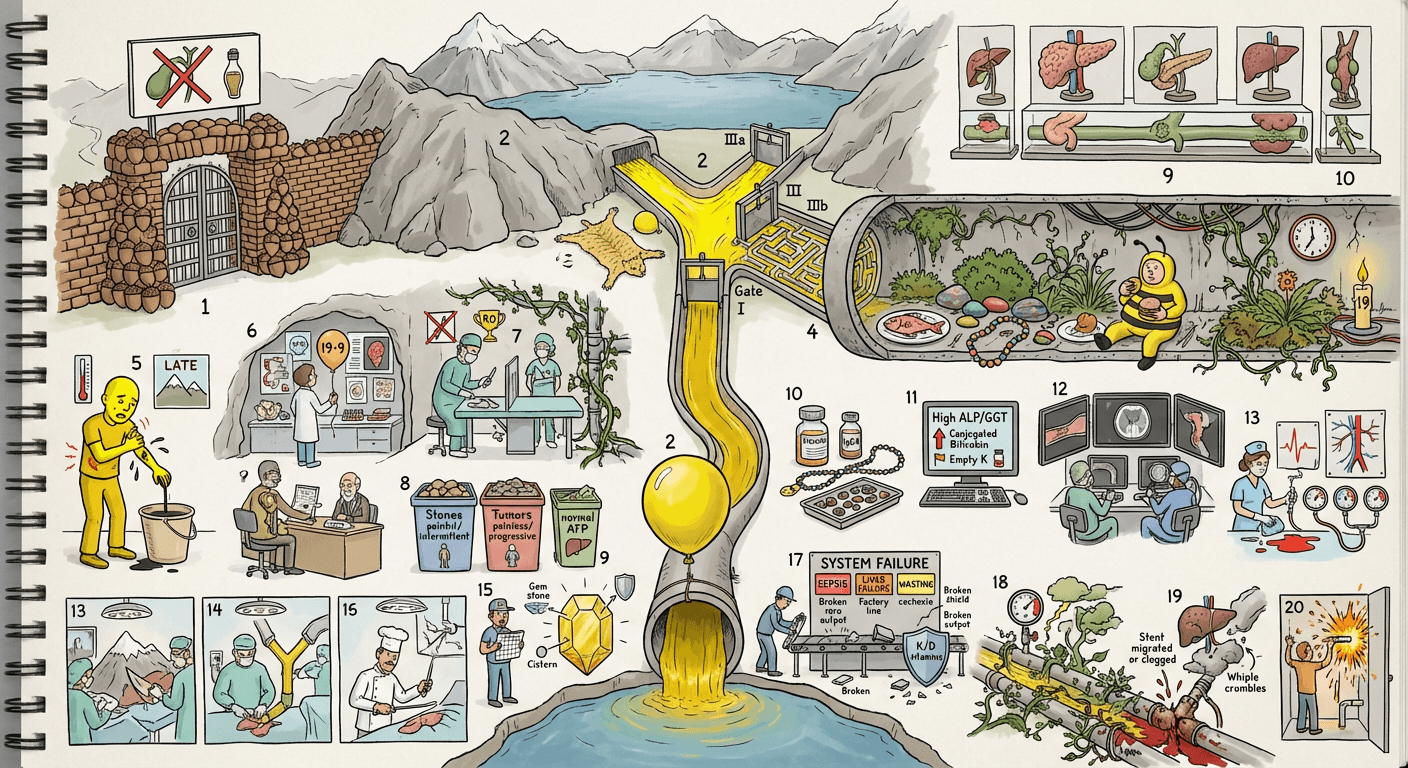
Sketchy memory palace for Cholangiocarcinoma
| No. | Visual Cue | Meaning |
|---|---|---|
| 1 | A massive gate made of 90% acorn-shaped stones, blocking out images of a gallbladder and a small ampulla. | - Definition: Cancer arising from bile duct epithelium; > 90% adenocarcinoma. Excludes gallbladder and ampullary carcinoma. |
| 2 | Mountain mass (intrahepatic), Cat-skin rug at a fork with yellow water and flat balloon (perihilar), and a distal pipe with yellow water and a giant blown-up balloon (distal). | - Intrahepatic (10%): behaves as liver mass, NO early jaundice - Perihilar (60%, MC): Klatskin tumour if at bifurcation, EARLY jaundice, Courvoisier NEGATIVE - Distal extrahepatic (20–30%): behaves like periampullary tumour, Courvoisier POSITIVE |
| 3 | A series of numbered sluice gates (I, II, IIIa, IIIb, IV) positioned specifically at and around the canal confluence. | - Bismuth-Corlette (perihilar): I (below confluence) → II (at confluence) → IIIa (+ RHD) → IIIb (+ LHD) → IV (both/multicentric) |
| 4 | Raw fish, beaded necklace, and obese bee-keeper next to hard concrete walls with vines strangling wires and markers for 7 and 19. | - Key risk factors (HK): RPC, hepatolithiasis, Clonorchis sinensis (raw freshwater fish), HBV, choledochal cysts, obesity/DM. In West: PSC + UC. - Pathophysiology: Chronic inflammation → cholestasis → DNA damage → metaplasia → dysplasia → adenocarcinoma. Perineural invasion is hallmark. - Histology: Sclerosing (desmoplastic, MC), Nodular (annular), Papillary (bulky, best prognosis). CK7+/CK19+ on IHC. |
| 5 | A yellow, scratching worker with dark oil, pale clay, fever, and a 'late' mountain sign. | - Painless progressive jaundice (extrahepatic CCA) - Dark urine + pale stools (obstructive) - Pruritus (bile salt deposition in skin) - RUQ pain, hepatomegaly (capsular stretch) - Weight loss, fever (cholangitis) - Intrahepatic CCA: NO jaundice until late |
| 6 | A lab tech with CEA shells, 19-9 balloons, and a complex diagnostic puzzle. | - Tumour markers: CEA, CA 19-9 (non-specific, may be normal) - Determine if presentation is obstructive jaundice (extrahepatic CCA) or liver mass (intrahepatic CCA) - No single diagnostic criterion for CCA — diagnosis is based on combination of clinical, biochemical, radiological, and histological findings. |
| 7 | A scalpel allowing 20% through, a crossed-out needle, and a gold R0 trophy. | - Resection: Only curative treatment; resectability rate ~20%. FNAC/biopsy ONLY for unresectable cases. - Biopsy: FNAC/Trucut ONLY for unresectable cases (risk of tumour seeding). CK7+/CK19+ on IHC. - Resectability rate: Only ~20%. Unresectable if: major vessel invasion, bilateral 2° radicle involvement, distant LN or organ metastasis. - Only ~20% resectable at presentation. R0 resection is the strongest prognostic factor. |
| 8 | A sorting bin for stones vs tumors, an elderly figure in a malignant bin, and an AFP label. | - For obstructive jaundice: differentiate stone vs tumour (intermittent/painful/fever vs progressive/painless/constitutional) - For liver mass: differentiate HCC vs iCCA vs metastasis (AFP, imaging characteristics, IHC) - Key rule: Painless progressive obstructive jaundice in elderly = malignant biliary obstruction until proven otherwise. |
| 9 | Six anatomical models of biliary obstruction: Klatskin, pancreatic head CA, periampullary CA, gallbladder CA, HCC, and lymphadenopathy. | - CCA at hilum (Klatskin tumour) - CA head of pancreas - Periampullary carcinoma (ampulla, duodenum, distal CBD) - CA gallbladder (cystic duct LN, direct infiltration, tumour fragments) - HCC (compression from Seg 4/5, direct infiltration, tumour fragments in CBD) - Porta lymphadenopathy (CRC, lymphoma, gastric cancer) |
| 10 | Steroid bottle with IgG4 label, beaded necklace, and a tray of pigmented stones. | - IgG4-related sclerosing cholangitis (check IgG4, responds to steroids) - PSC with dominant stricture (beaded appearance on MRCP) - RPC (intrahepatic pigment stones, left lobe predilection) - IgG4: to exclude IgG4-related sclerosing cholangitis (critical mimic) |
| 11 | High ALP/GGT icons, Lewis-antigen flag, and an empty Vitamin K vial with a bleeding drip. | - LFT: cholestatic pattern (ALP/GGT >> AST/ALT), conjugated hyperbilirubinaemia - Tumour markers: CA 19-9 (sensitivity ~70%, NOT specific, requires Lewis antigen), CEA (not sensitive) - AFP: to differentiate from HCC (normal in CCA) - Clotting: prolonged PT/INR from Vitamin K malabsorption |
| 12 | Dilated pipe without stones, a centripetal fill-in CT scan, and dual scopes (top-down and bottom-up). | - Investigation sequence: Bloods → USG (1st line) → CT triphasic / MRI-MRCP → Cholangiography (ERCP for distal, PTC for proximal) → Tissue diagnosis ONLY if unresectable. - USG findings: Ductal dilatation without stones = malignant until proven otherwise. Level of dilatation localises the obstruction. - CT/MRI: Triphasic CT for staging + resectability. MRI/MRCP superior for ductal anatomy and nodal disease. iCCA shows peripheral rim enhancement with delayed centripetal fill-in (opposite of HCC washout). - Cholangiography: ERCP for distal CCA (diagnostic + therapeutic). PTC for proximal/perihilar CCA. MRCP has largely replaced both for pure diagnostic purposes. |
| 13 | Treating sepsis first, a vascular map (SMA/Celiac), and a drainage tube with 50/20 gauges. | - Three management steps: (1) Treat sepsis first → (2) Assess resectability → (3) Operate if fit and resectable, palliate if not. - Resectability criteria: No distant mets, no SMA/celiac involvement, patent SMV-PV confluence. PV involvement is NOT absolute contraindication. - Pre-operative drainage: ERCP stenting 1st line. Target bilirubin < 50 µmol/L (or < 20 for concomitant hepatectomy). QMH practice: drain ALL patients (surgery wait 6–8 weeks). |
| 14 | A mountain cutting, a complex Y-pipe reconstruction, and a chef's whip. | - iCCA → Hepatectomy ± portal LN dissection - pCCA → Bile duct resection + hepatic lobectomy + caudate lobectomy + LN dissection + Roux-en-Y HJ - dCCA → Whipple procedure |
| 15 | A Bill-cap with a 6-month calendar and a Topaz gem being bombarded by a gem, a cistern, and a shield. | - Adjuvant: Capecitabine × 6 months (BILCAP trial) - Advanced disease (2025 standard): Gemcitabine + Cisplatin + Durvalumab (TOPAZ-1). Molecular profiling for IDH1/FGFR2/HER2/BRAF/MSI-H. |
| 16 | Metal stent in a pipe and a nerve block needle. | - Palliation: ERCP stenting (preferred) or PTBD or surgical bypass. Metal stents for confirmed inoperable disease. Pain: celiac plexus block. |
| 17 | Flashing lights for sepsis/failure/cachexia, a stopped factory line, a broken shield, and shattered K/D vitamins. | - Three causes of mortality in MBO (must know): Biliary sepsis, Liver failure, Cancer cachexia. - Impaired protein synthesis, clotting factor synthesis, gluconeogenesis, ketogenesis - Endotoxaemia, decreased reticuloendothelial function, decreased cell-mediated immunity - Vitamin K deficiency → coagulopathy; Vitamin D deficiency → osteomalacia |
| 18 | Pressure gauge at 25, melting liver rock, spreading seeds/vines, and a bloody pipe leak. | - Ascending cholangitis (recurrent; biliary pressure > 25 cmH₂O → bacteraemia) - Progressive liver failure (bile acid toxicity to hepatocytes) - Metastasis: perineural invasion (hallmark), peritoneal seeding, haematogenous to lung/bone/brain - Portal hypertension (PV invasion or secondary biliary cirrhosis) - Haemobilia (tumour erosion into hepatic artery/PV) |
| 19 | Migrating/sludged stent, a bleeding puncture, a crumbling liver, a leaking hose, and a rusty narrow Y-joint. | - Stenting: occlusion (tumour ingrowth/sludge), migration, cholangitis, post-ERCP pancreatitis - PTBD: bleeding (portal triad puncture), haemobilia, fluid/electrolyte loss - Post-hepatectomy: liver failure (THE feared complication), bile leak, haemorrhage - Post-Whipple: pancreatic fistula (most feared), delayed gastric emptying, exocrine/endocrine insufficiency - HJ stricture: most common long-term complication → recurrent cholangitis/jaundice |
| 20 | A tube installation causing fire and sparks. | - Pre-op biliary drainage itself increases complications (pancreatitis 7%, cholangitis 26%, blocked stent 15%) but is necessary when surgery is delayed. |
Biliary Cysts
Biliary cysts are congenital cystic dilatations of the intrahepatic and/or extrahepatic bile ducts that predispose to cholangitis, stone formation, and cholangiocarcinoma.
Gallbladder Cancer
Gallbladder cancer is a rare, aggressive malignancy arising most commonly from the glandular epithelium of the gallbladder wall, often associated with gallstones and typically presenting at an advanced stage due to its insidious clinical course.